
Franciscus Haraeus
Illustration — Portrait of Franciscus Harraeus, theologican, historian and cartographer. • Illustration — Geographica restituta per globi trientes (1618) by Franciscus Haraeus Franciscus Haraeus (Latinised form of Franciscus Verhaer; also known as Frans Verhaer), (Utrecht 1555? - Leuven, 11 January 1631), was a theologian, historian, and cartographer from the Low Countries. He is best known for his history of the origins of the Dutch Revolt, written from a Catholic perspective but without polemical bias. He was one of the first cartographers to make thematic maps and globes.
Franciscus Haraeus
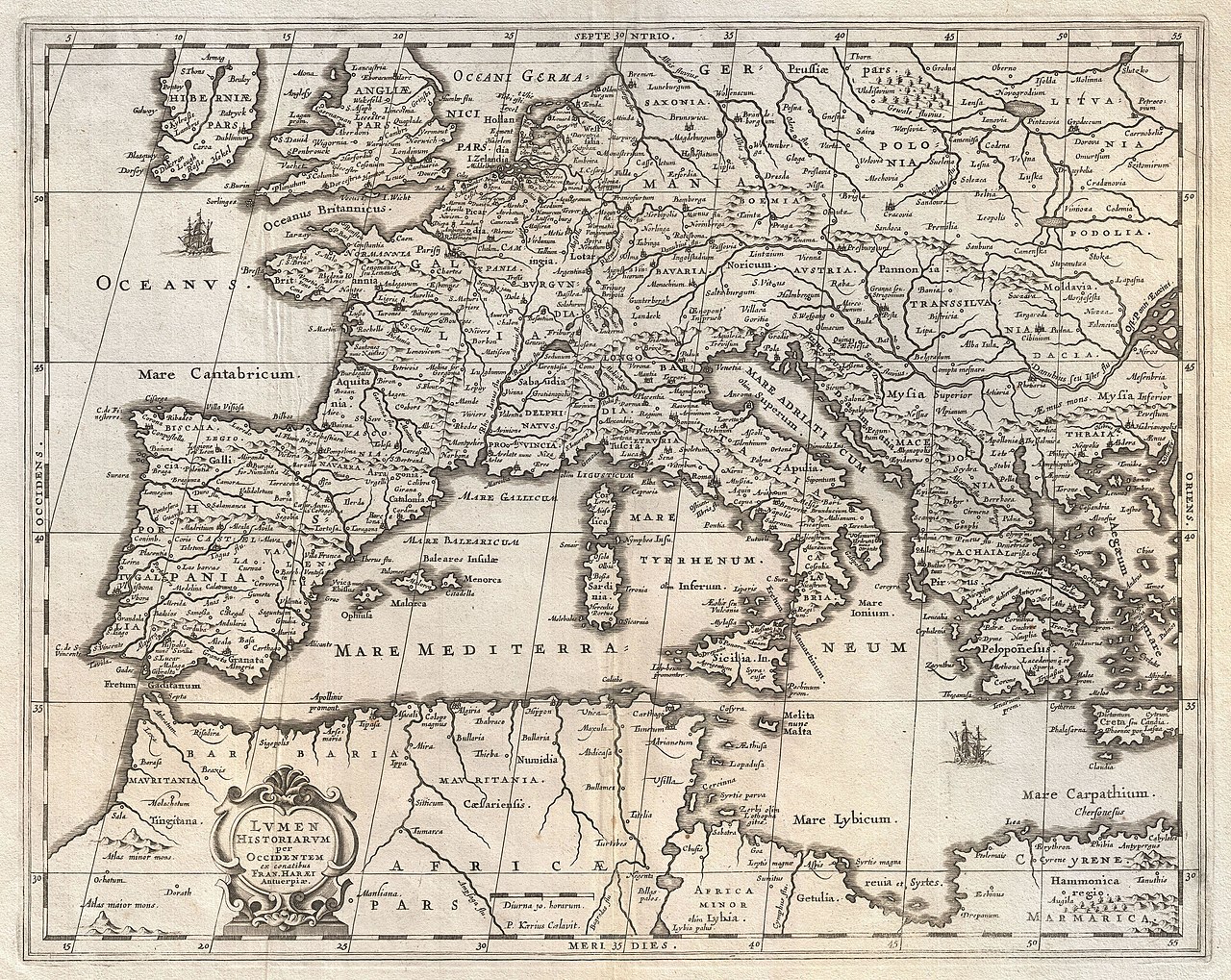
Jan Janssonius · This file was provided to Wikimedia Commons by Geographicus Rare Antique Maps, a specialist dealer in rare maps and other cartography of the 15th, 16th, 17th, 18th and 19th centuries, as part of a co · Public domain
- Born
- 1555 · Utrecht.
- Died
- 1631 · Leuven.
- Nationality
- Dutch Republic
- Occupation
- cartographer · historian · geographer · theologian
- Education
- University of Douai
- Languages
- Dutch · Latin
VALÉORINE Encyclopedia
VALÉORINE documentary reading
Documentary summary
Illustration — Portrait of Franciscus Harraeus, theologican, historian and cartographer. • Illustration — Geographica restituta per globi trientes (1618) by Franciscus Haraeus Franciscus Haraeus (Latinised form of Franciscus Verhaer; also known as Frans Verhaer), (Utrecht 1555? - Leuven, 11 January 1631), was a theologian, historian, and cartographer from the Low Countries. He is best known for his history of the origins of the Dutch Revolt, written from a Catholic perspective but without polemical bias. He was one of the first cartographers to make thematic maps and globes.
Admitted source layer · organised and presented by VALÉORINE
Note VALÉORINE
Franciscus Haraeus (1555–1631) was a cartographer, geographer and historian, among other activities, of Dutch nationality. The cartographer was born in Utrecht and died in Leuven. Franciscus Haraeus was educated at University of Douai. Languages used include Dutch and Latin.
Composed from admitted, traceable facts · 01 October 2026
VALÉORINE
Reference Check
Propose documentary evidence for Franciscus Haraeus. A contribution is never written directly as fact: identity, source, rights and evidence gates still decide.
Sign in to contribute
World of VALÉORINE
Documentary connections
Only confirmed graph relationships appear here. Images are shown only when their identity and reuse rights both pass the documentary gate.
Documentary evidence
Documentary basis
Authority files
wikidata · Q2120010 · wikipedia · Franciscus Haraeus
In this article
Life
Life
Haraeus first attended the Latin school of the Brethren of the Common Life in Utrecht and subsequently studied theology at the University of Louvain under Thomas Stapleton and Joannes Molanus. He was ordained a Roman Catholic priest at an early age, probably in 1578. He was appointed as a professor of rhetoric at the recently established University of Douai where he also obtained a Licentiate of Theology. In 1581 he accompanied the papal legate Antonio Possevino on an embassy to John III of Sweden and Ivan the Terrible. Back in the Dutch Republic he became a canon at St. John's Cathedral ('s-Hertogenbosch), later dean in Dunkirk and professor of theology at Tongerlo Abbey. In 1604-1609 he worked as a priest in Utrecht where he was in contact with Buchelius. After 1609 he moved permanently to the Spanish Netherlands where he became the rector of a nunnery in Antwerp, before becoming a canon in Namur in 1617, and after 1621 in Leuven. He died in the latter city on 11 January 1631, and was buried in the St. Peter Church in Leuven, near the tomb of Thomas Stapleton.
Historical works
Historical works
Haraeus compiled a large number of hagiographies. However, his historical works of longer lasting import concerned the first part of the Eighty Years' War through which he had lived himself. He clearly took the side of king Philip II of Spain against William the Silent, giving his work a clear bias. His first publication in this field was Onpartijdighe Verklaringhe der oorsaken der Nederlantsche oorloghs sedert 't jaer 1566 tot 1608 (Antwerp 1612). This provoked a critical response from the Dutch judge François Vranck. Meanwhile, Haraeus had already started on his major history: Annales ducum seu principum Brabantiae totiusque Belgii tomi tres: quorum primo solius Brabantiae, secundo Belgii uniti principum res gestae, tertio Belgici tumultus usque ad inductas anno MDCIX pactas, enarrantur (Antwerp 1623). This work was well received in the Spanish Netherlands where it was long a "best seller". The third volume was reworked by its author, but this version only exists in manuscript; it was never printed.
Cartographic work
Cartographic work
Haraeus was one of several clergymen from the Netherlands who around the turn of the 17th century made important contributions to the young science of map-making (another was Petrus Plancius). He was one of the three cartographers in the Spanish Netherlands who kept the craft of globe-making alive there after the exodus of many cartographers around the turn of the 17th century. In 1614 he published a six-gore map entitled Novus typus orbis ipsus globus, ex Analemmate Ptolomaei diductus This was one of the first instances of a thematic map as it showed the dispersion of Christianity and Islam at the time, using map symbols developed by Jodocus Hondius in his Designatio Orbis Christiani (1607) In 1624 a map entitled Lumen Historiarum per Orientem was published by Balthasar Moretus as part of a new edition of Ortelius' Theatrum orbis terrarum Parergon which recognized Haraeus as its maker. This map was part of a set of two made earlier by Haraeus and designed as a comprehensive guide to sacred geography. As a final example, Haraeus Geographica restituta per globi trientes (1618) shows the world in three globe-gores, with insets showing a map representing the 2nd-century worldview of Ptolemy at lower right, and a legend for the map in the lower center, explaining symbols which identify religious populations (a cross for Christian regions, a crescent for Islam, and a slanted arrow for barbarians).

Aardglobe - Franciscus Haraeus - Koninklijke Oudheidkundige Kring van het Land van Waas
Franciscus Haraeus

Portrait of Franciscus Haraeus (1547–1611), engraving by Hieronymus Wierix (c.1553–1619), after an earlier model, circa 1600.
Hieronymus Wierix
Life and career
Dated record
Life and career
The full dated record · 2 entries
1555
Franciscus Haraeus born at Utrecht.
1631
Franciscus Haraeus died at Leuven.
Places
Named by the record
Places
Only places the record itself states, plotted where the house gazetteer settles their coordinates. Nothing is inferred from a name or a nationality.
Utrecht.
Birth place
Leuven.
Death place
Notes from the source article
Cited by Wikipedia
Notes from the source article
These works are cited by the source article, in its own numbering. They are recorded as its citations, not as sources VALÉORINE has verified.
- 1.B.A. Vermaseren, De katholieke Nederlandsche geschiedschrijving, p. 223.
- 2.Nederlands Historisch Genootschap. Haraeus (Verhaer), Franciscus. Repertorium van Geschiedschrijvers in Nederland, 1500-1800. 171–172. 1990.
- 3.Van der Aa, A.J. Franciscus Haraeus. Biographisch woordenboek der Nederlanden. 8. 1. 164–166. 1867.
- 4.Sijthoff. Haraeus, Franciscus. Nieuw Nederlandsch Biografisch Woordenboek. 7. 529–530. 1927.
- 5.According to both Van der Aa and Molhuysen/Blok, he died in 1632, but more modern sources like Haitsma Mulier give 1631 as the year of death.
- 6."Impartial explanation of the causes of the Low Countries war from the year 1566 to 1608". On Google Books.
- 7.(Refutation of a certain booklet published by Franchois Verhaer, etc.), published 1618.
- 8."Annals of the dukes or princes of Brabant and the entire Netherlands in three volumes: which are firstly Brabant alone, secondly the acts of the prince of the united Netherlands, thirdly the Dutch troubles up to the truce of 1609, explained". On Google Books
- 9.Het kartografische werk van de theoloog-historicus Franciscus Haraeus (ca. 1555-1631). Annalen van de Koninklijke Oudheidkundige Kring van het Land van Waas. 87. 5–55. 1984.
- 10.Van der Krogt, P.C.J. Globi Neerlandici: De globeproduktie in de Nederlanden. Utrecht Cartography Dissertations 1989.
- 11.New image of the world as a globe, derived from the Analemmata of Ptolemy.
- 12.Outmapping of the Christian World.
- 13.Novus typus orbis ipsus globus, ex Analemmate Ptolomaei diductus 1614.
- 14.Light of histories over the East.
- 15.Appendix to Theatrum orbis terrarum or Theater of the Lands of the World.
- 16.Lumen Historiarum per Orientem.
- 17.Shalev, Zur. Sacred Words and Worlds: Geography, Religion, and Scholarship, 1550-1700. Brill. 233–234. 2011.
- 18.Geography set up by thirds of a globe.
- 19.Norman B. Leventhal map center. Geographica restituta per globi trientes.
References
Citations
References
Each reference names the institution holding it, so a reader may go to the document itself.
reference work
Secondary witnessreference work
Secondary witness
The Encyclopedia exists whether or not anything is for sale. Corrections are recorded rather than overwritten, and every version of this record is kept. Published 16 August 2026.
Elsewhere in Maps and atlases
1,180 published records in this field, each with its sources named.
- Francis BlomefieldAuthor
- Francis Richard MaunsellAuthor
- Francisco CoelloAuthor
- Francisco GalíAuthor
- Franciszek Florian CzakiAuthor
- François AndréossyAuthor
- François BerthelotAuthor
- François NoëlAuthor
Best supported in this field
For owners
Own a work by Franciscus Haraeus?
A specialist will read what you send and tell you what the house can establish, what it cannot, and whether the object is suited to sale. There is no charge and no obligation. The object stays with you throughout; nothing is shipped to us unless it is arranged in writing beforehand.