
Engelbert Kaempfer
Engelbert Kaempfer (16 September 1651 – 2 November 1716) was a German naturalist, physician, explorer, and writer known for his tour of Russia, Persia, India, Siam and Japan between 1683 and 1693. He wrote two books about his travels. Amoenitatum exoticarum, published in 1712, is important for its medical observations and the first extensive description of Japanese plants (Flora Japonica).
Also recorded as Kaempf. · Kaempfer · Engelbert Kempfer · Engelbert Kämpfer
Engelbert Kaempfer

Matthäus Seutter · Detail from cartouche of Regni Japoniae Nova Mappa Geographica (1730) · Public domain
- Born
- 1651.
- Died
- 1716.
- Nationality
- County of Lippe.
- Occupation
- explorer, physician, biologist, botanist, writer, naturalist and cartographer.
- Known for
- The History of Japan and Amoenitatum exoticarum.
VALÉORINE Encyclopedia
VALÉORINE documentary reading
Documentary summary
Engelbert Kaempfer (16 September 1651 – 2 November 1716) was a German naturalist, physician, explorer, and writer known for his tour of Russia, Persia, India, Siam and Japan between 1683 and 1693. He wrote two books about his travels. Amoenitatum exoticarum, published in 1712, is important for its medical observations and the first extensive description of Japanese plants (Flora Japonica).
Admitted source layer · organised and presented by VALÉORINE
Note VALÉORINE
Engelbert Kaempfer (1651–1716) was a biologist, botanist and cartographer, among other activities and a national of the County of Lippe. Works include Amoenitatum exoticarum and The History of Japan.
Composed from admitted, traceable facts · 27 September 2026
VALÉORINE
Reference Check
Propose documentary evidence for Engelbert Kaempfer. A contribution is never written directly as fact: identity, source, rights and evidence gates still decide.
Sign in to contribute
Documentary evidence
Evidence Panel
not yet certified
- Identity
- resolved
- Independent source families
- 0
- Admitted assertions
- 0
- Open conflicts
- 0
Authority files
gnd · 1049305213 · wikidata · Q58042 · wikipedia · Engelbert Kaempfer
In this article
Early life
Early life
His History of Japan, published posthumously in 1727, was the chief source of Western knowledge about the country throughout the 18th and mid-19th centuries, when it was closed to foreigners.
Kaempfer was born at Lemgo in the Principality of Lippe, within the Holy Roman Empire. His father was a pastor and his mother helped support the congregation. He studied at Hameln, Lüneburg, Hamburg, Lübeck and Danzig (Gdańsk), and after graduating at Kraków, spent four years at Königsberg in Prussia, studying medicine and natural science.
Persia
Persia
In 1681, Kaempfer visited Uppsala in Sweden, where he was offered inducements to settle. His desire for foreign travel led him to become secretary to the second embassy of the Swedish ambassador Ludvig Fabritius, whom Charles XI sent through Russia to Persia in 1683. Kaempfer's travelogue of this embassy was later published. He reached Persia by way of Moscow, Kazan and Astrakhan, landing at Nizabad "in Shirvan" (now in Azerbaijan) after a voyage in the Caspian Sea. From Shemakha in Shirvan, he made an expedition to the Baku peninsula, being perhaps the first modern scientist to visit the "fields of eternal fire" around Baku. In 1684 Kaempfer reached Isfahan, then the Persian capital. When after a stay of more than a year the Swedish embassy prepared to return to its homeland, Kaempfer joined the fleet of the Dutch East India Company (VOC) in the Persian Gulf as chief surgeon. In spite of fever caught at Bandar Abbas, he saw something of Arabia (visiting Muscat in 1688) and many of the western coastlands of India.
Siam and Japan
Siam and Japan
In September 1689, Kaempfer reached Batavia. He spent the following winter studying Javanese natural history. In May 1690 he set out for Japan as physician to the VOC trading post in Nagasaki. En route to Japan, the ship in which he sailed touched at Siam, whose capital Ayutthaya he visited. He recorded his meeting with Kosa Pan, the Siamese Minister and former ambassador to France. In September 1690 Kaempfer arrived in Nagasaki, the only Japanese port then open to Dutch and Chinese ships. Kaempfer stayed two years in Japan, during which time he twice visited Edo and the shōgun Tokugawa Tsunayoshi. He conducted extensive studies on local plants, many of which were published in his "Flora Japonica" (part of Amoenitatum Exoticarum). When he visited Buddhist monks in Nagasaki in February 1691, he was the first western scholar to describe the tree Ginkgo biloba. He brought some Ginkgo seeds back that were planted in the botanical garden in Utrecht. The trees have survived to the 21st century. (The curious "–kgo" spelling has long been considered to be an error Kaempfer made in his notes, but Nagata et al. showed that it was the spelling of his interpreter, Genemon Imamura, who spoke the dialect of Nagasaki. Kaempfer also collected materials and information on Japanese acupuncture and moxibustion. His treatise on the cure of colic (Japanese senki) using needles and his presentation of a Japanese "Moxa-mirror" had a considerable influence on the reception of Far Eastern medicine in 18th-century Europe. In his posthumously published notes on Japan, he mixes careful observation with a strong desire to make these observations conform to European conceptions of Asia. He argues that the Japanese have a separate ethnic origin from the Chinese and claims they descend directly from the builders of the Tower of Babel. Thus he links Shinto to Babylonian religion. At the same time, he was among the first Europeans to claim that Japan had a diversity of religions rather than one religion that corresponded to ethno-national identity. During his stay in Japan, Kaempfer's tact, diplomacy, and medical skill overcame the cultural reserve of the Japanese. He elicited much valuable information. In November 1692 he left Japan for Java.
Return to Europe
Return to Europe
After twelve years abroad, Kaempfer returned to Europe in 1695, landing at Amsterdam. He was awarded a doctorate in medicine at the University of Leiden in the Netherlands. Kaempfer settled in his native city of Lemgo, where he became the physician of the Count of Lippe. In Germany he published the book Amoenitatum exoticarum (Lemgo 1712). Among many other Japanese plants, it included an illustration of a camellia and introduced 23 varieties. It was notable for its description of the electric eel, acupuncture, moxibustion, and the hyena. This was the first scientific description of the hyena (about which until then only confused and downright fanciful things had been "reported" since antiquity), and Linnaeus used it extensively. It can be argued that the modern zoological name of the striped hyena, Hyaena hyaena Linnaeus, could or should include the name Kaempfer based on the tradition of taxonomic naming based on who described something first. Kaempfer's other work was also often praised by Linnaeus, including his systematic description of tea, as well as his other work on Japanese plants, and Linnaeus adopted some of Kaempfer's plant names, such as Ginkgo. In 1716, Kaempfer died at Lemgo. Most of his manuscripts and many objects from his collection are preserved in the British Library and the British Museum. Kaempfer's works on Japan had a profound influence on European and German research on East Asia, which culminated in the studies by Philipp Franz von Siebold.
Manuscripts
Manuscripts
At Kaempfer's death his mostly unpublished manuscripts were purchased by Sir Hans Sloane via George I's court physician Johann Georg Steigerthal and conveyed to England. Among them was a History of Japan, translated from the manuscript into English by Sloane's librarian John Gaspar Scheuchzer (1702–1729). It was first published in London, in 2 vols., in 1727. The original German (Heutiges Japan, Japan of Today) had not been published; the extant German version was translated from the English. Besides Japanese history, this book contains a description of the political, social and physical state of the country in the 17th century. For upwards of a hundred years, when Japan was closed to foreigners, it was the chief source of information for the general reader. In the 21st century it is considered to have some value. A life of the author is prefixed to the History. Kaempfer's original manuscripts are held by the British Library. Most have been published since 2001: Engelbert Kaempfer, Werke. Kritische Ausgabe in Einzelbänden. Herausgegeben von Detlef Haberland, Wolfgang Michel, Elisabeth Gössmann. Vol 1/1 Engelbert Kaempfer: Heutiges Japan. Herausgegeben von Wolfgang Michel und Barend J. Terwiel. 2001.[xiv, 779 pp., 93 ills. Transliteration of EKs manuscript, British Library London, Ms Sl 3060, reproduction of drawings, index] Vol 1/2 Engelbert Kaempfer: Heutiges Japan. Herausgegeben von Wolfgang Michel und Barend J. Terwiel. 2001 [vii, 828 pp., 56 ills.] [Extensive commentary by Michel on Kaempfer's manuscript and drawings, Japanese and Western coworkers, Kaempfer's research context, his Japanese collection etc. including a bibliography] ISBN 3-89129-931-1 Vol 2 Briefe 1683–1715. München: Iudicium Verl., 2001. ISBN 3-89129-932-X Letters 1683–1715 Vol 3 Zeichnungen japanischer Pflanzen. München: Iudicum Verl., 2003. ISBN 3-89129-933-8 Drawings of Japanese plants Vol 4 Engelbert Kaempfer in Siam. München: Iudicum Verl., 2003. – ISBN 3-89129-934-6 Kaempfer in Siam Vol 5 Notitiae Malabaricae. München: Iudicum Verl., 2003. ISBN 3-89129-935-4 Notes on Malabar: on the southern India region, known as South Kerala] Vol 6 Russlandtagebuch 1683. München: Iudicum Verl., 2003. ISBN 3-89129-936-2 Russia diary 1683
Kaempfer's works
Kaempfer's works
Exercitatio politica de Majestatis divisione in realem et personalem, quam [...] in celeberr. Gedanensium Athenaei Auditorio Maximo Valedictionis loco publice ventilendam proponit Engelbertus Kämpffer Lemgovia-Westphalus Anno MDCLXXIII [= 1673] d. 8. Junii h. mat. Dantisci [= Danzig], Impr. David Fridericus Rhetius. Disputatio Medica Inauguralis Exhibens Decadem Observationum Exoticarum, quam [...] pro gradu doctoratus [...] publico examini subjicit Engelbert Kempfer, L. L. Westph. ad diem 22. Aprilis [...] Lugduni Batavorum [= Leiden], apud Abrahanum Elzevier, Academiae Typographum. MDCXCIV [= 1694]. Amoenitatum exoticarum politico-physico-medicarum Fasciculi V [= quinque], Quibus continentur Variae Relationes, Observationes et Descriptiones Rerum persicarum & [= et] ulterioris Asiae, multâ attentione, in peregrinationibus per universum Orientum, collectae, ab Auctore Engelberto Kaempfero, D. Lemgoviae [= Lemgo], Typis & Impensis Henrici Wilhelmi Meyeri, Aulae Lippiacae Typographi, 1712 (Google, biodiversitylibrary.org) The History of Japan, giving an Account of the ancient and present State and Government of that Empire; of Its Temples, Palaces, Castles and other Buildings; of Its Metals, Minerals, Trees, Plants, Animals, Birds and Fishes; of The Chronology and Succession of the Emperors, Ecclesiastical and Secular; of The Original Descent, Religions, Customs, and Manufactures of the Natives, and of their Trade and Commerce with the Dutch and Chinese. Together with a Description of the Kingdom of Siam. Written in High-Dutch [= Hochdeutsch – High German] by Engelbertus Kaempfer, M. D. Physician to the Dutch Embassy to the Emperor's Court; and translated from his Original Manuscript, never before printed, by J. G. Scheuchzer, F. R. S. and a Member of the College of Physicians, London. With the Life of the Author, and an Introduction. Illustrated with many Copperplates. Vol. I/II. London: Printed for the Translator, MDCCXXVII [= 1727]. De Beschryving van Japan, behelsende een Verhaal van den ouden en tegenwoordigen Staat en Regeering van dat Ryk, van deszelfs Tempels, Paleysen, Kasteelen en andere Gebouwen; van deszelfs Metalen, Mineralen, Boomen, Planten, Dieren, Vogelen en Visschen. Van de Tydrekening, en Opvolging van de Geestelyke en Wereldlyke Keyzers. Van de Oorsprondelyke Afstamming, Godsdiensten, Gewoonten en Handwerkselen der Inboorllingen, en van hunnen Koophandel met de Nederlanders en de Chineesen. Benevens eene Beschryving van het Koningryk Siam. In 't Hoogduytsch beschreven door Engelbert Kaempfer, M. D. Geneesherr van het Hollandsche Gezantschap na 't Hof van den Keyzer, Uyt het oorspronkelyk Hoogduytsch Handschrift, nooit te vooren gedrukt, in het Engelsch overgezet, door J. G. Scheuchzer, Lidt van de Koninklyke Maatschappy, en van die der Geneesheeren in London. Die daar by gevoegt heeft het Leven van den Schryver. Voorzien met kunstige Kopere Platen, onder het opzicht van den Ridder Hans Sloane uytgegeven, en uyt het Engelsch in 't Nederduytsch vertaalt. MDCCXXIX [= 1729]. Engelbert Kämpfers Weyl. D. M. und Hochgräfl. Lippischen Leibmedikus Geschichte und Beschreibung von Japan. Aus den Originalhandschriften des Verfassers herausgegeben von Christian Wilhelm Dohm [...]. Erster Band. Mit Kupfern und Charten. Lemgo, im Verlage der Meyerschen Buchhandlung, 1777; Zweiter und lezter Band. Mit Kupfern und Charten. Lemgo, im Verlage der Meyerschen Buchhandlung, 1779. Icones selectae plantarum quas in Japonia collegit et delineavit Engelbertus Kaempfer (in Latin). London. 1791. Engelbert Kaempfer: 1651 – 1716. Seltsames Asien (Amoenitates Exoticae). In Auswahl übersetzt von Karl Meier-Lemgo, Detmold 1933 "Engelbert Kaempfer: Am Hofe des persischen Großkönigs (1684–1685)", Ed. Walther Hinz, Stuttgart 1984. Engelbert Kaempfer: Der 5. Faszikel der "Amoenitates Exoticae" - die japanische Pflanzenkunde. Herausgegeben und kommentiert von Brigitte Hoppe und Wolfgang Michel-Zaitsu. Hildesheim/Zuerich/New York: Olms-Weidmann, 2019.
Life and career
Dated record
Life and career
The full dated record · 2 entries
1651
Engelbert Kaempfer was born on 16 September 1651.
1716
Engelbert Kaempfer died on 2 November 1716.
Primary material
Documents and archives
scholarly publication
- VIII. Kaempfers Japanforschungen, Engelbert Kaempfer (1651–1716) erforscht das seltsame Asien, 1960
Scholarly · Crossref registry · 1960
reference work
- “Engelbert Kaempfer”, English Wikipedia, consulted as further reading
Reputable secondary · Wikipedia
authority record
- Wikidata, structured authority record Q58042: Engelbert Kaempfer
Unverified · Wikidata
Literature on E. Kaempfer
Van Der Pas, Peter W.: Kaempfer, Engelbert. Complete Dictionary of Scientific Biography Kapitza, Peter: Engelbert Kaempfer und die europäische Aufklärung. Dem Andenken des Lemgoer Reisenden aus Anlaß seines 350. Geburtstags am 16. September 2001. München: Iudicum Verlag, 2002. Haberland, Detlef (Hrsg.): Engelbert Kaempfer – Werk und Wirkung. Stuttgart, Franz Steiner, 1993. Haberland, Detlef (Hrsg.): Engelbert Kaempfer (1651–1716): Ein Gelehrtenleben zwischen Tradition und Innovation. Wiesbaden, Harrassowitz, 2005. David Mervart: "A closed country in the open seas: Engelbert Kaempfer's Japanese solution for European modernity's predicament," in: History of European Ideas, 35,3 (2009), 321–329. Andreas W. Daum: "German Naturalists in the Pacific around 1800: Entanglement, Autonomy, and a Transnational Culture of Expertise," in Explorations and Entanglements: Germans in Pacific Worlds from the Early Modern Period to World War I, ed. Hartmut Berghoff, Frank Biess and Ulrike Strasser. New York: Berghahn Books, 2019, 79-102.
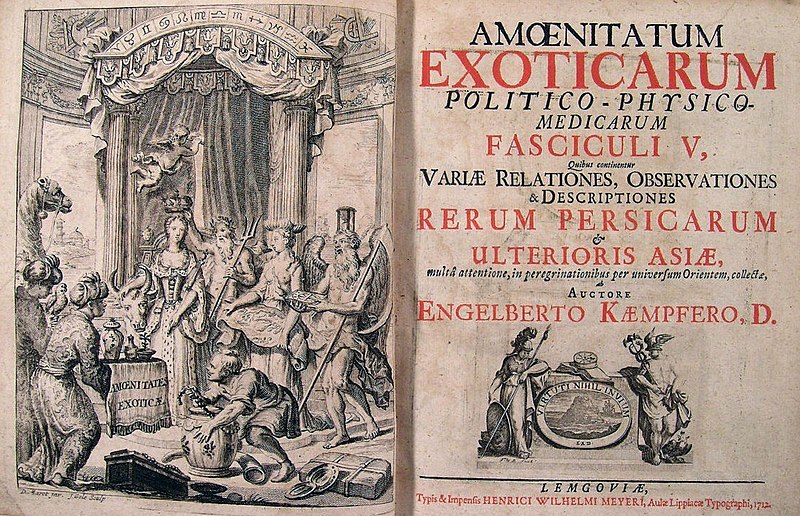
Титульные листы книга Энгельберт Кемпфера (Engelbert_Kaempfer) =Amoenitatum exoticarum= («Прелести чужих стран») (г.Лемго, 1712 г.)
Кемпфер Э. · https
Notes from the source article
Cited by Wikipedia
Notes from the source article
These works are cited by the source article, in its own numbering. They are recorded as its citations, not as sources VALÉORINE has verified.
- 1.Suarez, Thomas (1999), Early Mapping of Southeast Asia, Tuttle Publishing p.30
- 2.Nagata, Toshiyuki; DuVal, Ashley & Crane, Peter R., 2015. Engelbert Kaempfer, Genemon Imamura and the origin of the name Ginkgo. Taxon, 64(1): 131-136.
- 3.Michel, Wolfgang. On Engelbert Kaempfer's "Ginkgo" (revised version). Kyushu University.
- 4.W Michel: "Glimpses of medicine and pharmaceutics in early Japanese-German intercourse," in International Medical Society of Japan (ed.): The Dawn of Modern Japanese Medicine and Pharmaceuticals – The 150th Anniversary Edition of Japan-German Exchange. Tokyo 2011, pp. 72–94. ( ; pdf file)
- 5.Josephson, Jason. The Invention of Religion in Japan. University of Chicago Press. 13–4. 2012. 9780226412351.
- 6.Cincy Museum.
- 7.Publishers, HarperCollins. The American Heritage Dictionary entry: ginkgo. www.ahdictionary.com.
- 8.Wolfgang Michel, [//catalog.lib.kyushu-u.ac.jp/opac_download_md/2898/Ginkgo_biloba2_revised_2011.pdf On Engelbert Kaempfer’s “Ginkgo”, 2011]
- 9.Engelbert Kaempfer's report on the Persian hyena as the main source of Linnaeus' hyaena description in the Systema Naturae, Holger Funk; p. 77: [W]e discuss the reception of Kaempfer's report by one of the most eminent 18th century zoologists, Carolus Linnaeus (Carl von Linné), who increasingly utilised Kaempfer's description in the various editions of his Systema Naturae. As a result, the zoological name of the striped hyena, which was the subject of Kaempfer's report, is today connected with his name: Hyaena hyaena Linnaeus, 1758. Without Kaempfer's achievement, surely this would have been impossible. p. 87: Kaempfer provided the first description of a hyena species which complies with scientific demands in the sense of today's zoology and on which further hyena research could be based. The value of this achievement was recognised by Linnaeus, who integrated Kaempfer's information in his biological systematics. Linnaeus held Kaempfer in high esteem. In 1736 he praised him as "one of the best travelling researchers" (inter optimos numeratur peregrinatores), shortly afterwards he called Kaempfer the "most inquisitive of all travelling researchers" (inter Peregrinatores omnium curiosissimus); ten years later Linnaeus called Kaempfer again an "outstanding traveller" (Peregrinator eximius). Alone in the 10th edition of the Systema Naturae Linnaeus repeatedly refers to Kaempfer's Amoenitates as well as to his posthumous History of Japan from 1727 (Scheuchzer edition). Thus, after all, it is no surprise that Linnaeus exploited also Kaempfer's hyena description for his purposes.
- 10.A.W. Daum: "German Naturalists in the Pacific around 1800: Entanglement, Autonomy, and a Transnational Culture of Expertise,” in Explorations and Entanglements: Germans in Pacific Worlds from the Early Modern Period to World War I, ed. Hartmut Berghoff, Frank Biess, and Ulrike Strasser. New York: Berghahn Books, 2019, 83, 94.
Bibliography printed in the source article · 5
- Kaempfer, Engelbert. (1727). The History of Japan: Giving an Account of the Ancient and Present State and Government of That Empire ... of the Chronology and Succession of the Emperors ... Together with a Description of the Kingdom of Siam, translated by John Gaspar Scheuchzer. London: printed for the translator. OCLC 234194789
- Kaempfer, Engelbert. (1906) The History of Japan: Together with a Description of the Kingdom of Siam, 1690–92, Vol I. London: J. MacLehose & Sons. OCLC 5174460
- Kaempfer, Engelbert. (1906) The History of Japan: Together with a Description of the Kingdom of Siam, 1690–92, Vol II. London: J. MacLehose & Sons. OCLC 5174460
- Kaempfer, Engelbert. (1906) The History of Japan: Together with a Description of the Kingdom of Siam, 1690–92, Vol III. London: J. MacLehose & Sons. OCLC 5174460
- Beatrice Bodart-Bailey and Derek Massarella. The Furthest Goal: Engelbert Kaempfer's Encounter with Tokugawa Japan. Routledge, 2012.
References
Citations
References
Each reference names the institution holding it, so a reader may go to the document itself.
scholarly publication
VIII. Kaempfers Japanforschungen, Engelbert Kaempfer (1651–1716) erforscht das seltsame Asien, 1960Crossref registry
Verifiedreference work
Partially resolvedauthority record
Unverified
A further 1 witness is held back from this article because the person or object named in it is not yet resolved to this record. They are kept, not discarded, and return once the identity is established.
The Encyclopedia exists whether or not anything is for sale. Corrections are recorded rather than overwritten, and every version of this record is kept. Published 14 August 2026.
Elsewhere in Maps and atlases
1,180 published records in this field, each with its sources named.
- Emiland GautheyAuthor
- Émile CheyssonAuthor
- Emma WillardAuthor
- Emmor CopeAuthor
- Ephraim George SquierAuthor
- Erhard EtzlaubAuthor
- Erhard ReuwichAuthor
- Eric de BisschopAuthor
Best supported in this field
For owners
Own a work by Engelbert Kaempfer?
A specialist will read what you send and tell you what the house can establish, what it cannot, and whether the object is suited to sale. There is no charge and no obligation. The object stays with you throughout; nothing is shipped to us unless it is arranged in writing beforehand.