
Francisco Brennand
Francisco Brennand, or Francisco de Paula de Almeida Brennand, (June 11, 1927 – December 19, 2019), was a Brazilian painter and sculptor, best known for his work in ceramics.
Also recorded as Brennand · Francisco de Paula Coimbra de Almeida Brennand
Francisco Brennand

Ministério da Cultura · Marcelo Calero visita Oficina Brennand · CC BY 2.0
- Name
- Francisco Brennand
- Born
- 11 June 1927
- Birthplace
- Recife, Pernambuco
- Died
- 19 December 2019
- Place of death
- Recife
- Occupation
- Sculptor and visual artist
- Nationality
- Brazil
- Known for
- Oficina Brennand
- Honours
- Order of Cultural Merit (Brazil)
- Languages
- Portuguese
VALÉORINE Encyclopedia
VALÉORINE documentary reading
Documentary summary
Francisco Brennand, or Francisco de Paula de Almeida Brennand, (June 11, 1927 – December 19, 2019), was a Brazilian painter and sculptor, best known for his work in ceramics.
Admitted source layer · organised and presented by VALÉORINE
Reference Check
Propose documentary evidence for Francisco Brennand. A contribution is never written directly as fact: identity, source, rights and evidence gates still decide.
Sign in to contribute
Documentary evidence
Documentary basis
Authority files
wikidata · Q3750972 · wikipedia · Francisco Brennand
In this article
Key facts
Key facts
• Name — Francisco Brennand • Born — 11 June 1927 • Birthplace — Recife, Pernambuco • Died — 19 December 2019 • Place of death — Recife • Occupation — Sculptor and visual artist
Life
Life
Francisco de Paula de Almeida Brennand was born in Recife, Brazil, to Ricardo Monteiro Brennand and Olímpia Padilha Nunes Coimbra on June 11, 1927. He was a descendant from an Irish ancestor who migrated to Recife in 1820 and married into a sugar plantation family. His father, Ricardo Brennand, added ceramic tile and brick to the business in 1917, and sent his son Francisco to Europe to study technical ceramic skills. Arriving in Paris in 1949, Brennand discovered the ceramic work of Pable Picasso, Joan Miró and Fernand Léger, and became a ceramic artist. In 1948, he married Déborah de Moura Vasconcelos. In 1950 he was awarded second prize at the 9th Pernambuco Salon with the painting “Mamão e Bananas”. In 1961, Brennand began producing the ceramic mural “Batalha dos Guararapes”, with poems by Cesar Leal and Ariano Suassuna, on Recife's Rua das Flores. Later, in 1968, he collaborated with Suassuna on the costumes for the first cinematographic production of O Auto da Compadecida. In 1971, he participated in the 11th São Paulo Biennial with 12 paintings. In 1971, Brennand returned to the ruins of his father's tile factory and set about turning it into what would become the Oficina Brennand, producing both tiles and his own ceramic sculpture. Between 1975 and 1985, he created many of the sculptures that now inhabit the studio, where he developed and refined his ceramic imaginary. In the following years, he produced murals and panels for various public and corporate buildings, such as the mural for the Companhia Hidroelétrica do São Francisco (1979), in Recife; the ceramic mural for the Companhia do Desenvolvimento do Vale de São Francisco, in Brasilia (1980); and the “Monumento aos Três Heróis da Restauração” (1981) for the Departamento Nacional de Estradas de Rodagem, in Recife. In 1985, he was invited to participate in the 18th São Paulo Biennial. In the same year, he received the medal of "Officier de L'Ordre des Arts et des Lettres" from the French Ministry of Culture. In 1989, he took part in the 2nd International Biennial of Óbidos, Portugal. The following year, he represented Brazil at the 44th Venice Biennial. In 1992, he was part of the group shows EXPO 92, in Seville, and Imagem do Brasil/A Busca Europeia de um Paraíso Terrestre e a Arte Moderna Brasileira, in Zurich. In 1993, the Staatliche Kunsthalle in Berlin held a major retrospective of his work. The same year he received the Inter-American Prize of Culture Gabriela Mistral, awarded by the OEA - Organização dos Estados Americanos, in Washington, D.C. He creates “O Grande Sol” (1995–1996) for MAMAM - Museu de Arte Moderna Aloísio Magalhães, in Recife. In 2000, he created “Parque das Esculturas” (2000), located at Marco Zero in Recife, part of the project "Eu vi o mundo... Ele começava no Recife", which compiles almost 100 works by the artist. Among his most recent works, he produced “O Gigante Nabuco” (2010), for the Academia Brasileira de Letras, in Rio de Janeiro, and “Pássaro Rocca” (2013), located at the Trianon-Masp subway station in São Paulo. Brennand died of a respiratory infection on December 19, 2019, at the Real Hospital Português in Recife, at the age of 92. The Governor of the state of Pernambuco declared a three-day period of mourning. • Illustration — Outdoor ceramic sculptures by Francisco Brennand at the Oficina Brennand in Recife, Brazil. He has held several solo exhibitions in important institutions, such as "Brennand", at Casa França Brasil, in 2000; "Brennand no Acerto com o Mundo", at Fundação Júlio Rezende, in Portugal, in 2001; "Brennand Esculturas: o homem e a natureza", at the Museu Oscar Niemeyer, in 2004; "Francisco Brennand: Flores, frutos, bichos e pássaros dos anos 60, 70 e 80", at the Afro-Brazil Museum, in 2007; and "Francisco Brennand – Senhor da Várzea, da Argila e do Fogo", at Santander Cultural, in 2007.
Work
Work
• Illustration — Torre de Cristal, a tower by Francisco Brennand at the Sculptures Park in Recife Brennand primarily displayed his work at the Oficina Brennand, the compound encompassing the working tile factory, museum, chapel, and café. The Oficina features around 2,000 of Brennand's pieces in enormous open halls, outdoor monuments, alters, chapels, and gardens, all in the midst of an Atlantic forest reserve in the Varzea neighborhood of Recife. His work often returns to themes of the human body, eggs, animals, and fruit. At times, he was forced to defend his work against charges that it was too provocative or erotic. The New York Times called Brennand "the foremost artist in the city" and the Oficina Brennand "a metaphor for the city of Recife itself, consumed in simultaneous growth and decay." He has also been called "Brazil's greatest ceramicist." More than 90 of his works, including the 32-meter Crystal Tower, can be seen at the Parque das esculturas (Sculptures Park), located in the Recife Antigo port district in Recife. The city commissioned this park in 2000 in celebration of the 500th anniversary of the arrival of Europeans in Brazil.
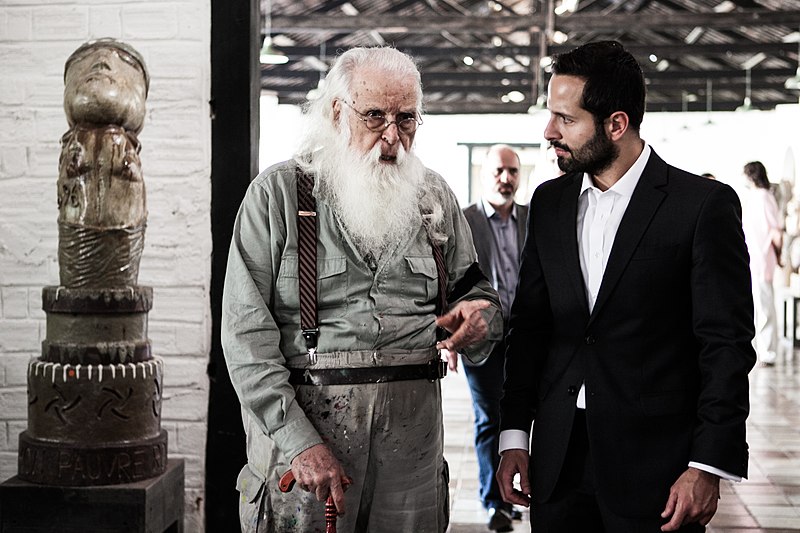
17-06-2016 Ministro da Cultura, Marcelo Calero, visita a Oficina Brennand acompanhado pelo artista Francisco Brennand, em Recife.
Secretaria Especial da Cultura do Ministério da Cidadania
Life and career
Dated record
Life and career
Explore 1927–2019
The full dated record · 3 entries
1927
Francisco Brennand was born in 1927 at Recife.
1997
Brennand is dated 1997.
2019
Francisco Brennand died in 2019 at Recife.
Primary material
Documents and archives
scholarly publication
- Brennand, Francisco, Benezit Dictionary of Artists, 2011
Scholarly · Crossref registry · 2011
authority record
- Wikidata, structured authority record Q3750972: Francisco Brennand
General reference · Wikidata
reference work
- “Francisco Brennand”, English Wikipedia, consulted as further reading
Reputable secondary · Wikipedia
Notes from the source article
Cited by Wikipedia
Notes from the source article
These works are cited by the source article, in its own numbering. They are recorded as its citations, not as sources VALÉORINE has verified.
- 1.Por dentro do legado da família Brennand. Forbes Brasil.
- 2.Rohter, Larry. In Brazil, Iconoclast Is Bearded In His Den; A Controversial Sculptor Revels in His Menagerie. The New York Times. 2004-04-22. 0362-4331.
- 3.Francisco Brennand. Enciclopédia Itaú Cultural.
- 4.Francisco Brennand, ceramista e artista plástico, morre aos 92 anos no Recife. G1. December 19, 2019.
- 5.Retrospectiva de Francisco Brennand busca unir natureza e cultura. Arte que Acontece.
- 6.O legado incalculável de Francisco Brennand segue imortal na história. Folha of Pernambuco.
- 7.Francisco Brennand. SP - Arte.
- 8.Francisco Brennand, mestre dos sonhos. University of Sao Paulo.
- 9.O fantástico mundo de Francisco Brennand. IstoÉ.
- 10.Rohter, Larry. Brazilians Dazzled (Mostly) By Prospect of a Guggenheim. The New York Times. 2000-11-25. 0362-4331.
- 11.Miller, Susan Katz. Bustle and Beaches in Brazil's North. The New York Times. 1995-09-03. 0362-4331.
- 12.Oficina Cerâmica Francisco Brennand Recife, Brazil Attractions. www.lonelyplanet.com.
- 13.Parque de esculturas Francisco Brennand é reinaugurado após três anos de obras no Marco Zero do Recife. G1.
- 14.Francisco Brennand | Artist. Artfacts.
References
Citations
References
Each reference names the institution holding it, so a reader may go to the document itself.
scholarly publication
Brennand, Francisco, Benezit Dictionary of Artists, 2011Crossref registry
Institutional witnessauthority record
Secondary witnessreference work
Secondary witness
Further particulars
Held on the record
Further particulars
Open the remaining particulars
The authorities additionally record the headings Brennand and Francisco de Paula Coimbra de Almeida Brennand. His recorded language was Portuguese. Other recorded relations include Ricardo Brennand. Recorded as having received Order of Cultural Merit (Brazil).
Identity and origins
The Encyclopedia exists whether or not anything is for sale. Corrections are recorded rather than overwritten, and every version of this record is kept. Published 16 August 2026.
Elsewhere in Ceramics
1,104 published records in this field, each with its sources named.
- Francesco GrueArtist
- Francesco NagarArtist
- Francesco Xanto AvelliArtist
- Francis PlaceArtist
- Franco GentiliniArtist
- Frank de MirandaArtist
- Frans LommenArtist
- Frans WildenhainArtist
Best supported in this field
For owners
Own a work by Francisco Brennand?
A specialist will read what you send and tell you what the house can establish, what it cannot, and whether the object is suited to sale. There is no charge and no obligation. The object stays with you throughout; nothing is shipped to us unless it is arranged in writing beforehand.