
Francesco Guardi
Francesco Lazzaro Guardi (franˈtʃesko ˈgwardi; 5 October 1712 – 1 January 1793) was an Italian painter, nobleman, and a member of the Venetian School. He is considered to be among the last practitioners, along with his brothers, of the classic Venetian school of painting. In the early part of his career he collaborated with his older brother Gian Antonio in the production of religious paintings.
Also recorded as Francesco Guada · François Guardi · Fr. Guardi · Francesco Gardis
Francesco Guardi
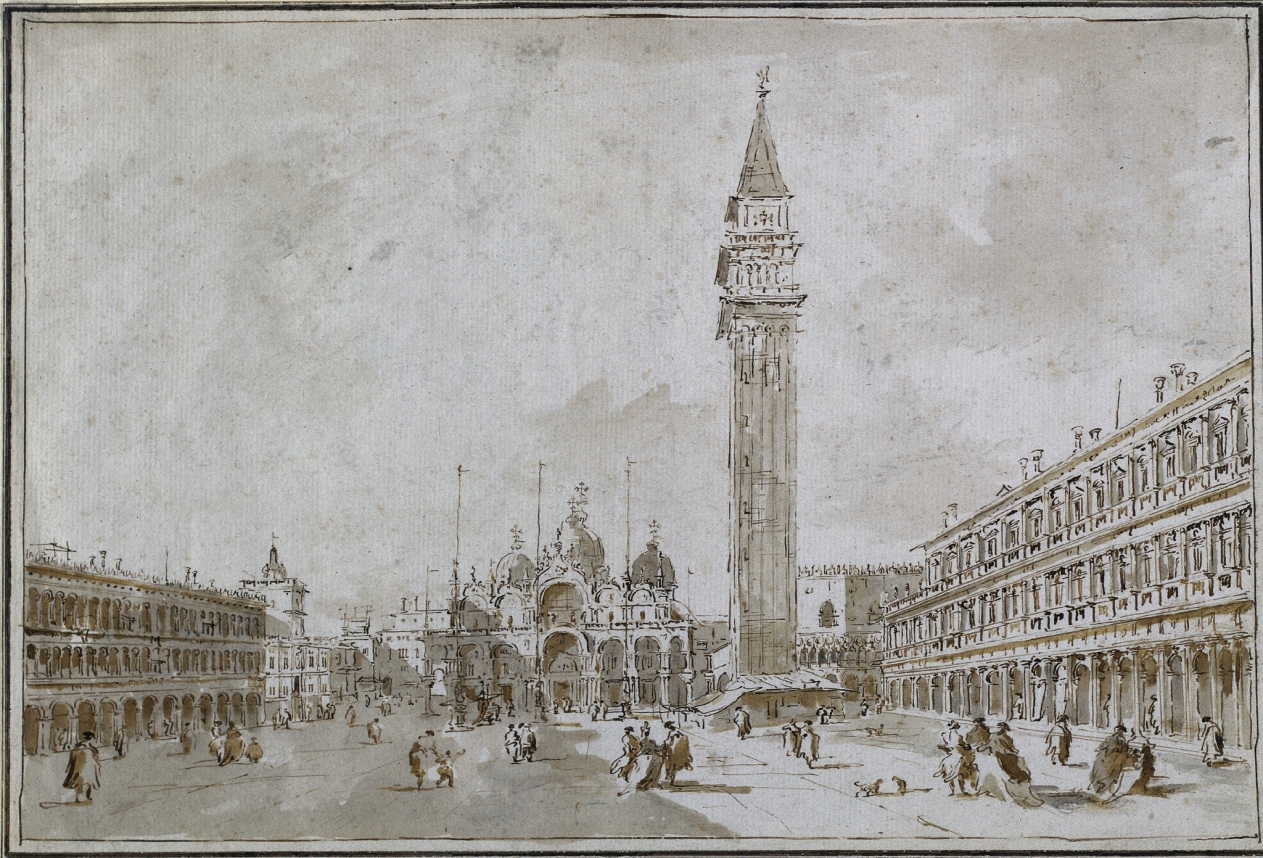
Francesco Guardi · The Cleveland Museum of Art · John L. Severance Fund · CC0
- Name
- Francesco Guardi
- Born
- 5 October 1712
- Birthplace
- Venice, Republic of Venice (now Italy)
- Died
- 1 January 1793
- Place of death
- Venice, Republic of Venice
- Field
- Painting
- Movement
- Venetian School
- Nationality
- Republic of Venice
- Occupation
- painter · graphic artist
- Fields
- Veduta · landscape painting
- Movements
- Rococo
- Known for
- A Regatta on the Grand Canal with the Rialto Bridge in Venice · Landscape with a Quay and Ships on a Lake · The Doge Alvise IV. Mocenigo on the Bucentaur near the Riva di Sant'Elena · The Parlor of the Nuns at San Zaccaria
VALÉORINE Encyclopedia
VALÉORINE documentary reading
Documentary summary
Francesco Lazzaro Guardi (franˈtʃesko ˈgwardi; 5 October 1712 – 1 January 1793) was an Italian painter, nobleman, and a member of the Venetian School. He is considered to be among the last practitioners, along with his brothers, of the classic Venetian school of painting. In the early part of his career he collaborated with his older brother Gian Antonio in the production of religious paintings.
Admitted source layer · organised and presented by VALÉORINE
Note VALÉORINE
Francesco Guardi was a graphic artist and painter, a national of the Republic of Venice.
The graphic artist worked in Venice. Francesco Guardi was associated with Rococo.
Among the works is The Parlor of the Nuns at San Zaccaria. The work spans landscape painting and Veduta.
Composed from admitted, traceable facts · 27 September 2026
VALÉORINE
Reference Check
Propose documentary evidence for Francesco Guardi. A contribution is never written directly as fact: identity, source, rights and evidence gates still decide.
Sign in to contribute
World of VALÉORINE
Documentary connections
Only confirmed graph relationships appear here. Images are shown only when their identity and reuse rights both pass the documentary gate.
Documentary evidence
Evidence Panel
not yet certified
- Identity
- resolved
- Independent source families
- 0
- Admitted assertions
- 0
- Open conflicts
- 0
Authority files
gnd · 1091403708 · wikidata · Q318769 · wikipedia · Francesco Guardi
In this article
Biography
Biography
After Gian Antonio's death in 1760, Francesco concentrated on vedute. The earliest of these show the influence of Canaletto, but he gradually adopted a looser style characterized by spirited brush-strokes and freely imagined architecture.
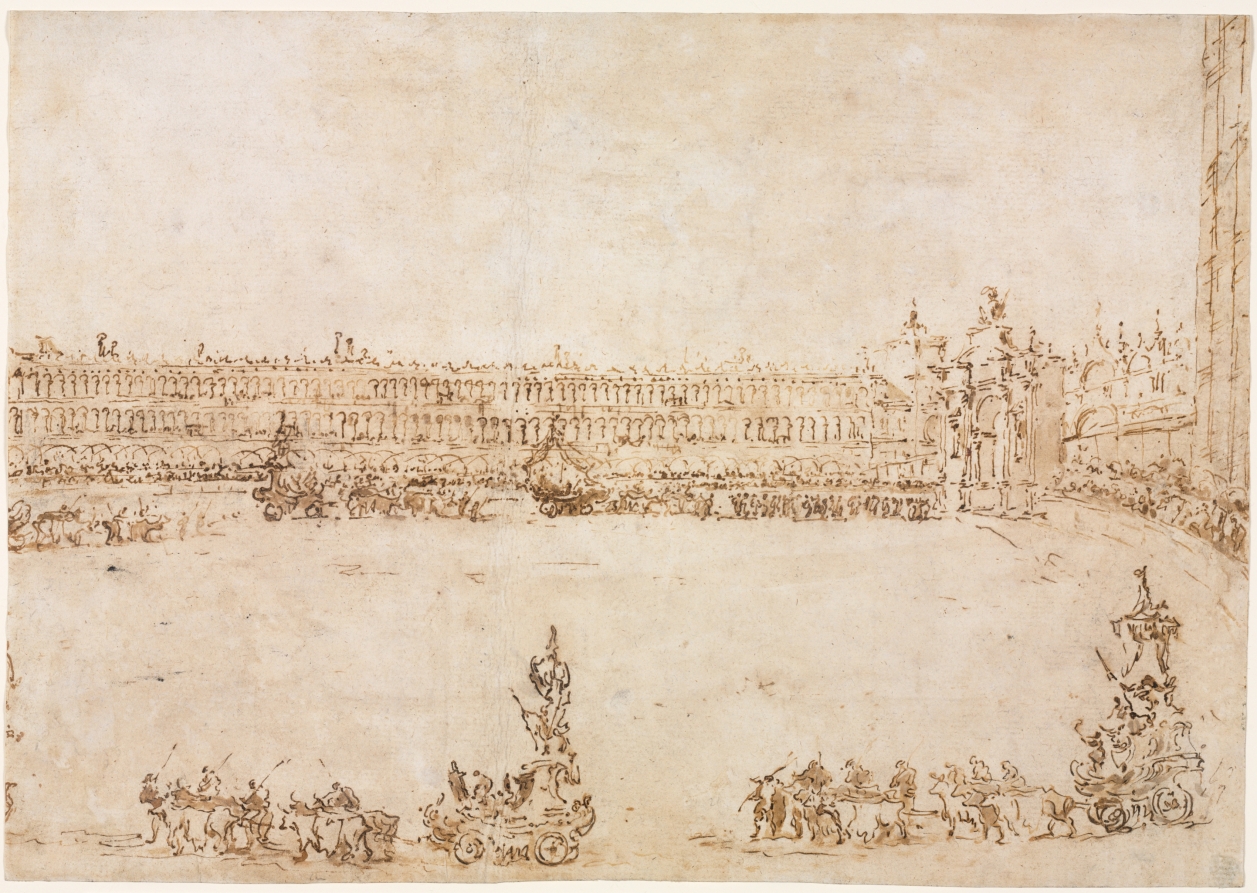
A Procession of Triumphal Cars in the Piazza San Marco, Venice, Celebrating the Visit of the Conti del Nord (recto), 1782, by Francesco Guardi
Francesco Guardi · The Cleveland Museum of Art · John L. Severance Fund
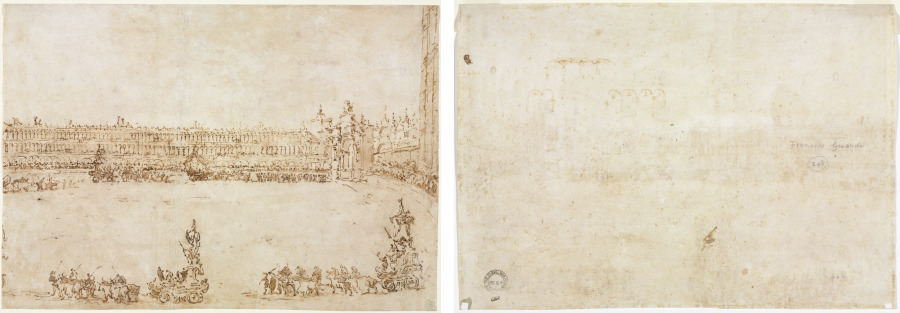
A Procession of Triumphal Cars in the Piazza San Marco, Venice, Celebrating the Visit of the Conti del Nord (recto); Three Sketches of Arches (verso), 1782, by Francesco Guardi
Francesco Guardi · The Cleveland Museum of Art · John L. Severance Fund
Key facts
Key facts
• Name — Francesco Guardi • Born — 5 October 1712 • Birthplace — Venice, Republic of Venice (now Italy) • Died — 1 January 1793 • Place of death — Venice, Republic of Venice • Field — Painting • Movement — Venetian School
Biography
Biography
Francesco Guardi was born in Venice into a family of nobility from Trentino. His father Domenico (born in 1678) and his brothers Niccolò and Gian Antonio were also painters, later inheriting the family workshop after the father's death in 1716. They probably all contributed as a team to some of the larger commissions later attributed to Francesco. His sister Maria Cecilia married the pre-eminent Veneto-European painter of his epoch, Giovanni Battista Tiepolo. In 1735, Guardi moved to the workshop of Michele Marieschi, where he remained until 1743. His first certain works are from 1738, for a parish at Vigo d'Anuania, in Trentino. In this period he worked alongside his older brother, Gian Antonio. The first work signed by Francesco is a Saint Adoring the Eucharist (c. 1739). • Illustration — House of Guardi in Cannaregio His works in this period included both landscapes and figure compositions. His early vedute show influence both from Canaletto and Luca Carlevarijs. On 15 February 1757, he married Maria Mattea Pagani, the daughter of painter Matteo Pagani. In 1760 his brother Gian Antonio died and his first son, Vincenzo, was born. His second son, Giacomo, was born in 1764. In 1763 he worked in Murano, in the church of San Pietro Martire, finishing a Miracle of a Dominican Saint clearly influenced by Alessandro Magnasco in its quasi-expressionistic style. Francesco Guardi's most important later works include the Doge's Feasts, a series of twelve canvases celebrating the ceremonies held in 1763 for the election of Doge Alvise IV Mocenigo. In his later years, Canaletto's influence on his art diminished, as shown by the Piazzetta in the Ca' d'Oro of Venice. In circa 1778, he painted the severe Holy Trinity Appearing to Sts. Peter and Paul in the parish church of Roncegno. • Illustration — Capriccio View of a Venetian Campo (c. 1780) In 1782, Guardi was commissioned by the Venetian government six canvases to celebrate the visit of the Russian Grand Dukes to the city, of which only two remain, and two others for that of Pope Pius VI. On September 12 of that year, he was admitted to the Fine Art Academy of Venice. A stronger attention to colours is present in late works such as the Concerto of 80 Orphans of 1782, now in Munich, and in the Façade of Palace with Staircase in the Accademia Carrara of Bergamo. Guardi died at Campiello de la Madona in Cannaregio (Venice) in 1793.
Mature style
Mature style
• Illustration — View on the Cannaregio Canal, Venice, c. 1775–1780, National Gallery of Art Among all the paintings attributed to either Francesco and his brother Gian Antonio Guardi, the most praised work is not a landscape, but instead the airy sfumato Story of Tobit painted for the organ loft in the small Chiesa dell'Angelo San Raffaele. To quote from the Web Gallery of Art: Perspective, organized aerial space, the Palladian solidity of Tiepolo... are exchanged for a personal style of coloured handwriting – now brilliantly calligraphic, and now brilliantly cloudy. Guardi's painterly style is known as pittura di tocco (of touch) for its small dotting and spirited brush-strokes. This looser style of painting had been used by Giovanni Piazzetta and Sebastiano Ricci, and recalls, in some religious themes, the sweetened sfumato of Barocci's Bolognese style. In this he differs from the more linear and architecturally accurate style of Canaletto's painting. This style, a century later, would make Guardi's works highly prized by the French Impressionists. Canaletto, as a vedutista, concentrated on glamorous urban architecture erected by the Serene Republic; on the other hand, in Guardi, the buildings often appear to be melting and sinking into a murky lagoon. Canaletto's canvases often have intricate linear and brilliant details, and depict Venice in sunny daylight. Guardi paints clouded skies above a city at dusk. These contrasts, however, simplify the facts, since Canaletto often painted the drab communal life and neighborhoods (creating in them some epic artistic qualities), while Guardi did not avoid sometimes painting the ceremonies of Ducal Venice. Ultimately, Guardi's paintings evoke the onset of the dissipation. The citizenry has shrunken to an impotent lilliputian crowd of "rubber-neckers", unable to rescue the crumbling Republic, as for example in the Fire in the Oil Depot in San Marcuola. It was fitting depiction of the rapidly declining empire, which had declined, in Napoleon's assessment, into a "drawing room of Europe" peopled with casinos, carnivals, and courtesans for hire.
Gallery
Gallery
• Illustration — Departure of Tobias and Angel, Chiesa dell'Angelo San Raffaele (Venice) • Illustration — View on the Grand Canal at San Geremia, Venice (1760–1765), Frick Collection • Illustration — The Bucintoro Festival of Venice (1780–1793), National Gallery of Denmark • Illustration — Miracle of a Dominican Saint (1763), private collection • Illustration — Regatta in Venice (1770), Frick Collection • Illustration — View of the Cannaregio Canal (c. 1770) • Illustration — Procession of Gondolas in the Bacino di San Marco (c. 1782), Museum of Fine Arts, Boston • Illustration — Fire in the Oil Depot in San Marcuola (1789), Gallerie dell'Accademia • Illustration — Venice landscape, Ryazan fine art museum, Ryazan • Illustration — Lagoon Looking Towards Murano from the Fondamenta Nuova (1765-1770), Fitzwilliam Museum • Illustration — A Colonnade, Partly Ruined, with Figures (1780 – 90), Metropolitan Museum of Art
Identity and origins
Identity and origins
The authorities additionally record the headings Francesco Guada, François Guardi, Fr. Guardi, Francesco Gardis and Franchesko Gvardi. His recorded language was Italian. He was the child of Domenico Guardi and Maria Claudia Pichler. One child is recorded: Giacomo Guardi.
Work and production
Work and production
Works recorded as notable number 4: A Regatta on the Grand Canal with the Rialto Bridge in Venice, Landscape with a Quay and Ships on a Lake, The Doge Alvise IV. Mocenigo on the Bucentaur near the Riva di Sant'Elena and The Parlor of the Nuns at San Zaccaria. His recorded genres are Veduta and landscape.
Life and career
Dated record
Life and career
The full dated record · 2 entries
1712
Francesco Guardi was born in 1712.
1793
Francesco Guardi died at Venice.
Places
Named by the record
Places
Only places the record itself states, plotted where the house gazetteer settles their coordinates. Nothing is inferred from a name or a nationality.
Francesco Guardi was born in Venice.
Birthplace
Francesco Guardi died in Venice.
Deathplace
Context
Primary material
Context
The circumstances in which Francesco Guardi stands. Guardi; Francesco Gardis; Franchesko Gvardi; Francesco Guarde.
Documents and archives
Primary material
Documents and archives
authority file
- Gemeinsame Normdatei 1091403708, Francesco Guardi: Vedute - Capricci - Feste (1993 : Venezia).
Unverified · Deutsche Nationalbibliothek
authority record
- Wikidata, structured authority record Q318769: Francesco Guardi
Unverified · Wikidata
reference work
- “Francesco Guardi”, English Wikipedia, consulted as further reading
Reputable secondary · Wikipedia
Notes from the source article
Cited by Wikipedia
Notes from the source article
These works are cited by the source article, in its own numbering. They are recorded as its citations, not as sources VALÉORINE has verified.
- 1.Wga.hu. Web Gallery of Art, image collection, virtual museum, searchable database of European fine arts (1100-1850).
- 2.Wga.hu. San Cristoforo, San Michele and Murano, Seen from the Fondamenta Nuove by GUARDI, Francesco.
- 3.Wga.hu. The Lagoon with Boats, Gondolas, and Rafts by GUARDI, Francesco.
- 4.Wga.hu. Ducal Palace.
- 5.Wga.hu. Web Gallery of Art, image collection, virtual museum, searchable database of European fine arts (1100-1850).
- 6.Oil on canvas, 31,7 x 52,7 cm. Fitzwilliam Museum, Cambridge.
References
Citations
References
Each reference names the institution holding it, so a reader may go to the document itself.
authority file
Gemeinsame Normdatei 1091403708, Francesco Guardi: Vedute - Capricci - Feste (1993 : Venezia).Deutsche Nationalbibliothek
Partially resolvedauthority record
Partially resolvedreference work
Partially resolved
Further particulars
Held on the record
Further particulars
Open the remaining particulars
Works and catalogued output.
Recognition and collections
Work by Francesco Guardi is
Museum Boijmans Van Beuningen, Städel Museum, Minneapolis Institute of Art and Museo del Prado
The Grand Canal with San Simeone Piccolo and Santa Lucia
Philadelphia Museum of Art (
Guardi; Francesco Gardis; Francesco Guarde.
The Encyclopedia exists whether or not anything is for sale. Corrections are recorded rather than overwritten, and every version of this record is kept. Published 14 August 2026.
Elsewhere in Paintings
18,970 published records in this field, each with its sources named.
- Francesco GhittoniArtist
- Francesco Giuseppe CasanovaArtist
- Francesco GnecchiArtist
- Francesco GranacciArtist
- Francesco GuarinoArtist
- Francesco ImparatoArtist
- Francesco LojaconoArtist
- Francesco LondonioArtist
Best supported in this field
For owners
Own a work by Francesco Guardi?
A specialist will read what you send and tell you what the house can establish, what it cannot, and whether the object is suited to sale. There is no charge and no obligation. The object stays with you throughout; nothing is shipped to us unless it is arranged in writing beforehand.