
Hubert-François Gravelot
Hubert-François Bourguignon, commonly known as Gravelot (26 March 1699 – 20 April 1773), was a French engraver, a famous book illustrator, designer and drawing-master. Hubert-François Gravelot was born in Paris, he emigrated to London in 1732, where he quickly became a central figure in the introduction of the Rococo style in British design, which was disseminated from London in this period, through the media of book illustrations and engraved designs as well as by the examples of luxury goods in the "French taste" brought down from London to provincial towns and country houses.
Also recorded as Hubert François Bourguignon Gravelot · Bourguignon Gravelot · Hubert-François Bourguignon · Hubert-François Bourguignon d'Anville Gravelot
Hubert-François Gravelot

Maurice Quentin de La Tour · Bas van Houwelingen (23 April 2017). " Hubert François Gravelot ". Reading and Art. Blogspot. · Public domain
- Name
- Hubert-François Gravelot
- Birth Name
- Hubert-François Bourguignon
- Born
- 26 March 1699
- Birthplace
- Paris, France
- Died
- 20 April 1773
- Field
- * Engraving
- Education
- * Jean II Restout
- Nationality
- France.
- Occupation
- painter, draftsperson, illustrator, caricaturist, engraver and graphic artist.
- Movements
- Rococo.
VALÉORINE Encyclopedia
VALÉORINE documentary reading
Documentary summary
Hubert-François Bourguignon, commonly known as Gravelot (26 March 1699 – 20 April 1773), was a French engraver, a famous book illustrator, designer and drawing-master. Hubert-François Gravelot was born in Paris, he emigrated to London in 1732, where he quickly became a central figure in the introduction of the Rococo style in British design, which was disseminated from London in this period, through the media of book illustrations and engraved designs as well as by the examples of luxury goods in the "French taste" brought down from London to provincial towns and country houses.
Admitted source layer · organised and presented by VALÉORINE
Note VALÉORINE
No house-authored Note is published until its assertions and sources pass the VALÉORINE evidence contract. The documentary article remains available in full while that enrichment is being consolidated.
Documentary enrichment in progress · no unsupported statement published
Reference Check
Propose documentary evidence for Hubert-François Gravelot. A contribution is never written directly as fact: identity, source, rights and evidence gates still decide.
Sign in to contribute
World of VALÉORINE
Documentary connections
Only confirmed graph relationships appear here. Images are shown only when their identity and reuse rights both pass the documentary gate.

Documentary evidence
Evidence Panel
not yet certified
- Identity
- resolved
- Independent source families
- 0
- Admitted assertions
- 0
- Open conflicts
- 0
Authority files
bnf · getty · gnd · loc · wikidata · Q981197 · wikipedia · Hubert-François Gravelot
In this article
Key facts
Key facts
• Name — Hubert-François Gravelot • Birth Name — Hubert-François Bourguignon • Born — 26 March 1699 • Birthplace — Paris, France • Died — 20 April 1773 • Place of death — Paris, France • Field — * Engraving • book illustration • Education — * Jean II Restout • François Boucher • Relatives — Jean-Baptiste Bourguignon d'Anville (elder brother)
Education
Education
• Illustration — Illustration for the 6th edition of Samuel Richardson's Pamela, 1742, after a design by Francis Hayman Gravelot was a mediocre student, who did not profit from a premature stay in Rome, financed by his father, from which he returned, his funds depleted, without a stay in Lyon, an artistic center that often provided a stop-over for art students between Paris and Rome. Unsuccessful in a commercial venture at Saint Domingue on his father's account, he returned to Paris and became the pupil first of Jean II Restout, and then of François Boucher. • Illustration — Etching, 1733-1744, Hubert Gravelot (Victoria and Albert Museum)
Early career
Early career
His years in London, 1732–45 were fruitful ones. They coincided with a period when Britain and France were not at war. Though French-trained craftsmen, engravers and even some painters, were already working in London, but the Rococo style in luxury works of art was relatively new: the Spitalfields silk industry, always dominated by Parisian innovations rendered by Huguenot designers and weavers, produced its earliest asymmetrical and naturalistic floral designs in the early 1730s, and the earliest identified full-blown Rococo piece of London silver, by the second-generation Huguenot Paul de Lamerie, can be dated about 1731. Gravelot's trip was not a speculation; he had been invited by Claude du Bosc to engrave designs for an English translation of Bernard Picart's Ceremonies and Religious Customs of... the Known World. The chronicler of English art and artists George Vertue, an engraver himself, soon took note of Gravelot: "His Manner of designing neat and correct much like Picart" he noted in 1733. "A very curious pen & writes neatly. He has been lately in Glocestershire where he was imployed to drawn Antient Monuments in Churches & other Antiquities... He has tryd at painting a small piece or two." George Vertue noted in 1741 that Gravelot's "drawings for Engraving and all other kinds of Gold & Silver works shews he is endowed with a great fruitfull genius for desseins inventions of history and ornaments" By that time Gravelot had become a central figure in the artistic set that gathered at Slaughter's Coffee House in St Martin's Lane and formed the St. Martin's Lane Academy organised by William Hogarth in the premises of his father-in-law Sir James Thornhill. The St. Martin's Lane Academy was an unofficial precursor of the Royal Academy at a time when there were no public exhibitions of art in London, no annual salons as in Paris, no public museums and no places to see or copy from good examples of paintings save in the houses of the rich or noble. As a drawing-master Gravelot had Thomas Gainsborough for a pupil.
Personal adult life
Personal adult life
Gravelot himself was an inveterate, even obsessive reader; his brother's Éloge reports that he would take a small volume to bed with him, in case of insomnia. His easy and elegant book illustrations were worked up from dressed mannikins, fully jointed down to their fingers, which he had made expressly in London.
Late career
Late career
Gravelot's rococo book illustrations in London reached a peak in the designs he contributed to Theobald's 1740 edition of the complete works of William Shakespeare, for which Gravelot provided 35 frontispieces.
Escape back to France
Escape back to France
Anti-French sentiments in London after the Battle of Fontenoy in 1745 forced Gravelot's return to Paris that October, accompanied by his student Thomas Major, later the first engraver voted an Associate of the Royal Academy, and with a fortune of 10,000 pounds sterling; there he soon settled down as a book illustrator: among his book illustrations, projects were Tom Jones (Paris and London, 1750), Manon Lescaut (1753, illustration, left) a Décaméron (1757), La Nouvelle Héloïse (1761), the Contes moraux of Marmontel (1765), a French translation of Ovid's Metamorphoses (1767–71), and of Torquato Tasso's Gerusalemme Liberata (1771). He died in Paris.
His work
His work
His illustrations of contemporary manners and costumes are known to have influenced English artists. Gravelot revitalized illustrative engraving in England, and after his return to Paris, a group of accomplished engravers continued to work in his manner. The descriptive precision and elegance of his line and the variety of his inventions can be seen in the drawings for two of his more important commissions, the second volume of Gay’s Fables and the second edition of L. Theobald's The Works of Shakespeare in Eight Volumes, and in his illustrations for the first French translation of Boccaccio Le Decameron, 1757. The books are listed by Gordon Ray as one of the most outstanding illustrated books of all time. Gravelot's designs for the decorative arts were limited to a suite of engravings for wrought iron work, but his rocailles, his cartouches for maps, his rococo borders provided inspiration for goldsmiths and silversmiths, cabinet-makers like Thomas Chippendale, tapestry cartoons made at the Soho works, and china painters at the Chelsea porcelain manufactory. Gravelot's older brother was the geographer Jean-Baptiste Bourguignon d'Anville, whose "Éloge de M. Gravelot" appeared in La Nécrologie des hommes celebres de France (Paris 1774). • See Drawings for the illustrations of Boccaccio's Decamerone and Original Drawings From the Collections at the Library of Congress
Identity and origins
Identity and origins
The authorities additionally record the headings Hubert François Bourguignon Gravelot, Bourguignon Gravelot, Hubert-François Bourguignon, Hubert-François Bourguignon d'Anville Gravelot and Hubert François Bourguignon. His recorded language was French.
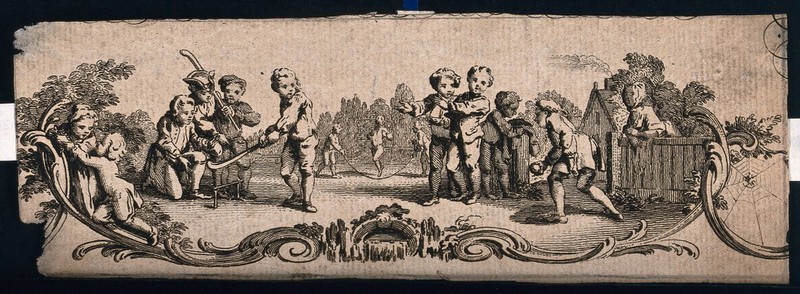
Children are playing cricket with a bat and ball, others are skipping in the background. Etching by H. Gravelot., 1700-1799, by Hubert-François Gravelot
Hubert-François Gravelot · Wellcome Collection, London · Wellcome Collection
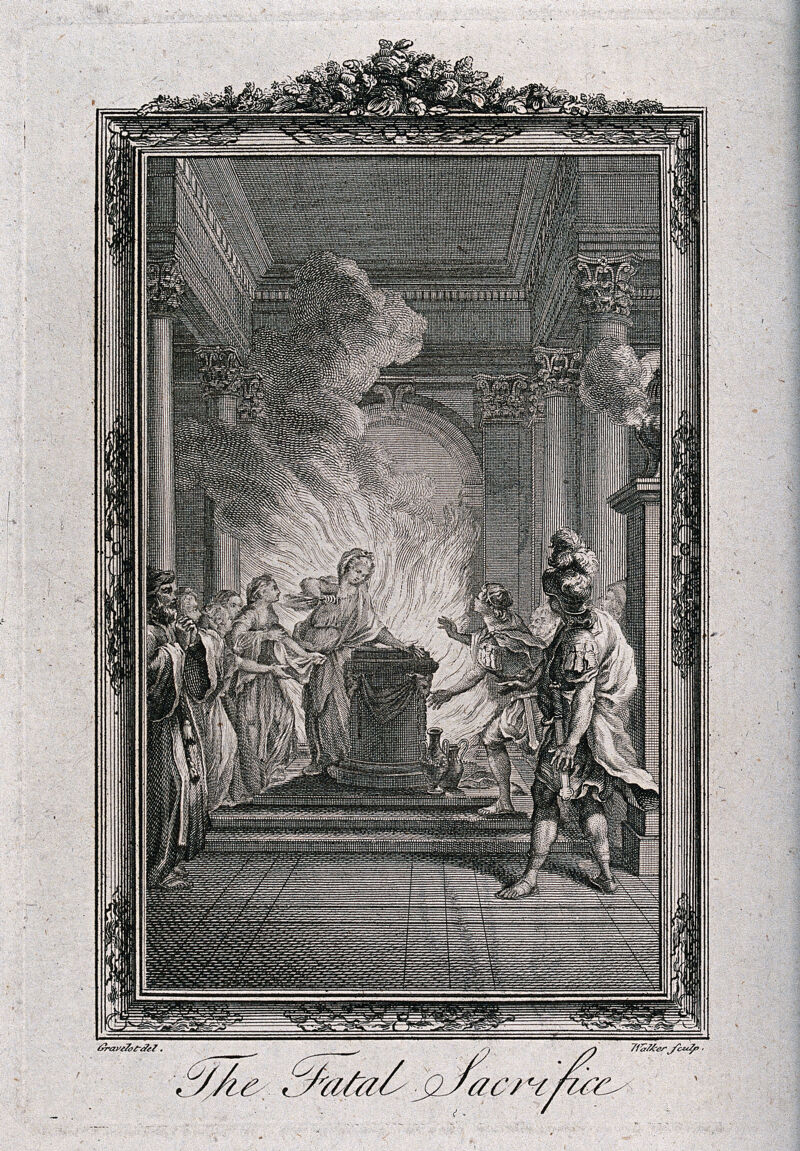
An episode in the play Olimpie by
Hubert-François Gravelot · Wellcome Collection, London · Wellcome Collection
Life and career
Dated record
Life and career
The full dated record · 2 entries
1699
Hubert-François Gravelot was born in 1699.
1773
Hubert-François Gravelot died at Paris.
Primary material
Documents and archives
institutional register
- Bibliothèque nationale de France authority file 11905756m
Unverified · Bibliothèque nationale de France
- FAST authority file 122284
Unverified · FAST
- GND (German National Library) authority file 121286673
Unverified · GND (German National Library)
- IdRef (French universities) authority file 026901307
Unverified · IdRef (French universities)
- ISNI authority file 0000000121313768
Unverified · ISNI
- Library of Congress authority file n83227326
Unverified · Library of Congress
reference work
- “Hubert-François Gravelot”, English Wikipedia, consulted as further reading
Reputable secondary · Wikipedia
Notes from the source article
Cited by Wikipedia
Notes from the source article
These works are cited by the source article, in its own numbering. They are recorded as its citations, not as sources VALÉORINE has verified.
- 1."He belongs to the group of vignettistes who are better known for their contribution to book illustration than for their paintings or independent drawings" Ruth S. Kraemer observed; (Kramer, "Drawings by Gravelot in the Morgan Library. A Checklist" Master Drawings 20.1 [Spring 1982: 3-21, 51-73] p. 3).
- 2.He was not a winner of the Prix de Rome nor a pensioner of the French Academy in Rome.
- 3.Museum no. E.2456-1932.
- 4.The period of peace lasted from 1713 to 1744.
- 5.Antoine Watteau's visit to London was a personal one, to consult Dr. Mead, but several lesser painters were already making careers in Britain, notably Philip Mercier, an early practitioner of the "conversation piece", and Andien de Clermont.
- 6.Peter K. Thornton, Baroque and Rococo Silks (London: Faber and Faber) 1965.
- 7.Philip A.S. Phillips, Paul de Lamerie: A study of His Life and Works (London) 1935: pls. lxx, lxxiii and lxxix; noted by Michael Snodin, "English Rococo and its Continental origins", in Rococo: Art and design in Hogarth's England (Victoria and Albert Museum, 1984:27-33) p. 29.
- 8.Snodin 1984:29.
- 9.The Note-Books of George Vertue vol. III, Walpole Society,22 (1934).
- 10.There are drawings for snuff-box lids at the Metropolitan Museum of Art and at the Morgan Library; an engraving that includes a design for an etui was included in the 1984 Victoria and Albert Museum exhibition Rococo: Art and Design in Hogarth's England
- 11.Vertue, vol. III:105
- 12.A point made by Alice Newlin, "The Celebrated Mr. Gravelot" The Metropolitan Museum of Art Bulletin, New Series, 5.2 (October 1946:61-66) p 61.
- 13."Gravelot's easy and elegant handling and composition, both of which can be described as rococo in character, were probably his chief contributions to English art." (Snodin 1984:30); a full section of the 1984 exhibition and its catalogue (D1-28) was devoted to "Gravelot and printmaking".
- 14.Éloge 1774.
- 15.The figure reported by Whitley (Artist and Their Friends in England, 1700-1799 [1928] I:94I) is £10,000. Whitley also describes how Gravelot was later able to arrange for Major's release from the Bastille, after the English had been rounded up in Paris and incarcerated.
- 16.The 5 volumes contain 89 plates, 97 tailpieces and 111 headpieces designed by Gravelot, François Boucher, Eisen and Charles-Nicolas Cochin.
- 17.Noted by Newlin 1946:66, note.
Bibliography printed in the source article · 4
- Andromeda Oxford Limited. A Biographical Dictionary of Artists. 280. 1995. 1-8497-2023-1.
- Rorschach, Kimerly. Gravelot. The Dictionary of Art. Grove's Dictionaries. 13. 324–325. 1996. 1-884446-00-0.
- Singer, Hans Wolfgang. Gravelot, Hubert-François. Allgemeines Lexikon der bildenden Künstler. E. A. Seemann. 14. 548–549. 1921. 1039517481.
- Sullivan, M. G. Gravelot [formerly Bourguignon], Hubert-François. Oxford Dictionary of National Biography. Oxford University Press. 23. 378–380. 0-19-861373-3.
References
Citations
References
Each reference names the institution holding it, so a reader may go to the document itself.
institutional register
Bibliothèque nationale de France authority file 11905756mBibliothèque nationale de France
Partially resolvedinstitutional register
Partially resolvedinstitutional register
GND (German National Library) authority file 121286673GND (German National Library)
Partially resolvedinstitutional register
IdRef (French universities) authority file 026901307IdRef (French universities)
Partially resolvedinstitutional register
Partially resolvedinstitutional register
Library of Congress authority file n83227326Library of Congress
Partially resolvedinstitutional register
National Library of Australia authority file 36187953National Library of Australia
Partially resolvedinstitutional register
RKDartists authority file 33432RKDartists
Partially resolved
Every cited source · 12
- 01
Bibliothèque nationale de France authority file 11905756m
institutional register · Unverified · Bibliothèque nationale de France
Consult the source - 02
- 03
GND (German National Library) authority file 121286673
institutional register · Unverified · GND (German National Library)
Consult the source - 04
IdRef (French universities) authority file 026901307
institutional register · Unverified · IdRef (French universities)
Consult the source - 05
- 06
Library of Congress authority file n83227326
institutional register · Unverified · Library of Congress
Consult the source - 07
National Library of Australia authority file 36187953
institutional register · Unverified · National Library of Australia
Consult the source - 08
- 09
Union List of Artist Names authority file 500004164
institutional register · Unverified · Union List of Artist Names
Consult the source - 10
- 11
“Hubert-François Gravelot”, English Wikipedia, consulted as further reading
reference work · Reputable secondary · Wikipedia
Consult the source - 12
Wikidata, structured authority record Q981197: Hubert-François Gravelot
institutional register · Unverified · Wikimedia Foundation
Consult the source
A further 1 witness is held back from this article because the person or object named in it is not yet resolved to this record. They are kept, not discarded, and return once the identity is established.
People, houses and institutions
Knowledge graph
People, houses and institutions
Teachers, collaborators, publishers and institutions recorded against this person, each on a stated basis.
Further particulars
Held on the record
Further particulars
Open the remaining particulars
Hubert-François Gravelot studied at Beaux-Arts de Paris. He trained under Jean Restout. Each of those relationships is stated by the authority record rather than inferred from style.
Recognition and collections
Work by Hubert-François Gravelot is
The Nelson-Atkins Museum of Art, Tate, Nationalmuseum and National Gallery of Canada
The Encyclopedia exists whether or not anything is for sale. Corrections are recorded rather than overwritten, and every version of this record is kept. Published 14 August 2026.
Elsewhere in Prints
4,138 published records in this field, each with its sources named.
- Howard CookEngraver
- Howell Chambers BrownEngraver
- Hubert GoltziusEngraver
- Hubert MaurerEngraver
- Hubertine HeijermansEngraver
- Hubertus QuellinusEngraver
- Hugh HughesEngraver
- Hugh MerrillEngraver
Best supported in this field
For owners
Own a work by Hubert-François Gravelot?
A specialist will read what you send and tell you what the house can establish, what it cannot, and whether the object is suited to sale. There is no charge and no obligation. The object stays with you throughout; nothing is shipped to us unless it is arranged in writing beforehand.