
Fortunino Matania
Illustration — A photograph of Fortunino Matania published in The Sphere in 1915 Chevalier Fortunino Matania (16 April 1881 – 8 February 1963) was an Italian artist noted for his realistic portrayal of World War I trench warfare and of a wide range of historical subjects.
Also recorded as Fortunio Matania · Chevalier Fortunino Matania
Fortunino Matania
Fortunino Matania · Wellcome Collection, London · Wellcome Collection · Public Domain Mark
- Born
- 1881 · Naples.
- Died
- 1963 · London.
- Nationality
- Italy · Kingdom of Italy
- Occupation
- painter · illustrator
- Languages
- Italian
VALÉORINE Encyclopedia
VALÉORINE documentary reading
Documentary summary
Illustration — A photograph of Fortunino Matania published in The Sphere in 1915 Chevalier Fortunino Matania (16 April 1881 – 8 February 1963) was an Italian artist noted for his realistic portrayal of World War I trench warfare and of a wide range of historical subjects.
Admitted source layer · organised and presented by VALÉORINE
Reference Check
Propose documentary evidence for Fortunino Matania. A contribution is never written directly as fact: identity, source, rights and evidence gates still decide.
Sign in to contribute
World of VALÉORINE
Documentary connections
Only confirmed graph relationships appear here. Images are shown only when their identity and reuse rights both pass the documentary gate.

Documentary evidence
Documentary basis
Authority files
wikidata · Q3078576 · wikipedia · Fortunino Matania
In this article
Life
Life
Born in Naples, the son of artist Eduardo Matania, Fortunino Matania studied at his father's studio, designing a soap advertisement at the age of 9 and exhibiting his first work at Naples Academy at 11. By the age of 14 he was helping his father produce illustrations for books and magazines. His talent was recognised by the editor of the Italian periodical L'Illustrazione Italiania and Matania produced weekly illustrations for the magazine between 1895 and 1902. At the age of 20, Matania began working in Paris for Illustration Francaise and, in 1902, was invited to London to cover the Coronation of Edward VII for The Graphic. Matania subsequently covered every major event – marriage, christening, funeral and Coronation – of British royalty up to the coronation of Elizabeth II in 1953. In 1904, Matania joined the staff of The Sphere where some of his most famous work was to appear, including his illustrations of the sinking of the RMS Titanic in 1912. Around 1906 to 1910 he painted the life in the lobby of the Hotel Excelsior in Rome. • Illustration — The Last General Absolution of the Munsters at Rue du Bois by Matania depicting the regiment on the eve of the Battle of Aubers Ridge in May 1915 At the outbreak of the First World War, Matania became a war artist and was acclaimed for his graphic and realistic images of trench warfare. His painting for the Blue Cross entitled Goodbye, Old Man, showing a British soldier saying farewell to his dying horse, is a fine example of his emotive work. His painting of the Green Howards including Henry Tandey is a central part of a famous story. But it was after the war, when he switched to scenes of ancient high life for the British woman's magazine, Britannia and Eve, that Matania found his real career. He filled his London studio with reproductions of Roman furniture, pored over history books for suitably lively subjects. Then, with the help of models and statues, he began to paint such subjects as Samson and Delilah, the bacchanalian roisters of ancient Rome, and even early American Indian maidens—all with the same careful respect for accuracy and detail he had used in his news assignments. Generally he managed to include one or two voluptuous nudes in each picture. "The public demanded it," says Matania. "If there was no nude, then the editor or I would get a shower of letters from readers asking politely why not." He was a standard in Britannia and Eve for 19 years. Matania exhibited regularly at the Royal Academy, and also at the Royal Institute of Painters in Water Colours, where in 1917 he was elected a member. From 1908 his work appeared in most of the principal magazines in Britain and America, including Illustrated London News, London Magazine, Nash's, Printer's Pie and others. When Britannia and Eve was launched in 1929, Matania became one of its first contributors. For 19 years, he wrote and illustrated historical stories for the magazine. His talents made him a popular illustrator for advertising, posters and catalogues, working for the LMS railway designing posters for Southport and Blackpool, Ovaltine, Burberry's (the sporting outfitters) and many others. Bénézit lists some auction records for Matania: • Tenterdem. 16 Oct 2002, Musical Soiree with Beethoven Playing the Piano (oil on canvas, 52x44 cm) 9,000 GBP • Tenterdem. 16 Oct 2002, Elegant Edwardian Scene with Men and Women at a Polo Match (watercolour, 46x67 cm) 18,250 GBP Matania was also recommended to Hollywood director Cecil B. DeMille and produced a number of paintings of Rome and Egypt from which authentic designs could be made for the movie The Ten Commandments. In 1933, Matania applied his very realistic style to illustrations for Edgar Rice Burroughs' "Pirates of Venus" and in 1933–24 to Burrough's "Lost on Venus." Matania was one of the leading illustrators selected by Percy Bradshaw for inclusion in his The Art of the Illustrator which presented a separate portfolio for each of twenty illustrators. In later years, Matania provided illustrations to big Italian magazines—from "Il Mattino Illustrato" (1924–1947) and "Scena Illustrata" to "Illustrazione del Popolo" (1941–1947), "Corriere dei Piccoli" (1948–1954), and "Domenica del Corriere" (1948–1951). Towards the end of his life, Matania illustrated features for the educational weekly Look and Learn, and was working on the series A Pageant of Kings at the time of his death.
Gallery
Gallery
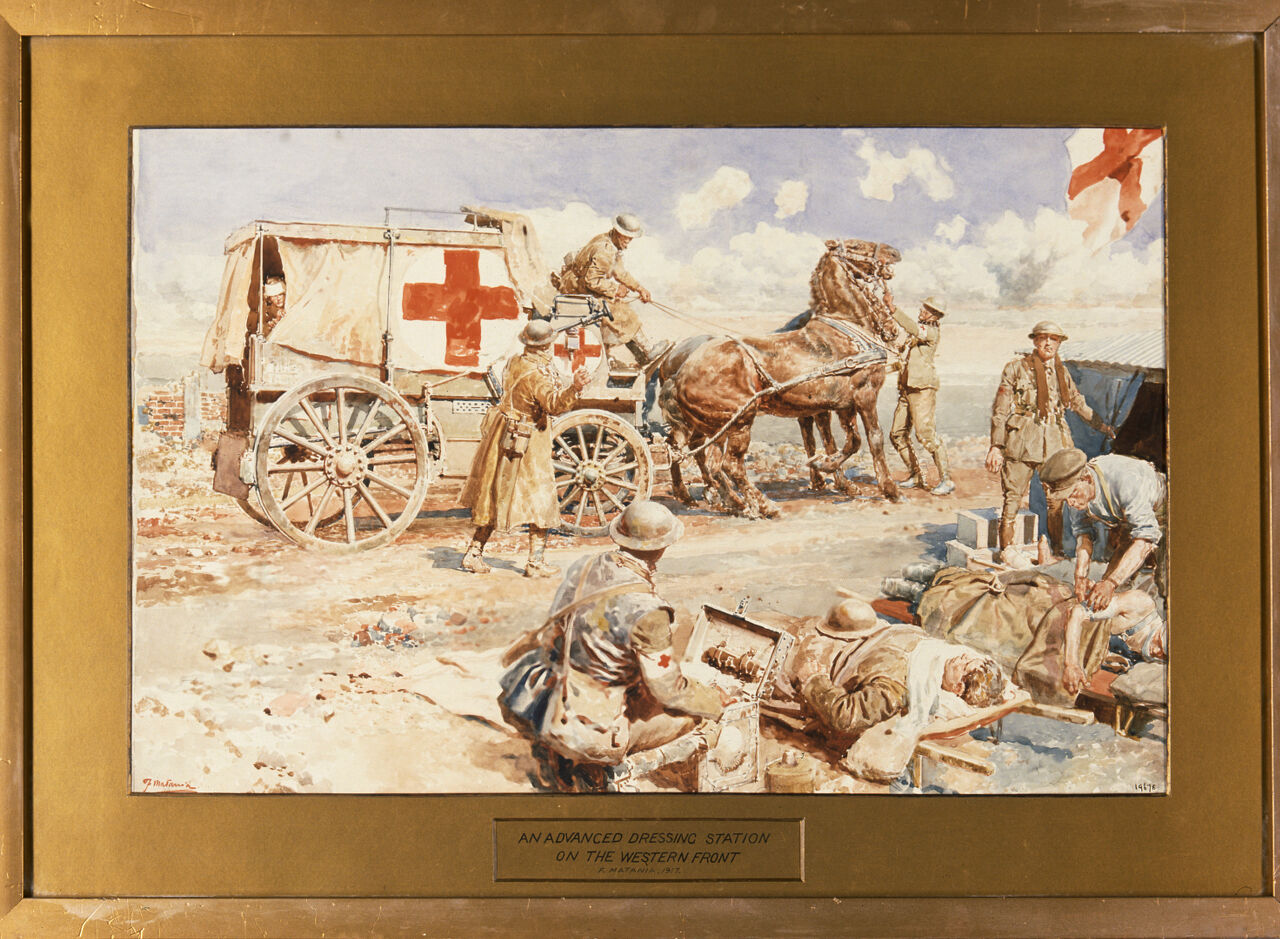
• Illustration — Transport of Wounded • Illustration — Dressing Station • Illustration — How Private Flynn of South Wales Borderers won the Victoria Cross Medal • Illustration — Horse-drawn transport of Wounded • Illustration — Piccadilly Circus by Fortunino Matania. Watercolor and gouache on paper. Early 20th century. Private Collection.
Identity
Identity
Fortunino Matania is recorded as painter and illustrator.
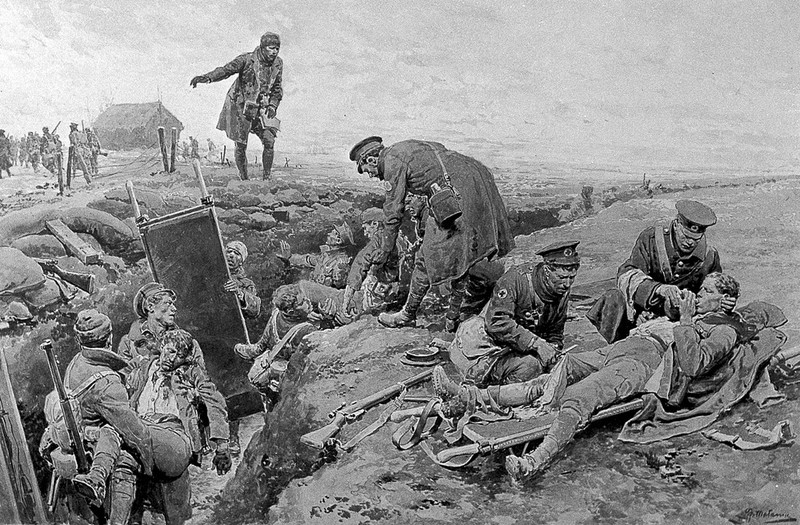
World War I: members of the Royal Army Medical Corps lifting dead and wounded men out of a bombed trench in France and treating the survivors. Photograph of drawing by F. Matania, ca. 1917., 1916-1918, by Fortunino Matania
Fortunino Matania · Wellcome Collection, London · Wellcome Collection
Life and career
Dated record
Life and career
The full dated record · 2 entries
1881
Fortunino Matania born at Naples.
1963
Fortunino Matania died at London.
Places
Named by the record
Places
Only places the record itself states, plotted where the house gazetteer settles their coordinates. Nothing is inferred from a name or a nationality.
Naples.
Birth place
London.
Death place
Books illustrated by Fortunino Matania
• Six Stories from Shakespeare, retold by John Buchan (1934) • Latin and the Romans, Book One. Ginn & Co. Jenkins & Wagener (1941) • Latin and the Romans, Book Two. Ginn & Co. Jenkins & Wagener (1942) • Raphael and Stella: A Baker's Delight Immortalised in Paint, by Matania (1944) • Great Stories from History, ed. Edward Horton and Peter Shellard (1970) • The Eagle Book of Amazing Stories 1974 (1973) • With the British Army on the Western Front: Twelve Signed Artist's Proofs. London: The Sphere & Tatler; [1916]
Citations
References
Each reference names the institution holding it, so a reader may go to the document itself.
reference work
Wikidata, structured authority record Q3078576: Fortunino MataniaWikimedia Foundation
Secondary witnessreference work
Secondary witness
The Encyclopedia exists whether or not anything is for sale. Corrections are recorded rather than overwritten, and every version of this record is kept. Published 16 August 2026.
Elsewhere in Illustration
5,224 published records in this field, each with its sources named.
- Florence White WilliamsIllustrator
- Florencio Molina CamposIllustrator
- Florin PucăIllustrator
- Fortunato PasquettiIllustrator
- Fotis KontoglouIllustrator
- Fran BullIllustrator
- France PodrekarIllustrator
- Frances BeemIllustrator
Best supported in this field
For owners
Own a work by Fortunino Matania?
A specialist will read what you send and tell you what the house can establish, what it cannot, and whether the object is suited to sale. There is no charge and no obligation. The object stays with you throughout; nothing is shipped to us unless it is arranged in writing beforehand.