
Filippo Napoletano
Illustration — Picnic on the Grass, 1619. • Illustration — Burning of Troy (Fondazione Cariplo) Filippo Napoletano, whose real name was Filippo Teodoro di Liagno (or Teodoro Filippo de Liagno) (c. 1587-89 – November 1629) was an Italian artist, with a varied output, mainly landscape and genre scenes and also drawings or etchings of diverse, often particular, items such as exotic soldiers, skeletons of animals, or cityscapes.
Also recorded as Il Napolitano · Felippo Napoletano · Filippo di Liagno · Filippo Dell'Agni
Filippo Napoletano

Filippo Napoletano · http: descr. · Public domain
- Died
- 1629 · Rome.
- Occupation
- painter · etcher · draftsperson · collector
- Fields
- genre · landscape · still life
Reference Check
Propose documentary evidence for Filippo Napoletano. A contribution is never written directly as fact: identity, source, rights and evidence gates still decide.
Sign in to contribute
Documentary evidence
Documentary basis
Authority files
wikidata · Q601644 · wikipedia · Filippo Napoletano
In this article
Biography
Biography
Subjects and genres recorded for the work are genre, landscape and still life. Places of work recorded in the authority are Florence, Rome and Naples. Work by Filippo Napoletano is recorded in the collections of Nationalmuseum, Art Institute of Chicago, Führermuseum, Bavarian State Painting Collections and Museum of Fine Arts of Lyon.
Born in Rome, he moved as a child with his family to Naples, where he began his career (1600–1613). He moved to Rome around 1614. He was influenced by successful Flemish landscape painters in Italy such as Paul Bril, Gottfried Wals, and Adam Elsheimer. He became one of the artistic protégés of Cardinal Del Monte. In 1617 Cosimo II de’ Medici summoned him to Florence, where he worked closely with Jacques Callot. He held the post of court painter to the Medici family and was highly esteemed for his original works with their wealth of dramatic, nocturnal scenes. From notebooks, Filippo is known to have made hundreds of sketches of Tuscan landscapes and towns. After his return to Rome in 1621, he combined easel painting with fresco decorations featuring views of the countryside in the region of Lazio with ancient Roman ruins. Napoletano's eclectic output recalls the nature focus of the Tuscan contemporary Jacopo Ligozzi. Starting in 1620 he reproduced in etchings part of his collection of animal skeletons owned by Johann Faber, a Bavarian physician-naturalist residing in Rome and a member of the scientific Accademia dei Lincei. In 1622, Napoletano published twelve etchings of caprices (capricci) and military uniforms (which he signed as signed Teodor Filippo de Liagno). He is described by Giovanni Baglione as possessing a collection, a wunderkammer of bellissime bizzarrie ("beautiful bizarre objects"), including among the objects exotic weaponry; fossilized plants; tiger, lion, and turtle skulls; oriental porcelain and sculpted crockery; a vest made of human skin; a harness for dragging whales on ice; a three-legged flea, Persian uniforms, and antiquities such as Roman coins, bronze lamps, and a few statuettes. After Napoletano's death at Rome in 1628, bidding for such material was made by collectors such as Cardinal Ippolito Aldobrandini (future Clement VIII) and Cassiano dal Pozzo.
Works
Works
• Navires amarrés dans une rade, au pied d'une forteresse rocheuse, pencil, brown ink, brown lavish, black stone, 15.6 by, Paris, Beaux-Arts de Paris. • Illustration — Two Shells, Pitti Palace • Illustration — Naval battle, Opificio delle Pietre Dure Museum, Florence • Illustration — River Landscape, Pitti Palace • Illustration — Seller of Snails, Pitti Palace • Illustration — Fiera (Festival) of Impruneta (1618), Pitti Palace • Illustration — Dante and Virgil in the Underworld (c. 1622)
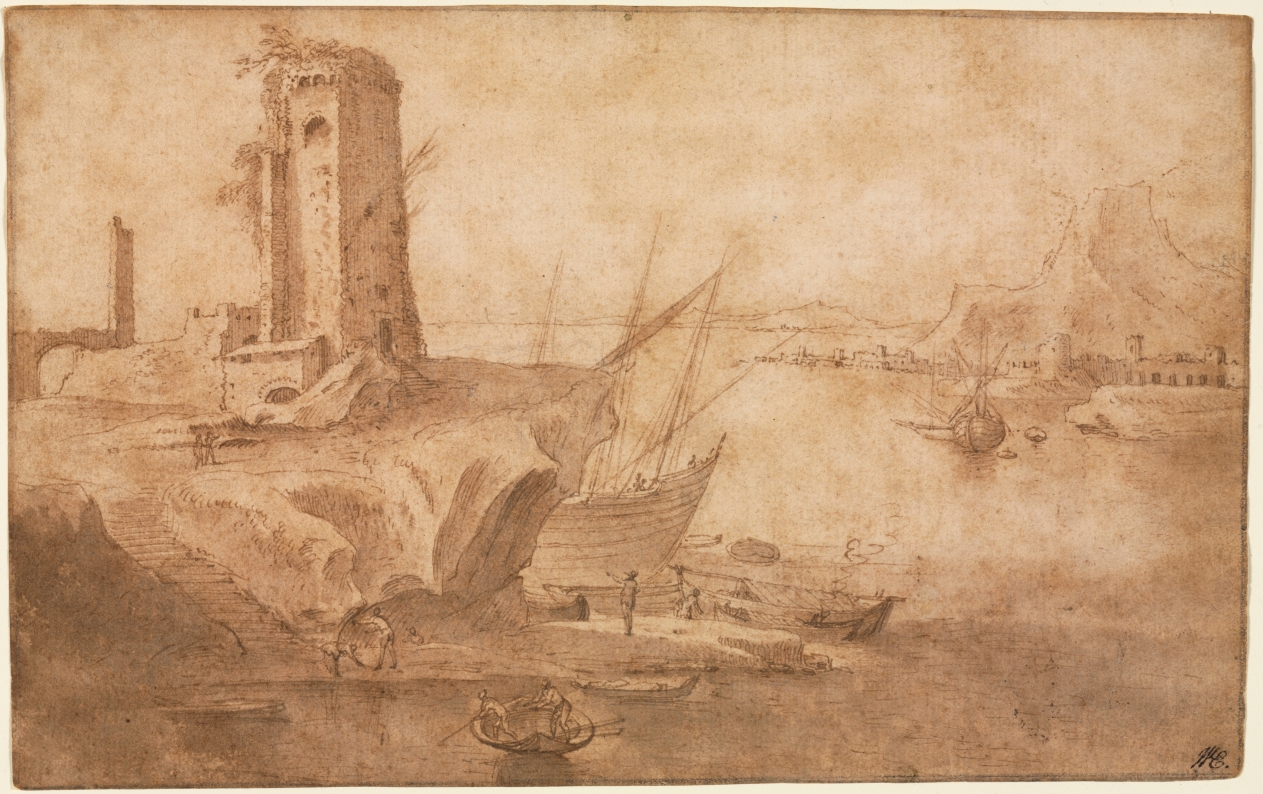
Landscape with Tower at Seashore, 1600–1614(?), by Filippo Napoletano
Filippo Napoletano · The Cleveland Museum of Art · The Norweb Collection
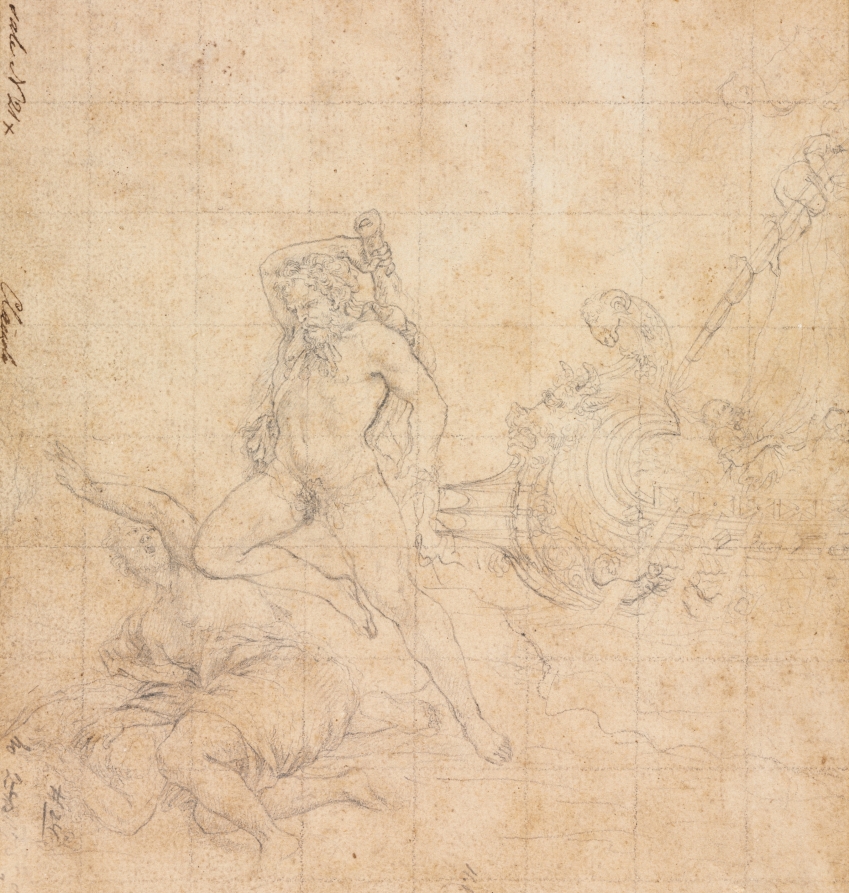
Hercules and the Girdle of Hippolyta, first quarter 1600, by Filippo Napoletano
Filippo Napoletano · The Cleveland Museum of Art · The Norweb Collection
Places
Named by the record
Places
Only places the record itself states, plotted where the house gazetteer settles their coordinates. Nothing is inferred from a name or a nationality.
Naples.
Birth place
Rome.
Death place
Text attribution
Licensing
Text attribution
Part of the biographical narrative on this page reuses licensed material. Its origin, revision and licence are recorded here.
The biographical narrative on this page is based on the Wikipedia article Filippo Napoletano, revision 1370410803 (EN edition), by its contributors. VALÉORINE has edited that text and built its own documentary record around it. The reused material is available under CC BY-SA 4.0, and this page's reuse of it is offered under the same licence. Everything else on this page — the chronology, the holdings, the evidence, the plates and the connections — is VALÉORINE's own record. Sources and licences.
References
Citations
References
Each reference names the institution holding it, so a reader may go to the document itself.
reference work
Secondary witnessreference work
Secondary witness
The Encyclopedia exists whether or not anything is for sale. Corrections are recorded rather than overwritten, and every version of this record is kept. Published 28 August 2026.
Elsewhere in Paintings
19,456 published records in this field, each with its sources named.
- Filippo GherardiArtist
- Filippo LauriArtist
- Filippo LippiArtist
- Filippo Maria GallettiArtist
- Filippo PasqualiArtist
- Filippo PedriniArtist
- Filippo ProsperiArtist
- Filippo RusutiArtist
Best supported in this field
For owners
Own a work by Filippo Napoletano?
A specialist will read what you send and tell you what the house can establish, what it cannot, and whether the object is suited to sale. There is no charge and no obligation. The object stays with you throughout; nothing is shipped to us unless it is arranged in writing beforehand.