
Fajr-3
The Fajr-3 (rarely Fadjr-3) is an Iranian heavy 240 mm intermediate-range multiple-launch artillery rocket (MLRS). The Fajr-3 is a license-built copy, with slight modifications, of a North Korean MLRS called the M-1985. The Fajr-3 was introduced in the 1990s and has since been exported to Syria, Hamas and Hezbollah.
Also recorded as Fadjr-3
Fajr-3

Hamid Reza Niko Maram · Fars Media Corporation · https: media.farsnews.ir/media/Uploaded/Files/Images/1392/06/31/13920631130303396_PhotoL.jpg · CC BY 4.0
- Name
- Fajr-3
- Field
- rocket artillery
- Region
- Iran
Reference Check
Propose documentary evidence for Fajr-3. A contribution is never written directly as fact: identity, source, rights and evidence gates still decide.
Sign in to contribute
World of VALÉORINE
Documentary connections
Only confirmed graph relationships appear here. Images are shown only when their identity and reuse rights both pass the documentary gate.

Documentary evidence
Documentary basis
Authority files
wikidata · Q559121
In this article
Overview
Overview
The Fajr-3 launcher fires twelve 5.2-meter-long, 240 millimeter-calibre Fajr-3 artillery rockets, with a range of 43 kilometres, weighing 407 kilograms each and carrying 90-kilogram fragmentation warheads with 45 kg of high explosive (HE). Fajr means 'dawn' in Arabic.
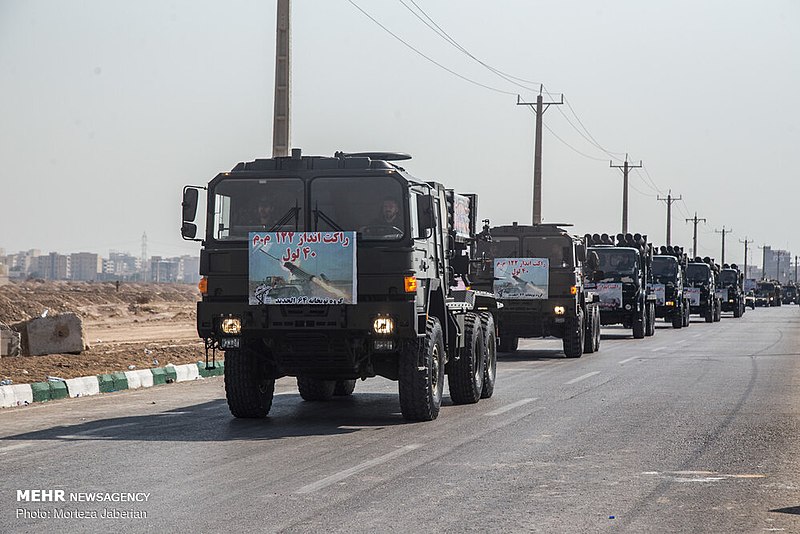
This photo is from the 2019 Sacred Defense parade in Ahvaz, Iran.
Morteza Jaberian · Mehr News Agency

This photo is from the 2019 Sacred Defense parade in Bandar Abbas, Iran.
Rahbar Emamdadi · Mehr News Agency
Key facts
Key facts
• Name — Fajr-3 • Origin — Iran • Type — Rocket artillery • Is Ranged — yes • Is Bladed — no • Is Artillery — yes • Is Vehicle — yes • Service — 1996–present • Used By — See Fajr-3 (artillery rocket) • Wars — 2006 Lebanon War Syrian Civil War • Manufacturer — Shahid Bagheri Industrial Group • Production Date — 1990 or 1996 –? • Weight — 15,000 kg (launcher) 45 kg (HE content) 90 kg (warhead) 407 kg (rocket) • Length — 10 m (launcher) 5,200 mm (rocket) • Width — 2.5 m (launcher) • Height — 3.34 m (launcher) • Caliber — 240 mm • Rate — 4–8 seconds 12 rounds in 48-96 seconds (est) • Max Range — 43 km • Elevation — 0 to 57 degrees • Traverse — 90 degrees left/100 degrees right • Diameter — 240mm • Filling — HE • Filling Weight — 45 kg • Engine — 280 hp, V-8 liquid-cooled, diesel engine • Speed — 60 km/h (road) 25 km/h (off-road)
History
History
• Illustration — The Fajr-3 is a copy of the North Korean M-1985 (seen here.) During the Iran–Iraq War, around 100 North Korean M-1985 MLRS systems were exported to Iran. The North Korean M-1985 was derived from Soviet Katyushas, and so the Fajr-3 is sometimes considered a Katyusha too. With North Korean assistance, Iran's state-run Shahid Bagheri Industries later began to produce the system under license. A minority of sources report that the Fajr-3 is built by Parchin Missile Industries. Dates for the production of the Fajr-3 are very unclear. Iranian Defense Minister Akbar Torkan announced in March 1990 that mass production of the Fajr-3 had started. Analysts in Abu Dhabi learned about the development less than a month later and described it as "one of the most important new weapons" entering production in Iran. However, it was not until November 6, 1996 that Iran announced that they had actually built a Fajr-3 system. The system was tested that same month and entered service that year. This discrepancy in start date may be the difference between first building a copy, and then an improved version of the system. The development program for the Fajr-3 might have been run in conjunction with the development of the Oghab. Early versions of the Fajr-3 apparently had reduced range and it was not until December 1998 that Iran tested a rocket with the full 43 km range. Fajr-3 rockets are known to have still been in production in 2006.
Launcher
Launcher
The Fajr-3 launcher has twelve tubes in two groups of six. The Fajr-3 system was first installed on the same Japanese Izuzu chassis used by the North Korean M-1985. It was later installed on Mercedes-Benz 2624 series chassis, and today is uniformly used on Mercedes-Benz 2631 chassis. Apart from the chassis differences, which are trivial, there are no Fajr-3 variants. The launcher is unarmored and weighs 15000 kg when unloaded. It can fire rockets singly or in salvo. The US Army reports that the Fajr-3 has no fire-control system, while Iran's Defense Industries Organization reports that the Fajr-3 has a computer system with indigenous software that can calculate range and azimuth. The Fajr-3 launcher is 10 m long, 2.5m wide, and 3.34m tall (when traveling). The tubes are 5.36 m long, fire for maximum range when set to 57˚, and have a maximum azimuth of 90-100 degrees.
Rocket
Rocket
The rocket is solid fueled and has a fragmentation high explosive warhead. The rocket is 5.2 meters long, 240mm in diameter, and weighs 407 kg. It has wraparound fins for stabilization in flight, which reach a diameter of 512 mm when extended. The rocket also has spin-stabilization, but is not guided. The rocket's double layer propulsion burns for an average time of 4 seconds, reaching a peak velocity of 930 m/s. Sources differ on whether the Fajr-3 rocket has an 85 kg warhead or a 90 kg warhead. The warhead contains 45 kg of HE and the rest of metal pellets for fragmentation. The warhead is detonated by a nose-mounted impact fuse. In 2018 Iran announced an assembly line for proximity fuses for a variety of rockets and guided missiles, including the Fajr-3. One source reports that Fajr-3 rockets can likely carry (plain) high explosive, submunitions, incendiary, smoke, or chemical payloads as well. The shelf life of a Fajr-3 rocket is 15 years.
Reloading
Reloading
When the Fajr-3 is reloaded, the launch tubes (in two groups of six) are detached from the launcher and laid on the ground by a crane. Then, a machine called a "Loading machine" is used to mechanically press the heavy Fajr-3 rockets into their launch tubes one by one. When all the tubes are filled, the crane is used to reattach the launch tubes to the vehicle. A reload is estimated to take 12–15 minutes. Because of the long reload time and large size of the "Loading machine" (10.4m), the Fajr-3 MLRS is supposed to retreat after firing to safer rear battle areas to reload.
Iran
Iran
• Illustration — A Fajr-3 firing at an exercise in 2010. Iran used the Fajr-3 in an exercise in 2010 (see right). The Fajr-3 is likely to be in Iran's inventory for decades. One assessment of the system's capability is that its small number of rockets, combined with the poor accuracy of MLRS systems, means that the Fajr-3 is unlikely to be tactically effective. The Fajr-3 is used in service alongside nine of the original North Korean-built M-1985 systems, which are still on their original chassis.
Lebanon
Lebanon
Hezbollah maintains Fajr-3 rockets, as well as other unguided rocket artillery systems, to fire onto Israel in war. Fajr-3 rockets sent to Hezbollah are subsidized by the Iranian government. They are flown into Syria, then sent into Lebanon by Hezbollah agents, and are believed to be stored in southern Lebanon. The date the first Fajr-3 rockets were supplied to Hezbollah is unclear; some sources report the early 2000s, possibly 2002 specifically, while other sources report the late 1990s.
2006 Lebanon War
2006 Lebanon War
Fajr-3 MLRS were used in small numbers in the 2006 Lebanon War. The Israeli Air Force identified the Fajr-3, along with other medium- and long-range artillery rockets, as their main target in the war, and attempted to destroy them in a large attack in the beginning of the war. Similarly, Hezbollah viewed their Fajr-3 systems and similar rockets as their "centerpiece for operational planning" in the lead-up to the war. In Hezbollah use, the Fajr-3 was also known as the "Raad-1". At least some of Hezbollah's Fajr-3 rockets survived Israel's initial wave of airstrikes, and "tens" were fired sporadically at Israel over the course of the war, mainly targeting the Israeli city of Haifa. The rockets' long range meant that they were mostly deployed from north of the Litani River. Hezbollah's Fajr-3 MLRS were operated in a mobile fashion, not from fixed locations, and were reportedly controlled from a Hezbollah headquarters in Tyre. Hezbollah is estimated to have had 24-30 launchers at the beginning of the war; the number that survived is unknown.
Iraq
Iraq
A Fajr-3 rocket was fired by unidentified Iraqi groups on September 11, 2007, and injured an American soldier in Baghdad.
Gaza
Gaza
In 2009, Israel targeted Fajr-3 rockets, among other weapons, that were being smuggled to Hamas in Gaza via Sudan.
Operators
Operators
• Illustration — Map with Fajr-3 operators in blue
State operators
State operators
• – sources differ; one reports approximately 100 launchers; another approximately 10 launchers • Flag of the Islamic Republic of Iran Army Ground Forces.svg Islamic Republic of Iran Army Ground Forces • Flag of the Army of the Guardians of the Islamic Revolution.svg Navy of the Islamic Revolutionary Guard Corps *
Non-state operators
Non-state operators
• Hezbollah – a few dozen launchers • Flag of al-Qassam Brigades.svg Hamas – up to fifty rockets
Places
Named by the record
Places
Only places the record itself states, plotted where the house gazetteer settles their coordinates. Nothing is inferred from a name or a nationality.
- Iran
Named but not plotted · 1
Fajr-3 is associated with Iran.
Country
Description
A complete Fajr-3 system is manned by a crew of five and also includes one dedicated resupply vehicle with a crane.
Text attribution
Licensing
Text attribution
Part of the biographical narrative on this page reuses licensed material. Its origin, revision and licence are recorded here.
The biographical narrative on this page is based on the Wikipedia article Fajr-3 (artillery rocket), revision 1352041140 (EN edition), by its contributors. VALÉORINE has edited that text and built its own documentary record around it. The reused material is available under CC BY-SA 4.0, and this page's reuse of it is offered under the same licence. Everything else on this page — the chronology, the holdings, the evidence, the plates and the connections — is VALÉORINE's own record. Sources and licences.
Notes from the source article
Cited by Wikipedia
Notes from the source article
These works are cited by the source article, in its own numbering. They are recorded as its citations, not as sources VALÉORINE has verified.
- 1.Fighting vehicle Fadjr-3 | Missilery.info.
- 2.Johnson, David E., Hard Fighting: Israel in Lebanon and Gaza. Santa Monica, CA: RAND Corporation, 2011. p. 51. https://www.rand.org/pubs/monographs/MG1085.html . Also available in print form.
- 3.United States Army Training and Doctrine Command. Worldwide Equipment Guide 2015: Ground Systems. 412–413. 2015.
- 4.James Martin Center for Nonproliferation Studies at the Monterey Institute of International Studies. Iran: Missile Capabilities, Long-Range Artillery Rocket Programs. Nuclear Threat Initiative (NTI). February 2006.
- 5.SIPRI. Transfers and licensed production of major conventional weapons: Exports sorted by supplier. Deals with deliveries or orders made 1993-2002. c. 2006.
- 6.Christopher Harmer. Threat and Response: Israeli Missile Defense. Institute for the Study of War. August 16, 2012.
- 7.Iran's Ballistic Missile Capabilities: A Net Assessment. The International Institute for Strategic Studies. 2010.
- 8.Wisconsin Project on Nuclear Arms Control. Missile Industries Group - Iran Watch. www.iranwatch.org. February 3, 2010.
- 9.James Martin Center for Nonproliferation Studies at the Monterey Institute of International Studies. Iran: Missile Chronology, 1997. Nuclear Threat Initiative (NTI). September 2003.
- 10.Military Briefing on Hezbollah's Missile Capabilities: Examining the Fajr, Zelzal. Vital Perspective. December 2018.
- 11.Joint Publications Research Service. JPRS Report, Arms Control. 3 May 1990.
- 12.James Martin Center for Nonproliferation Studies at the Monterey Institute of International Studies. Iran: Missile Chronology, 1996. Nuclear Threat Initiative (NTI). February 2006.
- 13.Anthony H. Cordesman, with assistance from G. Ryan Faith (April 2003) The Military Balance in the Middle East: An Analytic Overview: Military Expenditures and Arms Transfers, Major Arms by Country and Zone, and Qualitative Trends
- 14.Major Brian H. Cunningham. Islamic Revolutionary Guard Corps: Instability in the Middle East. USMC Command and Staff College. 2009.
- 15.FADJR-3. Retrieved on May 12, 2008
- 16.Galen Wright (March 15th 2011) Iranian Military Capability 2011 - Ground Forces
- 17.Defense Industries Organization 2013 Catalog, Section 3: Rocket Industries Group.
- 18.Fajr-3 & Fajr-5 brochure. Retrieved on May 13, 2008.
- 19.Fadjr-3 Fajr-3 RAAD 240mm multiple rocket launcher system technical data sheet specifications. www.armyrecognition.com.
- 20.Iran launches production lines for missile fuses. AzerNews.az. 24 May 2016.
- 21.Mehr News. Test-firing of Fajr 3 and 5 rocket launchers. 26 April 2010.
- 22.Robbin Finley, Future Ground Requirements: 2012 and Beyond (23 March 2012) http://www.dtic.mil/dtic/tr/fulltext/u2/a559642.pdf
- 23.Devenny, Patrick. Hezbollah's Strategic Threat to Israel. Middle East Quarterly. 1 January 2006.
- 24.Benjamin S. Lambeth, Air Operations in Israel's War Against Hezbollah: Learning from Lebanon and Getting It Right in Gaza (Project Air Force). RAND Corp. (2011). p. 94
- 25.Cragin, Kim, Peter Chalk, Sara A. Daly, and Brian A. Jackson, Sharing the Dragon's Teeth: Terrorist Groups and the Exchange of New Technologies. Santa Monica, CA: RAND Corporation, 2007. https://www.rand.org/pubs/monographs/MG485.html . Also available in print form.
- 26.James Martin Center for Nonproliferation Studies at the Monterey Institute of International Studies. Iran: Missile Chronology, 1999. Nuclear Threat Initiative (NTI). September 2003.
- 27.James Martin Center for Nonproliferation Studies at the Monterey Institute of International Studies. Iran: Missile Chronology, 2000. Nuclear Threat Initiative (NTI). September 2003.
- 28.Nicolas Blanford (2011) Warriors of God: Inside Hezbollah's Thirty-Year Struggle Against Israel. New York: Random House. p. 338
- 29.Gabrielsen, Iver (2014) "The evolution of Hezbollah's strategy and military performance, 1982–2006," Small Wars & Insurgencies, 25:2, 257–283, DOI: 10.1080/09592318.2014.903636M
- 30.Anthony H. Cordesman, Arleigh A. Burke Chair in Strategy (July 14, 2006) Lebanese Security and the Hezbollah. Working Draft.
- 31.Ove Dullum, The Rocket Artillery Reference Book. Norwegian Defence Research Establishment (FFI). 30 June 2010.
- 32.MAJ Brad R. Henry, "Manufacturing the Horns of Dilemma: A Theory of Operational Initiative." April 13, 2015. School of Advanced Military Studies, United States Army Command and General Staff College, Fort Leavenworth, Kansas. http://www.dtic.mil/dtic/tr/fulltext/u2/1007877.pdf
- 33.William M. Arkin, Divining Victory: Airpower in the 2006 Israel-Hezbollah War (2007)
- 34.Cordesman, A. H., Sullivan, G., & Sullivan, W. D. (2007). Lessons of the 2006 Israeli-Hezbollah war. Washington (D.C.): CSIS Press.
- 35.UAVs hit Gaza-bound weapons convoys. Jerusalem Post. March 29, 2009.
- 36.International Institute for Strategic Studies (IISS). The Military Balance 2018. The Military Balance. Routledge. 118. 334. 14 February 2018.
- 37.Iran’s Asymmetric Naval Warfare Fariborz Haghshenass Policy Focus #87 | September 2008 https://www.washingtoninstitute.org/uploads/Documents/pubs/PolicyFocus87.pdf
- 38.Military Today. Fadjr 3.
- 39.Estimates for Hezbollah's Arsenal. Critical Threats.
- 40.Anthony H. Cordesman, Iran's Rocket and Missile Forces and Strategic Options. October 7, 2014. p. 60.
References
Citations
References
Each reference names the institution holding it, so a reader may go to the document itself.
authority record
General reference
Connections
Knowledge graph
Connections
Each connection was recorded deliberately, with the basis for it kept on the internal record.
Broader subject
1- rocket artilleryTerminology
Established from a fact already recorded on a verified source.
The Encyclopedia exists whether or not anything is for sale. Corrections are recorded rather than overwritten, and every version of this record is kept. Published 14 August 2026.
Elsewhere in Militaria
6,095 published records in this field, each with its sources named.
- FAD assault rifleTerminology
- FahrpanzerTerminology
- Fairbairn–Sykes fighting knifeTerminology
- Fairey StoogeTerminology
- Fajr-4Terminology
- Fajr-5Terminology
- Fakoor 90Terminology
- Falaq-1Terminology
Best supported in this field
For owners
Own an object connected with Fajr-3?
A specialist will read what you send and tell you what the house can establish, what it cannot, and whether the object is suited to sale. There is no charge and no obligation. The object stays with you throughout; nothing is shipped to us unless it is arranged in writing beforehand.