
Eustache Le Sueur
Eustache Le Sueur or Lesueur (19 November 161730 April 1655) was a French artist and one of the founders of the French Academy of Painting. He is known primarily for his paintings of religious subjects. He was a leading exponent of the neoclassical style of Parisian Atticism. • Illustration — Eustache Le Sueur • Illustration — Presentation of the Virgin in the Temple, c.
Also recorded as Eustache La Seur · Eustache Le Suere · Eustache Le Seur · Eustache Le Seuere
Eustache Le Sueur
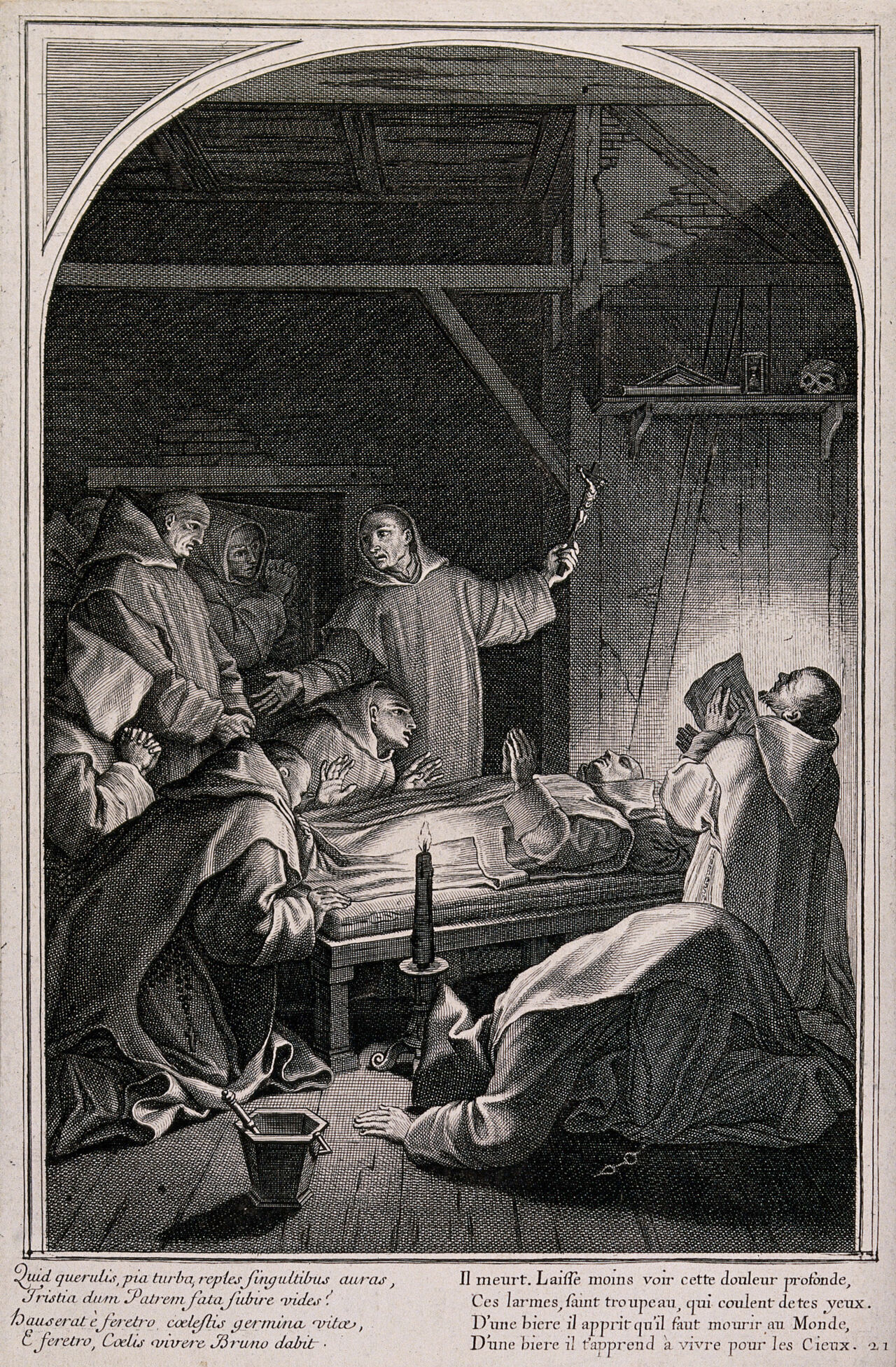
Eustache Le Sueur · Wellcome Collection, London · Wellcome Collection · Public Domain Mark
- Born
- 1616 · Paris.
- Died
- 1655 · Paris.
- Nationality
- Kingdom of France
- Occupation
- painter · illustrator · draftsperson · designer · artist
- Fields
- painting
- Movements
- Baroque
- Teachers
- Simon Vouet
- Known for
- Madonna and Child with Saint John the Baptist · Death of St Bruno
- Languages
- French
VALÉORINE Encyclopedia
VALÉORINE documentary reading
Documentary summary
Eustache Le Sueur or Lesueur (19 November 161730 April 1655) was a French artist and one of the founders of the French Academy of Painting. He is known primarily for his paintings of religious subjects. He was a leading exponent of the neoclassical style of Parisian Atticism. • Illustration — Eustache Le Sueur • Illustration — Presentation of the Virgin in the Temple, c.
Admitted source layer · organised and presented by VALÉORINE
Reference Check
Propose documentary evidence for Eustache Le Sueur. A contribution is never written directly as fact: identity, source, rights and evidence gates still decide.
Sign in to contribute
World of VALÉORINE
Documentary connections
Only confirmed graph relationships appear here. Images are shown only when their identity and reuse rights both pass the documentary gate.

Documentary evidence
Documentary basis
Authority files
wikidata · Q1378723 · wikipedia · Eustache Le Sueur
In this article
Training and career
Training and career
1640–1645, Hermitage Museum, St.
Training under Simon Vouet is recorded. Thomas_Goussé is recorded as having studied under Eustache Le Sueur. The recorded working language is French. The field of work recorded is painting. Subjects and genres recorded for the work are portrait, history and genre. Places of work recorded in the authority are Paris. Works named in the authority record are Madonna and Child with Saint John the Baptist and Death of St Bruno. Work by Eustache Le Sueur is recorded in the collections of Städel Museum, Minneapolis Institute of Art, Art Institute of Chicago, J. Paul Getty Museum and Nationalmuseum.
He was born in Paris, where he spent his entire life. His father, Cathelin Le Sueur, a turner and sculptor in wood, placed him with Vouet, in whose studio he rapidly distinguished himself. Admitted at an early age into the guild of master-painters, he left them to take part in establishing the French Royal Academy of Painting and Sculpture in 1648 and was elected as one of the original twelve elders in charge of its administration. • Illustration — Rape of Tamar, c. 1640 Some paintings, illustrative of the Hypnerotomachia Poliphili, which were reproduced in tapestry, brought him notice, and his reputation was further enhanced by a series of decorations (Louvre) in the mansion of Lambert de Thorigny, which he left uncompleted, for their execution was frequently interrupted by other commissions. Amongst these were several pictures for the apartments of the king and queen in the Louvre, which are now missing, although they were entered in Bailly's inventory (1710); but several works produced for minor patrons have come down to us. In the gallery of the Louvre are the Angel and Hagar, from the mansion of De Tonnay Charente; Tobias and Tobit, from the Fieubet collection; several pictures executed for the church of Saint Gervais; the Martyrdom of St Lawrence, from Saint Germain de l'Auxerrois; two works from the destroyed abbey of Marmoutiers; St Paul preaching at Ephesus, painted for the goldsmiths corporation in 1649; and his series of the Life of St Bruno, executed in the cloister of the Chartreux. Le Sueur was also a prolific draftsman and many of his chalk drawings are in the Louvre's Cabinet des Dessins. His pupils, who aided him much in his work, were his wife's brother, Theodore Goussé, and three brothers of his own, as well as Claude Lefèbvre and Pierre Patel the landscape painter. Most of his works have been engraved, chiefly by Picart, B. Audran, Leclerc, Drevet, Chauveau, Poilly and Desplaces.
Style
Style
According to the Encyclopædia Britannica Eleventh Edition, it was considered that Le Sueur's work lent itself readily to the engraver's art, as he had a delicate perception of varied shades of grave and elevated sentiment, and possessed the power to render them. His graceful facility in composition was always restrained by a very fine taste, but his works often fail to please completely, because, producing so much, he had too frequent recourse to conventional types, and partly because he rarely saw colour except with the cold and clayey quality proper to the school of Vouet; yet his St Paul at Ephesus and one or two other works show that he was not naturally deficient in this sense, and whenever we get direct reference to nature—as in the monks of the St Bruno series—we recognize his admirable power to read and render physiognomy of varied and serious type.
Selected works
Selected works
• Illustration — The Annunciation, (1650) • Illustration — The Muses: Clio, Euterpe and Thalia (between 1652 and 1655), Louvre • Illustration — Melpomene, Erato and Polyhymnia (1650s), Louvre • Illustration — An Allegory of Poetry • Illustration — Bacchus and Ariadne (about 1640) Museum of Fine Arts, Boston (68.764) • Illustration — Meeting of friends, Louvre Museum (around 1640) • Illustration — Camma Offers the Poisoned Wedding Cup to Synorix in the Temple of Diana (c. 1644), Museum of Fine Arts, Boston • Illustration — The Triumph of Galatea (1643–1644), private collection • Illustration — Christ on the Cross with the Magdalen, the Virgin Mary and Saint John the Evangelist (1643) • Illustration — Meeting of friends, (around 1640), Paris, Louvre Museum.
![Alexander the Great demonstrates his trust in his physician Philip by drinking a medicinal draught prepared by him even after receiving a letter alleging that Philip is trying to poison him. Drawing by or after E. Le Sueur, 16--., [between 1600 and 1699?], by Eustache Le Sueur](https://iiif.wellcomecollection.org/image/L0038311/full/800,/0/default.jpg)
Alexander the Great demonstrates his trust in his physician Philip by drinking a medicinal draught prepared by him even after receiving a letter alleging that Philip is trying to poison him. Drawing by or after E. Le Sueur, 16--., [between 1600 and 1699?], by Eustache Le Sueur
Eustache Le Sueur · Wellcome Collection, London · Wellcome Collection
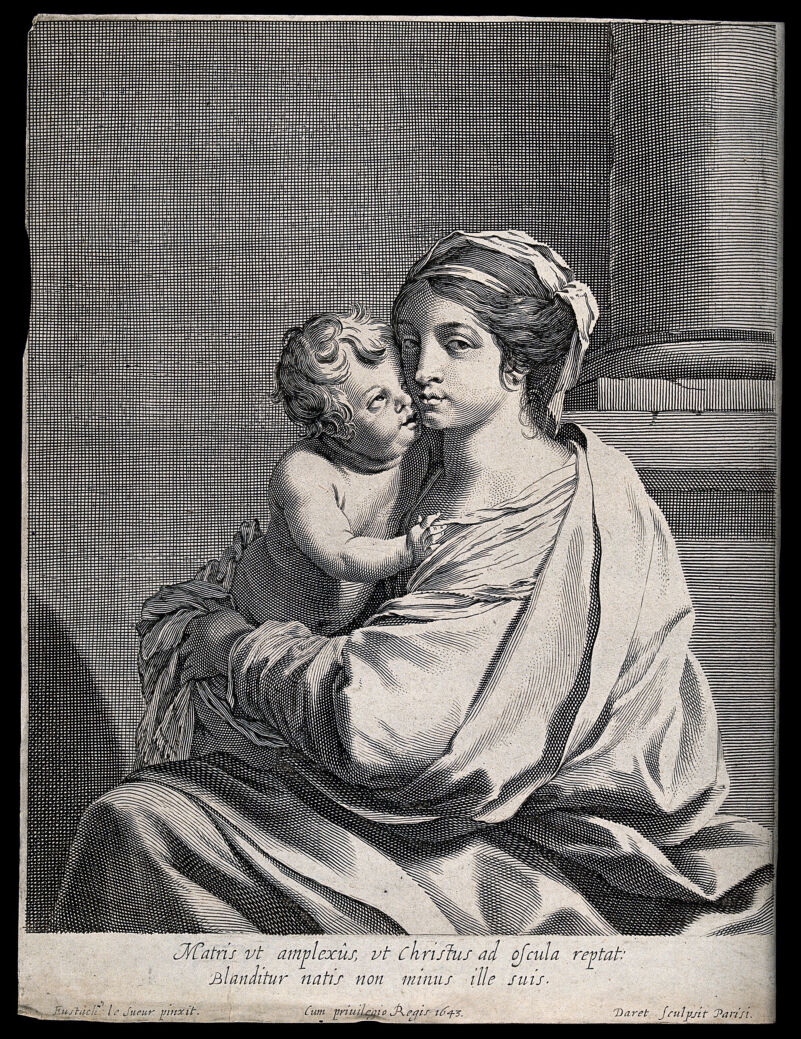
Saint Mary (the Blessed Virgin) with the Christ Child. Line engraving by P. Daret de Cazeneuve, 1643, after E. Le Sueur., by Eustache Le Sueur
Eustache Le Sueur · Wellcome Collection, London · Wellcome Collection
Life and career
Dated record
Life and career
Explore 1616–1655
The full dated record · 3 entries
1616
Eustache Le Sueur born at Paris.
1652
The Story of Gervasius and Protasius is dated 1652.
1655
Eustache Le Sueur died at Paris.
Primary material
Documents and archives
scholarly publication
- Le Sueur, Eustache (1616–1655), Historical Dictionary of Baroque Art and Architecture, 2018
Scholarly · Crossref registry · 2018
- Le Sueur, Eustache, Benezit Dictionary of Artists, 2011
Scholarly · Crossref registry · 2011
- Le Sueur, Eustache, Painting of the Golden Age, 1993
Scholarly · Crossref registry · 1993
reference work
- Wikidata, structured authority record Q1378723: Eustache Le Sueur
Reputable secondary · Wikimedia Foundation
- “Eustache Le Sueur”, English Wikipedia, consulted as further reading
Reputable secondary · Wikipedia
Notes from the source article
Cited by Wikipedia
Notes from the source article
These works are cited by the source article, in its own numbering. They are recorded as its citations, not as sources VALÉORINE has verified.
- 1.Mémoires pour servir à l'histoire de l'Académie royale de Peinture et de Sculpture depuis 1648 jusqu'en 1664, Ed. Anatole de Montaiglon, Paris 1853, vol. I, p. 36.
- 2.Bowley, Graham. The Mystery of the Painting in Gallery 634. The New York Times. 8 February 2020.
- 3.Guillet de St Georges, Mm. mid.; C Blanc, Histoire des peintres; Vitet, Catalogue des tableaux du Louvre; d'Argenville, Vies des peintres
References
Citations
References
Each reference names the institution holding it, so a reader may go to the document itself.
scholarly publication
Le Sueur, Eustache (1616–1655), Historical Dictionary of Baroque Art and Architecture, 2018Crossref registry
Institutional witnessscholarly publication
Le Sueur, Eustache, Benezit Dictionary of Artists, 2011Crossref registry
Institutional witnessscholarly publication
Le Sueur, Eustache, Painting of the Golden Age, 1993Crossref registry
Institutional witnessreference work
Wikidata, structured authority record Q1378723: Eustache Le SueurWikimedia Foundation
Secondary witnessreference work
Secondary witness
People, houses and institutions
Knowledge graph
People, houses and institutions
Teachers, collaborators, publishers and institutions recorded against this person, each on a stated basis.
The Encyclopedia exists whether or not anything is for sale. Corrections are recorded rather than overwritten, and every version of this record is kept. Published 14 August 2026.
Elsewhere in Illustration
5,224 published records in this field, each with its sources named.
- Eugenijus KarpavičiusIllustrator
- Eugenio BavaIllustrator
- Eugenio ColonneseIllustrator
- Eusebi Planas i FranquesaIllustrator
- Eustache LorsayIllustrator
- Eva BednářováIllustrator
- Eva ČinčerováIllustrator
- Eva ErikssonIllustrator
Best supported in this field
For owners
Own a work by Eustache Le Sueur?
A specialist will read what you send and tell you what the house can establish, what it cannot, and whether the object is suited to sale. There is no charge and no obligation. The object stays with you throughout; nothing is shipped to us unless it is arranged in writing beforehand.