
Eugène Carrière
Eugène Anatole Carrière (øʒɛn anatɔl kaʁjɛʁ; 16 January 1849 – 27 March 1906) was a French Symbolist artist of the fin-de-siècle period. Carrière's paintings are best known for their near-monochrome brown palette and their ethereal, dreamlike quality. He was a close friend of Auguste Rodin and his work likely influenced Pablo Picasso's Blue Period.
Also recorded as Eugene Carrière · Eugene Carriere · Eugene Carrier · Eugène Carriere
Eugène Carrière
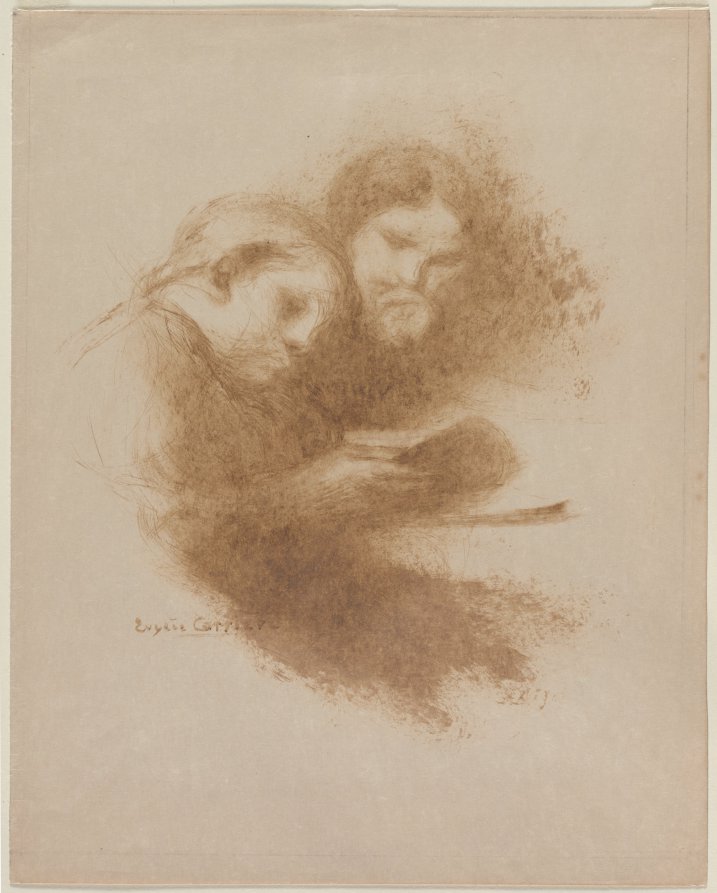
Eugène Carrière · The Cleveland Museum of Art · Gift of The Print Club of Cleveland in tribute to Mr. and Mrs. Lewis B. Williams · CC0
- Name
- Eugène Carrière
- Born
- 16 January 1849
- Birthplace
- Gournay-sur-Marne, France
- Died
- 27 March 1906
- Place of death
- Paris, France
- Field
- Painting, Lithography
- Movement
- Symbolism
- Full name
- Eugène Anatole Carrière.
- Nationality
- France.
- Fields
- painting.
- Movements
- Symbolism.
- Education
- Beaux-Arts de Paris.
VALÉORINE Encyclopedia
VALÉORINE documentary reading
Documentary summary
Eugène Anatole Carrière (øʒɛn anatɔl kaʁjɛʁ; 16 January 1849 – 27 March 1906) was a French Symbolist artist of the fin-de-siècle period. Carrière's paintings are best known for their near-monochrome brown palette and their ethereal, dreamlike quality. He was a close friend of Auguste Rodin and his work likely influenced Pablo Picasso's Blue Period.
Admitted source layer · organised and presented by VALÉORINE
Reference Check
Propose documentary evidence for Eugène Carrière. A contribution is never written directly as fact: identity, source, rights and evidence gates still decide.
Sign in to contribute
World of VALÉORINE
Documentary connections
Only confirmed graph relationships appear here. Images are shown only when their identity and reuse rights both pass the documentary gate.

Documentary evidence
Documentary basis
Authority files
wikidata · Q461464 · wikipedia · Eugène Carrière
In this article
Biography
Biography
He was also associated with such writers as Paul Verlaine, Stéphane Mallarmé and Charles Morice.
Eugène Carrière studied at Beaux-Arts de Paris. Training under Alexandre Cabanel is recorded. Ludvig Karsten, Francis Jourdain and Stefan Popescu are recorded as having studied under Eugène Carrière. The recorded working language is French. The field of work recorded is painting. Subjects and genres recorded for the work are portrait. Places of work recorded in the authority are Paris. Work by Eugène Carrière is recorded in the collections of Städel Museum, Minneapolis Institute of Art, Art Institute of Chicago, Auckland Art Gallery and Finnish National Gallery. Distinctions recorded are Officer of the Legion of Honour, Knight of the Legion of Honour and Prix Marie-Bashkirtseff.
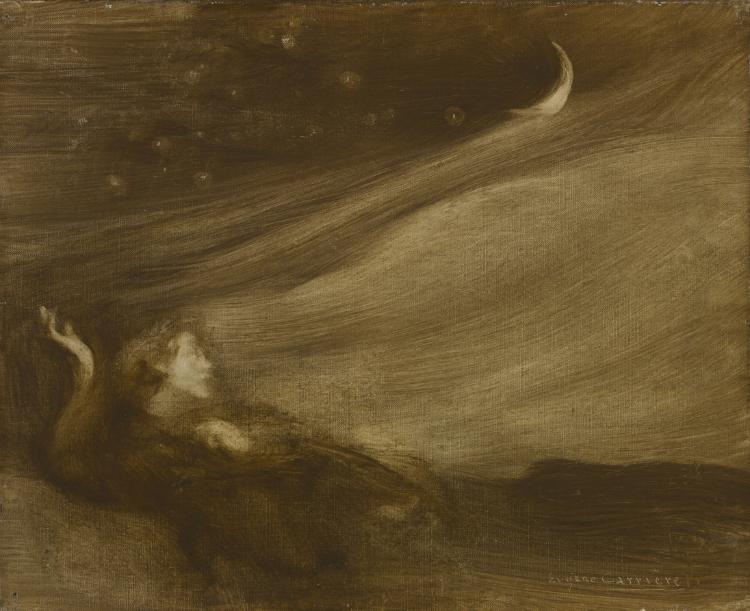
The Contemplator, 1901, by Eugène Carrière
Eugène Carrière · The Cleveland Museum of Art · In memory of Ralph King, gift of Mrs. Ralph King
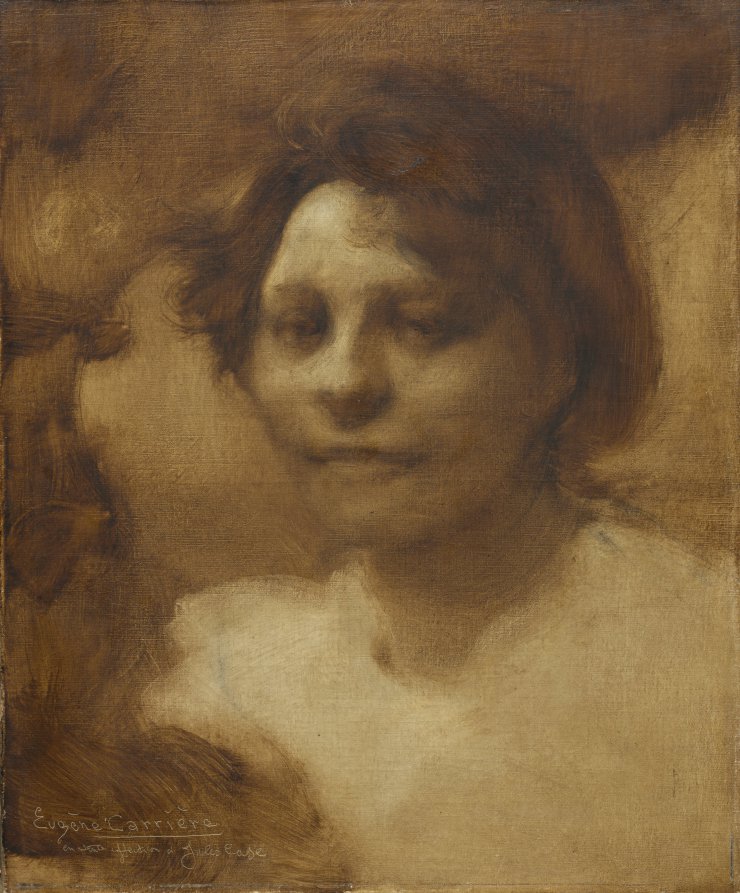
Madame Case, after September 1900, probably summer 1901, by Eugène Carrière
Eugène Carrière · The Cleveland Museum of Art · Mr. and Mrs. William H. Marlatt Fund
Key facts
Key facts
• Name — Eugène Carrière • Born — 16 January 1849 • Birthplace — Gournay-sur-Marne, France • Died — 27 March 1906 • Place of death — Paris, France • Field — Painting, Lithography • Movement — Symbolism
Biography
Biography
The eighth of nine children of an insurance salesman, Carrière was born at Gournay-sur-Marne (Seine-Saint-Denis) and brought up in Strasbourg, where he received his initial training in art at the Ecole Municipale de Dessin as part of his apprenticeship in commercial lithography. In 1868, while briefly employed as a lithographer, he visited Paris and was so inspired by the paintings of Peter Paul Rubens in the Louvre that he resolved to become an artist. His studies under Alexandre Cabanel at the Ecole des Beaux-Arts were interrupted by the Franco–Prussian War, during which he was taken prisoner. In 1872–73 he worked in the studio of Jules Chéret. In 1878 he participated in the Salon for the first time, but his work went unnoticed. The following year he ended his studies under Cabanel, married Sophie Desmonceaux (with whom he would have seven children) and moved briefly to London where he saw and admired the works of J.M.W. Turner. Success eluded him for a number of years after he returned to Paris and he was forced to find occasional employment, usually with printers to support his growing family. Between 1880 and 1885 his brother Ernest (1858–1908), a ceramicist, arranged part-time work for him at the Sèvres porcelain factory. There he met Auguste Rodin who became and remained a very close friend. At the Salon of 1884 one of Carrière’s paintings received an honourable mention, and the influential art critic Roger Marx became a champion of his work. Thereafter, Carrière found friends in most of the important artists, critics, writers and collectors of his time. He was a founding member of the Société Nationale des Beaux-Arts and of the Salon d’Automne (of which he was named honorary president). He played an influential role as an art teacher at Académie de La Palette. One of his students was Charles Edmond Kayser. He exhibited with the Libre Esthétique in Brussels (in 1894, 1896 and 1899), the Munich Secession (in 1896, 1899, 1905 and 1906) and the Berlin Secession in 1904, with works including Sleep (1890), the celebrated portrait of Paul Verlaine (1891, Luxembourg), Maternity (1892, Luxembourg), Christ on the Cross (1897), and Madame Menard-Dorian (1906). Carrière died from throat cancer in 1906. The cultural world of Paris, from Georges Clemenceau to young artists such as Francis Picabia, was present at his funeral, where Rodin spoke of his "arresting ideas, expressed urgently and with a new clarity, undimmed by his suffering". Carrière's last words, recorded by his children, were: "Aimez-vous avec frénésie." ("Love each other wildly.") The Société Nationale des Beaux-Arts and the Salon d’Automne in 1906, as well as the Ecole Nationale des Beaux-Arts and the Libre Esthétique in 1907, held major retrospective exhibitions of Carrière's work.
Identity and origins
Identity and origins
Eugène Carrière was recorded at birth as Eugène Anatole Carrière. He also worked under the name Carriere, Eugene. The authorities additionally record the headings Eugene Carrière, Eugene Carriere, Eugene Carrier, Eugène Carriere and Eugene Anatole Carriere. His recorded language was French. 3 children are recorded: Jean-René Carrière, Lisbeth Delvolvé-Carrière and Nelly Carrière.
Life and career
Dated record
Life and career
Explore 1849–1907
The full dated record · 3 entries
1849
Eugène Carrière born at Gournay-sur-Marne.
1906
Eugène Carrière died at Paris.
1907
Exposition de l'uvre de Eugène Carrière au palais de l'école nationale des beaux-arts, quai malaquais, Mai-Juin 1907 is dated 1907.
Places
Named by the record
Places
Only places the record itself states, plotted where the house gazetteer settles their coordinates. Nothing is inferred from a name or a nationality.
Gournay-sur-Marne.
Birth place
Paris.
Death place
Selected paintings
• Illustration — Priam at the Feet of Achilles (1876), oil on canvas, dimensions unknown, Musée des Beaux-Arts de Pau • Illustration — Winding Wool (1887), oil on canvas, 99.5 x 87.6 cm., National Gallery, London • Illustration — Woman from Behind Undressing (c. 1890–95), oil on canvas 46.5 x 38.5 cm., collection unknown • Illustration — The Theater of Belleville (1895), oil on canvas, 220 x 490 cm., Musée Rodin, Paris • Illustration — Virgin at the Foot of the Cross (1897), oil on canvas, Strasbourg Museum of Modern Art • Illustration — Le Réveil, Her Mother's Kiss (1899), oil on canvas, 94 x 120 cm., Pushkin Museum, Moscow • Illustration — The Mothers (1900). oil on canvas, 283.2 x 362.7 cm., Musée du Petit Palais, Paris • Illustration — The Contemplator (1901), oil on canvas, 33.6 x 41 cm., Cleveland Museum of Art, Cleveland, Ohio • Illustration — Landscape in the Orne (c. 1901), oil on prepared paper mounted on canvas, 32.7 x 41.3 cm., Museum of Art, Rhode Island School of Design, Providence Portraits and figures • Illustration — Portrait of a Boy (1886), oil on canvas, cm., Art Institute of Chicago • Illustration — Paul Verlaine (1890), oil on canvas, 149.8x 121.9 cm., Musée du Louvre, Paris • Illustration — Portrait of Paul Gauguin (1891), oil on canvas, Yale University Art Gallery, New Haven • Illustration — Woman Leaning on a Table (1893), oil on canvas, 65 x 54.3 cm., The Hermitage, Saint Petersburg • Illustration — Woman Looking (date unknown), oil on canvas, 81 x 65,3 cm., Museo Nacional de Bellas Artes, Buenos Aires • Illustration — Two Women (c. 1895), oil on canvas, Minneapolis Institute of Art, Minneapolis • Illustration — Girl with Her Hair Down (1900–05), dimensions unknown, Thiel Gallery, Stockholm • Illustration — Arsène Carriere (1899-1900), oil on canvas, 55.56 × 46.36 cm., National Gallery of Art, Washington, D.C. • Illustration — Self-portrait (1887), oil on canvas, 33 x 40cm., Museum of Fine Arts, Ghent Prints and graphics • Illustration — Newborn in a Bonnet (1890), lithograph, 25.5 x 19.2 cm., Cleveland Museum of Art • Illustration — Alphonse Daudet (1893), lithograph, National Gallery of Art, Washington, D.C. • Illustration — Henri Rochefort (1896), lithograph, British Museum, London • Illustration — Paul Verlaine (1896), lithograph, 52 x 40.6 cm., Cleveland Museum of Art • Illustration — Puvis de Chavannes (1897), lithograph, National Gallery of Art, Washington, D.C. • Illustration — Rodin (1897), lithograph, National Gallery of Art, Washington, D.C. • Illustration — Sleep (1897), lithograph, National Gallery of Art, Washington, D.C. • Illustration — Jean Dolent (1898), lithograph, 22.9 x 17 cm., British Museum, London • Illustration — Mlle Marguerite Carrière Singing (1901), litograph, Thiel Gallery, Stockholm • Illustration — Poster: Literary, Artistic, Aocial Aurore (1898), Bibliothèque Nationale de France
Style and influence
• Illustration — Little d'Artagnan 's color pallet of muted browns and reds is typical of Carrière's mid 1880s works. Eugène Carrière, Little d'Artagnan, c. 1880–85, oil on canvas. Clark Art Institute Carrière had great admiration for many of the Old Masters, but in his early work he was mainly influenced by his contemporary Jean-Jacques Henner. He increasingly used a near monochrome brown palette with occasional touches of other colours and a painterly technique somewhat like that of Henner, and by the mid-1880s his work was characterized by a dense, misty brown atmosphere out of which the images emerged. The Sick Child (1885; Paris, Mus. d’Orsay) is an example of the theme of a mother and her child that Carrière often used and that has come to be regarded as typifying his work. Carrière occupies an important place in fin-de-siècle Symbolism, which developed in the visual arts from the mid-1880s. The quality of poetic, dreamlike reverie that pervades his work particularly appealed to Symbolist critics such as Charles Morice and Jean Dolent; the latter described Carrière’s art as reality having the magic of dreams. Carrière also frequented the Café Voltaire and was involved in Symbolist theatre, bringing him into the mainstream of Symbolism. By employing a subdued palette, softening the focus and enveloping his figures in a thick, dark atmosphere, as in Maternity (c. 1889; Philadelphia, PA, Mus. A.), Carrière achieved a rarified sense of space, light and colour. His ethereal images have a quality of pervasive stillness. Carrière’s strong belief in the essential brotherhood of Man led him to consider his family as a microcosm of mankind. Though most of his paintings are of family members or family relationships, his interest in the universal rather than the specific usually resulted in figures without much individuality presented in a formless environment. He also produced a number of portraits, with notable examples being that of the poet Paul Verlaine (1890; Paris, Mus. d’Orsay) and the sculptor Louis-Henri Devillez (1887). Several of his works can be found at the Musée d'Orsay and the Musée Rodin in Paris, the Tate in London and the National Museum of Serbia in Belgrade.
Where the work is held
Recognition and collections
Eugène Carrière received Officer of the Legion of Honour, Knight of the Legion of Honour and Prix Marie-Bashkirtseff.
Literature
Literature
Literature
Carrière, Eugène, Benezit Dictionary of Artists, 2011
Carrière, Eugène, Oxford Art Online, 2003
Eugène Carrière et Goncourt: des affinités d'artiste, Cahiers Edmond et Jules de Goncourt, 1994
15 rue Eugène Carrière, 4 Rue Ernest Pécheux, Archéologie Médiévale, 2004
Scholarly footprint
Literature
Scholarly footprint
A count of publications is evidence of attention, not of standing, and is given here only as a measure.
References
Citations
References
Each reference names the institution holding it, so a reader may go to the document itself.
reference work
Wikidata, structured authority record Q461464: Eugène CarrièreWikimedia Foundation
Secondary witnessreference work
Secondary witness
People, houses and institutions
Knowledge graph
People, houses and institutions
Teachers, collaborators, publishers and institutions recorded against this person, each on a stated basis.
Died at
1- ParisPlace
Established from a fact already recorded on a verified source.
Further particulars
Held on the record
Further particulars
Open the remaining particulars
Eugène Carrière studied at Beaux-Arts de Paris. He trained under Alexandre Cabanel. Each of those relationships is stated by the authority record rather than inferred from style.
The Encyclopedia exists whether or not anything is for sale. Corrections are recorded rather than overwritten, and every version of this record is kept. Published 14 August 2026.
Elsewhere in Paintings
19,261 published records in this field, each with its sources named.
- Eugene AbeshausArtist
- Eugene AnkomahArtist
- Eugène BéjotArtist
- Eugène BochArtist
- Eugène CiceriArtist
- Eugene de BlaasArtist
- Eugène de KermadecArtist
- Eugène de MalbosArtist
Best supported in this field
For owners
Own a work by Eugène Carrière?
A specialist will read what you send and tell you what the house can establish, what it cannot, and whether the object is suited to sale. There is no charge and no obligation. The object stays with you throughout; nothing is shipped to us unless it is arranged in writing beforehand.