
Ernest Normand
Ernest Normand (1857-1923) was an English painter noted for his historical and Biblical scenes as well as Orientalist works.
Ernest Normand

Ernest Normand · Public domain
- Name
- Ernest Normand
- Born
- 30 December 1857
- Birthplace
- London, England
- Died
- 23 March 1923 (aged 65)
- Education
- Académie Julian, Paris
- Known for
- Painter
- Movement
- Orientalist; Victorian painting
- Spouse
- Henrietta Rae painter and writer (1859–1928)
- Nationality
- United Kingdom of Great Britain and Ireland
- Movements
- Orientalism
VALÉORINE Encyclopedia
VALÉORINE documentary reading
Documentary summary
Ernest Normand (1857-1923) was an English painter noted for his historical and Biblical scenes as well as Orientalist works.
Admitted source layer · organised and presented by VALÉORINE
Note VALÉORINE
Ernest Normand (1857–1923) was a painter, of British nationality. The painter was born and died in London.
Ernest Normand was educated at Académie Julian. The painter was associated with Orientalism. Works are held at Cartwright Hall Art Gallery, Gallery Oldham and Glasgow Museums Resource Centre, among others.
Composed from admitted, traceable facts · 26 September 2026
VALÉORINE
Reference Check
Propose documentary evidence for Ernest Normand. A contribution is never written directly as fact: identity, source, rights and evidence gates still decide.
Sign in to contribute
World of VALÉORINE
Documentary connections
Only confirmed graph relationships appear here. Images are shown only when their identity and reuse rights both pass the documentary gate.
Educated At · outgoing
Académie Julian
Organisation

Born In · outgoing
London
Place
Pencil sketch by George Henry Harlow, 1814, http://www.npg.org.uk/collections/search/largerimage.php?mkey=mw05495
Died In · outgoing
London
Place
Pencil sketch by George Henry Harlow, 1814, http://www.npg.org.uk/collections/search/largerimage.php?mkey=mw05495
Documentary evidence
Documentary basis
Authority files
wikidata · Q3057110 · wikipedia · Ernest Normand
In this article
Key facts
Key facts
• Name — Ernest Normand • Born — 30 December 1857 • Birthplace — London, England • Died — 23 March 1923 (aged 65) • Place of death — London, England • Education — Académie Julian, Paris • Known for — Painter • Movement — Orientalist; Victorian painting • Spouse — Henrietta Rae painter and writer (1859–1928)
Life and career
Life and career
Ernest Normand was born in London on 30 December 1857. He painted history and orientalist paintings, and also undertook portraits. In 1884 he married the painter and writer, Henrietta Rae (1859-1928). They both painted nude figures in lush settings, and were criticized for an apparent tendency toward an excess of sensuality in some of their paintings. The Normands were based in London from 1885, where Ernest had his studio and received support from the circle around Lord Leighton. They lived in Holland Park, an area known as the residence of many other artists of the day. Frequent visitors to their home included Leighton, Millais, Prinsep, and Watts. These more senior artists adopted the Normands, but their criticism was not always welcome. In her memoirs, Henrietta described the overbearing attitudes and conduct of some of the more senior artists. In 1890, the Normands travelled to Paris to study at the Académie Julian with Jules Joseph Lefebvre and Jean-Joseph Benjamin-Constant. In 1893, the Normands moved to Upper Norwood, into a studio that was custom-built for them by Normand's father. The couple had two children, a son (born in 1886) and a daughter (born in 1893).
Work
Work
He painted history and orientalist paintings, and also undertook portraits. His work was influenced by the Pre-Raphaelites. Normand painted the "King John Granting the Magna Carta" fresco at the Royal Exchange in London (painted 1900, restored 2001). • Illustration — The Bitter Draught of Slavery, 1885 • Illustration — Pygmalion and Galatea, 1886 • Illustration — Esther Denouncing Haman, 1888 • Illustration — Bondage, 1890 • Illustration — Pandora, 1899 • Illustration — Queen Vashti Deposed, 1890 • Illustration — The White Slave, 1894 Select list of paintings and illustrations • Pygmalion and Galatea, 1886 • Esther Denouncing Haman, 1888 • Death of Pharaoh's First Born, (illustration), 1905 • Queen Vashti Deposed, 1890 • The White Slave, 1894
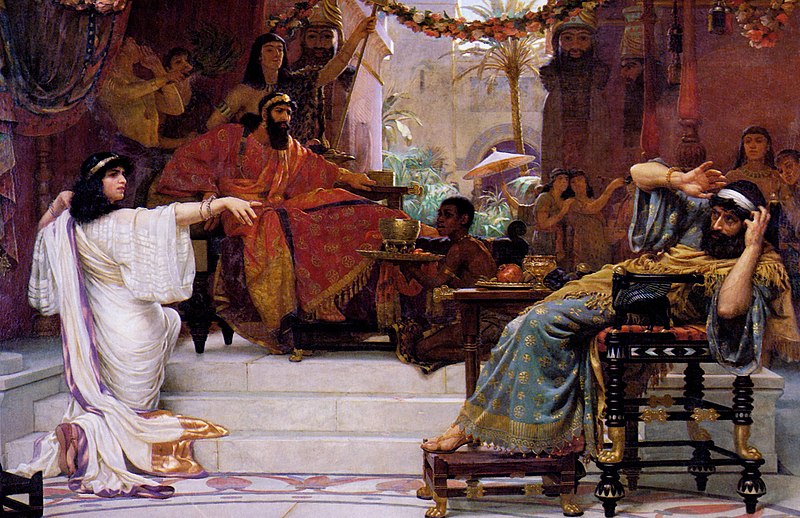
Esther Denouncing Haman
Ernest Normand · photo of an original painting
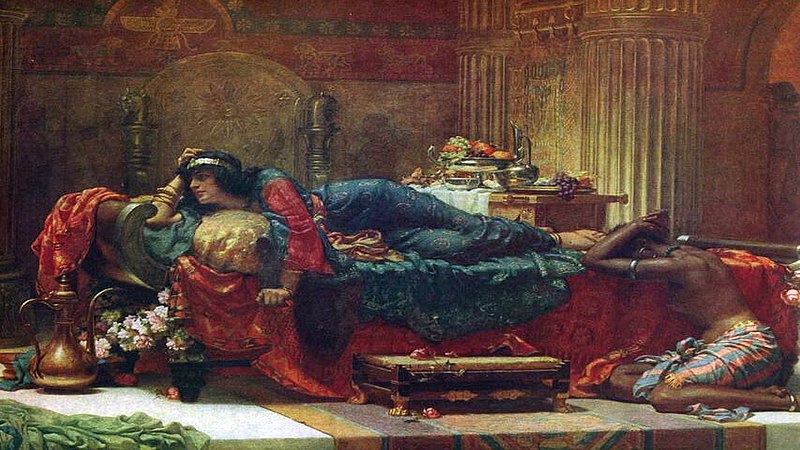
Ernest Normand, Normand, Ernest - Queen Vashti deposed, 1890
Ernest Normand
Primary material
Documents and archives
authority record
- Wikidata, structured authority record Q3057110: Ernest Normand
General reference · Wikidata
reference work
- “Ernest Normand”, English Wikipedia, consulted as further reading
Reputable secondary · Wikipedia
Notes from the source article
Cited by Wikipedia
Notes from the source article
These works are cited by the source article, in its own numbering. They are recorded as its citations, not as sources VALÉORINE has verified.
- 1.(fr)Orientalistes
- 2.Caroline Dakers, The Holland Park Circle: Artists and Victorian Society, New Haven, Yale University Press, 1999.
- 3.Fish, p. 47.
- 4.Debra Mancoff and D. J. Trela, eds., Victorian Urban Settings: Essays on the Nineteenth-Century City and Its Contexts, London, Taylor & Francis, 1996, pp 70-71
- 5.(fr)Orientalistes
References
Citations
References
Each reference names the institution holding it, so a reader may go to the document itself.
authority record
Secondary witnessreference work
Secondary witness
The Encyclopedia exists whether or not anything is for sale. Corrections are recorded rather than overwritten, and every version of this record is kept. Published 18 August 2026.
Elsewhere in Paintings
18,875 published records in this field, each with its sources named.
- Ernest Joseph BaillyArtist
- Ernest LawsonArtist
- Ernest Lee MajorArtist
- Ernest Martin HenningsArtist
- Ernest PeixottoArtist
- Ernest ProcterArtist
- Ernest SlingeneyerArtist
- Ernest Stephen LumsdenArtist
Best supported in this field
For owners
Own a work by Ernest Normand?
A specialist will read what you send and tell you what the house can establish, what it cannot, and whether the object is suited to sale. There is no charge and no obligation. The object stays with you throughout; nothing is shipped to us unless it is arranged in writing beforehand.