
Empress Zhao Feiyan
BC – September or October 1 BC), formally Empress Xiaocheng (孝成皇后), was a Chinese courtesan and empress. She was an empress during the Han dynasty. Her husband was Emperor Cheng.
Also recorded as Zhao Feiyan
Empress Zhao Feiyan

Tthe image is scanned from a Chinese book which was published at the Qing Dynasty, named as Bai mei xin yong tu zhuan(edited by 顔 希源、王翙, Qing dynasty) · [1] in 百美新詠 / 顔希源 [撰・輯 · Public domain
- Born
- 32.
- Died
- 1.
- Nationality
- Western Han.
- Occupation
- dancer, poet and emperor.
- Fields
- poetry.
- Languages
- Chinese.
VALÉORINE Encyclopedia
VALÉORINE documentary reading
Documentary summary
BC – September or October 1 BC), formally Empress Xiaocheng (孝成皇后), was a Chinese courtesan and empress. She was an empress during the Han dynasty. Her husband was Emperor Cheng.
Admitted source layer · organised and presented by VALÉORINE
Note VALÉORINE
Empress Zhao Feiyan was a dancer, emperor and poet, a national of Western Han. Activity centred on poetry. Languages used include Chinese.
Composed from admitted, traceable facts · 26 September 2026
VALÉORINE
Reference Check
Propose documentary evidence for Empress Zhao Feiyan. A contribution is never written directly as fact: identity, source, rights and evidence gates still decide.
Sign in to contribute
World of VALÉORINE
Documentary connections
Only confirmed graph relationships appear here. Images are shown only when their identity and reuse rights both pass the documentary gate.
Documentary evidence
Evidence Panel
original value insufficient · checked 25 September 2026
- Identity
- resolved
- Independent source families
- 0
- Admitted assertions
- 0
- Open conflicts
- 0
Authority files
wikidata · Q706244 · wikipedia · Zhao Feiyan
In this article
Early life
Early life
She was known in the collective consciousness of Chinese society more for her beauty than for the regal presence that she and her sister, the Consort Zhao Hede engaged in and exuded, but unlike most of the famous beauties in Chinese history (such as the Four Beauties), she was often vilified by her own sisters. She was often contrasted with Yang Guifei, the concubine of Emperor Xuanzong of Tang, because she was known for her slender build while Yang was known for her full build. This led to the Chinese idiom huanfei yanshou (環肥燕瘦, literally "fat Huan, thin Fei"), describing the range of beauty types. Later, the idiom was applied to literary styles that could be either verbose or sparse, but equally effective.
Zhao Feiyan’s birth year is assumed to be 45 BC. Historical accounts say her personal name was Yi Zhu (宜主). She was a daughter of two hereditary servants of imperial princes or princesses. It is said that when she was born, her parents were poor and that they abandoned her. Seeing that she was still alive after three days, they took her home and raised her. After her father died she and her sister were adopted by a housekeeper to a rich family. Their adoptive father's name was Zhao Lin (趙臨) and they took his surname. When she grew up, she was assigned to the household of Princess Yang'a (陽阿公主), a sister of Emperor Cheng. She became a courtesan there and was given the name that she would become known by — Feiyan (literally, flying swallow) because when she danced she flew about like a flying swallow.
Imperial consort to Cheng
Imperial consort to Cheng
Circa 19 BC, Emperor Cheng was visiting Princess Yang'a when he saw both her and her sister Hede, and he became enamored with them. He had both of them sent to his palace, and they became greatly favored imperial consorts, and they took his affection away from Empress Xu and Consort Ban. In 18 BC, they falsely accused Empress Xu and Consort Ban of witchcraft; Empress Xu was deposed, and while Consort Ban was able to successfully plead her case, she did not wish to return to the same environment and instead became a lady in waiting for Empress Dowager Wang. The Zhao sisters now dominated the palace. Emperor Cheng wanted to make Feiyan the new empress, but Empress Dowager Wang complained about her low birth and prior occupation as a dancing girl. In 16 BC, she finally capitulated to her son's wishes, and in preparation, Emperor Cheng first made Feiyan's father Zhao Lin the Marquess of Chengyang, so that she would no longer be viewed as coming from low birth. On 13 July, she was made empress.
Empress consort
Empress consort
After Feiyan was created empress, she began to lose favor from Emperor Cheng, while her sister Hede received the nearly exclusive affection of Emperor Cheng and acquired the title of "Zhaoyi" (second in rank; one lower rank than the Empress, which meant "concubine behind the Empress"). While the sisters initially were jealous of each other, they later reconciled. However, neither of them would produce any children who could serve as imperial heir—something greatly troubling to Emperor Cheng (whose earlier favorites Empress Xu and Consort Ban were also childless, and no other consort of whom was known to have had children). It was alleged that Empress Zhao, with her sister covering for her, often engaged in adulterous acts with men who were known to have fathered many children, in hopes of becoming pregnant. Empress Zhao and her sister Hede would also be alleged to have been involved in something even more sinister around this period. Based on an investigative report later authored in 6 BC (after Emperor Cheng's death), Emperor Cheng had two sons—one born to Consort Cao in 12 BC and one born to Consort Xu (a relative of the deposed Empress Xu) in 11 BC. However, both of the sons were murdered in their infancy by orders of Consort Zhao Hede, with at least tacit agreement from Emperor Cheng; Consort Cao was forced to commit suicide after her son was murdered. The report further alleged that the Zhao sisters engaged in many tactics, such as forced abortions, assassinations, and poisonings, to make sure that no other concubine would bear an imperial heir. In 9 BC, still heirless, Emperor Cheng appeared to come to the resolution of making either his younger brother Prince Liu Xing of Zhongshan (中山王劉興) or his nephew Prince Liu Xin of Dingtao his heir. Emperor Cheng became convinced that Prince Xin was more capable, and at the same time, Prince Xin's grandmother Consort Fu was endearing herself to Empress Zhao, her sister Hede, and Emperor Cheng's uncle Wang Gen with lavish gifts, and so the Zhaos and Wang Gen both praised Prince Xin as well. Emperor Cheng made Prince Xin crown prince on 20 March 8 BC.
Empress dowager
Empress dowager
Emperor Cheng died suddenly in April 7 BC, from an apparent stroke (historians also suggest the possibility of an overdose of aphrodisiacs given to him by Consort Zhao Hede). Immediately, rumors flew that he had had concubines who bore him sons, but that those sons and their mothers were murdered by Consort Zhao Hede (out of jealousy) and possibly Emperor Cheng himself. Grieving her husband and fearful of reprisals, Zhao Hede killed herself. Crown Prince Xin ascended the throne as Emperor Ai. Because the rumors largely centered around Hede and because of her role in Emperor Ai's becoming Emperor Cheng's heir, Empress Zhao was personally unscathed, and Emperor Ai honored her with the title of empress dowager. However, she would have little or no political influence during the reign of Emperor Ai. After the investigative report commissioned by Grand Empress Dowager Wang was published in 6 BC, accusing Consort Zhao Hede of the atrocities against the other imperial consorts and their children (and implicitly, although not directly, accusing Empress Dowager Zhao of the same thing), Empress Dowager Zhao's family was exiled, and the marquess titles granted to her brother and nephew removed. However, Empress Dowager Zhao herself was spared, particularly because she was on friendly relations with Emperor Ai's domineering grandmother Consort Fu (who insisted on and received the title of grand empress dowager). Some of her relatives, instead of going into exile, were hidden by Grand Empress Dowager Wang's nephew Wang Ren (王仁), but after they were discovered, Wang was punished by being sent back to his march.
Death
Death
In August 1 BC, Emperor Ai died. In decisive action, Grand Empress Dowager Wang seized power back from Emperor Ai's favorite Dong Xian and made her nephew Wang Mang regent to the succeeding Emperor Ping. Wang Mang, who wanted to extinguish all dissent (and who previously bore a grudge against Emperor Ai for demoting him and extended that grudge to those who supported Emperor Ai) had Empress Dowager Zhao demoted from her position as empress dowager to the title of Empress Xiaocheng. A few months later, she was further demoted to a commoner and ordered to guard her husband's tomb. That day, she committed suicide.
Inclusion in the Lienü zhuan
Inclusion in the Lienü zhuan
Her biography was included in the Confucian classic Biographies of Exemplary Women (Lienü Zhuan), compiled by the Han dynasty scholar Liu Xiang. Zhao Feiyan's biography is part of Scroll 9, titled Supplemental Biographies (新刊續列女傳).
In popular culture
In popular culture
She is portrayed as one of the antagonists in the 2008 Chinese television series "The Queens" by Tong Liya. Zhao is portrayed as one of the characters of the Chinese television series Love Weaves Through a Millennium, played by Niki Yi.
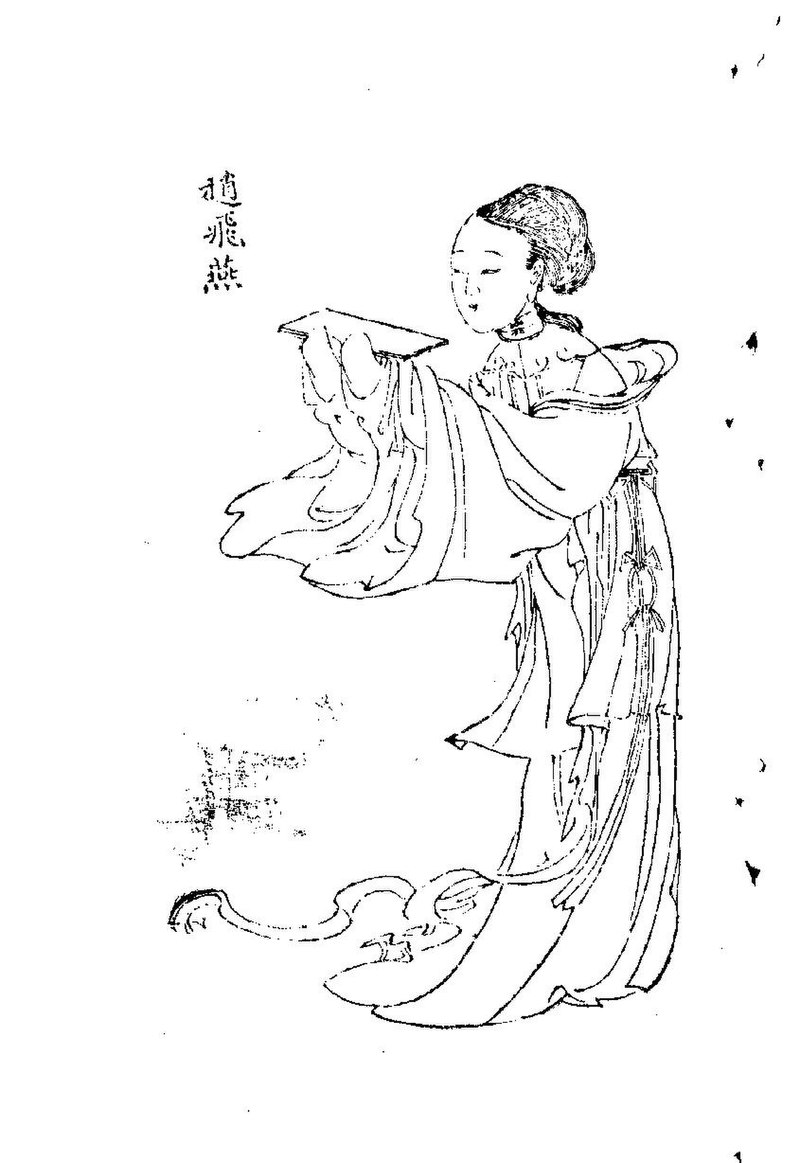
Empress Zhao Feiyan(c. 32 BC – 1 BC),ormally Empress Xiaocheng.
Although it proclaimed the copyright, but the image is scanned from a Chinese book which was published at 1772, named as Li chao ming yuan shi ci: 12 juan (edited by Lu Chang, Qing dynasty) (歷朝名媛詩詞﹕十二 · Zhao Feiyan in Harvard-Yenching Library
Life and career
Dated record
Life and career
The full dated record · 2 entries
1
Empress Zhao Feiyan died.
32
Empress Zhao Feiyan born.
Primary material
Documents and archives
reference work
- Wikidata, structured authority record Q706244: Empress Zhao Feiyan
Reputable secondary · Wikidata
- “Zhao Feiyan”, English Wikipedia, consulted as further reading
Reputable secondary · Wikipedia
scholarly publication
- Appendix Two. Chinese Text of The Scandalous Tale of Zhao Feiyan, The Empress in the Pepper Chamber, 2021
Scholarly · Crossref registry · 2021
Notes from the source article
Cited by Wikipedia
Notes from the source article
These works are cited by the source article, in its own numbering. They are recorded as its citations, not as sources VALÉORINE has verified.
- 1.8th month of the 2nd year of the Yuan'shou era, per vol.35 of Zizhi Tongjian. The month corresponds to 18 Sep to 16 Oct 1 BC in the proleptic Julian calendar.
- 2.Peterson, Barbara Bennett & He Hong Fei & Han Tie & Wang Jiyu & Zhang Guangyu. (1999) Notable Women of China "M.E. Sharpe". pp. 87–90. .
- 3.Raphals, Lisa. (1998) Sharing the Light "SUNY Press" p. 81. .
- 4.M. E. Sharpe. Notable Women of China. 9780765619297.
- 5.Lee, Lily Xiao Hong. Biographical Dictionary of Chinese Women: Antiquity Through Sui, 1600 B.C.E. - 618 C.E. Routledge. 2015. 9781317475903.
- 6.Chen, Shou (1999) Empresses and Consorts "University of Hawaii Press". p. 20. .
- 7.bingyin day of the 6th month of the 1st year of the Yong'shi era, per vol.31 of Zizhi Tongjian
- 8.guichou day of the 2nd month of the 1st year of the Sui'he era, per vol.32 of Zizhi Tongjian
References
Citations
References
Each reference names the institution holding it, so a reader may go to the document itself.
scholarly publication
Appendix Two. Chinese Text of The Scandalous Tale of Zhao Feiyan, The Empress in the Pepper Chamber, 2021Crossref registry
Verifiedreference work
Partially resolvedreference work
Partially resolved
The Encyclopedia exists whether or not anything is for sale. Corrections are recorded rather than overwritten, and every version of this record is kept. Published 14 August 2026.
Elsewhere in Books
38,582 published records in this field, each with its sources named.
- Empress XiaoquanchengAuthor
- Empress XuAuthor
- Empress YamatoAuthor
- Empress ZhangsunAuthor
- Empress ZhenAuthor
- Empu SedahAuthor
- Emrys RobertsAuthor
- Emyr DaviesAuthor
Best supported in this field
For owners
Own a work by Empress Zhao Feiyan?
A specialist will read what you send and tell you what the house can establish, what it cannot, and whether the object is suited to sale. There is no charge and no obligation. The object stays with you throughout; nothing is shipped to us unless it is arranged in writing beforehand.