
Edward Hicks
Edward Hicks (April 4, 1780 – August 23, 1849) was an American folk painter and distinguished Christian minister of the Society of Friends (a.k.a. He became a notable Quaker because of his paintings.
Also recorded as Hicks
Edward Hicks
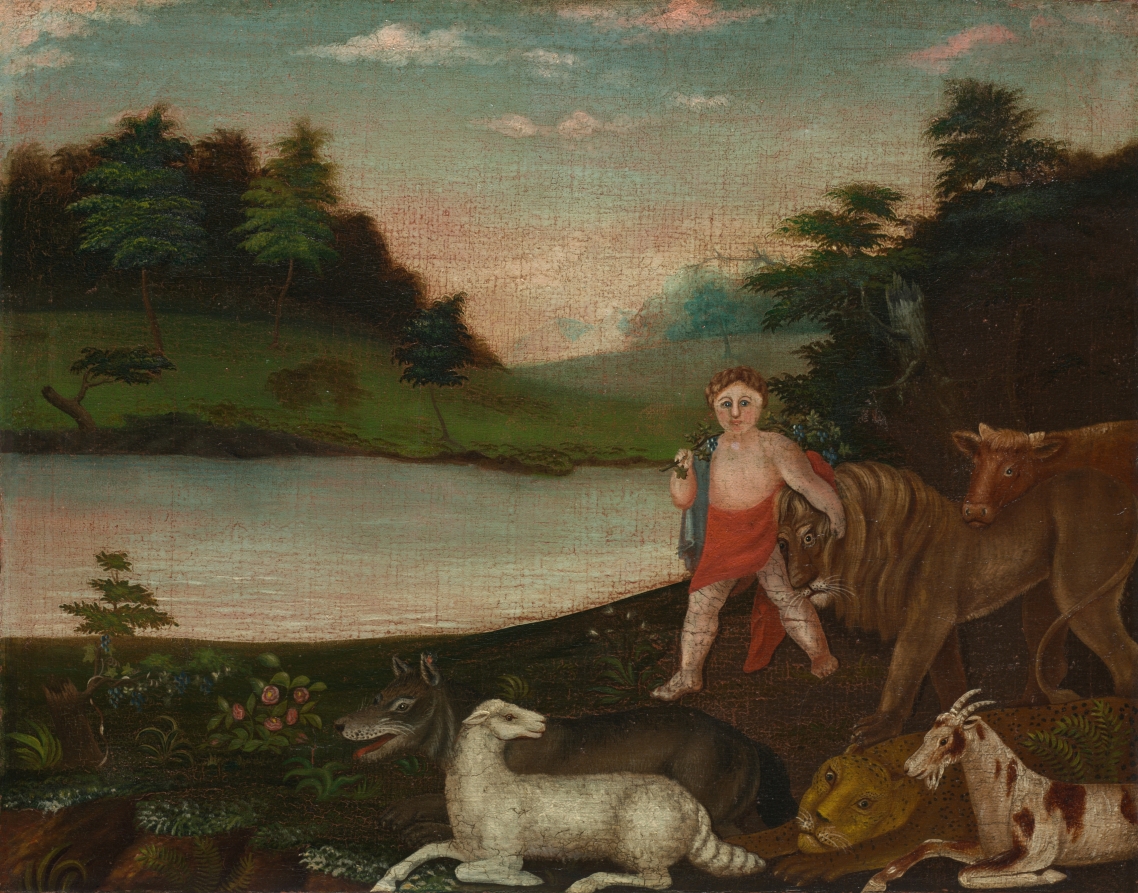
Edward Hicks · The Cleveland Museum of Art · Gift of the Hanna Fund · CC0
- Born
- 4 April 1780
- Birthplace
- Attleboro, Pennsylvania
- Died
- 23 August 1849
- Place of death
- Newtown, Pennsylvania, U.S.
- Nationality
- United States
- Occupation
- painter
- Fields
- painting
- Movements
- naïve art
- Known for
- The Cornell Farm
- Languages
- English
VALÉORINE Encyclopedia
VALÉORINE documentary reading
Documentary summary
Edward Hicks (April 4, 1780 – August 23, 1849) was an American folk painter and distinguished Christian minister of the Society of Friends (a.k.a. He became a notable Quaker because of his paintings.
Admitted source layer · organised and presented by VALÉORINE
Reference Check
Propose documentary evidence for Edward Hicks. A contribution is never written directly as fact: identity, source, rights and evidence gates still decide.
Sign in to contribute
World of VALÉORINE
Documentary connections
Only confirmed graph relationships appear here. Images are shown only when their identity and reuse rights both pass the documentary gate.
Documentary evidence
Documentary basis
Authority files
wikidata · Q2723190 · wikipedia · Edward Hicks
In this article
Biography
Biography
The recorded working language is English. The field of work recorded is painting. Subjects and genres recorded for the work are religious. Places of work recorded in the authority are Pennsylvania, Hulmeville and Newtown. Works named in the authority record are The Cornell Farm. Work by Edward Hicks is recorded in the collections of The Nelson-Atkins Museum of Art, Metropolitan Museum of Art, Cleveland Museum of Art, American Folk Art Museum and Buffalo AKG Art Museum.
Key facts
Key facts
• Born — 4 April 1780 • Birthplace — Attleboro, Pennsylvania • Died — 23 August 1849 • Place of death — Newtown, Pennsylvania, U.S. • Relatives — Elias Hicks (cousin)
Early life
Early life
• Illustration — Edward Hicks, The Peaceable Kingdom (1826), National Gallery of Art, Washington, DC Edward Hicks was born in his grandfather's mansion at Attleboro (now Langhorne), in Bucks County, Pennsylvania. His parents were Anglican. Isaac Hicks, his father, was a Loyalist who was left without any money after the British defeat in the Revolutionary War. After young Edward's mother died when he was eighteen months old, Matron Elizabeth Twining – a close friend of his mother's – raised him as one of her own at their farm, known as the Twining Farm. He apparently also resided at the David Leedom Farm. She also taught him the Quaker beliefs, which had a great effect on the rest of his life. At the age of thirteen Hicks began an apprenticeship to coach makers William and Henry Tomlinson. He stayed with them for seven years, during which he learned the craft of coach painting. In 1800 he left the Tomlinson firm to earn his living independently as a house and coach painter, and in 1801 he moved to Milford to work for Joshua C. Canby, a coach maker. At this stage of his life Hicks was, as he later wrote in his memoirs, "in my own estimation a weak, wayward young man... exceedingly fond of singing, dancing, vain amusements, and the company of young people, and too often profanely swearing". Dissatisfied with his life, he started to attend Quaker meetings regularly, and in 1803 he was accepted for membership in the Society of Friends. Later that same year he married a Quaker woman named Sarah Worstall.
Working career
Working career
• Illustration — A Peaceable Kingdom with Quakers Bearing Banners (1829–30), Terra Foundation for American Art. In 1812, his congregation recorded him as a minister, and by 1813, he began traveling throughout Philadelphia as a Quaker preacher. To meet the expenses of traveling, and for the support of his growing family, Hicks decided to expand his trade to painting household objects and farm equipment as well as tavern signs. His painting trade was lucrative, but it upset some in the Quaker community, because it contradicted the plain customs they respected. In 1815 Hicks briefly gave up ornamental painting and attempted to support his family by farming, while also continuing with the plain, utilitarian type of painting that his Quaker neighbors thought acceptable. His financial difficulties only increased, as utilitarian painting was less remunerative, and Hicks did not have the experience he needed to cultivate the land, or run a farm primarily on his own. By 1816, his wife was expecting a fifth child. After a relative of Hicks, at the urging of Hicks' close friend John Comly, talked to him about painting again, Hicks resumed decorative painting. This friendly suggestion saved Hicks from financial disaster, and preserved his livelihood not as a Quaker Minister but as a Quaker artist. Around 1820, Hicks made the first of his many paintings of The Peaceable Kingdom. Hicks' easel paintings were often made for family and friends, not for sale, and decorative painting remained his main source of income. In 1827, a schism formed within the Religious Society of Friends, between Hicksites (named after Edward Hicks' cousin Elias Hicks) and Orthodox Friends. As new settlers swelled Pennsylvania's Quaker community, many branched off into sects whose differences sometimes conflicted with one another, which greatly discouraged Edward Hicks from continuing to preach. Nonetheless, in his lifetime Hicks was better known as a minister than as a painter. He is buried at Newtown Friends Meetinghouse Cemetery in Newtown Township, Bucks County, Pennsylvania. He died in 1849.
Painting
Painting
Quaker beliefs prohibited a lavish life or having excessive quantities of objects or materials. Unable to maintain his work as a preacher and painter at the same time, Hicks transitioned into a life of painting, and he used his canvases to convey his beliefs. He was unconfined by rules of his congregation, and able to freely express what religion could not: the human conception of faith. • Illustration — One of over 60 versions of The Peaceable Kingdom painted by Edward Hicks, c. 1833–1834. Brooklyn Museum Hicks painted 62 versions of the Peaceable Kingdom. It exemplifies Quaker ideals. The animals and children are taken from Isaiah 11:6–8 (also echoed in Isaiah 65:25), including the lion eating straw with the ox. Hicks used his paintings as a way to define his central interest, which was the quest for a redeemed soul. This theme was also from one of his theological beliefs. Hicks' work was influenced by a specific Quaker belief referred to as the 'Inner Light'. George Fox and other founding Quakers had established and preached the Inner Light doctrine. Fox explained that along with scriptural knowledge, many individuals achieve salvation by yielding one's self-will to the divine power of Christ and the "Christ within". This "Christ in You" concept was derived from the Bible's Colossians 1:27. Hicks depicted humans and animals to represent the Inner Light's idea of breaking physical barriers (of difference between two individuals) to working and living together in peace. Many of his paintings further exemplify this concept with depictions of Native Americans meeting the settlers of Pennsylvania, with William Penn prominent among them. Hicks admired Penn as an opponent of British power in America, and he hoped that Penn could help ensure reform. Like Penn, Hicks opposed Britain's hierarchy. Hicks most esteemed Penn for establishing the treaty of Pennsylvania with the Native Americans, because it was a state that strongly fostered the Quaker community.
Exhibition
Exhibition
• Illustration — Peaceable Kingdom of the Branch, oil on canvas, c. 1826–1830. Reynolda House Museum of American Art Edward Hicks' first major exhibition took place in 1860 at Williamsburg, Virginia. It got mixed reviews due to Hicks' habit of repeating various arrangements over and over again. Hicks' earliest presentation of work was in 1826. Kingdoms of the Branch was at that time in the Philadelphia Museum of Art. Hicks used Penn and the Native Americans to paraphrase Isaiah's prophecy, in full. His work often focused on religious subject matter while using current events to portray them. Hicks conveyed meaning through symbols, and depicted predators (such as lions) and prey (such as lambs) next to each other to show a theme of peace. Peaceable Kingdoms of the Branch (1826–30), is now located in Reynolda House, Museum of American Art, Winston-Salem, NC. It is a notable example of Hicks' legacy. A special collection on Edward Hicks is among the holdings of the Newtown Historic Association.
Works
Works
Hicks' works display similarities from painting to painting. For example, his 1834 version of "Peaceable Kingdom" and 1845 version of "The Residence of David Twining" offer many comparisons (please see the second and third paintings displayed below). First, the right area of both paintings appears to be the most congested area, in which the size of each object seems to reflect its importance regardless of its position in space. Both paintings show humans and animals interacting together, and evoke a sense of community because the people are portrayed as trying to accomplish something. In the case of "Peaceable Kingdom", there are settlers in the background, signing a treaty with the Native Americans. Calmness and peace, rather than abrupt action, characterize Hicks' compositions. Many of the shapes and forms in his work appear to be organic, flowing and soft. One must pay close attention to the gestures of individuals and animals in his paintings to derive meaning. Hicks uses small detail variations as a way to force viewers to pay attention to content because they are deliberate and purposeful. Although none of his paintings are completely identical, there are certain compositional structures and patterns Hicks follows within all of his work. Although the space may appear shallow on the picture plane of these paintings, depth is created through objects and objects size, and secondarily by light and shadows. The foreground, middle ground and background are all defined by objects, animals, landscape, humans, and skylines. Hicks almost always painted outdoor scenes, in which the light source is the sun or sky. The color schemes of his work are not complicated, and within a painting such as "Peaceable Kingdom" many of the colors have the same warmth or brown tone. This is another way that Hicks' tries to convey "uniformity" or peace. Most of these paintings are asymmetrically balanced, to reflect actions taking place between groups of people and animals within the work.
Gallery of major works
Gallery of major works
• Illustration — Washington at the Delaware, (c.1849) • Illustration — The Peaceable Kingdom, circa1834 • Illustration — The Residence of David Twining, (1845–1848), Abby Aldrich Rockefeller Folk Art Collection • Illustration — Noah's Ark (1846), Philadelphia Museum of Art • Illustration — Penn's Treaty (1847), private collection • Illustration — The Cornell Farm (1848), National Gallery of Art
Selected works and their locations
Selected works and their locations
• The Residence of David Twining 1785, 1846, American Folk Art Museum, New York City • The Peaceable Kingdom, c. 1833, Worcester Art Museum, Worcester, Massachusetts • The Falls of Niagara, c. 1825, and The Peaceable Kingdom, c. 1830–32, Metropolitan Museum of Art, New York City • Penn's Treaty, c. 1830–40, Gilcrease Museum, Tulsa, Oklahoma • Noah's Ark, 1846 and The Peaceable Kingdom, c. 1844–46, Philadelphia Museum of Art, Philadelphia • Grave of William Penn, 1847, Newark Museum, Newark, New Jersey • The Cornell Farm, 1848; The Grave of William Penn, c. 1847–48; The Landing of Columbus, c. 1837; The Peaceable Kingdom, c. 1834; Penn's Treaty With the Indians, c. 1840–1l44; and Portrait of a Child, c. 1840, National Gallery of Art, Washington, DC • The Peaceable Kingdom, 1830–32, Montgomery Museum of Fine Arts, Montgomery, Alabama • Peaceable Kingdom of the Branch, c. 1826–30, Reynolda House Museum of American Art, Winston-Salem, North Carolina • Library Sign, 1825, Newtown Library Company, Newtown, Pennsylvania
Identity
Identity
Edward Hicks is recorded as painter. Identity and origins. The authorities additionally record the heading Hicks. His recorded language was English. His recorded confession was Quakers. He was the child of Isaac Hicks.
Life and career
Dated record
Life and career
Explore 1780–1851
The full dated record · 4 entries
1780
Edward Hicks born at Langhorne.
1825
Sermons Delivered By Elias Hicks And Edward Hicks: In Friends Meetings, New York, In Fifth Month, 1825 (1825) is digitised and catalogued by Internet Archive.
1849
Edward Hicks died at Newtown.
1851
Memoirs of the Life and Religious Labors of Edward Hicks: Late of Newtown, Bucks County... (1851) is digitised and catalogued by Internet Archive.
Places
Named by the record
Places
Only places the record itself states, plotted where the house gazetteer settles their coordinates. Nothing is inferred from a name or a nationality.
Langhorne.
Birth place
Newtown.
Death place
Citations
References
Each reference names the institution holding it, so a reader may go to the document itself.
reference work
Wikidata, structured authority record Q2723190: Edward HicksWikimedia Foundation
Secondary witnessreference work
Secondary witness
The Encyclopedia exists whether or not anything is for sale. Corrections are recorded rather than overwritten, and every version of this record is kept. Published 16 August 2026.
Elsewhere in Paintings
18,717 published records in this field, each with its sources named.
- Edward Frank GilletArtist
- Edward HargittArtist
- Edward Harrison MayArtist
- Edward Henry CorbouldArtist
- Edward HopperArtist
- Edward HughesArtist
- Edward KellyArtist
- Edward Killingworth JohnsonArtist
Best supported in this field
For owners
Own a work by Edward Hicks?
A specialist will read what you send and tell you what the house can establish, what it cannot, and whether the object is suited to sale. There is no charge and no obligation. The object stays with you throughout; nothing is shipped to us unless it is arranged in writing beforehand.