
Edward Brodhead Green
Edward Brodhead Green (May 10, 1855 – February 2, 1950), very often referred to as E. Green, was a major American architect from New York state.
Also recorded as Edward B. Green
Edward Brodhead Green

Pubdog (talk) · Own work (Original text: I created this work entirely by myself.) · Public domain
- Name
- Edward Brodhead Green
- Born
- 10 May 1855
- Birthplace
- Utica, New York, U.S.
- Died
- 11 February 1950
- Place of death
- Buffalo, New York, U.S.
- Education
- Cornell University
- Awards
- Fellow of the American Institute of Architects (1890)
- Nationality
- United States
- Occupation
- architect
- Known for
- Buffalo Memorial Auditorium
Reference Check
Propose documentary evidence for Edward Brodhead Green. A contribution is never written directly as fact: identity, source, rights and evidence gates still decide.
Sign in to contribute
World of VALÉORINE
Documentary connections
Only confirmed graph relationships appear here. Images are shown only when their identity and reuse rights both pass the documentary gate.
Documentary evidence
Documentary basis
- Independent source families
- 1
- Admitted assertions
- 4
Authority files
wikidata · Q5342021 · wikipedia · Edward Brodhead Green
VALÉORINE Encyclopedia
The documentary record
Statements marked “Documentary record” are set in the article beside the passage they confirm. Each is read from the authority records of the institutions named here; select “Prove” to see the record it was read from, where in that record, and when.
Institutions cited
Deutsche Nationalbibliothek · Getty Union List of Artist Names
Complete reading chain (JSON)In this article
Key facts
Key facts
• Name — Edward Brodhead Green • Born — 10 May 1855 • Birthplace — Utica, New York, U.S. • Died — 11 February 1950 • Place of death — Buffalo, New York, U.S. • Education — Cornell University • Practice — Green & Wicks, Edward B. Green & Son • Awards — Fellow of the American Institute of Architects (1890)
Documentary record
Edward Brodhead Green (1855 – 1950) was an architect. The birth of Edward Brodhead Green is recorded in 1855, and the death in 1950.
Early life and education
Early life and education
Green was born in Utica, New York, on May 10, 1855. He attended Cornell University in Ithaca, New York, graduating with a bachelor of architecture degree in 1878. Following his graduation, Green was the thir architect to be registered by the State University of New York.
Career
Career
• Illustration — Albright Art Gallery in 1913; designed by Green and built between 1890 and 1905 for the Pan-American Exposition in Buffalo, New York After graduation, Green worked as a junior architect with William Miller in Ithaca for three years while teaching at Cornell for one year. In 1880, along with William Sydney Wicks, an M.I.T. architecture graduate, he opened a practice in Auburn, New York, moving a year later to 69 Genesee Street in Buffalo, New York, in 1881. Through approximately 1940, Green was active in Buffalo, New York, where his work left a lasting impression on the city of Buffalo, and it includes such noteworthy structures as the Albright-Knox Art Gallery, Young Men's Christian Association Central Building, and Twentieth Century Club (1894); all three listed on the National Register of Historic Places. His public buildings include the Buffalo Savings Bank, the Market Arcade, the Buffalo Crematory, and South Park High School, The First Presbyterian Church of Buffalo, Kibler High School, Tonawanda Municipal Building, and Dayton Art Institute (1930) among others. In Canada, Green made the designs for several structures owned by the Ontario Power Company at Niagara Falls, Ontario. He also designed and built many private residences, including the Charles W. Goodyear Residence, Granger Mansion, and his own residence at 180 Summer Street, which is not visible from the road. During his 72-year career, he designed more than 370 major structures. More than 160 of his Buffalo buildings survive today. After the death of his partner Wicks in 1919, he continued the practice with his son, Edward B. Green Jr., and then with R.M. James from 1936 to 1950.
Personal life
Personal life
In 1887, Green was married to Harriet Edson (1858–1935). Together, they were the parents of: • Edward Brodhead Green Jr. (1888–1933), also an architect. • Cornelia Green (1890–1959) • Paul Edson Green (1892–1957), also an architect. Green died in Buffalo on February 2, 1950, after a two-week illness. He was buried in Forest Lawn Cemetery.

Kibler High School, December 2009
Pubdog (talk) · I (Pubdog (talk)) created this work entirely by myself.
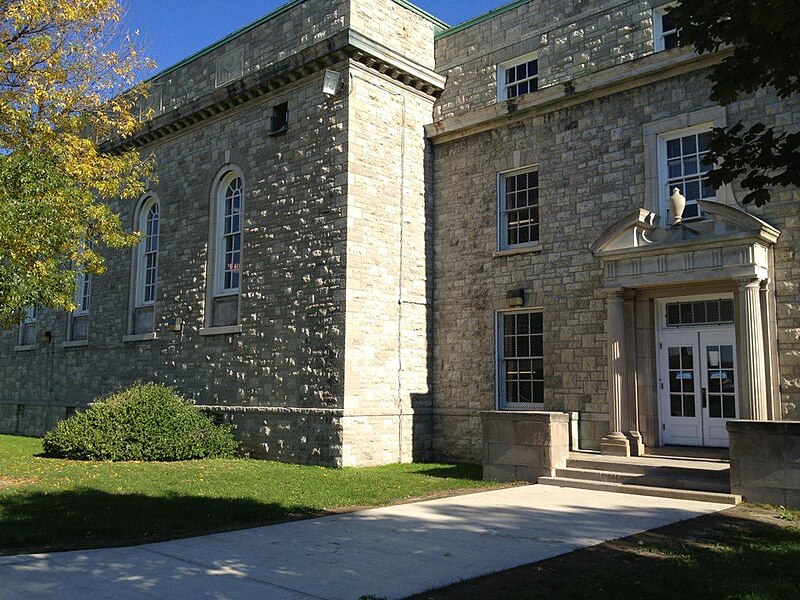
Clark Hall on UB's South Campus
Davidhar
Life and career
Dated record
Life and career
The full dated record · 2 entries
1855
Edward Brodhead Green was born on 10 May 1855.
1950
Edward Brodhead Green died on 11 February 1950.
Places
Named by the record
Places
Only places the record itself states, plotted where the house gazetteer settles their coordinates. Nothing is inferred from a name or a nationality.
Edward Brodhead Green was born at Utica.
Birthplace
Edward Brodhead Green died at Buffalo.
Deathplace
Utica.
Birth place
Buffalo.
Death place
Context
Primary material
Context
The circumstances in which Edward Brodhead Green stands.
Documents and archives
Primary material
Documents and archives
Institutional database
- Wikidata, structured authority record Q5342021: Edward Brodhead Green
Scholarly · Wikimedia Foundation
reference work
- “Edward Brodhead Green”, English Wikipedia, consulted as further reading
Reputable secondary · Wikipedia
Text attribution
Licensing
Text attribution
Part of the biographical narrative on this page reuses licensed material. Its origin, revision and licence are recorded here.
The biographical narrative on this page is based on the Wikipedia article Edward Brodhead Green, revision 1372359998 (EN edition), by its contributors. VALÉORINE has edited that text and built its own documentary record around it. The reused material is available under CC BY-SA 4.0, and this page's reuse of it is offered under the same licence. Everything else on this page — the chronology, the holdings, the evidence, the plates and the connections — is VALÉORINE's own record. Sources and licences.
Notes from the source article
Cited by Wikipedia
Notes from the source article
These works are cited by the source article, in its own numbering. They are recorded as its citations, not as sources VALÉORINE has verified.
- 1.Corcoran, Kathryn L. Edward B. Green, Architect: A Selected Bibliography. Vance Bibliographies. 1989. 9780792002758.
- 2.Goldman, Mark. City on the Edge: Buffalo, New York, 1900 - Present. Prometheus Books. 88. 3 June 2010. 9781615920679.
- 3.Western Architect and Engineer. 46. 1908.
- 4.Biographical Dictionary of Architects in Canada. Green, Edward Brodhead. dictionaryofarchitectsincanada.org.
- 5.Banham, Reyner. Buffalo Architecture: A Guide. MIT Press. 120. 1981. 9780262520638.
- 6.Edward B. Green. The New York Times. 13 February 1950.
- 7.LaChiusa, Chuck. E.B. Green. buffaloah.com. Buffalo Architecture and History.
References
Citations
References
Each reference names the institution holding it, so a reader may go to the document itself.
Institutional database
Wikidata, structured authority record Q5342021: Edward Brodhead GreenWikimedia Foundation
Institutional witnessreference work
Secondary witness
The Encyclopedia exists whether or not anything is for sale. Corrections are recorded rather than overwritten, and every version of this record is kept. Published 17 August 2026.
Elsewhere in Design
11,558 published records in this field, each with its sources named.
- Edward BloreDesigner
- Edward BlumDesigner
- Edward BoardmanDesigner
- Edward Brickell WhiteDesigner
- Edward BrowningDesigner
- Edward Buckton LambDesigner
- Edward Buehler DelkDesigner
- Edward Charles BassettDesigner
Best supported in this field
For owners
Own a work by Edward Brodhead Green?
A specialist will read what you send and tell you what the house can establish, what it cannot, and whether the object is suited to sale. There is no charge and no obligation. The object stays with you throughout; nothing is shipped to us unless it is arranged in writing beforehand.