
Domenico Piola
Illustration — Job and his children Domenico Piola (1627 – 8 April 1703) was a Genoese painter of the Baroque period. He was the leading artist in Genoa in the second half of the 17th century, working on ceiling frescoes for many Genoese churches and palaces and canvas paintings for private collectors. His family studio was highly prolific and frequently collaborated with other artists.
Also recorded as Domenico I Piola · Domenico, I Piola · I Domenico Piola · D.co Piola
Domenico Piola

Domenico Piola · Web Gallery of Art: Image Info about artwork wga QS:P11807,"p/piola/2magdale" · Public domain
- Born
- 1627. · Genoa.
- Occupation
- painter and printmaker.
- Known for
- Drawings by Domenico Piola and Saint Mary Magdalene.
- Languages
- Italian.
VALÉORINE Encyclopedia
VALÉORINE documentary reading
Documentary summary
Illustration — Job and his children Domenico Piola (1627 – 8 April 1703) was a Genoese painter of the Baroque period. He was the leading artist in Genoa in the second half of the 17th century, working on ceiling frescoes for many Genoese churches and palaces and canvas paintings for private collectors. His family studio was highly prolific and frequently collaborated with other artists.
Admitted source layer · organised and presented by VALÉORINE
Reference Check
Propose documentary evidence for Domenico Piola. A contribution is never written directly as fact: identity, source, rights and evidence gates still decide.
Sign in to contribute
World of VALÉORINE
Documentary connections
Only confirmed graph relationships appear here. Images are shown only when their identity and reuse rights both pass the documentary gate.

Documentary evidence
Documentary basis
Authority files
wikidata · Q1054362 · wikipedia · Domenico Piola
In this article
Biography
Biography
The recorded working language is Italian. The field of work recorded is painting, Baroque art and engraving. Works named in the authority record are Drawings by Domenico Piola and Saint Mary Magdalene. Work by Domenico Piola is recorded in the collections of Minneapolis Institute of Art, Museo del Prado, Art Institute of Chicago, The Nelson-Atkins Museum of Art and J. Paul Getty Museum.
Piola was an Italian painter, draughtsman, printmaker and designer. He was the leading artist in Genoa in the second half of the 17th century, working for both public and private collectors. His first teacher was his 17-year older brother-in-law Stefano Camogli. Piola was further trained by his older brother Pellegro and then studied under Pellegro's teacher, Giovanni Domenico Cappellino (1580–1651). • Illustration — Allegory of peace and abundance, with Stefano Camogli From 1650 onwards, the Piola family played a dominant role in the decoration of Genoese ceilings for nearly a century. While Domenico was the key figure in the family studio, known as Casa Piola, in the second half of the 17th century, other members were Piola's younger brother, his brother-in-law Stefano Camogli, his three sons, and his two sons-in-law. The studio streamlined the design and production of decorated ceilings. The studio also produced designs for sculptors and for craftsmen in wood, ceramics and metalwork. In 1684–5 Domenico visited Milan, Piacenza, Bologna and Asti. At Piacenza, he painted decorations in the Casa Baldini. In Genoa in 1688, he and Gregorio de’ Ferrari began to decorate rooms in the Palazzo Rosso on the theme of the four seasons, Piola executing Autumn and Winter and Ferrari the more lyrical Spring and Summer. Preparatory drawings for Winter survive in (Genoa, Palazzo Rosso; London, British Museum).
Works
Works
• Illustration — The Rape of Europa Piola's early copies after Giovanni Benedetto Castiglione and his working relationship with Valerio Castello in the late 1640s and early 1650s encouraged the development of a more Baroque style. Piola absorbed Castiglione's work, as is visible in The Communion of Clare of Montefalco (London, British Museum) and his paintings in the Oratory of St John the Baptist at Spotorno. Piola's style was fully matured by 1670. The influence of Parmese art was strengthened after the return of Gregorio de’ Ferrari from Parma circa 1672. Correggio’s style encouraged Piola's own predilection for diagonal movement, bright colours and strongly foreshortened figures. In 1674 Ferrari married Piola's daughter. The work of the Casa Piola was considerably augmented. In the 1670s and 1680s, the two artists collaborated on many fresco projects. In 1684 Piola began to fresco the choir of San Leonardo and two rooms in the Villa Gropallo at Zerbino; all work was interrupted in this year after a French bombardment destroyed much of Genoa, including Domenico's house and studio. Piola also often collaborated with his brother-in-law Stefano Camogli, a specialist still life and animal painter. Examples of compositions in which Camogli was responsible for the still life elements and Piola for the figures are the Allegory of Summer (Collection Torriglia Chiavari, Palazzo Rocca) and the Allegory of Peace and Abundance (Private collection).
Casa Piola through the ages
Casa Piola through the ages
Other members of the Piola family who were artists included Domenico's brother, Giovanni Andrea and his three sons Paolo Gerolamo, Anton Maria, and Giovanni Battista; his two sons-in-law, Gregorio de’ Ferrari (his most distinguished pupil and married to his daughter Margherita Piola) and Domenico Parodi; and his brother-in-law Stefano Camogli. The large family studio, called Casa Piola, excelled in both quadratura fresco decoration and canvases. Generations of artists, down to the 20th century, descended from the line of Piola-De Ferrari, including Giovanni Maria De Simoni, who died in 1913 in the original residence of Domenico's family.
Public collections
Piola is represented in the following collections: Museo dell'Accademia Ligustica di Belle Arti, Genoa; Palazzo Bianco, Genoa; Palazzo Rosso Gallery, Genoa; Drawings from the Biblioteca Ambrosiana, Milan; The Royal Collection, London; Courtauld Institute of Art, London; J. Paul Getty Museum, Los Angeles; Fine Arts Museums of San Francisco; Hermitage Museum, Saint Petersburg, amongst others.
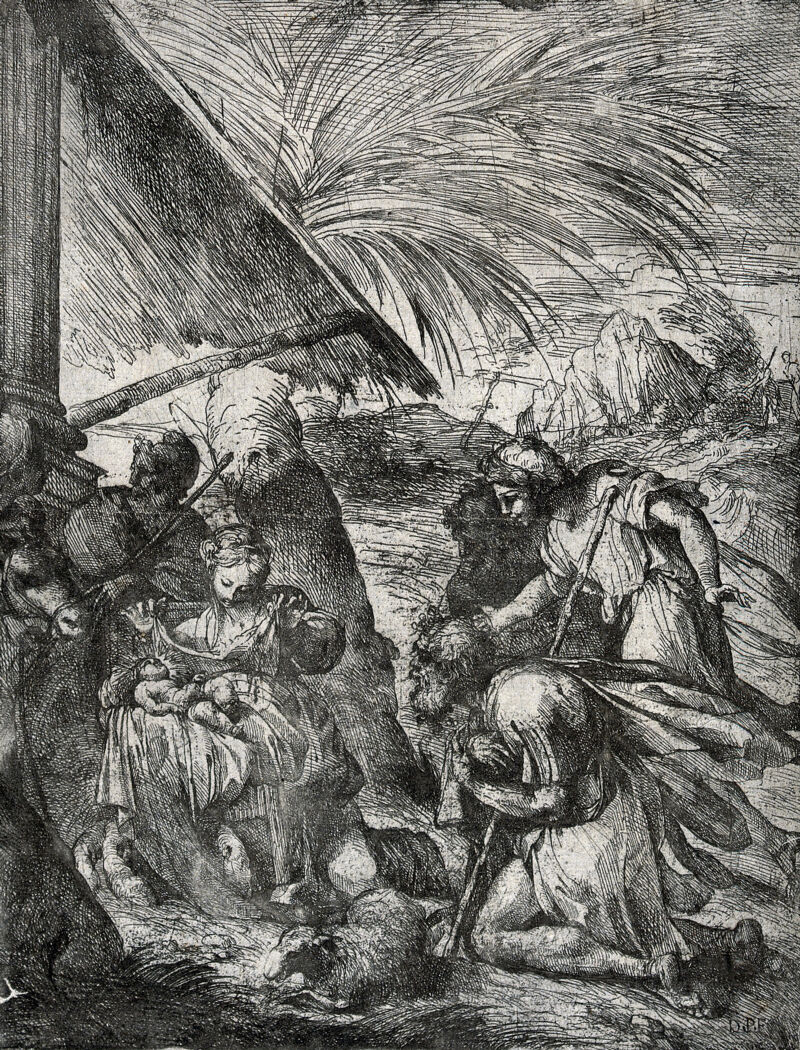
The adoration of the shepherds. Etching by D. Piola the elder., by Domenico Piola
Domenico Piola · Wellcome Collection, London · Wellcome Collection
Citations
References
Each reference names the institution holding it, so a reader may go to the document itself.
reference work
Secondary witnessreference work
Secondary witness
The Encyclopedia exists whether or not anything is for sale. Corrections are recorded rather than overwritten, and every version of this record is kept. Published 16 August 2026.
Elsewhere in Prints
4,138 published records in this field, each with its sources named.
- Domenico FalciniEngraver
- Domenico MaggiottoEngraver
- Domenico Maria BonaveraEngraver
- Domenico MorelliEngraver
- Domenico TibaldiEngraver
- Domingo LaporteEngraver
- Dominicus CustosEngraver
- Dominicus Franciscus du BoisEngraver
Best supported in this field
For owners
Own a work by Domenico Piola?
A specialist will read what you send and tell you what the house can establish, what it cannot, and whether the object is suited to sale. There is no charge and no obligation. The object stays with you throughout; nothing is shipped to us unless it is arranged in writing beforehand.