
Claudio Costa
Illustration — Claudio Costa Claudio Costa (1942 – 1995) was a Contemporary Artist from the 1970s avant-garde movement.
Also recorded as Cláudio Costa · Cláudio Figueiredo Costa · Claudio Figueiredo Costa
Claudio Costa

Wikimedia Commons · CC BY-SA 3.0
- Born
- 1942 · Tirana.
- Died
- 1995 · Genoa.
- Nationality
- Italy · Kingdom of Italy
- Occupation
- painter · sculptor · ceramicist
- Education
- Polytechnic University of Milan
- Languages
- Italian
VALÉORINE Encyclopedia
VALÉORINE documentary reading
Documentary summary
Illustration — Claudio Costa Claudio Costa (1942 – 1995) was a Contemporary Artist from the 1970s avant-garde movement.
Admitted source layer · organised and presented by VALÉORINE
Reference Check
Propose documentary evidence for Claudio Costa. A contribution is never written directly as fact: identity, source, rights and evidence gates still decide.
Sign in to contribute
World of VALÉORINE
Documentary connections
Only confirmed graph relationships appear here. Images are shown only when their identity and reuse rights both pass the documentary gate.

Documentary evidence
Documentary basis
Authority files
wikidata · Q3679999
In this article
Personal life
Personal life
Costa was born to Italian parents in Tirana, Albania. His family returned to Italy the same year he was born and settled in Monleone of Cicagna in Liguria. In 1961, Costa enrolled in the faculty of Architecture at Milan Polytechnic. His interests in the early 1960s were drawing and informal painting. In 1964, he obtained a grant awarded by the French government to go to Paris and study engraving. In 1965, he married Anita Zerio and in the same year their daughter, Marisol, was born. Costa's time in Paris was productive. He met Marcel Duchamp at the rue Daguerre workshop in 1965 and also took part in the May 1968 student protests together with a group of artists, including Pierre Alechinsky, Asger Jorn, Roberto Matta, Antonio Seguí, Silvia Cortazar and others. In the autumn of the same year, he returned to Italy and began living in Rapallo with his family.
Work
Work
Costa's artistic production is divided in several different periods. He explored Arte povera, Conceptual Art, paleontologist and anthropological art, alchemic art. As an artist associated with the Arte Povera movement, Costa's first exhibition took place at the La Bertesca Gallery in Genova directed by Francesco Masnata. He produced a series of "tele acide" (acid canvases) (1970–1971), where he deployed a new pictorial language made of symbolical and magic elements by mixing them with materials and glue-earth-bone-blood-acids. Costa explained the acid canvases in his writings: "I used three acids and a sulfate; nitric acid, which corroded the support almost immediately, iron chloride which gave a brownish colour, and copper sulphate, which reminded me of the wonderful color of vine leaves when they are sprayed and which I needed to obtain a light blue base". In 1971, Costa investigated the confines between science and art as a paleontologist and anthropologist. He returned to the remote prehistoric past in search of the roots of mankind, especially in pieces like "Museo dell'Uomo" (Museum of Man), where he attempted a summary and condensation of his anthropological studies. "Alchemic Art" was also his main focus when he exhibited at the Venice Biennale in 1986 In 1988, he started working in Psychiatric Hospital in Genoa as an art-therapist. Costa had a large workshop inside the hospital. In this period he founded the "Institute for Unconscious Matter and Forms", where he exhibited works of patients as well as professional artists. Costa died suddenly in Genoa on 2 July 1995.
Selected exhibitions
Selected exhibitions
• La Bertesca Gallery, Genoa (1969, 1971 and 1972) • Diter Hacher Galerie, Berlin (1971) • Venice Biennale (1972, 1986) • Paris Biennale (1973) • Ludwing Galerie, Aachen (1974) • Project '74, Cologne (1974) • Palazzo Reale, Milan (1974) • Monteghirfo Museum of Active Anthropology (1975) • Documenta 6, Museum Fridericianum, Kassel (1977) • Museo Vostell, Càceres de Extremadura (1978) • "Mythos and Ritual", Kunsthaus Zurich (1981)
Places
Named by the record
Places
Only places the record itself states, plotted where the house gazetteer settles their coordinates. Nothing is inferred from a name or a nationality.
Tirana.
Birth place
Genoa.
Death place
Selected bibliography
• Franco Ragazzi, Delle Magie e dei Miti, Erga Edizioni, Genoa, 1999 • Sandra Solimano (ed.), Claudio Costa, Museo d'Arte Contemporanea di Genova and Skira, Milan, 2000

Claudio Costa, Costa 2
Wikimedia Commons
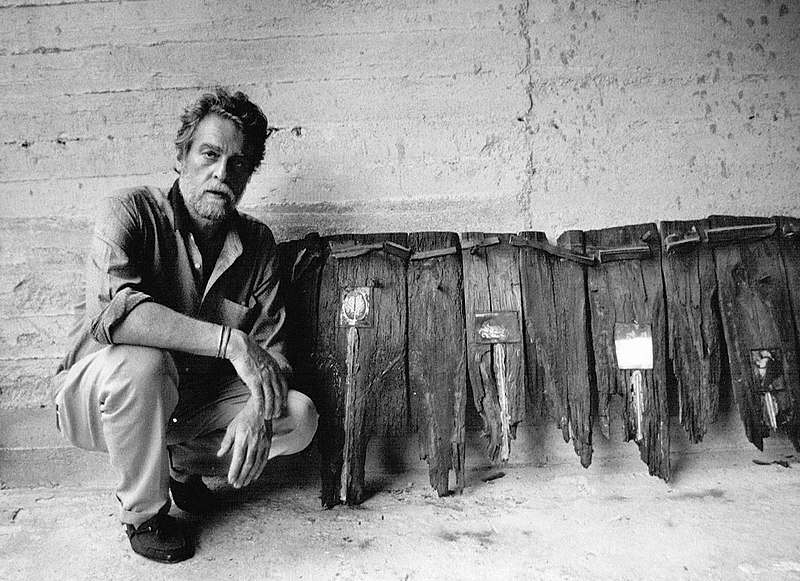
Claudio Costa nel 1991
Stefano.castelli1979
References
Citations
References
Each reference names the institution holding it, so a reader may go to the document itself.
reference work
Secondary witness
People, houses and institutions
Knowledge graph
People, houses and institutions
Teachers, collaborators, publishers and institutions recorded against this person, each on a stated basis.
Studied at
1- Polytechnic University of MilanOrganisation
Established from a fact already recorded on a verified source.
The Encyclopedia exists whether or not anything is for sale. Corrections are recorded rather than overwritten, and every version of this record is kept. Published 17 August 2026.
Elsewhere in Sculpture
6,174 published records in this field, each with its sources named.
- Claude-Léon MascauxArtist
- Claudia AnselmiArtist
- Claudia CobizevArtist
- Claudio Castelucho DianaArtist
- Claudio GranzottoArtist
- Claudio Silveira SilvaArtist
- Claudius de Cap BlancArtist
- Claudius MariotonArtist
Best supported in this field
For owners
Own a work by Claudio Costa?
A specialist will read what you send and tell you what the house can establish, what it cannot, and whether the object is suited to sale. There is no charge and no obligation. The object stays with you throughout; nothing is shipped to us unless it is arranged in writing beforehand.