
Charles Sims
Charles Henry Sims (28 January 1873, Islington–13 April 1928, St. Boswells) was a British figurative painter known for his portraits and landscapes. He initially became renowned as a leading Edwardian painter, but following the death of his son in World War I, his work became increasingly idiosyncratic, surreal and controversial.
Also recorded as Charles H. Sims · Charles Henry Sims
Charles Sims
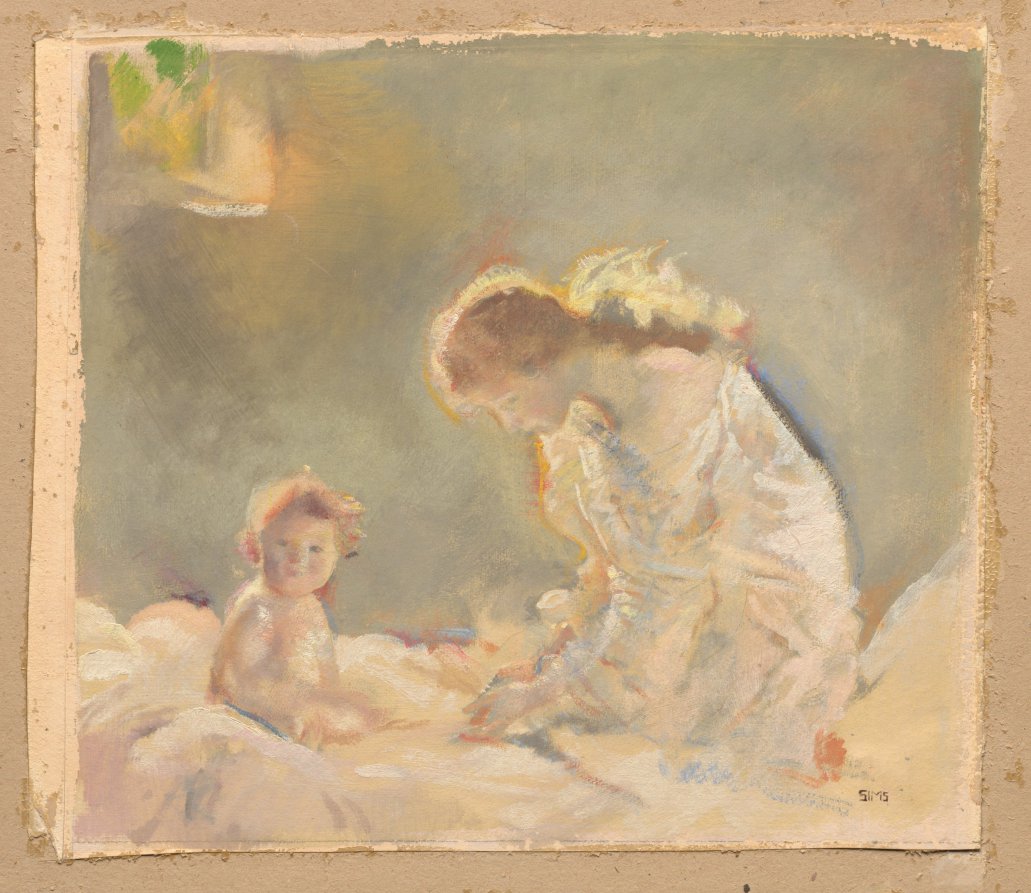
Charles Sims · The Cleveland Museum of Art · Bequest of Mrs. Henry A. Everett for the Dorothy Burnham Everett Memorial Collection · CC0
- Name
- Charles Sims
- Born
- 28 January 1873
- Birthplace
- Islington, England
- Place of death
- St.
- Education
- Académie Julian, Royal Academy Schools (expelled)
- Nationality
- United Kingdom
- Occupation
- painter · graphic artist · illustrator
- Languages
- English
VALÉORINE Encyclopedia
VALÉORINE documentary reading
Documentary summary
Charles Henry Sims (28 January 1873, Islington–13 April 1928, St. Boswells) was a British figurative painter known for his portraits and landscapes. He initially became renowned as a leading Edwardian painter, but following the death of his son in World War I, his work became increasingly idiosyncratic, surreal and controversial.
Admitted source layer · organised and presented by VALÉORINE
Note VALÉORINE
Charles Sims (1873–1928) was a graphic artist, illustrator and painter, of British nationality. The graphic artist was born in Islington and died in St Boswells.
Charles Sims was educated at Académie Julian. The graphic artist was a member of Royal Academy of Arts.
Languages used include English. Works are held at Art Gallery of New South Wales, Art Institute of Chicago and Hermitage Museum, among others.
Composed from admitted, traceable facts · 26 September 2026
VALÉORINE
Reference Check
Propose documentary evidence for Charles Sims. A contribution is never written directly as fact: identity, source, rights and evidence gates still decide.
Sign in to contribute
World of VALÉORINE
Documentary connections
Only confirmed graph relationships appear here. Images are shown only when their identity and reuse rights both pass the documentary gate.
Documentary evidence
Documentary basis
Authority files
wikidata · Q5082527
In this article
Biography
Biography
In 1920, he was appointed Keeper, or head, of the Royal Academy Schools, a post he was eventually forced to resign in 1926. At the same time, he became estranged from his wife and children. Sims' final paintings, the Spiritual Ideas, were to some viewers his "most beautiful works," but to others highly disturbing. He committed suicide in 1928.
Key facts
Key facts
• Name — Charles Sims • Born — 28 January 1873 • Birthplace — Islington, England • Place of death — St. Boswells, Scotland • Years Active — 1886-1928 • Education — Académie Julian, Royal Academy Schools (expelled) • Works — An Island Festival (1907); Clio and the Children (1913/15); the Spiritual Ideas (series, 1927-28)
Education and early career
Education and early career
Born in Islington, London, Sims was the son of a costume manufacturer. An injury in infancy threatened his life and resulted in lifelong lameness in one leg. His earliest memories were of painful physiotherapy, and as a child he was unable to fully participate in physical activities. This disability was to have a profound influence on his work as an artist. As his son and biographer Alan Sims writes, "His lameness…remained always a considerable burden," and "had much to do with the peculiar direction of his art towards playful subjects and athletic technique," so that "the most notable characteristics" included "a prepossession with the swift movement of flawless bodies bathed in sunlight and air" and "a determination to escape from the actual confines of physical life into a region of his own fancy.…The charm of his happiest pictures is heightened by this pathos." Initially apprenticed in the drapery business, at age 14 he was sent to Paris, where he learned French. Turning his back on a mercantile career, he decided to study art, and in 1890 enrolled at the South Kensington College of Art before moving back to Paris for two years at the Académie Julian. In the need of bursaries to support himself, he moved back to London and enrolled at the Royal Academy Schools in 1893, but "his Parisian insolence and cavalier ways alienated the authorities, and in 1895 he was unceremoniously expelled." Despite the expulsion, Sims "had gained the confidence to start painting bacchanalian scenes of revelry, executed with astonishing flair," including The Vine in 1896, his first painting to be exhibited at the Royal Academy. In 1897 he exhibited Childhood, which "established his mastery of the effects of sunlight"; it was shown at the Paris Salon of 1900 and purchased by the French State (it is now at the Musée d'Orsay). He specialized in neo-classical fantasies, typically idealized scenes of women and children (and sometimes fairies and fauns) in outdoor settings. He also found success as a painter of society portraits. In 1897, he married Agnes, a daughter of the painter John MacWhirter. She and their children, sometimes captured in photographs, would become frequent models and subjects in his paintings. In 1906, a one-man show at the Leicester Galleries brought him critical and financial success, allowing him to relocate to rural Fittleworth and then Lodsworth, both villages near Petworth, West Sussex. In 1907 he painted An Island Festival, "possibly his masterpiece." In 1910, The Art Journal declared him "The very Ariel of the Academy…This is the art which Keats imagined in his 'Ode on a Grecian Urn,' 'For ever panting and for ever young.'" In 1910 he was elected a fellow of the Royal Watercolour Society, and in 1915 to the Royal Academy. The "breezy, sunny, outdoor subjects" for which he became known were partly inspired by holidays in Arran in Scotland and later at Bruges in Belgium and at Étaples in France, where there was an international artists' colony. In 1921, art critic P.G. Konody reflected on Sims' body of joyous paintings:Life is an eternal Arcadian holiday for him.…The key-note of his art is an intense joie de vivre. And this joie de vivre expressed in his paintings is contagious. The serene happiness of Sims' art makes the spectator forget all the worries and tribulations and petty concerns of his daily life. The New York Times found in Sims' works "an individuality incapable of dullness or heaviness," and "an unquenchable sprit." • Illustration — "What are these to me and you who deeply drink of wine?" (1895) • Illustration — Childhood (1897) • Illustration — A Fairy Wooing (1898) • Illustration — Dame Lilian Braithwaite (c. 1902) • Illustration — The Little Faun (version of 1905–1906) • Illustration — An Island Festival (1907) • Illustration — The Fountain (1907/8) • Illustration — Kenneth Clark (c. 1911) • Illustration — The Wood Beyond the World (1913) • Illustration — "...and the fairies ran away with their clothes" (n.d.)
The First World War
The First World War
The First World War was a deeply traumatic experience for Sims. His eldest son, John, serving as a midshipman in the Royal Navy, was killed in November 1914, in the loss of HMS Bulwark, a blow that caused Sims in 1915 to add to his idyllic work Clio and the Children, staining the scroll of the Muse of History with red paint to represent blood. "Sims believed that the War had violated the innocence of future generations. He felt that History could no longer be personified as a beautiful goddess passing on wisdom but that she had more violent lessons to teach." Sims's son is among the missing commemorated on the Portsmouth Naval Memorial. • Illustration — Marriage, from The Seven Sacraments of the Holy Church (1917). In February 1917, Sims exhibited a suite of austere, idiosyncratic, deliberately archaic paintings depicting The Seven Sacraments of the Holy Church. According to his son Alan, "Nobody knew what to make of them." Their present location is unknown, and they are today the least-known of his works. In 1918, he traveled to France as an official war artist, painting a series of devastated landscapes. He also painted works memorializing the war dead, using the imagery of the Crucifixion. In Greater Love Hath No Man (1916), his own son appears on a cross, with members of the family below. Another crucifixion on a much larger scale and with panoramic details, with Christ on the cross, became Sims' contribution to the Canadian War Museum, Sacrifice (1919). In 1920 Sims was commissioned to decorate the ceiling of the Institute of Civil Engineers in Great George Street, Westminster, and the result was a more conventional but still "highly inventive" paean to the war effort, wherein "a figure of Victory swoops down, surrounded by a billowing Union Jack and holding the victor's laurels, although it also serves as a wreath for the dead. At the edges people crane their necks to peer upwards…and a biplane, emblem of modernity, crosses the composition." Victory wears a hood and most of her face cannot be seen. • Illustration — Clio and the Children (1913/15) • Illustration — Greater Love Hath No Man (1916) • Illustration — Dawn over the battlefields of Vimy, Loos, Mons, Trones (c. 1918) • Illustration — The Old German Front Line, Arras, 1916 (1919) • Illustration — Sacrifice (1919) • Illustration — Study for Ceiling Painting for the Great Hall of the Institute of Civil Engineers (c. 1920)
Professional controversies, personal upheavals
Professional controversies, personal upheavals
• Illustration — Introduction of Lady Astor as the First Woman MP (c. 1919) In the last decade of his life, Sims' work became increasingly controversial. In 2019, a surviving version of the painting, on loan from The Box, Plymouth, was put on display in the Member's Dining Room in the Palace of Westminster to mark the centenary of Astor taking her seat. • Illustration — George V (surviving version, c. 1924) In 1920, Sims was appointed Keeper, or head, of the Royal Academy Schools, an ironic achievement for a man who had himself been expelled as a student. The position included a residence in Burlington House, and "placed him at the very heart of the organisation, as the guardian of future generations of painters rigorously drilled in the traditional methods of drawing and composition." A surviving, smaller version of Sims' portrait of George V is kept at the Scottish National Portrait Gallery. In 1925, Sims was commissioned to contribute to "The Building of Britain," a series of historical paintings by various artists in St. Stephen's Hall of the Palace of Westminster in London. Unveiled in 1927, King John assents to Magna Carta attracted criticism from the press, Members of Parliament and other artists for its idiosyncrasy. Added to these professional tribulations and lingering grief for his son was upheaval in Sims' personal life. His biographer H. Cecilia Holmes suggests that Sims took as his mistress Vivienne Jeudwine, whose portrait with her son (possibly by Sims) he exhibited at the Royal Academy in 1924. Another portrait of Jeudwine by Sims, undated, is unabashedly intimate. His affair with Jeudwine eventually ended, but Sims was irreconcilably estranged from his wife, Agnes. When he vacated the Keeper's residence at Burlington House in June, 1926, "he did not return to his wife and children—by this stage his marriage was dead in all but name—but embarked upon a series of foreign trips and long-term spells as a guest in the homes of friends." • Illustration — The Sands at Dymchurch (c. 1920-2) • Illustration — King John assents to Magna Carta (1925-1927) • Illustration — Mrs. Jeudwine and her son Wynne (1924) • Illustration — Portrait of Vivienne Jeudwine, undated
The Spiritual Ideas and subsequent suicide
The Spiritual Ideas and subsequent suicide
• Illustration — Crowds of Small Souls in Flame (1927) Abandoning portraiture and representational painting altogether, Sims embarked on the final phase of his creative career, which resulted in a series of paintings that would be termed the Spiritual Ideas. They depict visually smeared and abstracted maelstroms of cosmic energy in which naked and contorted figures are overwhelmed by gigantic, personified forces; their enigmatic content and Sims' apparent turn to a modernist style startled and confused the artistic establishment. Critics likened the paintings to the works of El Greco, William Blake, Wassily Kandinsky, and the Italian Futurists. In private letters from March 1928, Sims wrote of his "acute mental distress," saying that "something has happened far away, something that I need have no shame in telling you one day"; it is believed he was referring to his estrangement from his wife, which further isolated him as he was grieving the loss of his son. On 13 April 1928, weeks before a Royal Academy exhibition including six of Sims' Spiritual Ideas was to open on 7 May, he committed suicide by drowning in the River Tweed near St. Boswells, Scotland, jumping from the Leaderfoot Viaduct with stones in his pockets. Contemporary viewers of the exhibition were concerned about the content of the paintings, especially with regard to Sims' mental health and subsequent suicide, and saw critical reception of the exhibition as insensitive. The RA president, Sir Frank Dicksee, who had previously overseen the destruction of Sims' portrait of George V, said the paintings were "in marked contrast to all his previous work," indicating "a violent change of mentality." Ultimately, to address the public's curiosity, all six of the exhibited Spiritual Ideas were illustrated in colour in the popular press; a headline in the New York Times declared "Suicide's Pictures Make London Gasp." Months later, when four of the Spiritual Ideas were shown in the United States as part of the annual Carnegie International, they "were unquestionably the profound sensation of that exhibition." Sims' state of mind was addressed by Frank Rutter, critic of The Sunday Times: "A man who has been suffering from continued insomnia may well not be responsible for his actions, but he is not necessarily insane. To suggest that there are traces of mania in these last and most beautiful works from his brush betrays a lamentable lack of understanding, and is an undeserved slight on the memory of a sweet and reasonable painter." Sims himself, in a posthumously published essay, reflected on the Spiritual Ideas: Alan Sims wrote of his father's suicide: "He himself followed out his Epicureanism to its logical conclusion, and ceased to live when he ceased to believe in future happiness." • Illustration — Saints and Sinners (c. 1927) • Illustration — Man's Last Pretence of Consummation in Indifference (c. 1927) • Illustration — I Am the Abyss and I Am Light (1928) • Illustration — My Pain Beneath Your Sheltering Hand (c. 1928)
London
London
• Clio and the Children, 1913 and 1915, Royal Academy of Arts • King John assents to Magna Carta, 1925–1927, Palace of Westminster • The Fountain, 1907–8; The Wood Beyond the World, 1913; The Sands at Dymchurch, c.1920–2; I Am the Abyss and I Am Light, 1928, Tate • A Camouflaged Quarry: Between Chérisy and Hendicourt, 1916; "Sacrifice": Study for the painting in Ottawa, 1918; The Land of Nod (poster), 1917, Imperial War Museums • Dame Lilian Braithwaite, c. 1902, The Garrick Club Collections • of a Young Man; Aspiration, 1927; Crowds of Small Souls in Flame, 1927; A Spiritual Idea, 1927; Swing; My Pain Beneath Thy Sheltering Hand, 1927, Bethlem Museum of the Mind
United Kingdom
United Kingdom
• Two Girls Seated: Diana and Sarah Churchill, 1922, National Trust, Chartwell. • The Little Faun, version of 1905–1906, The Fitzwilliam Museum; The Little Faun, version of 1908, Royal Cornwall Museum • Introduction of Lady Astor as the First Woman MP, c. 1919, The Box, Plymouth • What Are These to Me and You Who Deeply Drink of Wine?, 1895, Leeds Art Gallery • An Interrupted Picnic, 1901, Cartwright Hall • Man's Last Pretence of Consummation in Indifference, 1927, Ulster Museum • George V, c. 1924, Scottish National Portrait Gallery • Mrs. MacWhirter, City Art Centre, Edinburgh
Elsewhere
Elsewhere
• L'Enfance (Childhood), 1897, Musée d'Orsay • Sacrifice, c. 1918, Canadian War Museum • Child Worship, c. 1909, Cleveland Museum of Art • An Island Festival, 1907, Art Gallery of New South Wales • By Summer Seas, c. 1904; Figure of a Woman c. 1905; The Death of the Year, 1910-1912, Museum of New Zealand Te Papa Tongarewa • Bacchanalia, n.d., Hermitage Museum
At auction
At auction
An auction record for a work by Charles Sims was set by In Elysium, auctioned for £36,000 at Sotheby's London in 2006, then equivalent to $66,212.
Early life and training
Early life and training
Charles Sims was born on 28 January 1873 in Islington. Sims held the nationality of United Kingdom. Sims was educated at Académie Julian.
Places
Named by the record
Places
Only places the record itself states, plotted where the house gazetteer settles their coordinates. Nothing is inferred from a name or a nationality.
Islington.
Birth place
St Boswells.
Death place
Writings and published texts, 1934–2022
Catalogued output
Writings and published texts, 1934–2022
These are catalogued publications carrying the name — editions and printings, distinct from the works they contain and from writing about the subject. The 1930s are the densest part of the run, with 3 titles, and that concentration is a fact about what the registers have catalogued rather than a judgement on the work itself. They belong to a run of 14 titles in all, from 1934 to 2022.
13 editions carry dates between 1934 and 2022
The run opens with Picture Making Technique & Inspiration and closes with Why?
The entries follow Open Library
Picture Making Technique & Inspiration
1934
Strike strategy and tactics
1934
A reply to Sir Edward Beatty
1938
The keys to speedy victory
1944
Greetings, Northern neighbor!
1946
Where is the C.C.F. going?
1950
Tim Buck
1951
The Royal Air Force the First Fifty Years
1968
The Royal Air Force
1968
Writings and published texts without a settled date
Catalogued output
Writings and published texts without a settled date
1 further edition are catalogued under Sims's name without a date the collections agree on, which is why they are set apart from the dated run rather than placed in it.
Paintings, drawings and prints, 1895–1928
Catalogued output
Paintings, drawings and prints, 1895–1928
These are objects catalogued as visual works, each held or recorded by the institution named against it. 37 works carry dates between 1895 and 1928. The run opens with What are these to me and you who deeply drink of wine' and closes with I Am the Abyss and I Am Light. The 1920s are the densest part of the run, with 17 titles, and that concentration is a fact about what the registers have catalogued rather than a judgement on the work itself. They belong to a run of 72 titles in all, from 1895 to 1928. A selection is set out below and the complete run may be opened beneath it.
What are these to me and you who deeply drink of wine'
1895
Bacchanalia
1900
Mary Elizabeth Menzies
1900
Alfred Fredwin
1900
An Interrupted Picnic
1901
Wartime (recto)
1901
Children at Play
1903
Alan Gordon MacWhirter
1903
The little faun
1905
An island festival
1907
The Fountain
1907
The Hen Wife
1911
The complete catalogue · 37
What are these to me and you who deeply drink of wine'
1895
Bacchanalia
1900
Mary Elizabeth Menzies
1900
Alfred Fredwin
1900
An Interrupted Picnic
1901
Wartime (recto)
1901
Children at Play
1903
Alan Gordon MacWhirter
1903
The little faun
1905
An island festival
1907
The Fountain
1907
The Hen Wife
1911
The Shower
1912
The Wood beyond the World
1913
A Camouflaged Quarry between Chérisy and Hendecourt
1916
Sacrifice
1918
Sir Edward Kemp
1918
'Sacrifice' (study for the painting in Ottawa)
1918
'… and the fairies ran away with their clothes'
1918
The Old German Front Line, Arras, 1916
1919
Study of a Nude
1920
The Sands at Dymchurch
1921
Two Girls Seated, Diana (1909-1963) and Sarah Churchill (1914-1982)
1922
Sybil, Countess of Rocksavage (1894–1989), later Marchioness of Cholmondeley
1922
Introduction of Lady Astor as the First Woman MP
1922
View in Kensington Gardens, London
1923
Lady Rocksavage
1923
George V (1865–1936), reigned 1910–1936
1924
Matthew Hay (1855–1932)
1924
Lower Mall, Hammersmith, Looking towards Chiswick Reach
1925
King John Assents to the Magna Carta, 1215
1926
My Pain beneath Thy Sheltering Hand
1927
Spiritual Idea
1927
Aspiration
1927
Crowds of Small Souls in Flame
1927
A Spiritual Idea
1927
I Am the Abyss and I Am Light
1928
Paintings, drawings and prints without a settled date
Catalogued output
Paintings, drawings and prints without a settled date
35 further works are catalogued under Sims's name without a date the collections agree on, which is why they are set apart from the dated run rather than placed in it.
Sap, an illustration of the springtime of life
The death of the year
Figure of a woman
Study of a dead rail
Clio and the Children
The Striped Skirt
Interior of the House of Commons
Mrs Sims and Family (verso)
Love Locked Out
The Little Archer
Country Scene, Forest Trees
Lady Astor (1879–1964), Lord Balfour (1848–1930), and David Lloyd George (1863–1945)
The complete catalogue · 24
Sap, an illustration of the springtime of life
The death of the year
Figure of a woman
Study of a dead rail
Clio and the Children
The Striped Skirt
Interior of the House of Commons
Mrs Sims and Family (verso)
Love Locked Out
The Little Archer
Country Scene, Forest Trees
Lady Astor (1879–1964), Lord Balfour (1848–1930), and David Lloyd George (1863–1945)
The Fairy Ring
George Leach Ashworth (1823–1873)
Sketch for 'Someone Passes'
Saints and Sinners
Man's Last Pretence of Consummation in Indifference
Portrait of a Young Man
Female Nude (study)
Children Bathing (study)
Female Figure (study)
Study of a Boy
Women and Child
Woman Holding a Basket
Legacy
• Illustration — The Faun—an Epilogue (undated; private collection) was among more than 80 works by Sims exhibited by The Royal Academy in 1933; possibly a "sequel" to The Little Faun, in both cases an imaginary self-portrait of the artist, who always felt himself to be set apart because of his lameness. In 1933, the Royal Academy presented a Commemorative Exhibition of Works by Late Members, which included over 80 works by Sims, a veritable retrospective of his career. The da Vinci expert Edward McCurdy wrote: 1934 saw the posthumous publication of Sims' Picture Making: Technique & Inspiration, a book "rich in insights into the theory and practice of painting." The illustrated volume also included Sims' notes on his own paintings and passages from his private journals, and a lengthy critical survey of his life and work by his son Alan Sims, making it an invaluable resource for researchers and art historians. The early paintings that established his career, like Childhood, "showed a whimsicality fashionable in Edwardian London but ultimately detrimental to a late-twentieth-century revival of interest in his work." Nonetheless, many of his most important works remain in museum collections, and whatever the fate of his reputation, the paintings themselves were made to last. Alan Sims asserts that his father, beginning around 1909, painstakingly researched and developed a "method of painting in tempera with an oil finish" that was Since 2005, three doctoral theses have dealt at length with Sims and his paintings. H. Cecilia Holmes' "A bright memory to remain": The Life and Works of Charles Sims RA (1873-1928), by delving into the archive of Sims' letters, diaries, and photographs at Northumbria University, creates a very human portrait of the artist. Holmes was the first scholar to suggest a connection between the remarriage of Vivienne Jeudwine and Sims' decision to commit suicide. • Illustration — Here Am I, 1927–28, location unknown. For almost a century, Sims' legacy has been dogged by rumors of insanity. The catalogue for the 1989 exhibit The Last Romantics at the Barbican Art Gallery (which included four works by Sims) repeated the notion that his final paintings were "apparently the product of a seriously disturbed mind." The initial inclusion of Sims' work in the collection of the Bethlem Museum of the Mind was apparently due to "a belief that Sims was suffering from serious mental disorder." And in the 21st century, one gallery specializing in Outsider art has gone so far as to suggest, with no supporting evidence, that Sims had schizophrenia. Ultimately, as the Bethlem acknowledges,At present we do not know much about his actual state of mind, but there seems little doubt that his painting was profoundly affected, both in style and content, by the mental turmoil which he was experiencing. There is no doubt at all that the most powerful and original paintings of his whole career are to be found among these final works." Alan Sims wrote that his father's series of Spiritual Ideas was both "the greatest and last work of his life." In 1929, when the Cleveland Museum of Art acquired Sims' Here Am I, museum curator William Mathewson Milliken wrote: In 1965, the Cleveland Museum of Art deaccessioned Here Am I. The present location of the painting is unknown.
In museum collections
• Illustration — An Interrupted Picnic, 1901, Cartwright Hall. • Illustration — Two Girls Seated: Diana and Sarah Churchill, 1922, National Trust, Chartwell.
Cultural references
Cultural references
A reference to Charles Sims and his work is made in Robert Aickman's story "Ravissante," where his paintings are described: "apparently confused on the surface, even demented, they made one doubt while one continued to gaze, whether the painter had not in truth broken through to a deep and terrible order."
Authority records
Notes from the source article
Cited by Wikipedia
Notes from the source article
These works are cited by the source article, in its own numbering. They are recorded as its citations, not as sources VALÉORINE has verified.
- 1.Colbourne (2011), p. i.
- 2.Rutter.
- 3.Sims, pp. 87, 90, 94.
- 4.Reynolds, p. 721.
- 5.Carter (1910), pp. 164 and 167.
- 6.Hall, pp. 23, 50, 228.
- 7.Konody (1921)
- 8."The World of Art…" (1925).
- 9.Sims, p. 102: Sims "crossed the borders of fairyland for the first time with 'A Fairy Wooing', and achieved lightness at a bound. Nothing so rich and delicate in fancy had ever shone out from the walls of the Academy before. The chill academic nymphs stared down their marmoreal noses in astonishment."
- 10.Buckingham, Ian. Midshipman John Sims. Rother Valley War Memorials. Midhurst U3A. 20 March 2014.
- 11.Sims, John.
- 12.Clio and the Children. royalacademy.org.uk.
- 13.Valentine.
- 14.Sims, pp. 120-122, which includes black and white reproductions of all seven paintings.
- 15.Victory—Study for Ceiling Painting in the Great Hall of the Institute of Civil Engineers. lissllewellyn.com.
- 16.Nancy Astor painting takes its place in Westminster. artsculture.newsandmediarepublic.org. October 7, 2019.
- 17.Wilcox.
- 18.Seel.
- 19.Holmes, pp. 189 and 213-216.
- 20.Rupert Maas. The Artist's Mistress by Charles Sims. victorianweb.org.
- 21.Holmes p. 232.
- 22."Mr. Sims's 'Mystical' Pictures" (review), The Times, London, 2 May 1928.
- 23.Milliken, pp. 52-54.
- 24.Wilcox, citing T.W. Earp, "The Academy," New Statesman, 12 May 2017.
- 25.Holmes, p. 267, n. 3.
- 26.Holmes, p. 266-267.
- 27."Mr. Sims's Last Pictures. Royal Academy Decision. New Phase of Work," The Times, London, 19 Apr 1928.
- 28.The New York Times, "Suicide's Pictures [...]" (1928).
- 29.Milliken, p. 53.
- 30.Sims, p. 94.
- 31.Royal Academy of Arts (1933), item 420, p. 89.
- 32.McCurdy, pp. 258-259: "Among much that dates from the period when his powers were at their freshest and most natural…[is] a small picture which bears the title The Faun—an Epilogue, in which the player has hung up his pipes…birds are sitting, spread about somewhat after the fashion of the listeners to St. Francis in the fresco at Assisi, waiting apparently for the music to begin again. I like fantasies such as these treated in the way that Sims treats them."
- 33.Royal Academy of Arts (1933).
- 34."Charles Sims—Decorative, Mystical: Works in the Winter Exhibition at the Royal Academy."
- 35.McCurdy, pp. 258-259.
- 36.Christian, p. 133.
- 37.Sims, p. 113.
- 38.Holmes (2005); Colbourne (2011); Bromwell (2019).
- 39.The archive is described at length by Holmes (2005), pp. 2-7, and by Colbourne (2011), p 3: "During the summer of 2001, Northumbria University accepted [from a descendent] a substantial archive of Charles Sims' work comprising over 570 paintings, sketches, prints and photographs covering his entire career.…In addition there are also a number of diaries, notebooks, letters and two scrapbooks or folios containing drawings, postcards, gallery catalogues and press cuttings," including reviews "from the Bombay Gazette to the Dundee Adventurer."
- 40.Charles Sims. outsiderart.co.uk. 20 June 2018.
- 41.Artist in Focus VII—Charles Sims. museumofthemind.org.uk.
- 42.Sims, p 127.
- 43.Sims, p. 129: This is the title of the painting according to Alan Sims, who also gives its date as 1927-28.
- 44.Milliken, pp. 53-54.
- 45.Ingalls Library, Cleveland Museum of Art: Item 194.29. library.clevelandart.org.
- 46.Holmes (2005), p. 302.
- 47.Aickman, Robert. "Ravissante" in Sub Rosa: Strange Tales, London: Victor Gollancz, 1968.
- 48.Victorian & Edwardian Art / Lot 131 Charles Sims 1875-1928. www.sothebys.com.
- 49.Art auction result for Charles Sims. findartinfo.com/.
Bibliography printed in the source article · 26
- "A Fairy Wooing", the 1898 painting by Charles Sims reproduced in colour with a brief essay, p. 47, Great Pictures in Private Galleries, London: Cassell and Co., Ltd., 1905.
- Baldry, A. Lys. "The Paintings of Mr. Charles Sims" (includes one colour and ten black and white reproductions) in The International Studio, issue 41, 1907, pp. 88–98.
- Bromwell, Thomas (2019). Visions of the End in Interwar British Art, Doctoral Thesis, University of York.
- Carter, A.C.R. (1898). "The Royal Academy, 1898", The Art Journal, 1898, pp. 161–184 (Sims reviewed, p. 183).
- Carter, A.C.R. (1910). "The Royal Academy, a General Survey", The Art Journal, 1910, pp. 162–170.
- "Charles Sims Resigns Royal Academy Post; Storm Over His Picture of King Is Recalled", The New York Times, 18 December 1926, p. 4.
- Colbourne, Jane Florence (2011). A Critical Survey of the Materials and Techniques of Charles Henry Sims RA (1873-1928) with Special Reference to Egg Tempera Media and Works of Art on Paper, Doctoral thesis, Northumbria University.
- "Charles Sims—Decorative, Mystical: Works in the Winter Exhibition at the Royal Academy" (full page with seven reproductions), The Illustrated London News, 14 January 1933, p. 56.
- Christian, John, editor. The Last Romantics: The Romantic Tradition in British art, Burne-Jones to Stanley Spencer, London: Lund Humphries in association with Barbican Art Gallery, 1989.
- "English Painter, Charles Sims, Dies…", The New York Times, 17 April 1928, p. 29.
- Grimsditch, H.B. "Sims, Charles (1873–1928)" in Oxford Dictionary of National Biography, Oxford University Press, 1937 (online as "archive edition").
- Hall, Susan, editor. The Edwardians: Secrets and Desires, National Gallery of Australia, 2004.
- Holmes, H. Cecilia (2005). "A bright memory to remain": The Life and Works of Charles Sims RA (1873-1928), Doctoral thesis, Northumbria University.
- Konody, P.G. "The Art of Charles Sims. R.A." in Art in Australia, no. 11, December, 1921.
- McCurdy, Edward. "Painters of Yesterday" in The Quarterly Review, Vol. 260, No. 516, April, 1933, pp. 258–259.
- Milliken, William Mathewson. "Lo, Here Am I", The Bulletin of the Cleveland Museum of Art, vol. 16, no. 3, 1929, pp. 47, 52–54.
- Reynolds, Simon. "Sims, Charles Henry (1873–1928)" in Oxford Dictionary of National Biography, Oxford University Press, 2004 (online as "current edition").
- Royal Academy of Arts (1933). Commemorative Exhibition of Works by Late Members, Winter Exhibition, Fifty-Second Year, 1933.
- Rutter, Frank. "The Academy," The Sunday Times, 8 May 1928.
- Seel, Graham. "The Artist and the King", History Today, vol. 65, issue 7, July 2015, pp. 39–44.
- Sims, Charles. Picture Making: Technique & Inspiration (with a critical survey of his life & work by Alan Sims), The New Art Library (Second Series), London: Seeley Service & Co., 1934.
- Speed, Harold. "Charles Sims, R.A." in The Old Water-Colour Society's Club, Vol. 6 (1928-1929), London, 1929, pp. 45–64; a self-portrait of Sims faces p. 46.
- "Suicide's Pictures Make London Gasp; Six Weird Paintings by Charles Sims at Royal Academy Exhibit Symbolize Pain…", The New York Times, 5 May 1928, p. 5.
- Valentine. Helen. "1916: Altered States" in The Royal Academy of Arts Summer Exhibition: A Chronicle, 1769–2018, edited by Mark Hallett, Sarah Victoria Turner and Jessica Feather, London: Paul Mellon Centre for Studies in British Art, 2018.
- Wilcox, Timothy. "1928: The Agony and Ecstasy of Charles Sims" in The Royal Academy of Arts Summer Exhibition: A Chronicle, 1769–2018, edited by Mark Hallett, Sarah Victoria Turner and Jessica Feather, London: Paul Mellon Centre for Studies in British Art, 2018.
- "The World of Art…Exhibition of Paintings by Charles Sims", The New York Times, 4 October 1925, Section SM, pp. 14–15.
References
Citations
References
Each reference names the institution holding it, so a reader may go to the document itself.
institutional register
Wikidata, structured authority record Q5082527: Charles SimsWikimedia Foundation
Secondary witness
The Encyclopedia exists whether or not anything is for sale. Corrections are recorded rather than overwritten, and every version of this record is kept. Published 17 August 2026.
Elsewhere in Illustration
5,224 published records in this field, each with its sources named.
- Charles Robinson SykesIllustrator
- Charles RodriguesIllustrator
- Charles SantoreIllustrator
- Charles Shepard ChapmanIllustrator
- Charles Spain VerralIllustrator
- Charles SpindlerIllustrator
- Charles Stanley ReinhartIllustrator
- Charles TochéIllustrator
Best supported in this field
For owners
Own a work by Charles Sims?
A specialist will read what you send and tell you what the house can establish, what it cannot, and whether the object is suited to sale. There is no charge and no obligation. The object stays with you throughout; nothing is shipped to us unless it is arranged in writing beforehand.