
Charles Edmund Brock
Illustration — Title page of Brock's edition of Emma, 1909 • Illustration — 'The Old Chevalier House, Fore Street, Exeter' by Charles Edmund Brock, about 1920–1930. This pencil and watercolour on paper depicts The Old Chevalier House Inn in Exeter from the Royal Albert Memorial Museum's collection (58/1999/2) Charles Edmund Brock (5 February 1870 – 28 February 1938) was a widely published English painter, line artist and book illustrator, who signed most of his work C. He was the eldest of four artist brothers, including Henry Matthew Brock, also an illustrator.
Also recorded as Charles Brock · C. E. Brock · Charles Edmond Brock · C. Edmond Brock
Charles Edmund Brock
Charles Edmund Brock · Wellcome Collection, London · Wellcome Collection · Public Domain Mark
- Born
- 1870. · Holloway.
- Died
- 1938. · London.
- Nationality
- United Kingdom and United Kingdom of Great Britain and Ireland.
- Occupation
- illustrator, draftsperson, painter and graphic artist.
- Fields
- young adult literature.
- Languages
- English.
VALÉORINE Encyclopedia
VALÉORINE documentary reading
Documentary summary
Illustration — Title page of Brock's edition of Emma, 1909 • Illustration — 'The Old Chevalier House, Fore Street, Exeter' by Charles Edmund Brock, about 1920–1930. This pencil and watercolour on paper depicts The Old Chevalier House Inn in Exeter from the Royal Albert Memorial Museum's collection (58/1999/2) Charles Edmund Brock (5 February 1870 – 28 February 1938) was a widely published English painter, line artist and book illustrator, who signed most of his work C. He was the eldest of four artist brothers, including Henry Matthew Brock, also an illustrator.
Admitted source layer · organised and presented by VALÉORINE
Note VALÉORINE
Charles Edmund Brock (1870–1938) was a British and British draftsperson, graphic artist and illustrator, among other activities. Born in Holloway, the draftsperson died in London. Charles Edmund Brock was active in young adult literature.
Languages used include English. Works by the draftsperson are held at Auckland Art Gallery.
Composed from admitted, traceable facts · 26 September 2026
VALÉORINE
Reference Check
Propose documentary evidence for Charles Edmund Brock. A contribution is never written directly as fact: identity, source, rights and evidence gates still decide.
Sign in to contribute
World of VALÉORINE
Documentary connections
Only confirmed graph relationships appear here. Images are shown only when their identity and reuse rights both pass the documentary gate.
Documentary evidence
Documentary basis
Authority files
wikidata · Q2930473
In this article
Early life
Early life
Brock was born on 5 February 1870 in Holloway, London. The family later settled in Cambridge. He studied art briefly under sculptor Henry Wiles.
Name confusion
Name confusion
Charles Edmund Brock of Cambridge was sometimes confused with the unrelated Charles Edmond Brock (1882–1952) of London, a portrait painter who painted members of the Royal Family and the aristocracy, and was the son of English Sculptor Thomas Brock RA (1 March 184722 August 1922). The confusion was so great that they even found themselves paying each other's bills. They solved by agreeing that Charles Edmund of Cambridge would stop using Edmund and that Charles Edmond of London would stop using Charles. In Graves' Dictionary of Contributors to the Royal Academy he lists the Cambridge Brock as Charles E. Brock - Painter, and the London Brock as C. Edmond Brock - Painter. This was not the only confusion. One report of a Cambridge Council meeting attributed the Victoria Memorial to C. E. Brock. The name of the sculptor to which the commission for a bust of Queen Victoria is entrusted is Mr. Thomas Brock, R.A., and not, of course, Mr. C. E, Brock, stated by a mistake which crept into our report of the meeting last week.
Work
Work
Brock received his first book commission at the age of 20 in 1890. He became very successful, and illustrated books for authors such as Jonathan Swift, William Thackeray, Jane Austen, Charles Dickens, and George Eliot. Brock also contributed pieces to several magazines such as The Quiver, The Strand, and Pearsons. He used the Cambridge college libraries for his "picture research." In illustration Brock is best known for his line work, initially working in the tradition of Hugh Thomson, but he was also a skilled colourist. As a painter he received plaudits for his realism and vibrancy he created in his work. Only a small quantity of his paintings have been located which is why their prices have been so high. Brock and his brothers maintained a Cambridge studio filled with various curios, antiques, furniture, and a costume collection. They owned a large collection of Regency era costume prints and fashion plates, and had clothes specially made as examples for certain costumes. Using these, family members modeled for each other. Unequivocally the most famous and valuable paintings in Brock's career were his golf paintings – The Bunker; The Drive; and The Putt – all of which were painted in 1894 as part of the same series.These paintings were acquired together by a Japanese collector in 1991 for $1.5 million. The most valuable of these is The Putt, which was repainted due to the position of the caddy and bystander as the commissioner of the painting wanted to bring himself, the putter, more into the forefront of the painting. The initial unsigned painting is considered to be the more impressive of the two versions, and is even used as the print for postcards and posters sold in many golf museums. • Illustration — The Drive 1894 Collection Villa Haas Sinn • Illustration — Brock's first Punch sketch • Illustration — Brock's last Punch sketch Illustrations by Brock in Punch (by year) • Year — 1901 — 1902 — 1903 — 1904 — 1905 — 1906 — 1907 — 1910 — Total • Number — 29 — 28 — 14 — 21 — 11 — 4 — 1 — 1 — 108 • Notes Brock published 109 illustrations in Punch between 6 February 1901 and 30 March 1910. He output in Punch tapered off after 1905 and he did not publish any more work in Punch after 1910. Brock continued to work on book illustration and on portraits. Some of the portraits by Brock in national collections date from the 1920. He continued to illustrate books right up until his death, with Gunby Hadath's Pamela: A Story for Girls (1938) being one of the last books he illustrated. Books he was working on at the time of his death were completed by other illustrators. Brock was one of the twenty leading illustrators selected by Percy Bradshaw for a portfolio in his 1917/1918 The Art of the Illustrator. Brock was an occasional exhibitor at various venues. He died on 28 February 1938 in Cambridge.
Style
Style
The approach of C.E. Brock's work varied with the sort of story he was illustrating. Some was refined and described as "sensitive to the delicate, teacup-and-saucer primness and feminine outlook of the early Victorian novelists," while other work was "appreciative of the healthy, boisterous, thoroughly English characters" – soldiers, rustics, and "horsey types." Other illustrations were grotesqueries drawn to amuse children looking at or reading storybooks. • — —
Assessment
Assessment
Joseph Pennell in his Pen Drawing and Pen Draughtmanship... made the following assessment of Brock at the very start of his career as an illustrator: Mr. Brock has come out with "Hood's Humorous Poems". His drawing can scarce be called original, — there are many reminiscences in it, — but his humour, dramatic action, and his arrangement are quite his own. H is sense of illustration is good, and is well shown in the concentration on the black horse and black cap of the huntsman in the title; possibly this is exaggerated, but it is a good sort of exaggeration. In the other drawing, " The Supper Superstition", the story is extremely well told with movement and go. There are several other drawings in the book quite as good; enough of them to prove that Mr. Brock has something to say for himself, besides showing how well he has studied other people.
An adventure novel
An adventure novel
Brock illustrated a new edition of Sir Walter Scott's Ivanhoe for Service & Paton in 1897. The new edition had 16 full page illustrations. New illustrations were one of the ways in which publishers tried to sell titles were had already had a number of editions. The illustrations are by courtesy of The British Library the whole book is available on-line. The illustrations for Ivanhoe would have benefited from the props that the Brock's kept in their studio to serve as examples for arms, clothing, and so on. • Illustration — Whipping • Illustration — Palmer • Illustration — Challenge • Illustration — Quarter-staff • Illustration — Harp • Illustration — Seized • Illustration — Torture • Illustration — Haughty • Illustration — Curious • Illustration — Hard blow • Illustration — Rope-led • Illustration — Arrogance • Illustration — Pleading • Illustration — Signal • Illustration — Contrition • Illustration — Yield
A book for children
A book for children
Lucas Malet was the pseudonym of Mary St Leger Kingsley (4 June 1852 – 27 October 1931), a Victorian novelist. Although most of here output was for adults, she did produce some juvenile fiction In 1887, Kegan Paul & Co. published Malet's short book Little Peter: A Christmas Morality for Children of any Age with nine full page illustrations including the frontispiece, and several smaller ones, by Paul Hardy. The book tells the story of a small boy who befriends a very ugly and socially-despised man, who saves him in the end. The story was apparently popular as it was reprinted numerous times, most recently in 2010. In 1909, Henry Frowde and Hodder & Stoughton's joint venture reissued the book, but this time with eight full-page colour illustrations, including the frontispiece, by Charles Brock. The costs of colour illustration had decreased significantly since the 1887 edition, and colour was now the norm for books for younger children. This was good news for an artist as versatile as Brock, as it increased the options for selling his work. The following illustrations show the story in outline. • Illustration — First • Illustration — Second • Illustration — Third • Illustration — Fourth • Illustration — Fifth • Illustration — Sixth • Illustration — Seventh • Illustration — Eight
Identity
Identity
Charles Edmund Brock is recorded as illustrator, draftsperson, painter and graphic artist.
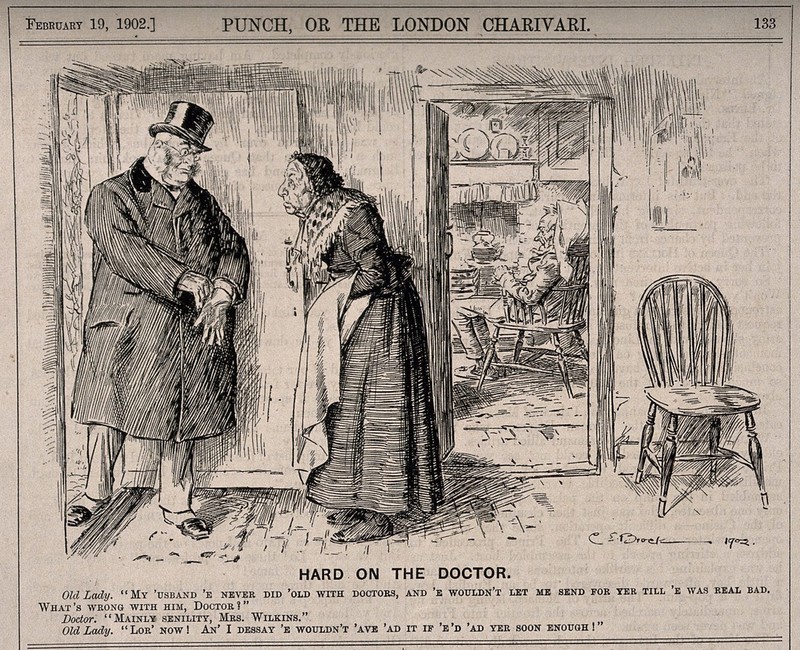
A doctor visiting a senile old man and discussing his verdict with the patient's wife. Wood engraving by C.E. Brock, 1902., 1902, by Charles Edmund Brock
Charles Edmund Brock · Wellcome Collection, London · Wellcome Collection
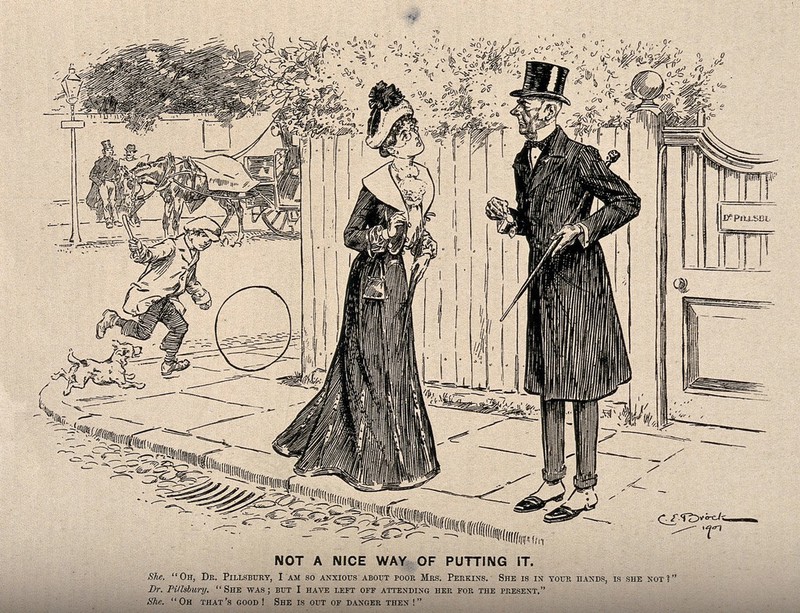
A well dressed lady asking a doctor how one of his patients is, he retorts that the patient is no longer in his care, the relieved lady replies she is glad the patient is now out of danger. Wood engraving by C.E. Brock, 1901., 1901, by Charles Edmund Brock
Charles Edmund Brock · Wellcome Collection, London · Wellcome Collection
Life and career
Dated record
Life and career
Explore 1870–1938
The full dated record · 3 entries
1870
Charles Edmund Brock born at Holloway.
1899
John Venn is dated 1899.
1938
Charles Edmund Brock died at London.
Places
Named by the record
Places
Only places the record itself states, plotted where the house gazetteer settles their coordinates. Nothing is inferred from a name or a nationality.
Holloway.
Birth place
London.
Death place
Examples of complete book illustrations
The following examples show what a complete set of illustrations for a single book look like.
Notes from the source article
Cited by Wikipedia
Notes from the source article
These works are cited by the source article, in its own numbering. They are recorded as its citations, not as sources VALÉORINE has verified.
- 1.Dalby, Richard. The Golden Age of Children's Book Illustration. Gallery Books. 1991.
- 2.National Archives. 1939 Register; Reference: RG 101/466A E.D. ARNQ. 1939-09-29.
- 3.To confuse things even more, the London Brock was registered at Charles Edmund at birth, but opted to use Edmond rather than Edmund as this second name.
- 4.Wills and Probate 1996 to present: Search for Surname Brock and Year of Death 1964. Find a Will Service.
- 5.The Kind and Queen Visit the Academy. The Guardian. Monday 20 May 1935. 8. 1935-05-20.
- 6.Charles Skinton Ltd. The Brocks: a family of Cambridge artists and illustrators. 29. 1975.
- 7.Graves, Algernon. The Royal Academy of Arts: A completed Dictionary of Contributors and their work from its foundation in 1769 to 1904. George Bell and Sons. III: Eadie to Harraden. 389. 1905.
- 8.Town and County News: Cambridge: The Victoria Memorial. Cambridge Independent Press. Friday 26 June 1903. 5. 1903-06-26.
- 9.Houfe, Simon. The Dictionary of British Book Illustrators and Caricaturists, 1800–1914. Antique Collectors' Club Ltd. 195–196. 1981. 0902028731.
- 10.Golfiana, Magazine. Golfiana Magazine. 3. 4. 1991.
- 11.Charles Skinton Ltd. The Brocks: a family of Cambridge artists and illustrators. 141–152. 1975.
- 12.Two of these were in the Punch Annual Almanac (that is, they appear only in the bound set of a year's editions rather than in the weekly editions).
- 13.One of these was in the Annual Almanac.
- 14.One of these was in the Annual Almanac.
- 15.One of these was an illustration for a poem in the Annual Almanac.
- 16.There were none in 1908 or 1909, and the 1910 sketch was actually dated 1909.
- 17.Technically, Punch called these illustrations sketches as they were accompanied by dialogue. Punch reserved the name cartoons for illustrations without any accompanying text, or only with a title.
- 18.This was one of the school stories for girls written under Hadath's female pseudonym, Florence Gunby Hadath.
- 19.Wills and Probates 1858-1996: Pages for Brock and the year of death 1938. Find a Will Service.
- 20.Bradshaw, Percy V. The Art of the Illustrator: CE Brock & His Work. Press Art School.
- 21.Macmillan. Pen Drawing and Pen Draughtsmen: Their work and there methods: A study of the art to-day with technical suggestions. 344. 1894.
- 22.Keegan Paul & Co has long ago been subsumed into Routledge.
- 23.The British Library Catalogue shows that the 8º size book had 168-page in the 1887 edition and 175 in the 1909 edition.
- 24.The edition with the illustrations by Paul Hardy is available on Project Gutenberg and elsewhere.
- 25.The Connisseur Bookself. The Connoisseur: An Illustrated Magazine for Collectors. 51. 204. 223. 1918-08-01.
- 26.Johnson, J. The Dictionary of British Artists 1880-1940. Antique Collectors' Club. 76. 1905-06-08.
- 27.Charles Edmund Brock: Charles E Brock and His Work: The Art of the Illustrator (Limited Edition Prints). Illustration Art Gallery with The Book Palace.
References
Citations
References
Each reference names the institution holding it, so a reader may go to the document itself.
Institutional database
Wikidata, structured authority record Q2930473: Charles Edmund BrockWikimedia Foundation
Institutional witness
The Encyclopedia exists whether or not anything is for sale. Corrections are recorded rather than overwritten, and every version of this record is kept. Published 16 August 2026.
Elsewhere in Illustration
5,224 published records in this field, each with its sources named.
- Charles CopelandIllustrator
- Charles CordinerIllustrator
- Charles Dana GibsonIllustrator
- Charles DoudietIllustrator
- Charles Édouard DelortIllustrator
- Charles Edwin FrippIllustrator
- Charles EyckIllustrator
- Charles FouquerayIllustrator
Best supported in this field
For owners
Own a work by Charles Edmund Brock?
A specialist will read what you send and tell you what the house can establish, what it cannot, and whether the object is suited to sale. There is no charge and no obligation. The object stays with you throughout; nothing is shipped to us unless it is arranged in writing beforehand.