
Charles Altamont Doyle
Charles Altamont Doyle (25 March 1832 – 10 October 1893) was a British illustrator, watercolourist and civil servant. A member of an artistic family, he is remembered today primarily for being the father of author Sir Arthur Conan Doyle, creator of fictional character Sherlock Holmes.
Also recorded as Charles Altimont Doyle
Charles Altamont Doyle
Charles Altamont Doyle · Wellcome Collection, London · Wellcome Collection · Public Domain Mark
- Name
- Charles Altamont Doyle
- Born
- 25 March 1832
- Birthplace
- London, England
- Died
- 10 October 1893
- Place of death
- Dumfries, Scotland
- Known for
- * Watercolours
- Nationality
- United Kingdom of Great Britain and Ireland
- Occupation
- painter · illustrator · draftsperson
- Fields
- painting · illustration
- Languages
- English
VALÉORINE Encyclopedia
VALÉORINE documentary reading
Documentary summary
Charles Altamont Doyle (25 March 1832 – 10 October 1893) was a British illustrator, watercolourist and civil servant. A member of an artistic family, he is remembered today primarily for being the father of author Sir Arthur Conan Doyle, creator of fictional character Sherlock Holmes.
Admitted source layer · organised and presented by VALÉORINE
Reference Check
Propose documentary evidence for Charles Altamont Doyle. A contribution is never written directly as fact: identity, source, rights and evidence gates still decide.
Sign in to contribute
Documentary evidence
Documentary basis
Authority files
wikidata · Q342969 · wikipedia · Charles Altamont Doyle
In this article
Key facts
Key facts
• Name — Charles Altamont Doyle • Born — 25 March 1832 • Birthplace — London, England • Died — 10 October 1893 • Place of death — Dumfries, Scotland • Children — 9 or 10, including Arthur Conan Doyle • Parents — John Doyle (father) • Known for — * Watercolours • illustrations
Early life
Early life
Born in London, Doyle was the son of artist John Doyle, a political cartoonist known as H.B., and Marianna (Conan) Doyle. The family had seven children, and three of his older brothers were artists: James William Edmund Doyle, Richard "Dickie" Doyle, and Henry Edward Doyle. The family was of Irish background but Doyle was born and raised in England. Similarly to his elder brother Richard, he had no formal training, apart from lessons in his father's studio.
Career
Career
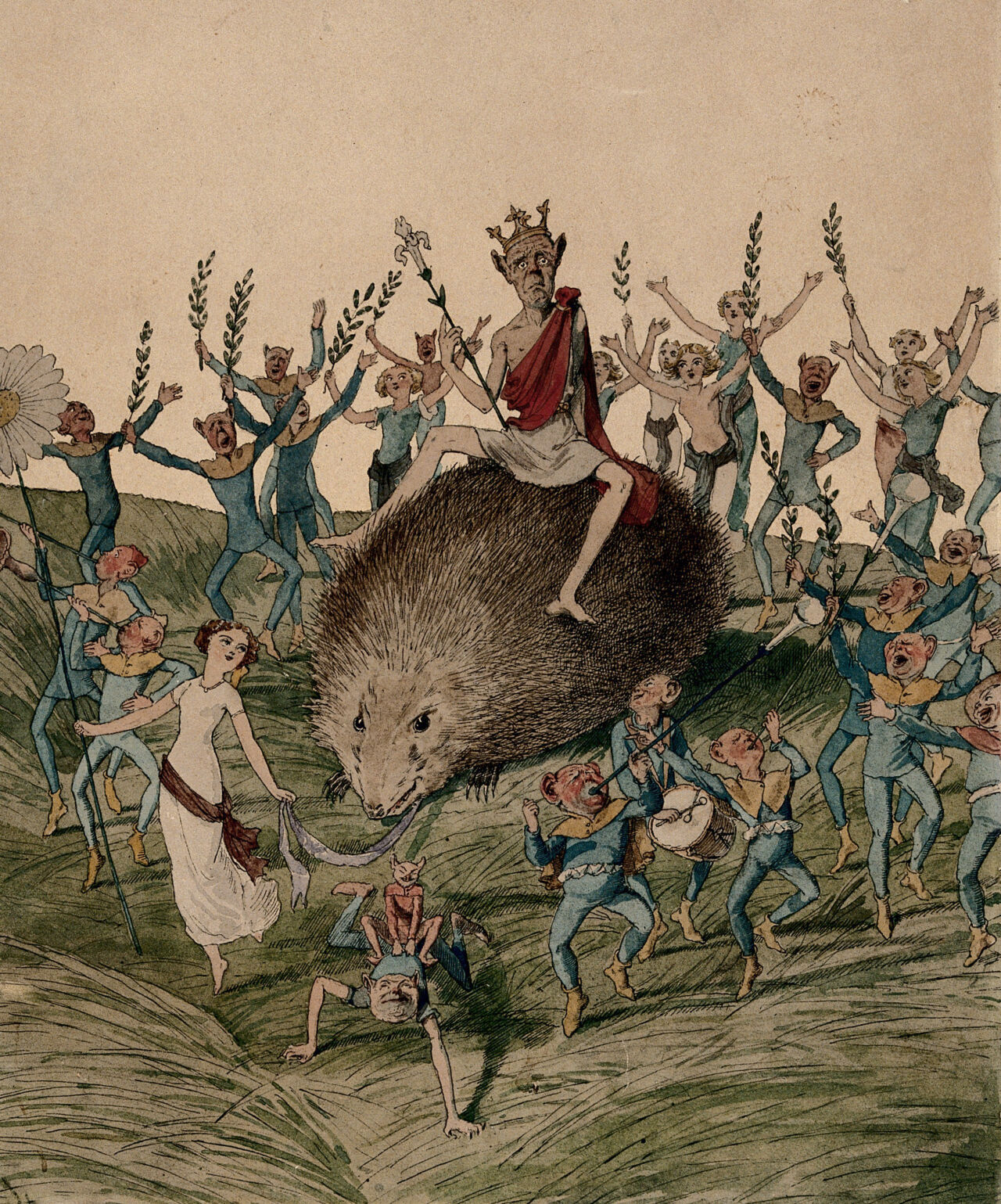
In 1849 Doyle moved to Edinburgh, to take up a post at the Scottish Office of Works, where he was employed as an assistant surveyor. On 31 July 1855, he married Mary Foley (1837–1920), his landlady's daughter. Together they became parents to several children (sources debate whether it was nine or ten), seven of whom survived childhood, including Arthur Conan Doyle, John Francis Innes Hay (known as Innes or Duff), and Jane Adelaide Rose (known as Ida). To support his growing family, in addition to full-time employment Doyle continued to produce illustrations for at least 23 books, as well as several designs for journals. These included editions of The Pilgrim's Progress (1860) and Robinson Crusoe (1861), Beauty and the Beast (late 1860s), The Queens of Society (1872), and Our Trip to Blunderland (1877) a parody of Lewis Carroll. Although he exhibited at the Royal Scottish Academy, Doyle was not as successful an artist as he wanted, and suffered depression and alcoholism. His paintings, which were generally of fairies, such as In the shade or A Dance Around The Moon, or similar fantasy scenes, reflected his mood, becoming more macabre over time. • Illustration — Meditation, Self Portrait 1885–1893, by Charles Altamont Doyle In 1876 he was dismissed from his job and given a pension; in 1881 Doyle's family sent him to Blairerno House, a "home for Intemperate Gentlemen". After several escapades, in 1885 he was sectioned after managing to "procure drink", and becoming aggressively excited, remaining confused and incoherent for several days afterwards. He was admitted to Sunnyside, Montrose Royal Lunatic Asylum. While there, his depression grew worse, and he began experiencing epileptic seizures and problems with short-term memory loss due to the effects of long-term drinking. Nonetheless, he continued to paint. He completed illustrations for the July 1888 edition of his son's first Sherlock Holmes novel A Study in Scarlet. During his period at the asylum he continued to work, producing volumes of drawings and watercolours in sketchbooks with fantasy themes such as elves, faerie folk, and scenes of death and heavenly redemption. His accompanying notes featured wordplay and visual puns, described as a "sort of bucolic phantasmagoria: mammoth lilypads and leafy branches, giant birds and mammals, sinister blossoms sheltering demons and damsels alike". Doyle created these illustrations to both protest his confinement and provide evidence of his sanity. He sent the drawings to his family as proof that he had been wrongfully committed, writing "Keep steadily in view that this Book is ascribed wholly to the produce of a MADMAN. Whereabouts would you say was the deficiency of intellect? Or depraved taste?" At other times he was more contented, contributing drawings and articles to the asylum's newsletter and sketching the staff. On 23 January 1892 he was admitted as a patient to the Royal Edinburgh Hospital, and was treated there until 26 May 1892. In May 1892 he was moved to the Crichton Royal Institution, Dumfries. He died from "a fit during the night" on 10 October 1893. He was buried in the High Cemetery in Dumfries.
Re-evaluation
Re-evaluation
• Illustration — In the shade, by Charles Altamont Doyle His son, Arthur Conan Doyle, remembered his father with affection, describing him in his autobiography as "...full of the tragedy of unfulfilled powers and of underdeveloped gifts. He had his weaknesses, as all of us have ours, but he had also some very remarkable and outstanding virtues". In the Sherlock Holmes story "His Last Bow" (1917), Holmes uses the name Altamont as an alias. In 1924 he mounted an exhibition of his father's works at the Brook Galleries in London, where they were praised by George Bernard Shaw. The Doyle Diary, containing a facsimile of works from a sketchbook he created from March to July 1889 while at Montrose, was published in 1978. This brought Doyle's work to wider attention and appreciation.
General reference
General reference
*
Identity and origins
Identity and origins
The authorities additionally record the heading Charles Altimont Doyle. His recorded language was English. He was the child of John Doyle. He married Mary Foley. 3 children are recorded: Arthur Conan Doyle, Jane Adelaide Rose Doyle and John Francis Innes Hay Doyle. Recorded as painter, illustrator and draftsperson.
Life and career
Dated record
Life and career
The full dated record · 2 entries
1832
Charles Altamont Doyle born at London.
1893
Charles Altamont Doyle died at Dumfries.
Places
Named by the record
Places
Only places the record itself states, plotted where the house gazetteer settles their coordinates. Nothing is inferred from a name or a nationality.
London.
Birth place
Dumfries.
Death place
Notes from the source article
Cited by Wikipedia
Notes from the source article
These works are cited by the source article, in its own numbering. They are recorded as its citations, not as sources VALÉORINE has verified.
- 1.Self portrait. National Gallery of Scotland.
- 2.The Dictionary of Scottish Painters. 1600 to the present. Paul Harris and Julian Halsby. Canongate Publishing. 1990.
- 3.ULAN Full Record Display. The J. Paul Getty Trust.
- 4.Miller, Russell. The Adventures of Arthur Conan Doyle. Random House. 2010. 9781407093086.
- 5.Cooke, Simon. Charles Altamont Doyle. www.victorianweb.org.
- 6.Charles Altamont Doyle. National Galleries of Scotland.
- 7.Stacy, Greg. Discovering the Jolly Nightmare. L.A. Weekly. 27 November 2003.
- 8.Beveridge, Allan. What became of Arthur Conan Doyle's father? The last years of Charles Altamont Doyle. Journal of the Royal College of Physicians of Edinburgh. 36. 3. 264–270. 2006. 10.1177/1478271520063603022.
- 9.Beveridge, Allan. Psychiatry in pictures. The British Journal of Psychiatry. 191. 6. A22. 2007. 0007-1250.
- 10.Fiction. The Washington Post. 17 February 1980.
- 11.Devers, A.N. The Father and Son Who Believed in Faeries. Lapham's Quarterly. 4 September 2012.
- 12.Lothian Health Services Archive. lhsa.blogspot.com.
- 13.Charles Altamont Doyle: National Art Gallery NSW. www.artgallery.nsw.gov.au.
- 14.The Life and Art of Charles Doyle. ils.unc.edu.
- 15.Powell, Violet. Book review:The Doyle diary. Apollo (Archive 1925–2005). 109. 73. 1 January 1979.
References
Citations
References
Each reference names the institution holding it, so a reader may go to the document itself.
reference work
Secondary witnessreference work
Secondary witness
The Encyclopedia exists whether or not anything is for sale. Corrections are recorded rather than overwritten, and every version of this record is kept. Published 16 August 2026.
Elsewhere in Illustration
5,224 published records in this field, each with its sources named.
- channelIllustrator
- Charles Abraham ChasselatIllustrator
- Charles Allan GilbertIllustrator
- Charles Allston CollinsIllustrator
- Charles BarberIllustrator
- Charles Bécart de Granville et de FonvilleIllustrator
- Charles BraggIllustrator
- Charles Burton BarberIllustrator
Best supported in this field
For owners
Own a work by Charles Altamont Doyle?
A specialist will read what you send and tell you what the house can establish, what it cannot, and whether the object is suited to sale. There is no charge and no obligation. The object stays with you throughout; nothing is shipped to us unless it is arranged in writing beforehand.