
Australian dollar banknote
The notes of the Australian dollar were first issued by the Reserve Bank of Australia on 14 February 1966, when Australia changed to decimal currency and replaced the pound with the dollar. This currency was a lot easier for calculating compared to the previous Australian pound worth 20 shillings or 240 pence.
Also recorded as banknote of Australia · Australian dollar note · AUD banknote
Australian dollar banknote
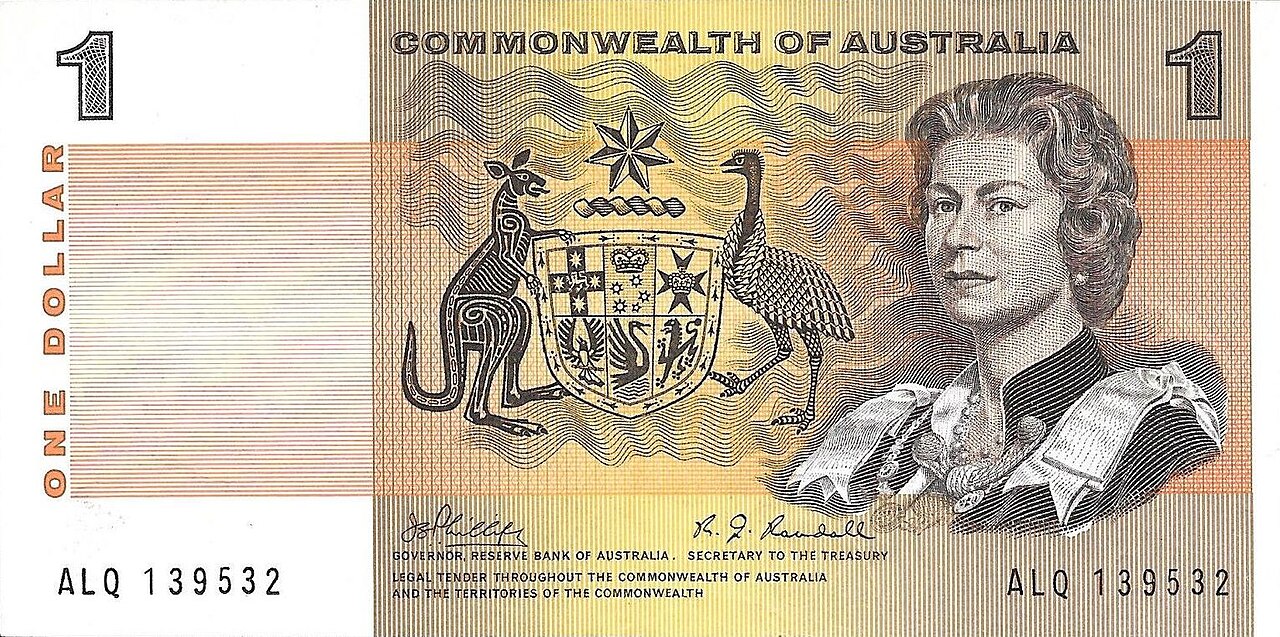
Reserve Bank of Australia · E-BAY · Public domain
- Field
- banknote
VALÉORINE Encyclopedia
VALÉORINE documentary reading
Documentary summary
The notes of the Australian dollar were first issued by the Reserve Bank of Australia on 14 February 1966, when Australia changed to decimal currency and replaced the pound with the dollar. This currency was a lot easier for calculating compared to the previous Australian pound worth 20 shillings or 240 pence.
Admitted source layer · organised and presented by VALÉORINE
Note VALÉORINE
No house-authored Note is published until its assertions and sources pass the VALÉORINE evidence contract. The documentary article remains available in full while that enrichment is being consolidated.
Documentary enrichment in progress · no unsupported statement published
Reference Check
Propose documentary evidence for Australian dollar banknote. A contribution is never written directly as fact: identity, source, rights and evidence gates still decide.
Sign in to contribute
Documentary evidence
Evidence Panel
original value insufficient · checked 25 September 2026
- Identity
- resolved
- Independent source families
- 0
- Admitted assertions
- 0
- Open conflicts
- 0
Authority files
wikidata · Q4856391
In this article
First series (paper)
First series (paper)
The $1 (10/-), $2 (£1), $10 (£5), and $20 (£10) had exact exchange rates with pounds and were a similar colour to the notes they replaced, but the $5 (worth £2 10s) did not, and was not introduced until May 1967 when the public had become more familiar with decimal currency. The original notes were designed by Gordon Andrews, who rejected traditional Australian clichés in favour of interesting and familiar subjects such as Aboriginal culture, women, the environment, architecture and aeronautics. Notes issued between 1966 and 1973 bore the title "Commonwealth of Australia". Starting from 1974, the title on the new notes only read "Australia" and the legal tender phrase was also changed from "Legal Tender throughout the Commonwealth of Australia and the territories of the Commonwealth" to "This Australian Note is legal tender throughout Australia and its territories". The $50 note was introduced in 1973 and the $100 note in 1984, in response to inflation requiring larger denominations for transactions. The $1 note was replaced by a $1 coin in 1984, while the $2 note was replaced by a smaller $2 coin in 1988. Although no longer printed, all previous notes of the Australian dollar are still considered legal tender. Paper series (1966–1996) • Image — Value — Dimensions — colours — Description — Date of circulation • Front — Back — Front — Back • — — $1 — 140 xx — Brown and orange — Queen Elizabeth II — David Malangi (artwork) — 1966–1984 • — — $2 — 145 xx — Green and yellow — John Macarthur — William Farrer — 1966–1988 • — — $5 — 150 xx — Mauve — Sir Joseph Banks — Caroline Chisholm — 1967–1992 • — — $10 — 155 xx — Blue and orange — Francis Greenway — Henry Lawson — 1966–1993 • — — $20 — 160 xx — Red and yellow (orange backset) — Sir Charles Kingsford Smith — Lawrence Hargrave — 1966–1994 • — — $50 — 165 xx — Yellow, blue, brown and green — Howard Florey, Baron Florey — Sir Ian Clunies Ross — 1973–1995 • — — $100 — 172 xx — Light blue and grey — Sir Douglas Mawson — John Tebbutt — 1984–1996 •;Remarks
Polymer commemorative $10 note
Polymer commemorative $10 note
In 1988, the Reserve Bank of Australia issued $10 notes in plastic. The polypropylene polymer banknotes were produced by Note Printing Australia, to commemorate the bicentenary of European settlement in Australia. These notes contained a transparent "window" with a diffractive optically variable device (DOVD) image of Captain James Cook as a security feature. Australian notes were the first in the world to use such features. All current Australian notes also contain microprinting for further security. Polymer commemorative (1988) • Note — Obverse design — Reverse design — Dimensions (mm) — Weight (g) — Main colour — Window image — Embossing — Printed — Issued • $10 — HMS Supply anchored at Sydney Cove — Australian Aboriginal culture and peoples — 155 xx — Green, orange and yellow — Captain Cook — 26 Jan 1988 •;Remarks
Second series (polymer)
Second series (polymer)
There were initial difficulties with the first polymer note issued; the $10 note had problems with the holographic security feature detaching from the note itself. However, the Reserve Bank saw potential in the issue of plastic notes and commenced preparations for an entirely new series made from polymer, commencing with the $5 note in 1992. Today all Australian notes are made of polymer. The Reserve Bank also changed the individuals depicted on the currency, becoming one of only five other countries in the world that depict a greater number of women than men on their banknotes. In April 1995, the design of the $5 notes was updated to match the rest of the New Banknote Series, with additional slight changes in 1996. In 2001, a special commemorative 'Federation' $5 note was produced, but in 2002, the previous version's production commenced again. From 2002, the design of all notes (except for the $5 note picturing the Queen) was slightly changed to include the names of the people pictured on them under the portraits, and swapping the order of the signatures of officials on the notes. Second series (1992–2016) • Note — Image — Obverse design — Reverse design — Dimensions 4 — Weight 4 — Main colour — Window image — Embossing 5 — Printed — Issued • Front — Back • $5 original 1 — Queen Elizabeth II — Parliament House, Old Parliament House — 130 xx — 0.764 g — Pale mauve — Gum flower — rowspan="2" — 1992–1993 — 7 Jul 1992 • $5 recoloured — 130 xx — 0.783 g — Violet, pink — 1995–2015 — 24 April 1995 • $5 Federation 2 — Sir Henry Parkes — Catherine Helen Spence — 130 xx — 0.815 g — Leaf-shaped window — "5" — 1 Jan 2001 • $10 3 — — — Banjo Paterson — Dame Mary Gilmore — 137 xx — 0.841 g — Blue — Windmill — Wavy lines — 1993–2015 — 1 Nov 1993 • $20 — — — Mary Reibey — Reverend John Flynn — 144 xx — 0.900 g — Red/Orange — Compass — "20" — 1994–2013 — 31 Oct 1994 • $50 — — — David Unaipon — Edith Cowan — 151 xx — 0.955 g — Yellow — Southern Cross — "50" — 1995–2016 — 4 Oct 1995 • $100 — — — Dame Nellie Melba — Sir John Monash — 158 xx — 1.006 g — Green — Lyrebird — "100" — 1996–2017 — 15 May 1996 •;Remarks # Some members of the public had difficulties in differentiating between the $5 and $10 notes especially in poor light conditions. # Commemorating the Centenary of Federation. It also features the text of the speech Henry Parkes gave to parliament in favour of federation in microprint, on the side featuring his face. # This note features excerpts of text from Banjo Paterson's most famous poem The Man From Snowy River intertwined with the text "TEN DOLLARS" in microprint on the front, and the text of Mary Gilmore's patriotic poem No Foe Shall Gather Our Harvest on the reverse. # Thickness and weight of notes is ±5% per 1000 notes # Embossing is inside the shiny, transparent window.
Third series (polymer)
Third series (polymer)
On 13 February 2015 the Reserve Bank of Australia announced that the next series of Australia notes would have a tactile feature to help the visually impaired community to tell the value of the note after a successful campaign led by 15-year-old Connor McLeod, who is blind, to introduce the new feature. The notes retain the key aspects of the previous series' design such as the colour, size and people portrayed for ease of recognition and to minimise disruption to businesses. The new $5 note includes the tactile feature and was issued on 1 September 2016, to coincide with Australia's National Wattle Day, followed by the new $10 banknote on 20 September 2017. The new $50 note was released for circulation on 18 October 2018, followed by the new $20 note on 9 October 2019, and the new $100 was released on 29 October 2020. The Reserve Bank currently has no plans to release fourth series notes in denominations higher than $100, despite the amount of inflation that has occurred since the $100 note was introduced in 1984. In May 2019 the Reserve Bank confirmed that the $50 note contained a misspelling of the word "responsibility" on the reverse design, a typo that would be corrected in future printings. It was announced on 2 February 2023 that the new $5 note would not feature Charles III, but rather an Indigenous design. Treasurer Jim Chalmers said, "The monarch will still be on the coins, but the $5 note will say more about our history and our heritage and our country, and I see that as a good thing." Next Generation Banknote (NGB) series (2016–present) • Value — Image — Design — Dimensions 1 — Weight 1 — Main colour — Window image — Embossing 3 — Printed — Issued • Front — Back — Front — Back • $5 — — — Queen Elizabeth II — Parliament House 4 — 130 xx — unknown — Purple — Top to Bottom window 2 — Federation star — Currently printing — 1 September 2016 • $10 — — — Banjo Paterson — Dame Mary Gilmore — 137 xx — unknown — Blue — Pen nib — 20 September 2017 • $20 — — — Mary Reibey — Reverend John Flynn — 144 xx — 0.82 g — Red — Compass — 9 October 2019 • $50 — — — David Unaipon — Edith Cowan — 151 xx — unknown — Yellow — Book — 18 October 2018 • $100 — — — Dame Nellie Melba — Sir John Monash — 158 xx — unknown — Green — Fan — 29 October 2020 • Source: Reserve Bank of Australia. •;Remarks # Thickness and weight of notes is ±5% per 1000 notes # A new clear polymer window that goes from the top to the bottom of the note that is all clear # Embossing is inside the small window. # There are two blocks of micro-text on the reverse side of the Fourth series five dollar note, which contains excerpts of the Constitution of Australia

Global money collection. Paper banknotes of various countries, world currencies displayed in a hotel reception area in South Korea. Global currency showcase of different banknotes.)
Marek Ślusarczyk (Tupungato) Photo portfolio · Marek Slusarczyk
Notes from the source article
Cited by Wikipedia
Notes from the source article
These works are cited by the source article, in its own numbering. They are recorded as its citations, not as sources VALÉORINE has verified.
- 1.Reserve Bank of Australia. The Reserve Bank and Reform of the Currency: 1960–1988: Australia's First Decimal Banknotes. Reserve Bank of Australia Museum.
- 2.Australia, Reserve Bank of. The Designer: Gordon Andrews The Decimal Revolution Reserve Bank of Australia – Museum.
- 3.Reserve Bank of Australia. The Reserve Bank and Reform of the Currency: 1960–1988, Inflation and the Note Issue. Reserve Bank of Australia Music um.
- 4.Reserve Bank of Australia. DELIBERATE DAMAGE. Legal.
- 5.Renniks Australian Coin and Banknote Values
- 6.Reserve Bank of Australia. Other Banknotes.
- 7.Reserve Bank of Australia. Introducing Polymer Banknotes: A New Era. Reserve Bank of Australia Museum.
- 8.Reserve Bank of Australia. List of Security Features. Counterfeit Detection.
- 9.Australia $10 – 1998.
- 10.Introducing Polymer Banknotes – 1988. Reserve Bank of Australia.
- 11.Coade, Melissa. Half the people depicted on Australian banknotes are women but it's a superficial measure of equality. The Mandarin. 2023-05-30.
- 12.Reserve Bank of Australia. Banknotes in Circulation-$5 BANKNOTE. banknotes.rba.gov.au.
- 13.Reserve Bank of Australia. A Complete Series of Polymer Banknotes: 1992–1996. Reserve Bank of Australia Museum.
- 14.Ian W. Pitt. Renniks Australian Coin and Banknote Values. Renniks Publications. 168. 2000. 0-9585574-4-6.
- 15.Other Banknotes.
- 16.Media Office-Reserve Bank of Australia. Next Generation Banknotes: Additional Feature for the Vision Impaired. rba.gov.au. 13 February 2015.
- 17.Haxton, Nance. RBA to introduce tactile banknotes after 15yo blind boy Connor McLeod campaigns for change. Australian Broadcasting Corporation. 18 February 2015.
- 18.Next Generation of Banknotes: Issuance Date for the New $5 Banknote Reserve Bank of Australia (www.rba.gov.au). Retrieved on 2016-02-16.
- 19.Reserve Bank of Australia. Next Generation of Banknotes: $10 Design Reveal. 17 February 2017.
- 20.Reserve Bank of Australia. Next Generation of Banknotes: Circulation Date for the New $50 Banknote. 5 September 2018.
- 21.Reserve Bank of Australia. Next Generation of Banknotes: $20 Enters General Circulation. 8 October 2019.
- 22.Reserve Bank of Australia. Next Generation of Banknotes: $100 Design Reveal. 24 February 2020.
- 23.Reserve Bank of Australia. Next Generation of Banknotes: Circulation Date for the New $100 Banknote. 30 September 2020.
- 24.BBC. Australia's A$50 note misspells responsibility. 8 May 2019.
- 25.Perry, Nick. Australia is removing British monarchy from its bank notes. Associated Press. 2 February 2023.
- 26.RBA Banknotes: Banknote Features.
References
Citations
References
Each reference names the institution holding it, so a reader may go to the document itself.
reference work
Partially resolved
Connections
Knowledge graph
Connections
Each connection was recorded deliberately, with the basis for it kept on the internal record.
Broader subject
3- Australian 1 dollar noteTerminology
Established from a fact already recorded on a verified source.
- Australian 100 dollar noteTerminology
Established from a fact already recorded on a verified source.
- Australian 50 dollar noteTerminology
Established from a fact already recorded on a verified source.
The Encyclopedia exists whether or not anything is for sale. Corrections are recorded rather than overwritten, and every version of this record is kept. Published 14 August 2026.
Elsewhere in Banknotes
194 published records in this field, each with its sources named.
- Australian 2 dollar noteTerminology
- Australian 20 dollar noteTerminology
- Australian 5 dollar noteTerminology
- Australian 50 dollar noteTerminology
- Australian five-pound noteTerminology
- Australian five-shilling noteTerminology
- Australian one-pound noteTerminology
- Australian ten pound noteTerminology
Best supported in this field
For owners
Own an object connected with Australian dollar banknote?
A specialist will read what you send and tell you what the house can establish, what it cannot, and whether the object is suited to sale. There is no charge and no obligation. The object stays with you throughout; nothing is shipped to us unless it is arranged in writing beforehand.