
United States one-hundred-dollar bill
The United States one-hundred-dollar bill (US$100) is a denomination of United States currency. The first United States Note with this value was issued in 1862, and the Federal Reserve Note version was first produced in 1914. Inventor and U.S. Founding Father Benjamin Franklin has been featured on the obverse of the bill since 1914, which now also contains stylized images of the Declaration of Independence, a quill pen, the Syng inkwell, and the Liberty Bell.
Also recorded as $100 · United States one hundred-dollar bill · United States 100-dollar bill · United States $100 bill
United States one-hundred-dollar bill

Bureau of Engraving and Printing · Public domain
- Field
- Federal Reserve Note
- Region
- United States
- Related practice
- cotton · linen
VALÉORINE Encyclopedia
VALÉORINE documentary reading
Documentary summary
The United States one-hundred-dollar bill (US$100) is a denomination of United States currency. The first United States Note with this value was issued in 1862, and the Federal Reserve Note version was first produced in 1914. Inventor and U.S. Founding Father Benjamin Franklin has been featured on the obverse of the bill since 1914, which now also contains stylized images of the Declaration of Independence, a quill pen, the Syng inkwell, and the Liberty Bell.
Admitted source layer · organised and presented by VALÉORINE
Note VALÉORINE
No house-authored Note is published until its assertions and sources pass the VALÉORINE evidence contract. The documentary article remains available in full while that enrichment is being consolidated.
Documentary enrichment in progress · no unsupported statement published
Reference Check
Propose documentary evidence for United States one-hundred-dollar bill. A contribution is never written directly as fact: identity, source, rights and evidence gates still decide.
Sign in to contribute
World of VALÉORINE
Documentary connections
Only confirmed graph relationships appear here. Images are shown only when their identity and reuse rights both pass the documentary gate.

Documentary evidence
Evidence Panel
not yet certified
- Identity
- resolved
- Independent source families
- 0
- Admitted assertions
- 0
- Open conflicts
- 0
Authority files
wikidata · Q550687 · wikipedia · United States one-hundred-dollar bill
In this article
Overview
Overview
The reverse depicts Independence Hall in Philadelphia, Pennsylvania, which it has featured since 1928. The bill is the largest denomination that has been printed and circulated since July 13, 1969, when the larger denominations of, and were retired. The bills are also informally referred to as "Benjamins", in reference to the use of Benjamin Franklin's portrait by the French painter Joseph Duplessis on the denomination, as "C-Notes" or "Century Notes", based on the Roman numeral for 100, or as "blue faces", based on the blue security features in the current design. The bill is one of two denominations printed today that does not feature a president of the United States, the other being the $10 bill, featuring Alexander Hamilton. The Series 2009 bill redesign was unveiled on April 21, 2010, and was issued to the public on October 8, 2013. The new bill costs 12.5 cents to produce and has a blue ribbon woven into the center of the currency with "100" and Liberty Bells, alternating, that appear when the bill is tilted. In 2024, $100 bills represented 82.46% of cash in circulation. Federal Reserve data from 2017 showed that the number of bills exceeded the number of bills. However, a 2018 research paper by the Federal Reserve Bank of Chicago estimated that 80 percent of bills were in other countries. Possible reasons included bills being used as a reserve currency against economic instability that affected other currencies, and use for criminal activities.
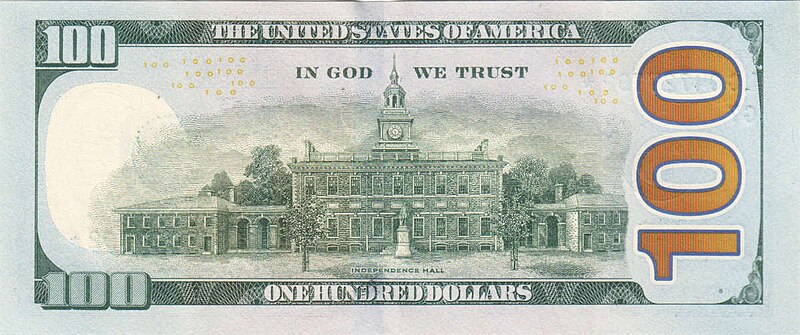
Reverse of the series 2009 $100 Federal Reserve Note
Bureau of Engraving and Printing
Key facts
Key facts
• Denomination — One hundred dollars • Country — United States • Width Mm — 157 • Height Mm — 66.3 • Weight G — ≈ 1.0 • Security Features — Security fibers, watermark, 3D security ribbon, security thread, color shifting ink, microprinting, raised printing, EURion constellation • Paper Type — 75% cotton 25% linen • Years Of Printing — 1861–present • Obverse Design — Benjamin Franklin's portrait by Joseph Duplessis, Declaration of Independence, quill pen, Syng inkwell, and an embedded image of the Liberty Bell • Obverse Design Date — 2009 • Reverse Design — Independence Hall • Reverse Design Date — 2009
Large-size notes
Large-size notes
(7.4218 × 3.125 in ≈ 189 × 79 mm) • Illustration — 1863 Legal Tender note The first Gold Certificates were issued with a bald eagle to the left and large green 100 in the middle of the obverse. • Illustration — 1880 Legal Tender (1869 version) A new United States Note was issued with a portrait of Abraham Lincoln on the left of the obverse and an allegorical figure representing architecture on the right. • Illustration — Series 1878 silver certificate The first silver certificate was issued with a portrait of James Monroe on the left side of the obverse. • Illustration — 1914 Federal Reserve Note The first Federal Reserve Note was issued with a portrait of Benjamin Franklin on the obverse and allegorical figures representing labor, plenty, America, peace, and commerce on the reverse. • Illustration — 1922 Gold Certificate The Series of 1880 Gold Certificate was re-issued with an obligation to the right of the bottom-left serial number on the obverse. • 1861: Three-year Interest Bearing Notes were issued that paid 7.3% interest per year. These notes were not primarily designed to circulate and were payable to the original purchaser of the dollar bill. The obverse of the note featured a portrait of General Winfield Scott. • 1862: The first United States Note was issued. Variations of this note were issued that resulted in slightly different wording (obligations) on the reverse; the note was issued again in Series of 1863. • 1863: Both one and two and one half year Interest Bearing Notes were issued that paid 5% interest. The one-year Interest Bearing Notes featured a vignette of George Washington in the center, and allegorical figures representing "The Guardian" to the right and "Justice" to the left. The two-year notes featured a vignette of the U.S. treasury building in the center, a farmer and mechanic to the left, and sailors firing a cannon to the right. • 1863: The first Gold Certificates were issued with a bald eagle to the left and large green '100' in the middle of the obverse. The reverse was distinctly printed in orange instead of green like all other U.S. federal government issued notes of the time. • 1864: Compound Interest Treasury Notes were issued that were intended to circulate for three years and paid 6% interest compounded semi-annually. The obverse is similar to the 1863 one-year Interest Bearing Note. • 1869: A new United States Note was issued with a portrait of Abraham Lincoln on the left of the obverse and an allegorical figure representing architecture on the right. Although this note is technically a United States Note, TREASURY NOTE appeared on it instead of UNITED STATES NOTE. • 1870: A new Gold Certificate with a portrait of Thomas Hart Benton on the left side of the obverse was issued. The note was one-sided. • 1870: National Gold Bank Notes were issued specifically for payment in gold coin by participating national gold banks. The obverse featured vignettes of Perry leaving the USS St. Lawrence and an allegorical figure to the right; the reverse featured a vignette of U.S. gold coins. • 1875: The reverse of the Series of 1869 United States Note was redesigned. Also, TREASURY NOTE was changed to UNITED STATES NOTE on the obverse. This note was issued again in Series of 1878 and Series of 1880. • 1878: The first silver certificate was issued with a portrait of James Monroe on the left side of the obverse. The reverse was printed in black ink, unlike any other U.S. Federal Government issued bill. • 1882: A new and revised Gold Certificate was issued. The obverse was partially the same as the Series 1870 gold certificate; the border design, portrait of Thomas H. Benton, and large word GOLD, and gold-colored ink behind the serial numbers were all retained. The reverse featured a perched bald eagle and the Roman numeral for 100, C. • 1890: Treasury or "Coin Notes" were issued for government purchases of silver bullion from the silver mining industry. The note featured a portrait of Admiral David G. Farragut. The note was also nicknamed a "watermelon note" because of the watermelon-shaped 0's in the large numeral '100' on the reverse; the large numeral '100' was surrounded by an ornate design that occupied almost the entire note. • 1891: The reverse of the Series of 1890 Treasury Note was redesigned because the Treasury felt that it was too "busy" which would make it too easy to counterfeit. More open space was incorporated into the new design. • 1891: The obverse of the Silver Certificate was slightly revised with some aspects of the design changed. The reverse was completely redesigned and also began to be printed in green ink. • 1902: An extremely rare National Banknote was issued. It had a blue seal, and John J. Knox on the obverse, and two men and an eagle on top of a shield on the reverse. • 1914: The first Federal Reserve Note was issued with a portrait of Benjamin Franklin on the obverse and allegorical figures representing labor, plenty, America, peace, and commerce on the reverse. • 1922: The Series of 1880 Gold Certificate was re-issued with an obligation to the right of the bottom-left serial number on the obverse.
Small size notes
Small size notes
(6.14 × 2.61 in ≅ 156 × 66 mm) • Illustration — Both views (obverse and reverse) of the Series of 1934 Gold Certificate • Illustration — Obverse of a Series 2006A note • Illustration — Joseph Duplessis portrait of Benjamin Franklin used on the bill from Series 1928 until Series 1995 • Illustration — H. B. Hall engraving of Joseph Duplessis portrait of an older Benjamin Franklin used on the current bill since Series 1996 • Illustration — Comparison between a Series 1990 note and a Series 2009A note • Illustration — Obverse of a Series 2025 note (with the signature of the U.S. President Donald Trump) • 1929: Under the Series of 1928, all U.S. currency was changed to its current size and began to carry a standardized design. All variations of the bill would carry the same portrait of Benjamin Franklin, same border design on the obverse, and the same reverse with a vignette of Independence Hall. The bill was issued as a Federal Reserve Note with a green seal and serial numbers and as a Gold Certificate with a golden seal and serial numbers. • 1933: As an emergency response to the Great Depression, additional money was pumped into the American economy through Federal Reserve Bank Notes issued under Series of 1929. This was the only small-sized bill that had a slightly different border design on the obverse. The serial numbers and seal on it were brown. • 1934: The redeemable in gold clause was removed from Federal Reserve Notes due to the U.S. withdrawing from the gold standard. • 1934: Special Gold Certificates were issued for non-public, Federal Reserve bank-to-bank transactions. These notes featured a reverse printed in orange instead of green like all other small-sized notes. The wording on the obverse was also changed to ONE HUNDRED DOLLARS IN GOLD PAYABLE TO THE BEARER ON DEMAND AS AUTHORIZED BY LAW. • 1950: Many minor aspects on the obverse of the Federal Reserve Note were changed. Most noticeably, the treasury seal, gray numeral '100', and the Federal Reserve Seal were now smaller with small "spikes" added around the Federal Reserve seal, like the Treasury seal. • 1963: Because dollar bills were no longer redeemable in silver, beginning with Series 1963A, WILL PAY TO THE BEARER ON DEMAND was removed from the obverse of the Federal Reserve Note and the obligation was shortened to its current wording, THIS NOTE IS LEGAL TENDER FOR ALL DEBTS, PUBLIC AND PRIVATE. Also, IN GOD WE TRUST was added to the reverse. • 1966: The first and only small-sized United States Note was issued with a red seal and serial numbers. It was the first of all United States currency to use the new U.S. treasury seal with wording in English instead of Latin. Like the Series 1963 and United States Notes, it lacked WILL PAY TO THE BEARER ON DEMAND on the obverse and featured the motto IN GOD WE TRUST on the reverse. The United States Note was issued due to legislation that specified a certain dollar amount of United States Notes that were to remain in circulation. Because the and United States Notes were soon to be discontinued, the dollar amount of United States Notes would drop, thus warranting the issuing of this note. United States Notes were last printed in 1969 and last issued in 1971. • 1990: The first new-age anti-counterfeiting measures were introduced under Series 1990 with microscopic printing around Franklin's portrait and a metallic security strip on the left side of the bill. • March 25, 1996: The first major design change of the note since 1929 took place with the adoption of a contemporary style layout. The main intent of the new design was to deter counterfeiting, which had become more rampant following the rise of computer printing and image scanning technology. New security features included a watermark of Franklin to the right side of the bill, optically variable ink (OVI) that changed from green to black when viewed at different angles on the lower right corner '100', an enlarged and different portrait of Franklin, and hard-to-reproduce fine line printing around Franklin's portrait and Independence Hall. Older security features such as interwoven red and blue silk fibers, microprinting, and a plastic security thread (which glows pink [nominally red] under a black light) were kept. The individual Federal Reserve Bank Seal with district letter was changed to a unified Federal Reserve System Seal along with an additional prefix letter being added to the serial number, w. The first of the Series 1996 bills were produced in October 1995. • February 2007: The first bills (a shipment of 128,000 star notes from the San Francisco FRB) from the Western Currency Facility in Fort Worth, Texas, were produced, almost 16 years after the first notes from the facility were produced. The shipment makes the bill the most recently added production to the facility's lineup. 4.6 billion notes were produced at the facility with Series 2006 and Cabral and Paulson signatures, including about 4.15 million star notes. • October 8, 2013: The newest bill was announced on April 21, 2010, and, because of printing problems, did not enter circulation until nearly three and a half years later, on October 8, 2013. In addition to design changes introduced in 1996, the obverse features the brown quill that was used to sign the Declaration of Independence; faint phrases from the Declaration of Independence; the Syng inkstand's inkwell; a bell within the inkwell's image that appears and disappears depending on the angle at which the bill is viewed using optically variable ink (OVI) and changes from copper to green; teal background color; a borderless portrait of Benjamin Franklin; a blue "3D security ribbon" (trademarked "Motion" by Crane Currency) on which images of Liberty Bells shift into numerical designations of '100' as the note is tilted; and to the left of Franklin, small yellow '100's whose zeros form the EURion constellation. The reverse features a large gradient '100' printed vertically on the right side, small yellow EURion '100's and has the fine lines removed from around the vignette of Independence Hall. These notes were issued as Series 2009A with Rios-Geithner signatures. Many of these changes are intended not only to thwart counterfeiting but to also make it easier to quickly check authenticity and help vision-impaired people. The first of the Series 2009 bills were produced in February 2010 while the Series 2009A replacement banknote was first produced in September 2011. • July 5, 2026: U.S. President Donald Trump posted a new image of the $100 bill featuring his signature on the social media site Truth Social, months after the Treasury Department announced that the signature of a sitting president would appear on U.S. paper money for the first time ahead of the United States Semiquincentennial.
Small size
Small size
• Type — Series — Register — Treasurer — Seal • National Bank Note Types 1 & 2 — 1929 — Jones — Woods — Brown • Federal Reserve Bank Note — 1928A • Type — Series — Secretary — Treasurer — Seal • Gold Certificate — 1928 — Mellon — Woods — Gold • United States Note — 1966 — Fowler — Granahan — Red • 1966A — Kennedy — Elston • Federal Reserve Note — 1928 — Mellon — Woods — Green • 1928A • 1934 — Morgenthau — Julian • 1934A • 1934B — Vinson • 1934C — Snyder • 1934D — Clark • 1950 • 1950A — Humphrey — Priest • 1950B — Anderson • 1950C — Dillon — Smith • 1950D — Granahan • 1950E — Fowler • 1963A • 1969 — Kennedy — Elston • 1969A — Kabis • 1969B — Connally • 1969C — Shultz — Bañuelos • 1974 — Simon — Neff • 1977 — Blumenthal — Morton • 1981 — Regan — Buchanan • 1981A — Ortega • 1985 — Baker • 1988 — Brady • 1990 — Villalpando • 1993 — Bentsen — Withrow • 1996 — Rubin • 1999 — Summers • 2001 — O'Neill — Marin • 2003 — Snow • 2003A — Cabral • 2006 — Paulson • 2006A • 2009 — Geithner — Rios • 2009A • 2013 — Lew • 2017A — Mnuchin — Carranza • 2021 — Yellen — Malerba • 2025 — Bessent
Withdrawal of large denomination bills ($500 and up)
Withdrawal of large denomination bills ($500 and up)
On July 14, 1969, the Federal Reserve announced that the large denominations of United States currency would be withdrawn from circulation; banks were instructed to return any notes received or deposited larger than $100 to the United States Treasury. While the larger denominations remained legal tender, with their removal, the $100 note was the largest denomination remaining in circulation. All the Federal Reserve Notes produced from Series 1928 up to before Series 1969 (i.e. 1928, 1928A, 1934, 1934A, 1934B, 1934C, 1934D, 1950, 1950A, 1950B, 1950C, 1950D, 1950E, 1963, 1966, 1966A) of the denomination added up to billion. Since some banknotes had been destroyed, and the population was 200 million at the time, there was less than one banknote per capita circulating. As of June 30, 1969, the U.S. coins and banknotes in circulation of all denominations were worth 50.936 billion of which 4.929 billion was circulating overseas. The currency and coin circulating within the United States was per capita. Since 1969, the demand for U.S. currency has greatly increased. The total amount of circulating currency and coin passed one trillion dollars in March 2011. Despite the degradation in the value of the U.S. banknote (which was worth about $ in 1969), and despite competition from some more valuable foreign notes (most notably, the 500 euro banknote), there are no current plans to re-issue banknotes above. Today's widespread use of electronic means to conduct high-value transactions has made large-scale physical cash transactions for legitimate business unnecessary from the government's point of view. Quoting T. Allison, Assistant to the Board of the Federal Reserve System in his October 8, 1998, testimony before the U.S. House of Representatives, Subcommittee on Domestic and International Monetary Policy, Committee on Banking and Financial Services:
Chronology
Dated record
Chronology
The full dated record · 1 entries
1861
United States one-hundred-dollar bill first recorded.
Places
Named by the record
Places
Only places the record itself states, plotted where the house gazetteer settles their coordinates. Nothing is inferred from a name or a nationality.
- United States
Named but not plotted · 1
United States one-hundred-dollar bill is associated with United States.
Country
Primary material
Documents and archives
institutional register
- Internet Archive holdings naming United States one-hundred-dollar bill
Unverified · Internet Archive
- Wikidata, structured authority record Q550687: United States one-hundred-dollar bill
Unverified · Wikimedia Foundation
reference work
- “United States one-hundred-dollar bill”, English Wikipedia, consulted as further reading
Reputable secondary · Wikipedia
Citations
References
Each reference names the institution holding it, so a reader may go to the document itself.
institutional register
Partially resolvedreference work
Partially resolvedinstitutional register
Wikidata, structured authority record Q550687: United States one-hundred-dollar billWikimedia Foundation
Unverified
The Encyclopedia exists whether or not anything is for sale. Corrections are recorded rather than overwritten, and every version of this record is kept. Published 14 August 2026.
Elsewhere in Banknotes
194 published records in this field, each with its sources named.
- United States NoteTerminology
- United States one hundred thousand-dollar billTerminology
- United States one thousand-dollar billTerminology
- United States one-dollar billTerminology
- United States ten-dollar billTerminology
- United States ten-thousand-dollar billTerminology
- United States twenty-dollar billTerminology
- United States two-dollar billTerminology
Best supported in this field
For owners
Own an object connected with United States one-hundred-dollar bill?
A specialist will read what you send and tell you what the house can establish, what it cannot, and whether the object is suited to sale. There is no charge and no obligation. The object stays with you throughout; nothing is shipped to us unless it is arranged in writing beforehand.