
Asger Jorn
Asger Oluf Jorn (3 March 1914 – 1 May 1973) was a Danish painter, sculptor, ceramic artist, and author. He was a founding member of the avant-garde movement COBRA and the Situationist International. The largest collection of Jorn's works—including his major work Stalingrad—can be seen in the Museum Jorn, Silkeborg, Denmark.
Also recorded as Asger Oluf Jørgensen · Asger Oluf Jorn · Asger Oluf Jorgensen · Asgeir Jorn
Asger Jorn
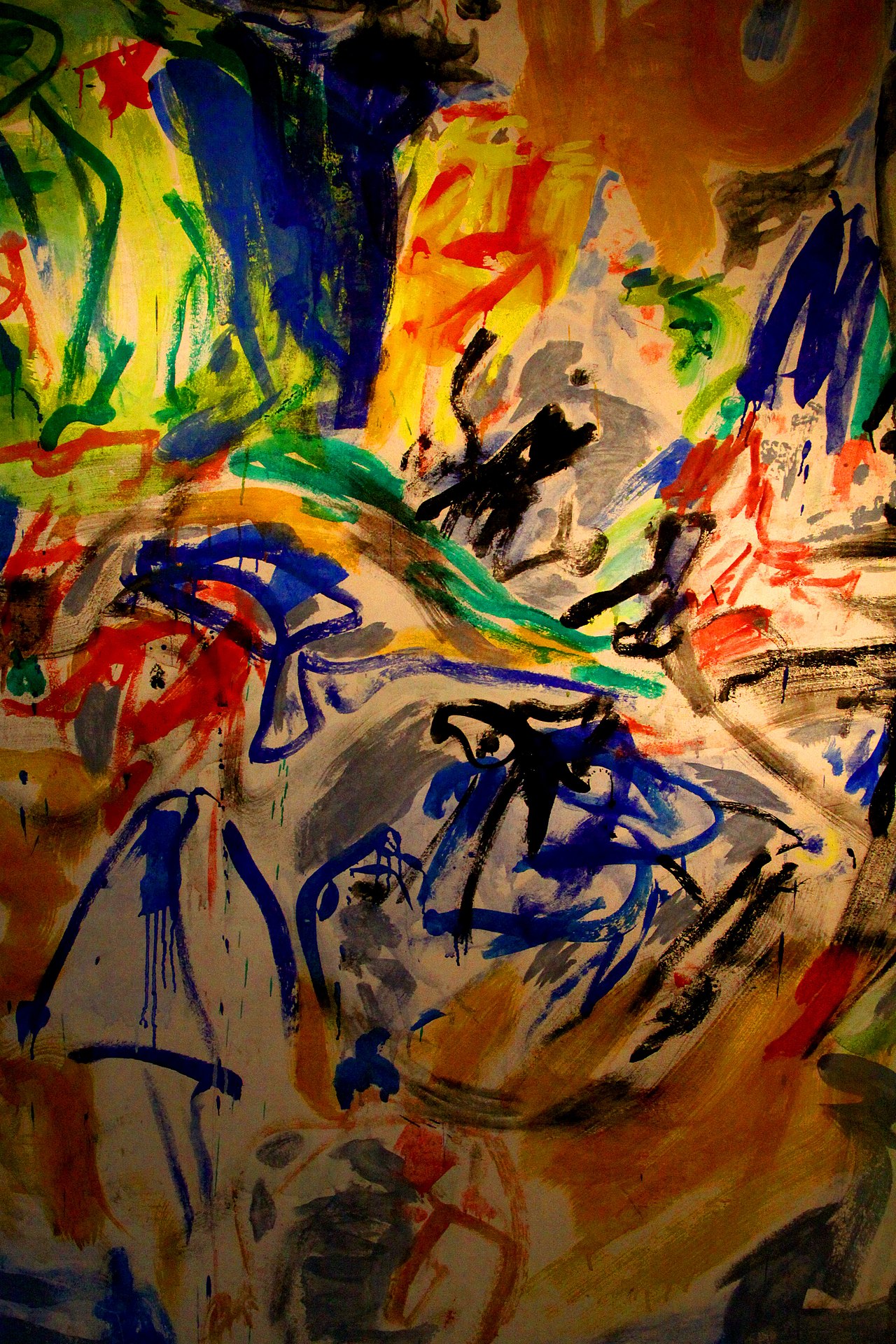
Guillaume Baviere · CC BY-SA 2.0
- Name
- Asger Jorn
- Birth Name
- Asger Oluf Jørgensen
- Born
- 3 March 1914
- Birthplace
- Vejrum, Jutland, Denmark
- Died
- 1 May 1973
- Place of death
- Århus, Denmark
- Known for
- Painting
- Movement
- CoBrA Situationist International
- Nationality
- Kingdom of Denmark.
- Movements
- COBRA and Situationist International.
VALÉORINE Encyclopedia
VALÉORINE documentary reading
Documentary summary
Asger Oluf Jorn (3 March 1914 – 1 May 1973) was a Danish painter, sculptor, ceramic artist, and author. He was a founding member of the avant-garde movement COBRA and the Situationist International. The largest collection of Jorn's works—including his major work Stalingrad—can be seen in the Museum Jorn, Silkeborg, Denmark.
Admitted source layer · organised and presented by VALÉORINE
Note VALÉORINE
No house-authored Note is published until its assertions and sources pass the VALÉORINE evidence contract. The documentary article remains available in full while that enrichment is being consolidated.
Documentary enrichment in progress · no unsupported statement published
Reference Check
Propose documentary evidence for Asger Jorn. A contribution is never written directly as fact: identity, source, rights and evidence gates still decide.
Sign in to contribute
World of VALÉORINE
Documentary connections
Only confirmed graph relationships appear here. Images are shown only when their identity and reuse rights both pass the documentary gate.
Documentary evidence
Evidence Panel
not yet certified
- Identity
- resolved
- Independent source families
- 0
- Admitted assertions
- 0
- Open conflicts
- 0
Authority files
gnd · 1091490074 · wikidata · Q83578 · wikipedia · Asger Jorn
In this article
Biography
Biography
Jorn willed his property and the works of art located inside to the Municipality of Albissola Marina (Savona), so the Italian museum called "Casa Museo Jorn" was created for displaying his works.
Key facts
Key facts
• Name — Asger Jorn • Birth Name — Asger Oluf Jørgensen • Born — 3 March 1914 • Birthplace — Vejrum, Jutland, Denmark • Died — 1 May 1973 • Place of death — Århus, Denmark • Burial Place — Grötlingbo Church cemetery • Known for — Painting • Movement — CoBrA Situationist International • Notable Works — Stalingrad
Early life
Early life
He was born in Vejrum, in the northwest corner of Jutland, Denmark, and baptized Asger Oluf Jørgensen. He was the second oldest of six children, an elder brother to Jørgen Nash. Both of his parents were teachers. His father, Lars Peter Jørgensen, a fundamentalist Christian, died from pneumonia (contracted after a car crash) when Asger was 12 years old. His mother, Maren, née Nielsen, was more liberal but nevertheless a deeply committed Christian. This early heavy Christian influence had a negative effect on Asger who began progressively to inwardly rebel against it, and more generally against other forms of authority. In 1929, aged 15, he was diagnosed with tuberculosis, from which he recovered after spending three months on the west coast of Jutland. By the age of 16 he was influenced by N. F. S. Grundtvig, and although he had already started to paint, Asger enrolled in the Vinthers Seminarium, a teacher-training college in Silkeborg where he paid particular attention to a course in 19th century Scandinavian thought. Also at about this time Jorn became the subject of a number of oil paintings by the painter Martin Kaalund-Jørgensen, which encouraged Jorn to try his hand in this medium.
Early career
Early career
When he graduated from college in 1935, the principal wrote a reference for him which said that he had attained "an extraordinary rich personal development and maturity" – especially because of his wide reading in areas outside the topics required for his studies. While at college he joined the small Silkeborg branch of the Communist Party of Denmark and came under the direct influence of the syndicalist Christian Christensen, with whom he became close friends and who, Jorn was later to write, was to become a second father to him. In 1936 he traveled (on a BSA motorbike he had scraped together enough money to buy) to Paris to become a student of Kandinsky. However, when he discovered that Kandinsky was having economic difficulties, barely able to sell his own paintings, Jorn decided to join Fernand Léger's Académie Contemporaine; it was during this period that he turned away from figurative painting and to abstract art. In 1937 he joined Le Corbusier in working on the Pavillon des Temps Nouveaux at the 1937 Paris Exhibition. He returned again to Denmark in the summer of 1937. He again traveled to Paris in the summer of 1938, before returning to Denmark, traveling to Løkken, Silkeborg and Copenhagen. Asger Jorn was a good friend of the Danish art dealer Børge Birch, owner of Galerie Birch, who sold his art as early as the 1930s. Later on Jorn held many group exhibitions and solo exhibitions in different galleries. From 1937 to 1942, he studied at the Royal Danish Academy of Fine Arts in Copenhagen.
World War II
World War II
The occupation of Denmark by Nazi Germany was a time of deep crisis for Jorn, who had been deeply inculcated with pacifism. The occupation initially sank him into deep depression. He subsequently became active in the communist resistance movement. During the war he also co-founded with the architect Robert Dahlmann Olsen the underground art group, Helhesten or "hell-horse," and was a contributor to its journal with the same name, Helhesten. In 1939, he wrote the key theoretical essay, "Intimate Banalities," published in Helhesten, which claimed that the future of art was kitsch and praised amateur landscape paintings as "the best art today." He was also the first person to translate Franz Kafka into Danish.
Post-war
Post-war
After the war, he complained that opportunities for critical thinking within the context of the communist arena had been curtailed by what he characterised as a centralised bourgeois political control. Finding this unacceptable, he broke with the Communist Party of Denmark, although he did not hand in his membership until the mid-1960s and remained committed philosophically to a revision of the Marxist analysis of capitalism from the point of view of the artist. He traveled again to France where in the autumn of 1948 he, together with Christian Dotremont and Constant, founded COBRA (a European avant-garde art movement), and edited monographs of the Bibliothèque Cobra. However, by 1949 Jorn had started a relationship with Matie van Domselaer, the daughter of the composer Jakob van Domselaer and music teacher Maike Middelkoop. She had been married to Constant since 1942 and they had not separated yet. Constant did not take to this kindly, which played a role in the later falling apart of the Cobra Movement. This caused tension in the COBRA group with the Dutch artists boycotting a conference held at Bregnerød later that year. Matie and Jorn were married in 1950 and they had a son Ole and daughter Bodil. The COBRA group dissolved in 1951 He returned, impoverished and seriously ill with tuberculosis, to Silkeborg in 1951 and resumed work in the ceramics field in 1953. The following year he traveled to Albissola Marina in Italy where he became involved with an offshoot of COBRA, the International Movement for an Imaginist Bauhaus.
Situationist International
Situationist International
In 1954 he met Guy Debord, who was to become a close friend. The two men collaborated on two artist's books, Fin de Copenhague (1957) and Mémoires (1959), along with prints, and forewords to each other's work. • Illustration — English translation of Creation Ouvert published by Unpopular Books He participated in the conference that led to the merger of the International Movement for an Imaginist Bauhaus, the Lettriste Internationale, and London Psychogeographical Association to form the Situationist International in 1957. Here he applied his scientific and mathematical knowledge drawn from Henri Poincaré and Niels Bohr to develop his situlogical technique. Jorn never believed in a conception of the Situationist ideas as exclusively artistic and separated from political involvement. He was at the root and at the core of the Situationist International project, fully sharing the revolutionary intentions with Debord. The Situationist general principles were an attack on the capitalist exploitation and degradation of the life of people, and solution of alternative life experiences, construction of situations, unitary urbanism, psychogeography, with the union of play, freedom and critical thinking. Such general principles were applied by Jorn to painting. In 1961 he amicably quit his activity in the SI, still fully supporting its contents and goals, and continuing to support it financially, but believing that the new strategy of the SI was ineffective. He went on to found the Scandinavian Institute of Comparative Vandalism in Silkeborg and contributed material to the Situationist Times. Later, he donated a museum for modern art to the Danish town of Silkeborg, near where he grew up. He was to remain close to Debord, however, and continued to fund Situationist publications. His philosophical system Triolectics was given a practical manifestation through the development of three sided football.
Later years
Later years
His first American solo exhibition was at the Lefebre Gallery in 1962. After 1966, Jorn continued to produce oil paintings while traveling throughout Europe collecting images with photographer Gerard Franceschi for his vast archive of "10,000 Years of Nordic Folk Art". He traveled extensively, to Cuba, England, and the far east. Jorn traveled to the United States for the only time in 1970, for a gallery opening at Lefebre Gallery. He had earlier asserted that he refused to travel to a country that made visitors sign a statement maintaining that they were not communists. In 1964, he was awarded a Guggenheim Award including a generous cash prize, by an international jury assembled by Lawrence Alloway. The following day Jorn sent this telegram to the president of the Guggenheim, Harry F. Guggenheim: • Illustration — Asger Jorn's telegram to Guggenheim. GO TO HELL WITH YOUR MONEY BASTARD—STOP—REFUSE PRICE [sic] —STOP—NEVER ASKED FOR IT—STOP—AGAINST ALL DECENSY [sic] MIX ARTIST AGAINST HIS WILL IN YOUR PUBLICITY—STOP—I WANT PUBLIC CONFIRMATION NOT TO HAVE PARTICIPATED IN YOUR RIDICULOUS GAME JORN During the course of his artistic career he produced over 2,500 paintings, prints, drawings, ceramics, sculptures, artist's books, collages, décollages, and collaborative tapestries.Jorn authored more than twenty books on aesthetics, politics, and cultural theory in addition to his work as a painter and sculptor. He died in Aarhus, Denmark on 1 May 1973. He is buried in the cemetery at Grötlingbo Church, on the island of Gotland in Sweden.
Internationale Situationniste (1957–1961)
Internationale Situationniste (1957–1961)
• Originality and Magnitude (on Isou's System) (1960), article in Internationale Situationiste No. 4. • Open Creation and its Enemies (1960), article in Internationale Situationiste No. 5. • Pataphysics, A Religion in the Making (1961), article in Internationale Situationiste No. 6.
Value and Economy
Value and Economy
Critique of Political Economy and the Exploitation of the Unique (1961) This book consists of two parts. The first is a concise critique of the apparent contradictions in Marx's Das Kapital which Jorn uses to prepare the ground for a discussion of how the work of "the creative elite" can have "value" in any future society aligned on communist principles. This was originally published in French in 1959 by the Internationale Situationniste and is the most straightforward and least discursive of all of Jorn's texts, probably because Guy Debord had a hand in the editing. The second part is a long polemic against contemporaneous Russian revisionism and the failed attempt by Denmark and Britain to join the Common Market, before coming to Jorn's main proposal, an economically independent international "creative elite" adopting typical Scandinavian institutions to realize "artistic value" for the greater universal good. He also attempts to reconcile the unique and individual position of the "creative elite" with his socialist principles. The second part alternates between objective and subjective modes.
The Natural Order (1962)
The Natural Order (1962)
• If this is a critique of Niels Bohr's theory of complementarity, then it is also to just the same high degree a critique of that dialectical materialism, that I in my earliest youth took to my heart and perceived to be the only acceptable principle for thought. (Asger Jorn)
Signes gravés sur les églises de l'Eure et du Calvados (1964)
Signes gravés sur les églises de l'Eure et du Calvados (1964)
Jorn had noticed some graffiti scratched into the porch at the church in Damville during a visit in 1946. Having noticed similar scratchings in Scandinavia at the cathedrals in Ribe, Lund, and Trondheim, Jorn decided to study the phenomenon. He was able to make a trip to Normandy in 1961 with Franceschi. They were able to record a number of such markings in Eure and Calvados, but not elsewhere. The results of the study were published as a book.
Luck and Chance: Dagger and Guitar (1952)
The first edition of Luck and Chance was Jorn's first published book, issued privately to subscribers in 1952. It was written at the Silkeborg Sanatorium during his convalescence from a serious attack of tuberculosis aggravated by malnutrition and scurvy. Later in the process, it also became intended as a doctoral dissertation which was refused by a professor of philosophy at Copenhagen University. It is, amongst other things, a critique of Kierkegaard's triad of aesthetic, ethical and religious stages, and of his definition of truth. Another powerful influence appears to be present in ghostly form: Friedrich Nietzsche. It is one of the most fundamental texts to understand Jorn's undertaking of "a reconstruction of philosophy from the point of view of an artist".
Primary material
Documents and archives
scholarly publication
- Jorn, Asger (1914–1973), Historical Dictionary of Contemporary Art, 2017
Scholarly · Crossref registry · 2017
reference work
- “Asger Jorn”, English Wikipedia, consulted as further reading
Reputable secondary · Wikipedia
authority file
- Gemeinsame Normdatei 1091490074, Asger Jorn (1996 : Locarno).
Unverified · Deutsche Nationalbibliothek
Notes from the source article
Cited by Wikipedia
Notes from the source article
These works are cited by the source article, in its own numbering. They are recorded as its citations, not as sources VALÉORINE has verified.
- 1.Asger Jorn. Artnet.
- 2.Amici di Casa Jorn (Italian).
- 3.Arkivalieronline - Rigsarkivet.
- 4.Larkin, Ruth Baumeister; Paul. Fraternité avant tout. Asger Jorn's writings on art and architecture, 1938-1957. Uitgeverij 010. 2011. 9789064507601.
- 5.Atkins, Guy. Asger Jorn, Methuen, 1964
- 6.Fondation Constant. Wedding Constant & Matie van Domselaer, 1942. Fondation Constant / Stichting Constant. 25 October 2016.
- 7.Asger Jorn. museumjorn.dk.
- 8.Mario_Lippolis (2000) Notizie su Asger Jorn, situazionista iperpolitico published in Asper Jorn La comunità prodiga (edited by Mario Lippolis). Publisher: Zona, Rapallo, 2000.
- 9.Mario_Lippolis (2000) Un dialogo tra vandali civilizzatori nello sfacelo dell’impero della merce published in Asper Jorn La comunità prodiga (edited by Mario Lippolis). Publisher: Zona, Rapallo, 2000.
- 10.Poli, F. (1991), Sulla scia dei surrealisti, published in I Situazionisti e la loro storia
- 11.Leonardo_Lippolis (2000) Togliti i baffi, ti abbiamo riconosciuto – La vera storia di un bluff (il Luther Blissett Project e i suoi padrini) e della sua cattiva coscienza (l’Internazionale Situazionista)”. Published in journal Invarianti n. 34, 2000, section Una lezione di ripasso della storia quote: nella realtà storica, dopo le finte dimissioni del 1961, Keller-Jorn si era appena amichevolmente defilato dalle attività dell’IS, appoggiandone in pieno i contenuti e gli scopi (al punto da continuare a finanziarle), ma giudicandone poco efficace la nuova strategia.
- 12.Jorn, Asger [1964] Guy Debord and the Problem of the Accursed published in book Contre_le_Cinema (1964, Institute_for_Comparative_Vandalism ). Translated from the French by Roxanne Lapidus.
- 13.Atkins, Guy. Asger Jorn, the Crucial Years 1954–64, Lund Humphries 1977, p 57
- 14.The New York Times (1964) Guggenheim Prize Of $2,500 Refused By Danish Painter. 17 January 1964, Friday. Section: Business Financial, Page 41
- 15.Guy Debord, Correspondence, vol. 2 ("September 1960 – December 1964"), ed. Patrick Mosconi, Paris, Librairie Artheme Fayard, 2001, p. 273.
- 16.Tom_McDonough (2002) p.6
- 17.https://www.mutualart.com/Artist/Asger-Jorn/200410D0F53A18E1
- 18.CDDC.vt.edu
- 19.Infopool.org.uk.
- 20., Peter_Vilhelm_Glob, Gutorm_Gjessing, and Michel de Boüard, with photographs by Gérard Franceschi (1964). Signes_gravés_sur_les_églises_de_l'Eure_et_du_Calvados. Volume II of the Bibliothèque Alexandrie, published by the Scandinavian_Institute_of_Comparative_Vandalism.
References
Citations
References
Each reference names the institution holding it, so a reader may go to the document itself.
scholarly publication
Verifiedreference work
Partially resolvedauthority file
Gemeinsame Normdatei 1091490074, Asger Jorn (1996 : Locarno).Deutsche Nationalbibliothek
Partially resolvedauthority record
Unverified
The Encyclopedia exists whether or not anything is for sale. Corrections are recorded rather than overwritten, and every version of this record is kept. Published 14 August 2026.
Elsewhere in Sculpture
6,174 published records in this field, each with its sources named.
- Arvo SiikamäkiArtist
- Ary SchefferArtist
- Asa AmesArtist
- Asbjørg BorgfeldtArtist
- Asher WhiteArtist
- Ashwini BhatArtist
- Ásmundur SveinssonArtist
- AsopodorusArtist
Best supported in this field
For owners
Own a work by Asger Jorn?
A specialist will read what you send and tell you what the house can establish, what it cannot, and whether the object is suited to sale. There is no charge and no obligation. The object stays with you throughout; nothing is shipped to us unless it is arranged in writing beforehand.