
Ary Scheffer
Ary Scheffer (10 February 1795 – 15 June 1858) was a Dutch-French Romantic painter. He was known mostly for his works based on literature, with paintings based on the works of Dante, Goethe, Lord Byron and Walter Scott, as well as religious subjects. He was also a prolific painter of portraits of famous and influential people in his lifetime.
Also recorded as Scheffer · A. Scheffer · Schefefr Ary · a. schaeffer
Ary Scheffer
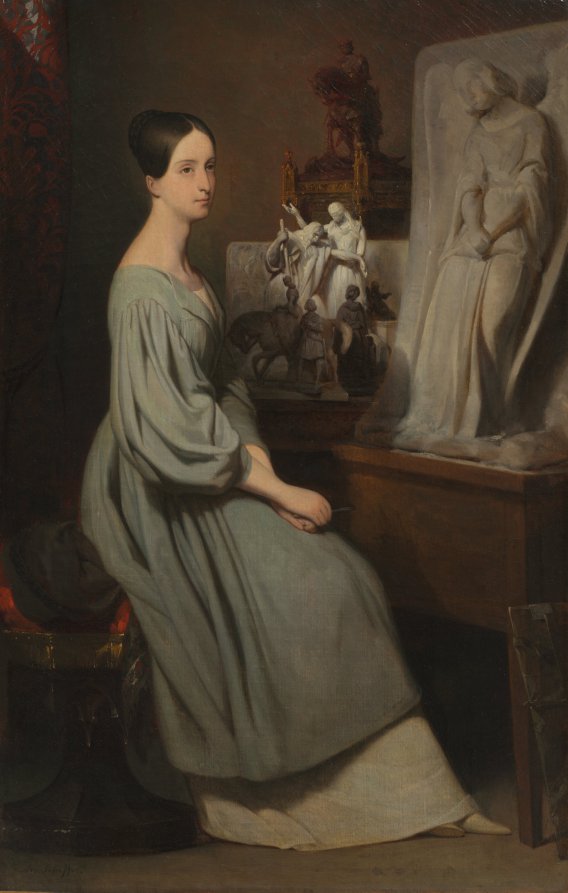
Ary Scheffer · The Cleveland Museum of Art · Gift of Mr. and Mrs. Noah L. Butkin · CC0
- Born
- 1795.
- Nationality
- France and Kingdom of the Netherlands.
- Fields
- history painting and portrait.
- Movements
- Romanticism.
- Known for
- Battle of Tolbiac, Charlemagne at Paderborn and Francesca da Rimini and Paolo Malatesta appraised by Dante and Virgil.
VALÉORINE Encyclopedia
VALÉORINE documentary reading
Documentary summary
Ary Scheffer (10 February 1795 – 15 June 1858) was a Dutch-French Romantic painter. He was known mostly for his works based on literature, with paintings based on the works of Dante, Goethe, Lord Byron and Walter Scott, as well as religious subjects. He was also a prolific painter of portraits of famous and influential people in his lifetime.
Admitted source layer · organised and presented by VALÉORINE
Note VALÉORINE
Ary Scheffer (1795–1858) was French and Dutch.
Ary Scheffer worked in Dordrecht and Paris. Ary Scheffer was associated with Romanticism.
Among the works are Battle of Tolbiac and Charlemagne at Paderborn. The work spans history painting and portrait.
Composed from admitted, traceable facts · 27 September 2026
VALÉORINE
Reference Check
Propose documentary evidence for Ary Scheffer. A contribution is never written directly as fact: identity, source, rights and evidence gates still decide.
Sign in to contribute
Documentary evidence
Evidence Panel
not yet certified
- Identity
- resolved
- Independent source families
- 0
- Admitted assertions
- 0
- Open conflicts
- 0
Authority files
gnd · 16320661-2 · wikidata · Q436726 · wikipedia · Ary Scheffer
In this article
Early life and education
Early life and education
Politically, Scheffer had strong ties to King Louis Philippe I, having been employed as a teacher of the latter's children, which allowed him to live a life of luxury for many years until the French Revolution of 1848.
Scheffer was the son of Johan Bernard Scheffer (1765–1809), a portrait painter who was born in Homberg upon Ohm or Cassel (both presently in Germany; the latter has been spelled as Kassel since 1926) and moved to the Netherlands in his youth, and Cornelia Lamme (1769–1839), a portrait miniature painter and daughter of landscape painter Arie Lamme of Dordrecht, for whom Arij (later "Ary") was named. Ary Scheffer had two brothers, the journalist and writer Karel Arnold Scheffer (1796–1853) and the painter Hendrik Scheffer (1798–1862). His parents educated him and he attended the drawing academy in Amsterdam from the age of 11 years. In 1808 his father became the court painter of Louis Bonaparte in Amsterdam, yet his father died one year later. Encouraged by Willem Bilderdijk, Ary moved to Lille, France, for further study after the death of his father. In 1811, he and his mother, who greatly influenced his career, moved to Paris, France, where he studied at the École des Beaux-Arts as a pupil of Pierre-Narcisse Guérin. His brothers later followed them to Paris.
Career
Career
Scheffer started exhibiting at the Salon de Paris in 1812. He began to be recognized in 1817, and in 1819 he was asked to make a portrait of the Marquis de Lafayette. Perhaps because of Lafayette's acquaintances, Scheffer and his brothers were politically active throughout their lives and he became a prominent Philhellene. In 1822, he became drawing teacher to the children of Duke Louis-Philippe of Orléans. Because of his connection with them, he obtained many commissions for portraiture and other work. In 1830 riots against the rule of King Charles X resulted in his overthrow. On 30 July, Scheffer and influential journalist Adolphe Thiers rode from Paris to Orléans to ask Louis Philippe to lead the resistance, and a few days later he became "King of the French". That same year, Scheffer's daughter Cornélia was born. Francès Cornélia Scheffer (1830–1899) became a sculptor and painter in her own right. Ary Scheffer registered the name of her mother as "Maria Johanna de Nes", but nothing is known of her and she may have died soon after Cornélia's birth. Considering that his grandmother's name was "Johanna de Nes", it has been speculated that he kept the name of Cornélia's mother secret so as not to compromise the reputation of a noble family. Ary Scheffer's mother did not know of her namesake granddaughter until 1837, after which she cared for Cornélia until she died only two years later. Ary Scheffer became an associate member of the Royal Institute of the Netherlands in 1846, and resigned in 1851. Scheffer and his family prospered during the reign of King Louis Philippe, who abdicated on 24 February 1848. Scheffer and Hendrik were inundated with artistic commissions, and they taught numerous students in their workshop in Paris, so many that of the works produced during this period that bear his signature the number that he actually made himself cannot be verified. Scheffer was elevated as commander of the Legion of Honour in 1848. As a captain of the Garde Nationale, he escorted the French royal family in its escape from the Tuileries Palace and escorted the Duchess d'Orléans to the Chambre des Députés, where she in vain proposed her son as the next monarch of France. Scheffer fought in the army of Cavaignac during the June Days Uprising in Paris of 23 to 26 June 1848. The cruelty and hatred that the governmental faction exhibited and the misery of the lower classes so shocked him that he withdrew from politics and refused to make portraits of the family of Emperor Napoleon III, who reigned after the Uprising.
Personal life
Personal life
On 16 March 1850, he married Sophie Marin, the widow of General Baudrand, and on 6 November of that year he finally became a French citizen.
Death
Death
He continued to frequently travel to the Netherlands, and traveled to Belgium, Germany, and England, but a heart condition impaired his activity and eventually caused his death in 1858 in his summer house in Argenteuil. He is buried in the Cimetière de Montmartre.
Works
Works
When Scheffer left Guérin's studio, Romanticism had come into vogue in France, with such painters as Xavier Sigalon, Eugène Delacroix and Théodore Géricault. Scheffer did not show much affinity with their work and developed his own style, which has been called "frigidly classical". Scheffer often painted subjects from literature, especially the works of Dante, Byron and Goethe. Two versions of Dante and Beatrice have been preserved at Wolverhampton Art Gallery, United Kingdom, and Museum of Fine Arts, Boston, US. His L'Enterrement du Jeune Pêcheur, illustrating a scene from Walter Scott's The Antiquary and taking inspiration from David Wilkie's Distraining for Rent, was exhibited at the Salon of 1824. Particularly highly praised was his Francesca da Rimini, painted in 1836, which illustrates a scene from Dante Alighieri's Inferno. In the piece the entwined bodies of Francesca di Rimini and Paolo Malatesta swirl around in the never-ending tempest that is the second circle of Hell. The illusion of movement is created by the drapery that envelopes the couple, as well as by Francesca's flowing hair. These two figures create a diagonal line that intersects the majority of the canvas creating not only a sense of movement, but also giving the painting an air of instability. Francesca clings to Paolo as he turns his face away in anguish. There are an additional two figures in the image: hidden in the background, the poets Dante and Virgil look on as they make their way through the nine circles of Hell. Scheffer's popular Faust-themed paintings include Margaret at her wheel; Faust doubting; Margaret at the Sabbat; Margaret leaving church; The garden walk, and Margaret at the well. In 1836, he painted two pictures of Goethe's character Mignon: Mignon desires her fatherland (1836), and Mignon yearns for heaven (1851). He now turned to religious subjects: Christus Consolator (1836) was followed by Christus Remunerator, The shepherds led by the star (1837), The Magi laying down their crowns, Christ in the Garden of Olives, Christ bearing his Cross, Christ interred (1845), and St Augustine and Monica (1846). One of the reduced versions of his Christus Consolator (the prime version today to be found in the Van Gogh Museum, Amsterdam), lost for 70 years, was rediscovered in a janitor's closet in Gethsemane Lutheran Church in Dassel, Minnesota, in 2007. It has been restored and is on display at the Minneapolis Institute of Art. Scheffer was also an accomplished portrait painter, finishing 500 portraits in total. His subjects included composers Frédéric Chopin and Franz Liszt, the Marquis de la Fayette, Pierre-Jean de Béranger, Alphonse de Lamartine, Charles Dickens, Duchess de Broglie, Talleyrand and Queen Marie Amélie. After 1846, he ceased to exhibit. His strong ties with the royal family caused him to fall out of favour when, in 1848, the Second Republic came into being. Scheffer was made commander of the Legion of Honour in 1848, that is, after he had wholly withdrawn from the Salon. Shut up in his studio, he produced many paintings that were only exhibited after his death in 1858. The works, first exhibited posthumously, include Sorrows of the earth, and the Angel announcing the Resurrection, which he had left unfinished. By the time of his death, his reputation was damaged and was further undermined by the sale of the Paturle Gallery, which contained many of his most celebrated achievements: though his paintings were praised for their charm and facility, they were condemned for poor use of color and vapid sentiment.
Friends and family
Friends and family
At various times Maurice Sand, Scheffer, Charles Gounod, Hector Berlioz were in relationships with Pauline Viardot—in letters they claimed that they were in love with her. She wrote in one letter: Louis and Scheffer (Scheffer was the best friend of Louis Viardot, husband of Pauline Viardot) has always been my dearest of friends, and it is sad, that I was never able to respond to the hot and deep love of Louis, despite all my volition. She was married to Louis Viardot at 18 years old, when her husband was a director of an Italian opera house in Paris and a friend of Scheffer. Scheffer was a confidant of Pauline Viardot and a friend of her family until his death. In 1850 Scheffer became a French citizen and married Sophie Marin, the widow of General Marie Étienne François Henri Baudrand. Marin died in 1856. His younger brother Hendrik Scheffer, born in The Hague on 27 September 1798, was also a painter.
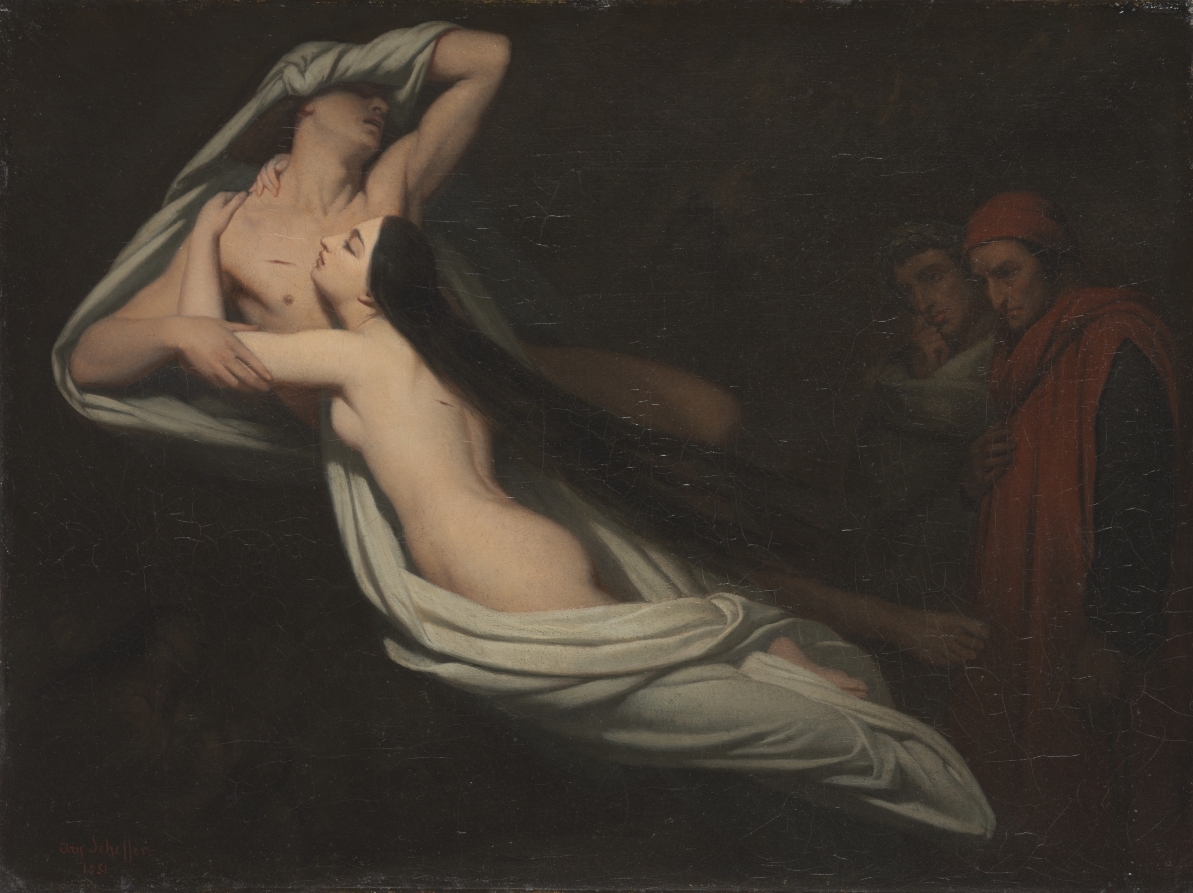
Dante and Virgil Meeting the Shades of Francesca da Rimini and Paolo, 1851, by Ary Scheffer
Ary Scheffer · The Cleveland Museum of Art · Mr. and Mrs. William H. Marlatt Fund
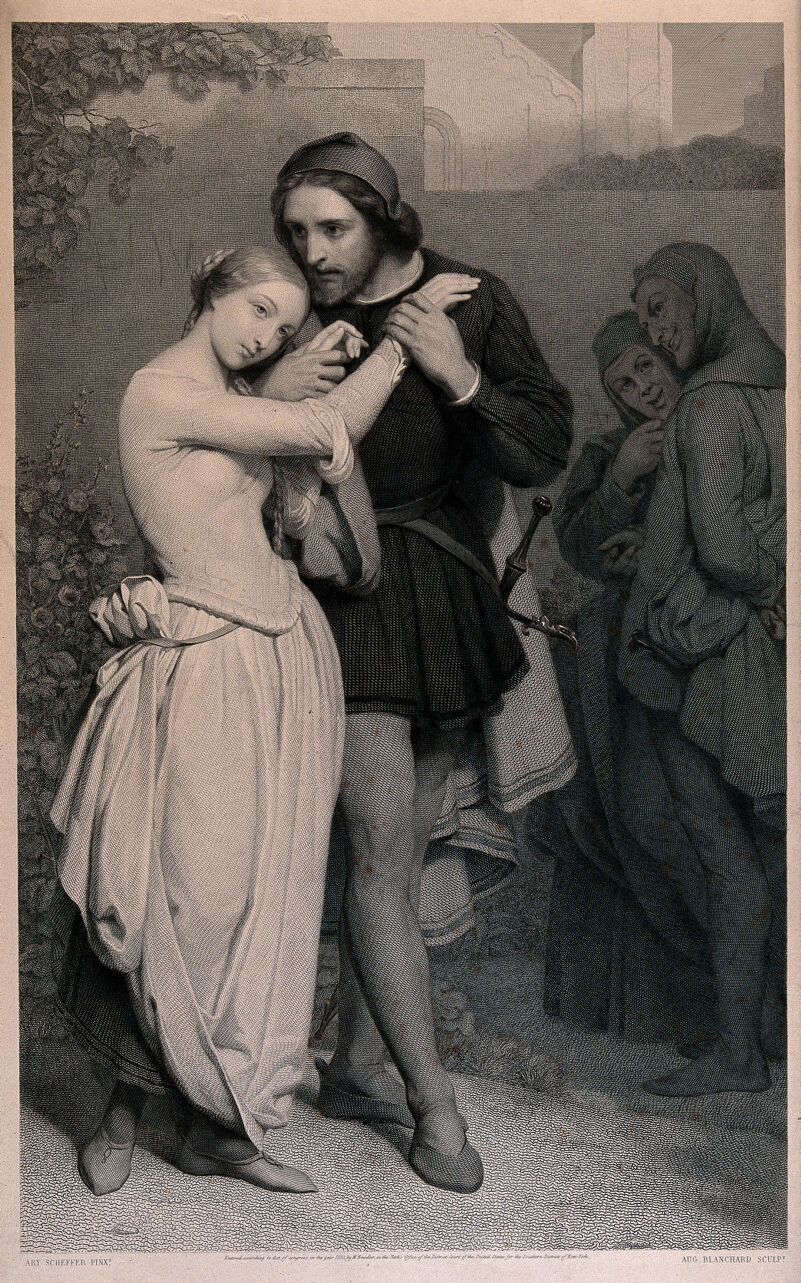
Faust and Marguerite in the garden walking hand-in-hand. Engraving by A. Blanchard III, 1853, after A. Scheffer, 1846., 1853, by Ary Scheffer
Ary Scheffer · Wellcome Collection, London · Wellcome Collection
Life and career
Dated record
Life and career
Explore 1795–1858
The full dated record · 4 entries
1795
Ary Scheffer born at Dordrecht.
1824
Portrait of the three Scheffer brothers in a landscape, dated 1824, held by Dordrechts Museum.
1838
Portrait of Karel Arnoldus Scheffer, dated 1838, held by Dordrechts Museum.
1858
Ary Scheffer died at Argenteuil.
Primary material
Documents and archives
reference work
- Wikidata, structured authority record Q436726: Ary Scheffer
Reputable secondary · Wikimedia Foundation
- “Ary Scheffer”, English Wikipedia, consulted as further reading
Reputable secondary · Wikipedia
scholarly publication
- Scheffer, Ary (1795–1858), Historical Dictionary of Neoclassical Art and Architecture, 2020
Scholarly · Crossref registry · 2020
authority file
- Gemeinsame Normdatei 16320661-2, Museum Ary Scheffer (Dordrecht).
Unverified · Deutsche Nationalbibliothek
Notes from the source article
Cited by Wikipedia
Notes from the source article
These works are cited by the source article, in its own numbering. They are recorded as its citations, not as sources VALÉORINE has verified.
- 1.Scheffer, Ary.
- 2.Macmillan, Duncan (2023), Scotland and the Origins of Modern Art, Lund Humphries, London, pp. 167 - 182,
- 3.Scheffer, Arij (1795–1858) in the Biographical Dictionary of the Netherlands: 1880–2000 (in Dutch)
- 4.Scheffer, Cornelia (1830–1899) in the Biographical Dictionary of the Netherlands: 1880–2000 (in Dutch)
- 5.Royal Netherlands Academy of Arts and Sciences. A. Scheffer (1795–1858).
- 6.Murray, P. & L. (1996), Dictionary of art and artists. Penguin Books. .
- 7.Smyth, Patricia. The Vision: Dante and Beatrice. The National Inventory of Continental European Paintings. VADS.
- 8.Dante and Beatrice. Museum of Fine Arts, Boston. 11 November 2017.
- 9.Dordrechts Museum. Ary Scheffer – Societyschilder in Parijs.
- 10.Wagener, Anne-Marie. Scheffer's Painting of Christ the Comforter Discovered in a Church in Rural Minnesota. Minneapolis Institute of Art. March 31, 2009.
- 11.Cite Collier's wstitle=Scheffer, Ary
- 12.EB1911 inline=1 wstitle=Scheffer, Ary volume=24 page=316 noprescript=1
- 13.Журнальный зал >> Author:Ирина ЧАЙКОВСКАЯ "Полина Виардо: возможность дискуссии". Chapter: "Безобразная красавица".
- 14.Журнальный зал >> Author:Ирина ЧАЙКОВСКАЯ "Полина Виардо: возможность дискуссии". Chapter: "Монашка или женщина-вамп?"
- 15.Barbara Kendall-Davis. P. 397.
- 16.Ary Scheffer Paintings, Scheffer Reproductions, Biography.
- 17.Bryan (3rd edition) title=Scheffer, Hendrik volume=2 inline=y no-prescript=y
Bibliography printed in the source article · 1
- Morris, Edward. Ary Scheffer and his English Circle. Oud Holland. 99. 4. 294–323. 1985. 10.1163/187501785X00143.
References
Citations
References
Each reference names the institution holding it, so a reader may go to the document itself.
scholarly publication
Scheffer, Ary (1795–1858), Historical Dictionary of Neoclassical Art and Architecture, 2020Crossref registry
Verifiedauthority file
Gemeinsame Normdatei 16320661-2, Museum Ary Scheffer (Dordrecht).Deutsche Nationalbibliothek
Partially resolvedreference work
Wikidata, structured authority record Q436726: Ary SchefferWikimedia Foundation
Partially resolvedreference work
Partially resolved
The Encyclopedia exists whether or not anything is for sale. Corrections are recorded rather than overwritten, and every version of this record is kept. Published 14 August 2026.
Elsewhere in Sculpture
6,174 published records in this field, each with its sources named.
- Arun YogirajArtist
- Arvid BoeckerArtist
- Arvid KarlsteenArtist
- Arvo SiikamäkiArtist
- Asa AmesArtist
- Asbjørg BorgfeldtArtist
- Asger JornArtist
- Asher WhiteArtist
Best supported in this field
For owners
Own a work by Ary Scheffer?
A specialist will read what you send and tell you what the house can establish, what it cannot, and whether the object is suited to sale. There is no charge and no obligation. The object stays with you throughout; nothing is shipped to us unless it is arranged in writing beforehand.