
Arundhati Roy
Suzanna Arundhati Roy (orundʱoti rae̯; born 24 November 1961)[4] is an Indian author best known for her novel The God of Small Things (1997), which won the Booker Prize for Fiction in 1997 and became the biggest-selling book by a non-expatriate Indian author.[137] She is also a political activist involved in human rights and environmental causes.[5] She was the winner of the 2024 PEN Pinter Prize, given by English PEN,[6] and she named imprisoned British-Egyptian writer and activist Alaa Abd El-Fattah as the "Writer of Courage" with whom she chose to share the award.[7]
Also recorded as Suzanna Arundhati Roy
Arundhati Roy

Augustus Binu / facebook · Augustus Binu · CC BY-SA 3.0
- Name
- Arundhati Roy
- Birth Name
- Suzanna Arundhati Roy
- Born
- 24 November 1961
- Birthplace
- Shillong, Assam, India
- Education
- Lawrence School SPA Delhi
- Occupation
- Writer, essayist, activist
- Awards
- * National Film Award for Best Screenplay (1988)
- Nationality
- India
- Fields
- essay · activism · film screenwriting · television screenwriting
- Known for
- The God of Small Things
- Honours
- Norman Mailer Prize · Sydney Peace Prize · Booker Prize · National Film Award for Best Screenplay · Lannan Cultural Freedom Prize · Sahitya Akademi Award in English
- Languages
- English · Hindi
VALÉORINE Encyclopedia
VALÉORINE documentary reading
Documentary summary
Suzanna Arundhati Roy (orundʱoti rae̯; born 24 November 1961)[4] is an Indian author best known for her novel The God of Small Things (1997), which won the Booker Prize for Fiction in 1997 and became the biggest-selling book by a non-expatriate Indian author.[137] She is also a political activist involved in human rights and environmental causes.[5] She was the winner of the 2024 PEN Pinter Prize, given by English PEN,[6] and she named imprisoned British-Egyptian writer and activist Alaa Abd El-Fattah as the "Writer of Courage" with whom she chose to share the award.[7]
Admitted source layer · organised and presented by VALÉORINE
Note VALÉORINE
No house-authored Note is published until its assertions and sources pass the VALÉORINE evidence contract. The documentary article remains available in full while that enrichment is being consolidated.
Documentary enrichment in progress · no unsupported statement published
Reference Check
Propose documentary evidence for Arundhati Roy. A contribution is never written directly as fact: identity, source, rights and evidence gates still decide.
Sign in to contribute
World of VALÉORINE
Documentary connections
Only confirmed graph relationships appear here. Images are shown only when their identity and reuse rights both pass the documentary gate.
Documentary evidence
Evidence Panel
not yet certified
- Identity
- resolved
- Independent source families
- 0
- Admitted assertions
- 0
- Open conflicts
- 0
Authority files
loc · n85338199 · wikidata · Q212801 · wikipedia · Arundhati Roy
In this article
Biography
Biography
Arundhati Roy studied at University of Delhi, Lawrence School, Lovedale and Pallikoodam. The recorded working language is English and Hindi. The field of work recorded is essay, activism and film screenwriting. Places of work recorded in the authority are Delhi. Works named in the authority record are The God of Small Things. Distinctions recorded are Norman Mailer Prize, Sydney Peace Prize, Booker Prize and National Film Award for Best Screenplay.

Arundhati Roy
Jean-Baptiste LABRUNE from Cambridge, MA, USA · Arundhati Roy
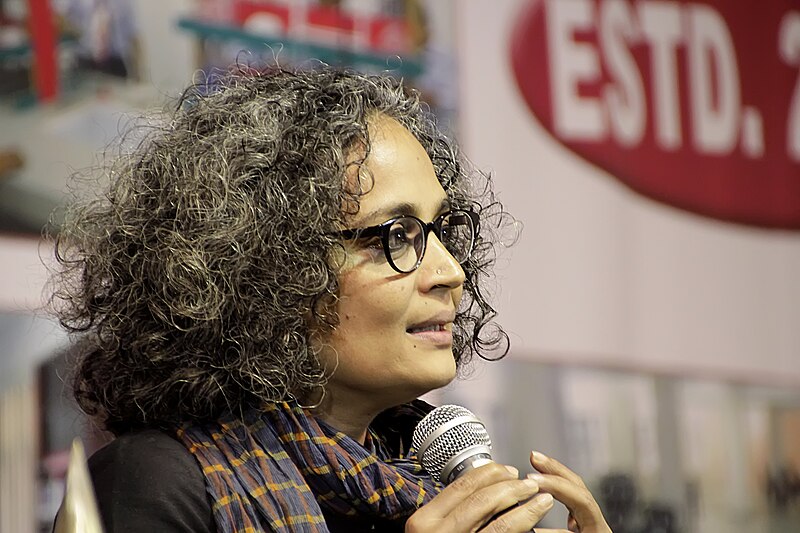
Arundhati Roy (born 24 November 1961) is an Indian author and political activist who was best known for the 1998 Man Booker Prize for Fiction winning novel The God of Small Things (1997) and for her involvement in environmental and human rights causes. Roy’s novel became the biggest-selling book by a nonexpatriate Indian author.
Vikramjit Kakati
Key facts
Key facts
• Name — Arundhati Roy • Birth Name — Suzanna Arundhati Roy • Born — 24 November 1961 • Birthplace — Shillong, Assam, India • Parents — Mary Roy (mother) • Partner — Gerard da Cunha (1978–1982)[1] • Relatives — * Prannoy Roy (cousin) • Maria Roy (niece) • Education — Lawrence School SPA Delhi • Occupation — Writer, essayist, activist • Genre — Fiction, non-fiction • Period — 1997–present • Notable Works — The God of Small Things • Awards — * National Film Award for Best Screenplay (1988) • Booker Prize (1997) • Sydney Peace Prize (2004) • Orwell Award (2004) • Norman Mailer Prize (2011) • PEN Pinter Prize (2024)
Early life
Early life
Roy was born in Shillong, in Undivided Assam (now in Meghalaya).[8] Her mother, Mary Roy,[9][10] was a Malayali Christian women's rights activist from Aymanam, Kerala, and belonged to the Jacobite Syrian denomination. Her father, Rajib Roy, was a Bengali Hindu who later embraced Christianity. He was a tea plantation manager from Kolkata, West Bengal.[11] Roy's father was an alcoholic. When she was two years old, her parents divorced, and she returned to Kerala with her mother and brother. For some time, the family lived with Roy's maternal grandfather in Ooty, Tamil Nadu. When she was five, the family moved back to Kerala, where her mother started a school. She attended school at Corpus Christi in Kottayam, Kerala, followed by the Lawrence School in Lovedale, Tamil Nadu. Roy then studied architecture at the School of Planning and Architecture in New Delhi, where she met architect Gerard da Cunha. They moved in together in 1978 and lived in Delhi, pretending to be married, and then in Goa, before separating in 1982. Roy then returned to Delhi, where she obtained a position with the National Institute of Urban Affairs.
Early career: screenplays
Early career: screenplays
Early in her career, Roy worked in television and movies. She starred in Massey Sahib in 1985. She wrote the screenplays for In Which Annie Gives It Those Ones (1989), a movie based on her experiences as a student of architecture, in which she also appeared as a performer,[12] and Electric Moon (1992).[13] Both were directed by her husband, Pradip Krishen, during their marriage. Roy won the National Film Award for Best Screenplay in 1988 for In Which Annie Gives It Those Ones.[14] She attracted attention in 1994 when she criticised Shekhar Kapur's film Bandit Queen, which was based on the life of Phoolan Devi. In her film review titled "The Great Indian Rape Trick", Roy questioned the right to "restage the rape of a living woman without her permission", and charged Kapur with exploiting Devi and misrepresenting both her life and its meaning.[15]
The God of Small Things
The God of Small Things
Roy began writing her first novel, The God of Small Things, in 1992, completing it in 1996.[18] The book is semi-autobiographical and a major part captures her childhood experiences in Aymanam. The publication of The God of Small Things catapulted Roy to international fame. It received the 1997 Booker Prize for Fiction and was listed as one of The New York Times Notable Books of the Year.[19] It reached fourth position on The New York Times Bestsellers list for Independent Fiction.[20] From the beginning, the book was also a commercial success: Roy received a publishing advance of half a million pounds. It was published in May, and the book had been sold in 18 countries by the end of June. The God of Small Things received very favourable reviews in major American newspapers such as The New York Times (a "dazzling first novel",[21] "extraordinary", "at once so morally strenuous and so imaginatively supple"[22]) and the Los Angeles Times ("a novel of poignancy and considerable sweep"[23]), and in Canadian publications such as the Toronto Star ("a lush, magical novel"[24]). It was one of the five best books of 1997 according to Time.[25] Critical response in the United Kingdom was less favourable, and the awarding of the Booker Prize caused controversy; Carmen Callil, a 1996 Booker Prize judge, called the novel "execrable" and a Guardian journalist called the content "profoundly depressing".[26] In India, E. K. Nayanar,[27] then the chief minister of Roy's home state of Kerala, especially criticised the book's unrestrained description of sexuality, and she had to answer charges of obscenity.[28]
Later career
Later career
Since the success of her novel, Roy has written a television serial, The Banyan Tree,[29] and the documentary DAM/AGE: A Film with Arundhati Roy (2002). In early 2007, Roy said she was working on a second novel, The Ministry of Utmost Happiness.[30] • Illustration — Roy, 1997 Man Booker Prize winner Roy contributed to We Are One: A Celebration of Tribal Peoples, a book released in 2009[31] that explores the culture of peoples around the world, portraying their diversity and the threats to their existence. The royalties from the sale of this book go to the indigenous rights organisation Survival International.[32] Roy has written numerous essays on contemporary politics and culture. In 2014, they were collected by Penguin India in a five-volume set. In 2019, her nonfiction was collected in a single volume, My Seditious Heart, published by Haymarket Books.[33] In October 2016, Penguin India and Hamish Hamilton UK announced that they would publish her second novel, The Ministry of Utmost Happiness, in June 2017.[34] The novel was chosen for the Man Booker Prize 2017 longlist,[35] and was a finalist for the National Book Critics Circle Award for fiction in January 2018.[36] Roy's book Mother Mary Comes to Me was published in September 2025.[37] A memoir, it focuses on her early years living with her mother,[38] whom Roy calls "my shelter and my storm".[39] It was broadcast in five parts on BBC Radio 4 as Book of the Week.[40] In 2026, Roy's restored 1989 film In Which Annie Gives It Those Ones was scheduled to screen at the 76th Berlin International Film Festival, and Roy was due to appear, but she withdrew after jury president Wim Wenders, said in response to a journalist's question that the jury "has to stay out of politics".[41]
Advocacy
Advocacy
Since publishing The God of Small Things in 1997, Roy has spent most of her time on political activism and non-fiction (such as collections of essays about social causes). She is a spokesperson of the anti-globalization/alter-globalization movement and a vehement critic of neo-imperialism and US foreign policy. She opposes India's policies toward nuclear weapons as well as industrialisation and economic growth (which she describes as "encrypted with genocidal potential" in Listening to Grasshoppers: Field Notes on Democracy).[44] She has also questioned the conduct of the Indian police and administration in the case of the 2001 Indian Parliament attack and the Batla House encounter case, contending that the country has had a "shadowy history of suspicious terror attacks, murky investigations, and fake encounters". At the Wayanad Literature Festival, in conversation with Parvathi Thiruvothu, Roy said her protests and writing are not shows of bravery, but of wanting space to breathe and create. She said that only if people have space can they create art and make mistakes. "Open the windows", she said.[45]
Support for Kashmiri independence
Support for Kashmiri independence
In an August 2008 interview with The Times of India, Roy expressed her support for the independence of Kashmir from India after the massive demonstrations in 2008 in favour of independence took place—some 500,000 people rallied in Srinagar in the Kashmir part of Jammu and Kashmir state of India for independence on 18 August 2008, following the Amarnath land transfer controversy.[46] According to her, the rallies were a sign that Kashmiris desired secession from India, and not union with India.[47] She was criticised by the Indian National Congress and Bharatiya Janata Party for her remarks.[48] All India Congress Committee member and senior Congress party leader Satya Prakash Malaviya asked Roy to withdraw her "irresponsible" statement, saying that it was "contrary to historical facts".[49] It would do better to brush up her knowledge of history and know that the princely state of Jammu and Kashmir had acceded to the Union of India after its erstwhile ruler Maharaja Hari Singh duly signed the Instrument of Accession on 26 October 1947. And the state, consequently has become as much an integral part of India as all the other erstwhile princely states have. She was charged with sedition along with separatist Hurriyat leader Syed Ali Shah Geelani and others by Delhi Police for their "anti-India" speech at a 2010 convention on Kashmir: "Azadi: The Only Way".[50] In June 2024, the UAPA Act was invoked against them.[52] Roy has been criticized for saying that India has "perpetually waged war" on its citizens in Kashmir, Manipur, Goa, among other regions. Former Indian Foreign Secretary Kanwal Sibal accused her of endorsing terrorism against India and said she "blatantly distorts the truth to support her deeply communal and anarchist agenda", calling her portrayal of India "venomous" and "deeply anti-Hindu".[53][54]
Sardar Sarovar Project
Sardar Sarovar Project
Roy has campaigned along with activist Medha Patkar against the Narmada dam project, saying that the dam will displace half a million people with little or no compensation, and will not provide the projected irrigation, drinking water, and other benefits.[55] Roy donated her Booker prize money, as well as royalties from her books on the project, to the Narmada Bachao Andolan. Roy also appears in Franny Armstrong's Drowned Out, a 2002 documentary about the project.[56] Roy's opposition to the Narmada Dam project was criticised as "maligning Gujarat" by Congress and BJP leaders in Gujarat.[57] In 2002, Roy responded to a contempt notice issued against her by the Supreme Court of India with an affidavit saying that the court's decision to initiate contempt proceedings based on an unsubstantiated and flawed petition, while refusing to inquire into allegations of corruption in military contracting deals pleading an overload of cases, indicated a "disquieting inclination" to silence criticism and dissent using the power of contempt.[58] The court found Roy's statement, which she refused to disavow or apologise for, constituted criminal contempt, sentenced her to a "symbolic" one day's imprisonment, and fined her 2500.[59] Roy served the jail sentence and paid the fine rather than serve an additional three months for default.[60] Environmental historian Ramachandra Guha has been critical of Roy's Narmada dam activism. While acknowledging her "courage and commitment" to the cause, Guha writes that her advocacy is hyperbolic and self-indulgent,[61] and that "Ms. Roy's tendency to exaggerate and simplify, her Manichaean view of the world, and her shrill hectoring tone, have given a bad name to environmental analysis".[62] He faulted Roy's criticism of Supreme Court judges who were hearing a petition brought by the Narmada Bachao Andolan as careless and irresponsible. Roy counters that her writing is intentional in its passionate, hysterical tone: "I am hysterical. I'm screaming from the bloody rooftops. And he and his smug little club are going 'Shhhh... you'll wake the neighbours!' I want to wake the neighbours, that's my whole point. I want everybody to open their eyes".[63] Gail Omvedt and Roy have fiercely debated Roy's strategy for the Narmada Dam movement. They disagree on whether to demand stopping the dam building altogether (Roy) or search for intermediate alternatives (Omvedt).[64]
US foreign policy, war in Afghanistan
US foreign policy, war in Afghanistan
• Illustration — Roy delivering a talk "Can We Leave the Bauxite in the Mountain? Field Notes on Democracy" at Harvard Kennedy School, 1 April 2010[65] In a September 2001 opinion piece in The Guardian titled "The algebra of infinite justice", Roy responded to the US military invasion of Afghanistan, finding fault with the argument that this war would be a retaliation for the September 11 attacks: "The bombing of Afghanistan is not revenge for New York and Washington. It is yet another act of terror against the people of the world." According to her, US president George W. Bush and UK prime minister Tony Blair were guilty of Orwellian doublethink: When he announced the air strikes, President George Bush said: "We're a peaceful nation." America's favourite ambassador, Tony Blair, (who also holds the portfolio of prime minister of the UK), echoed him: "We're a peaceful people." So now we know. Pigs are horses. Girls are boys. War is peace. She disputes US claims to be a peaceful and freedom-loving nation, listing China and 19 Third World "countries that America has been at war with—and bombed—since World War II", as well as previous US support for the Taliban movement and the Northern Alliance (whose "track record is not very different from the Taliban's"). She does not spare the Taliban: "Now, as adults and rulers, the Taliban beat, stone, rape, and brutalise women, they don't seem to know what else to do with them."[66] In the final analysis, Roy sees American-style capitalism as the culprit: "In America, the arms industry, the oil industry, the major media networks, and, indeed, U.S. foreign policy, are all controlled by the same business combines". She puts the attacks on the World Trade Center and on Afghanistan on the same moral level, that of terrorism, and mourns the impossibility of beauty after 2001: "Will it be possible ever again to watch the slow, amazed blink of a newborn gecko in the sun, or whisper back to the marmot who has just whispered in your ear—without thinking of the World Trade Centre and Afghanistan[67]?" In May 2003, she delivered a speech titled "Instant-Mix Imperial Democracy (Buy One, Get One Free)" at Riverside Church in New York City, in which she described the United States as a global empire that reserves the right to bomb any of its subjects at any time, deriving its legitimacy directly from God. The speech was an indictment of the US actions relating to the Iraq War.[68] In June 2005, she took part in the World Tribunal on Iraq, and in March 2006 she criticised President George W. Bush's visit to India, calling him a "war criminal".[70]
India's nuclear weaponry
India's nuclear weaponry
In response to India's testing of nuclear weapons in Pokhran, Rajasthan, Roy wrote The End of Imagination (1998), a critique of the Indian government's nuclear policies. It was published in her collection The Cost of Living (1999), in which she also crusaded against India's massive hydroelectric dam projects in the central and western states of Maharashtra, Madhya Pradesh, and Gujarat.
Israel
Israel
In August 2006, Roy, along with Noam Chomsky, Howard Zinn and others, signed a letter in The Guardian calling the 2006 Lebanon War a "war crime" and accusing Israel of "state terror".[71] In 2007, Roy was one of more than 100 artists and writers who signed an open letter initiated by Queers Undermining Israeli Terrorism and the South West Asian, North African Bay Area Queers calling on the San Francisco International LGBT Film Festival "to honor calls for an international boycott of Israeli political and cultural institutions, by discontinuing Israeli consulate sponsorship of the LGBT film festival and not cosponsoring events with the Israeli consulate".[72] During the 2021 Israel–Palestine crisis, she defended Hamas's rocket attacks, citing Palestinians' right to resistance.[73][74] In December 2023, during Israel's bombing campaign in Gaza, Roy said: "If we say nothing about Israel's brazen slaughter of Palestinians, even as it is live-streamed into the most private recesses of our personal lives, we are complicit in it."[76] In October 2024, Roy and thousands of other writers signed an open letter pledging to boycott Israeli cultural institutions.[77][78] In February 2026, Roy withdrew from the Berlin International Film Festival, saying she was "disgusted" after jury president Wim Wenders said politics should be avoided and the jury members made "unconscionable statements" about Israel's actions in Gaza.[79][80] Roy called the 2026 Iran war as "a continuation of the US-Israeli genocide in Gaza."[81]
2001 Indian parliament attack
2001 Indian parliament attack
Roy has raised questions about the investigation into the 2001 Indian Parliament attack and the trial of the accused. Mohammad Afzal Guru, a convict of 2001 parliament attack,[82][83] according to her was being scapegoated. She pointed to irregularities in the judicial and investigative process in the case and maintains that the case remains unsolved. In a 2013 opinion piece for The Hindu, Roy wrote that Guru was not one of "the terrorists who stormed Parliament House on December 13th 2001" or among those who "opened fire on security personnel, apparently killing three of the six who died".[84][85] In her book about Guru's hanging, she wrote that there is evidence of state complicity in the terrorist attack.[86] In an editorial in The Hindu, journalist Praveen Swami wrote that Roy's evidence of state complicity was "cherry-picked for polemical effect". He was critical of her assertion that media and political parties were in collusion.[87] Roy also called for Guru's death sentence to be stayed while a parliamentary enquiry into these questions was conducted, and denounced press coverage of the trial.[88] BJP spokesperson Prakash Javadekar criticised Roy for calling Afzal a "prisoner of war" and called her a "prisoner of her own dogma".[89] Afzal was hanged in 2013.[90] Roy called the hanging "a stain on India's democracy".[91]
The Muthanga incident
The Muthanga incident
In 2003, the Adivasi Gothra Maha Sabha, a social movement for Adivasi land rights in Kerala, organised a major land occupation of a piece of land of a former Eucalyptus plantation in the Muthanga Wildlife Reserve, on the border of Kerala and Karnataka. After 48 days, a police force was sent into the area to evict the occupants. One participant of the movement and a policeman were killed, and the leaders of the movement were arrested. Roy travelled to the area, visited the movement's leaders in jail, and wrote an open letter to the then Chief Minister of Kerala, A. K. Antony, saying: "You have blood on your hands."[92]
Comments on 2008 Mumbai attacks
Views on the Naxalites
Views on the Naxalites
Roy has criticised the Indian government's armed actions against the Naxalite-Maoist insurgency in India, calling it "war on the poorest people in the country". According to her, the government has "abdicated its responsibility to the people"[100] and launched the offensive against Naxals to aid the corporations with whom it has signed Memoranda of Understanding.[101] While she has received support from various quarters for her views,[102] Roy's description of the Maoists as "Gandhians" raised a controversy.[103] In other statements, she has described Naxalites as patriots "of a kind"[105] who are "fighting to implement the Constitution, (while) the government is vandalising it". • Illustration — Roy at the Jamia Millia Islamia in March 2014
Sedition charges
Sedition charges
In November 2010, Roy, Syed Ali Shah Geelani, and five others were brought up on charges of sedition by the Delhi Police. The filing of the First Information Report came after a directive from a local court on a petition filed by Sushil Pandit, who alleged that Geelani and Roy had made anti-India speeches at a conference on "Azadi—the Only Way" on 21 October 2010. Roy's words were: "Kashmir has never been an integral part of India. It is a historical fact. Even the Indian government has accepted this."[106] A Delhi city court directed the police to respond to the demand for a criminal case after the central government declined to charge Roy, saying that the charges were inappropriate.[111] In 2024, Lieutenant Governor of Delhi Vinai Kumar Saxena sanctioned the prosecution of Roy along with Sheikh Showkat Hussain, a former professor at Central University of Kashmir in the same 2010 case, with offences under 45(1) and 13 of the Unlawful Activities (Prevention) Act, 1967[113] and on prima facie basis with Indian Penal Code Sections 153A, 153B, 504, and 505.[114][115]
Views on Narendra Modi
Views on Narendra Modi
In 2013, Roy called Narendra Modi's nomination as prime minister a "tragedy". She said business houses were supporting his candidacy because he was the "most militaristic and aggressive" candidate.[119] She has argued that Modi has control over India to a degree unrecognised by most people in the Western world: "He is the system. He has the backing of the media. He has the backing of the army, the courts, a majoritarian popular vote... Every institution has fallen in line." She has expressed deep despair for the future, calling Modi's long-term plans for a highly centralised Hindu state "suicidal" for the multicultural subcontinent.[120] On 28 April 2021, The Guardian published an article by Roy describing the Indian government's response to the COVID-19 pandemic as a "crime against humanity",[121] in which The Washington Post said Roy "slammed Modi for his handling of the pandemic".[122][123] Roy's op-ed was also published in The Wire with the title "It's Not Enough to Say the Govt Has Failed. We Are Witnessing a Crime Against Humanity."[124]
Remarks about National Registers and CAA
Remarks about National Registers and CAA
On 25 December 2019, while speaking at Delhi University, Roy urged people to mislead authorities during the upcoming enumeration by the National Population Register (NPR) by furnishing fake names, which she said could serve as a database for the National Register of Citizens (NRC).[125] The remarks were criticised by the Congress and the Bharatiya Janata Party (BJP).[126] Meanwhile, Amit Shah maintained that there was no link between NRC and NPR.[128] A complaint against her was registered at Tilak Marg police station, Delhi, under sections 295A, 504, 153 and 120B of the Indian Penal Code.[129][130] Roy responded, "What I was proposing was civil disobedience with a smile", and said her remarks had been misrepresented.[131][132] Roy criticised the Citizenship Amendment Act (CAA) that passed in 2019. She participated in several mass protests in New Delhi calling the law "dangerous" to India. In 2022, she joined the protest to commemorate the 2019 Jamia Millia Islamia attack. There, she compared CAA and NRC to Hitler's Nuremberg Laws.[133][134] She said the laws represented a "Hindutva programme" and the government's plan to "ratchet up hatred".[135] She told protesters, "Now that we have all come together, no detention centre will be big enough to fill us in. I hope that a day will come when this government, which is trying to break the nation, will be in the detention centre and we will be azaad [free]. We won't back down."[136]
Personal life
Personal life
In 1984, Roy met independent filmmaker Pradip Krishen, who offered her a role as a goatherd in his award-winning movie Massey Sahib.[164] They married the same year. They collaborated on a television series about India's independence movement and on two films, In Which Annie Gives It Those Ones (1989) and Electric Moon (1992). Disenchanted with the film world, Roy experimented with various fields, including running aerobics classes. Roy and Krishen are still married but live separately.[165][166] Roy is a cousin of Prannoy Roy, former head of the Indian television media group NDTV.[167] She lives in Delhi. She reads, writes, and speaks English, Hindi, and Malayalam.[168]
Fiction
Fiction
• No. — Title — Publisher — Year — ISBN • 1 — The God of Small Things — Flamingo — 1997 • 2 — The Ministry of Utmost Happiness — Hamish Hamilton — 2017
Non-fiction
Non-fiction
• No. — Title — Publisher — Year — ISBN • 1 — The End of Imagination — Kottayam: D.C. Books — 1998 • 2 — The Cost of Living — Flamingo — 1999 • 3 — The Greater Common Good — Bombay: India Book Distributor — 1999 • 4 — The Algebra of Infinite Justice — Flamingo — 2002 • 5 — Power Politics — Cambridge: South End Press — 2002 • 6 — War Talk — Cambridge: South End Press — 2003 • 7 — An Ordinary Person's Guide To Empire — Consortium — 2004 • 8 — Public Power in the Age of Empire — New York: Seven Stories Press — 2004 • 9 — The Checkbook and the Cruise Missile: Conversations with Arundhati Roy (Interviews by David Barsamian) — Cambridge: South End Press — 2004 • 10 — The Shape of the Beast: Conversations with Arundhati Roy — New Delhi: Penguin — 2008 • 11 — Listening to Grasshoppers: Field Notes on Democracy — New Delhi: Penguin — 2010 • 12 — Broken Republic: Three Essays — New Delhi: Hamish Hamilton — 2011 • 13 — Walking with the Comrades — New Delhi: Penguin — 2011 • 14 — Kashmir: The Case for Freedom — Verso Books — 2011 • 15 — The Hanging of Afzal Guru and the Strange Case of the Attack on the Indian Parliament — New Delhi: Penguin — 2013 • 16 — Capitalism: A Ghost Story — Chicago: Haymarket Books — 2014[169] • 17 — Things that Can and Cannot Be Said: Essays and Conversations (with John Cusack) — Chicago: Haymarket Books — 2016 • 18 — The Doctor and the Saint: Caste, Race, and Annihilation of Caste (The Debate Between B. R. Ambedkar and M. K. Gandhi) — Chicago: Haymarket Books — 2017 • 19 — My Seditious Heart: Collected Non-Fiction — Chicago: Haymarket Books — 2019 • 20 — Azadi: Freedom, Fascism, Fiction — Haymarket Books — 2020 • 21 — Mother Mary Comes to Me — UK: Hamish Hamilton — 2025
Other
Other
• We, a political documentary about Roy's words. Available online. • Arundhati Roy denounces Indian democracy by Atul Cowshish, Asian Tribune, 2006-07-06 • Carreira, Shirley de S. G. "A representação da mulher em Shame, de Salman Rushdie, e O deus das pequenas coisas, de Arundathi Roy". In: MONTEIRO, Conceição & LIMA, Tereza M. de O. ed. Rio de Janeiro: Caetés, 2005 • Ch'ien, Evelyn Nien-Ming, "The Politics of Design" in Weird English. Cambridge, MA: Harvard University Press, 2004; 154–199. Essay on Roy's language.
Identity
Identity
Indexed under Legal and Regulatory Analysis, Linguistic, Cultural, and Literary Studies, Military Technology and Strategies, Politics and Conflicts in Afghanistan, Pakistan, and Middle East, Indian History and Philosophy. Associated with University of Delhi, Siksha O Anusandhan University, Hainan University, Gesundheitsdienst. Recorded as having received Norman Mailer Prize, Sydney Peace Prize and Booker Prize.
Life and career
Dated record
Life and career
Explore 1961–2017
The full dated record · 3 entries
1961
Arundhati Roy born at Shillong.
2002
Arundhati Roy's The God of small things (2 catalogued editions) (2002) is digitised and catalogued by Open Library.
2017
Arundhati Roy - Indiens Schriftstellerin und Kämpferin gegen Unterdrückung (2017 SRF) (2017) is digitised and catalogued by Internet Archive.
Books and articles on Roy
* * • "The Politics of Design", in * * * * * * * * * * * *
Influences
Influences
Roy cites William Shakespeare, Rudyard Kipling, James Baldwin, Toni Morrison, Maya Angelou, John Berger, James Joyce, Vladimir Nabokov, and Gabriel Garcia Marquez as influences and has said, "I’m grateful for the lessons one learns from great writers, but also from imperialists, sexists, friends, lovers, oppressors, revolutionaries—everybody. Everybody has something to teach a writer".[42][43]
Criticism of Sri Lankan government
Criticism of Sri Lankan government
In an opinion piece in The Guardian, Roy pleaded for international attention to what she called a possible government-sponsored genocide of Tamils in Sri Lanka. She cited reports of camps into which Tamils were being herded as part of what she called "a brazen, openly racist war".[97] She also said that the "Government of Sri Lanka is on the verge of committing what could end up being genocide" and described the Sri Lankan IDP camps where Tamil civilians are being held as concentration camps. The Sri Lankan writer Ruvani Freeman called Roy's remarks "ill-informed and hypocritical" and criticised her for "whitewashing the atrocities of the LTTE".[98] Roy has said of such accusations: "I cannot admire those whose vision can only accommodate justice for their own and not for everybody. However, I do believe that the LTTE and its fetish for violence was cultured in the crucible of monstrous, racist, injustice that the Sri Lankan government and to a great extent Sinhala society visited on the Tamil people for decades".[99]
Criticism of Anna Hazare
Criticism of Anna Hazare
On 21 August 2011, at the height of Anna Hazare's anti-corruption campaign, Roy criticised Hazare and his movement in an opinion piece published in The Hindu.[116] In the article, she questioned Hazare's secular credentials, pointing out the campaign's corporate backing, its suspicious timing, Hazare's silence on private-sector corruption, expressing her fear that the Lokpal will only end up creating "two oligarchies, instead of just one". She stated that while "his means may be Gandhian, his demands are certainly not", and alleged that by "demonising only the Government they" are preparing to call for "more privatisation, more access to public infrastructure and India's natural resources", adding that it "may not be long before Corporate Corruption is made legal and renamed a Lobbying Fee". Roy also accused the electronic media of blowing the campaign out of proportion. In an interview with Kindle Magazine, Roy pointed out the role of media hype and target audience in determining how well hunger strikes "work as a tool of political mobilization" by noting the disparity in the attention Hazare's fast has received in contrast to the decade-long fast of Irom Sharmila "to demand the repealing of a law that allows non-commissioned officers to kill on suspicion—a law that has led to so much suffering."[117] Roy's comparison of the Jan Lokpal Bill with the Maoists, claiming both sought "the overthrow of the Indian State", met with resentment from members of Team Anna. Medha Patkar reacted sharply calling Roy's comments "highly misplaced" and chose to emphasise the "peaceful, non-violent" nature of the movement.[118] Roy also has stated that "an 'anti-corruption' campaign is a catch-all campaign. It includes everybody from the extreme left to the extreme right and also the extremely corrupt. No one's going to say they are for corruption after all...I'm not against a strong anti-corruption bill, but corruption is just a manifestation of a problem, not the problem itself."
Primary material
Documents and archives
scholarly publication
- 3. The Politics of Design: Arundhati Roy, Weird English, 2004
Scholarly · Crossref registry · 2004
- Roy, Arundhati (1961–), Encyclopedia of Activism and Social Justice, 2007
Scholarly · Crossref registry · 2007
Institutional database
- Wikidata, structured authority record Q212801: Arundhati Roy
Scholarly · Wikimedia Foundation
authority file
- Library of Congress Name Authority File, Arundhati Roy, 1946- (USE Roy, Arundhati, 1946-) (n85338199).
Unverified · Library of Congress
Awards and recognition
Roy was awarded the 1997 Booker Prize for her novel The God of Small Things. The award carried a prize of approximately US$30,000 and a citation that noted, "The book keeps all the promises that it makes".[138] Roy donated the prize money she received, as well as royalties from her book, to human rights causes. Prior to the Booker, Roy won the National Film Award for Best Screenplay in 1989, for the screenplay of In Which Annie Gives It Those Ones, in which she captured the anguish among the students prevailing in professional institutions. In 2015, she returned the national award in protest against religious intolerance and the growing violence by rightwing groups in India.[139] In 2002, she won the Lannan Foundation's Cultural Freedom Award for her work "about civil societies that are adversely affected by the world's most powerful governments and corporations", in order "to celebrate her life and her ongoing work in the struggle for freedom, justice and cultural diversity".[140] In 2003, she was awarded "special recognition" as a Woman of Peace at the Global Exchange Human Rights Awards in San Francisco with Bianca Jagger, Barbara Lee, and Kathy Kelly. Roy was awarded the Sydney Peace Prize in May 2004 for her work in social campaigns and her advocacy of non-violence.[141] That same year she was awarded the Orwell Award, along with Seymour Hersh, by the National Council of Teachers of English.[143] In January 2006, she was awarded the Sahitya Akademi Award, a national award from India's Academy of Letters, for her collection of essays on contemporary issues, The Algebra of Infinite Justice, but she declined to accept it "in protest against the Indian Government toeing the US line by 'violently and ruthlessly pursuing policies of brutalisation of industrial workers, increasing militarisation and economic neo-liberalisation.[144] In November 2011, she was awarded the Norman Mailer Prize for Distinguished Writing.[146] Roy was featured in the 2014 list of Time 100, the 100 most influential people in the world.[147] St. Louis University gave Roy the 2022 St. Louis Literary Award, granted to the "most important writers of our time" to celebrate "the contributions of literature in enriching our lives".[148][149] The award ceremony was on 28 April 2022.[151][152] In September 2023, Roy received the lifetime achievement award at the 45th European Essay Prize for the French translation of her book Azadi.[153] In June 2024, Roy was announced as winner of the annual PEN Pinter Prize, given by the human rights organisation English PEN to a writer who, in the words of late playwright Harold Pinter, casts an "unflinching, unswerving" gaze on the world and shows "fierce intellectual determination... to define the real truth of our lives and our societies".[154] English PEN chair Ruth Borthwick said Roy tells "urgent stories of injustice with wit and beauty".[155] In August 2024, Roy and Toomaj Salehi shared the Disturbing the Peace Award, a recognition the Vaclav Havel Center accords to courageous writers at risk. The award committee chair, Bill Shipsey, called them "wonderful exemplars of the spirit of Václav Havel".[157] On 10 October 2024, Roy named imprisoned British-Egyptian activist Alaa Abd El-Fattah as the international "writer of courage" with whom she chose to share the 2024 PEN Pinter Prize, announced at a ceremony at the British Library, where Roy delivered her acceptance speech.[158][159] Author and journalist Naomi Klein also spoke, praising Roy's and Abd El-Fattah's work, and Lina Attalah, editor-in-chief of independent online Egyptian newspaper Mada Masr, accepted the award on Abd El-Fattah's behalf.[160] On 7–8 June 2024, Roy was awarded the Honorary Doctorate of Humane Letters by the American University of Beirut during AUB's 155th Commencement Exercises.[161] In March 2026, Roy's autobiography, Mother Mary Comes to Me won the 2025 National Book Critics Circle Award for Memoir and Autobiography.[162][163]
Notes from the source article
Cited by Wikipedia
Notes from the source article
These works are cited by the source article, in its own numbering. They are recorded as its citations, not as sources VALÉORINE has verified.
- 1.Deb, Siddhartha. Arundhati Roy, the Not-So-Reluctant Renegade. The New York Times. 5 March 2014.
- 2.Penguin Books. Mother Mary Comes To Me.
- 3.Arundhati Roy. 2 October 2011.
- 4.Arundhati Roy. Encyclopædia Britannica.
- 5.Gokulan, Dhanusha. 'Fairy princess' to 'instinctive critic'. Khaleej Times. 11 November 2012.
- 6.Mollan, Cherylann. Arundhati Roy wins PEN Pinter Prize for 'powerful voice'. BBC News. 27 June 2024.
- 7.Spanoudi, Melina. Arundhati Roy shares PEN Pinter Prize 2024 with Alaa Abd El-Fattah. The Bookseller. 10 October 2024.
- 8.Library of Congress, New Delhi Office. Arundhati Roy, 1959–. The South Asian Literary Recordings Project. 15 November 2002.
- 9.Aravind, Indulekha. 'A benevolent dictator': How a former student remembers Mary Roy. The News Minute. 28 October 2025.
- 10.Arundhati Roy’s fierce memoir on life with her mercurial mother. www.bbc.com. 4 September 2025.
- 11.Dey, Debalina. Arundhati Roy joins Shashi Tharoor, Kangana Ranaut in list of 'casteless' upper-caste Indians. The Print. 6 September 2020.
- 12.In Which Annie Gives It Those Ones: Indian writer Arundhati Roy's cult classic college film returns to spotlight. www.bbc.com. 14 February 2026.
- 13."Arundhati Roy, Author-Activist" , India Today. Retrieved 16 June 2013
- 14.Directorate of Film Festivals. 36th National Film Awards (PDF).
- 15.The Great Indian Rape-Trick @ SAWNET -The South Asian Women's NETwork. Retrieved 25 November 2011.
- 16.Arundhati Roy: A 'small hero'. BBC News. 6 March 2002.
- 17.Ramesh, Randeep. Live to tell. The Guardian. 17 February 2007.
- 18.Roy, Amitabh. The God of Small Things: A Novel of Social Commitment. Atlantic. 37–38. 2005. 978-81-269-0409-9.
- 19.Notable Books of the Year 1997. The New York Times. 7 December 1997.
- 20.Best Sellers Plus. The New York Times. 25 January 1998.
- 21.Kakutani, Michiko. Melodrama as Structure for Subtlety. The New York Times. 3 June 1997.
- 22.Truax, Alice. A Silver Thimble in Her Fist. The New York Times. 25 May 1997.
- 23.Eder, Richard. As the world turns: rev. of The God of Small Things. Los Angeles Times. 2. 1 June 1997.
- 24.Carey, Barbara. A lush, magical novel of India. Toronto Star. M.21. 7 June 1997.
- 25.Books: The best of 1997. Time. 29 December 1997.
- 26.The scene is set for the Booker battle. BBC News. 24 September 1998.
- 27.Kutty, N. Madhavan. Comrade of Small Jokes. The Indian Express. 9 November 1997.
- 28.Bumiller, Elisabeth. A Novelist Beginning with a Bang. The New York Times. 29 July 1997.
- 29.Sanghvi, Vir, "I think from a very early age, I was determined to negotiate with the world on my own", The Rediff Special. Retrieved 18 April 2012. .
- 30.Ramesh, Randeep. An activist returns to the novel. The Sydney Morning Herald. 10 March 2007.
- 31.Survival International. We Are One: a celebration of tribal peoples published this autumn. 16 October 2009.
- 32.Survival International. 'We Are One: A celebration of tribal peoples' – new book published this autumn. 21 July 2009.
- 33.Roy, Arundhati (2019), My Seditious Heart: Collected Nonfiction, Haymarket Books.
- 34."Arundhati Roy announces second book after 19 yrs; to release in June 2017", Hindustan Times. 3 October 2016. Retrieved 3 October 2016. .
- 35.Book Depository Retrieved 27 July 2017.
- 36.Arundhati Roy and Mohsin Hamid among five finalists for top US book critics award. Hindustan Times. Press Trust of India. 23 January 2018.
- 37.Alpern, Emma. 8 New Books You Should Read This September. Vulture. 2 September 2025.
- 38.Chaudhuri, Amit. Teview Mother Mary Comes To Me by Arundhati Roy review – brave and absorbing. The Guardian. 1 September 2025.
- 39.BBC Radio 4. Arundhati Roy and maternal inheritance. Start the Week. September 2025.
- 40.BBC Radio 4. Mother Mary Comes to Me by Arundhati Roy. Book of the Week. September 2025.
- 41.Khomami, Nadia. Arundhati Roy quits Berlin film festival over 'stay out of politics' comment. The Guardian. 13 February 2026.
- 42.Altaf, Hasan. Arundhati Roy, The Art of Fiction No. 249. The Paris Review. June 2021.
- 43.Mukerji, Debashish. Our life earlier was much saner. The Week. 26 October 1997.
- 44.Arundhati Roy: Necessary, but wrong. The Economist. 30 July 2009.
- 45.WLF Wayanad Literature Festival. WLF 2024 Arundhati Roy in Conversation with Parvathy Thiruvothu For the Lovers, For the Haters. 4 January 2025.
- 46.Thottam, Jyoti. Valley of Tears. Time. 4 September 2008.
- 47.Ghosh, Avijit. Kashmir needs freedom from India: Arundhati Roy. The Times of India. 19 August 2008.
- 48.Cong attacks Roy on Kashmir remark. The Times of India. 20 August 2008.
- 49.Cong asks Arundhati Roy to withdraw statement on J-K. The Indian Express. 25 October 2010.
- 50.Case registered against Arundhati, Geelani. The Hindu. 29 November 2010. 0971-751X.
- 51.Sedition case registered against Arundhati Roy, Geelani. NDTV.com. 29 November 2010.
- 52.'Trying to prove they're back': Opposition slams 'political' UAPA action against Arundhati Roy for old Kashmir speech. livemint.com. 15 June 2024.
- 53.'Venomous, anti-Hindu': Arundhati Roy's India-Pakistan analogy draws strong backlash. Hindustan Times. 17 September 2025.
- 54.'Venomous against her own country': Arundhati Roy faces backlash for allegations against Indian state, citizenship questioned. @mathrubhumi. 16 September 2025.
- 55.Roy, Arundhati. The Greater Common Good. Frontline. 16. 11. 4 June 1999.
- 56.Drowned Out.
- 57.Playwright Tendulkar in BJP gunsight. The Telegraph (Kolkata). 13 December 2003.
- 58.Venkatesan, V. Of contempt and legitimate dissent. Frontline. 31 August 2001.
- 59.6 March 2002.
- 60.Roy, Arundhati. Statement by Arundhati Roy. Friends of River Narmada. 7 March 2002.
- 61.Guha, Ramachandra (26 November 2000), , The Hindu.
- 62.Guha, Ramachandra (17 December 2000), "Perils of extremism", The Hindu. .
- 63.Ram, N. Scimitars in the Sun: N. Ram interviews Arundhati Roy on a writer's place in politics. Frontline, The Hindu. 19 January 2001.
- 64.Omvedt, Gail. An Open Letter to Arundhati Roy. Friends of River Narmada.
- 65.Roy, Arundhati. Can We Leave the Bauxite in the Mountain? Field Notes on Democracy Science & Democracy Lecture and Panel Discussion. sts.hks.harvard.edu. STS Program » Science and Democracy Lecture Series » News & Events. 1 April 2010.
- 66.Roy, Arundhati. The algebra of infinite justice. The Guardian. 29 September 2001.
- 67.Roy, Arundhati. 'Brutality smeared in peanut butter': Why America must stop the war now. The Guardian. 23 October 2001.
- 68.Roy, Arundhati. Instant-Mix Imperial Democracy (Buy One, Get One Free) Transcript of speech at the Riverside Church. CommonDreams.org. 13 May 2003.
- 69.Roy, Arundhati. Instant-Mix Imperial Democracy, Buy One Get One Free – An Hour With Arundhati Roy Speech at the Riverside Church. Democracy Now!. 24 October 2003.
- 70.Roy, Arundhati. George Bush Go Home. The Hindu. 28 February 2006.
- 71.Letters: War crimes and Lebanon. The Guardian. 3 August 2006.
- 72.Bajko, Matthew S. Political Notebook: Queer activists reel over Israel, Frameline ties. The Bay Area Reporter. 17 May 2007.
- 73.Gaza's rockets part of resistance, says collective led by Arundhati Roy, Nayantara Sahgal. The Hindu. 17 May 2021.
- 74.Palestinians have right to resist illegal occupation, India's leading thinkers say. Geo News. 18 May 2021.
- 75.'Palestinians have right to resist Israeli occupation'. The News International. 18 May 2021.
- 76.Roy, Arundhati. 'Our country has lost its moral compass': Arundhati Roy. The Hindu. 15 December 2023.
- 77.Sheehan, Dan. Thousands of Authors Pledge to Boycott Israeli Cultural Institutions. Literary Hub. 28 October 2024.
- 78.Creamer, Ella. Sally Rooney, Rachel Kushner and Arundhati Roy call for boycott of Israeli cultural institutions. The Guardian. 28 October 2024.
- 79.Rowlands, Lyndal. Arundhati Roy 'shocked' by jury's Gaza remarks, quits Berlin film festival. Al Jazeera. 14 February 2026.
- 80.Khomami, Nadia. Arundhati Roy quits Berlin film festival over 'stay out of politics' comment. The Guardian. 13 February 2026.
- 81.Roy, Arundhati. 'Iran Is Not Gaza': Read Arundhati Roy's Scathing Speech on the US-Israeli War. Zeteo. 11 March 2026.
- 82.Afzal Guru: A chronology of events. The Hindu. 2013-02-09. 0971-751X.
- 83.India condemns Pakistani 'interference' over Afzal Guru. BBC News. 2013-03-15.
- 84.Roy, Arundhati. A perfect day for democracy. The Hindu. 10 February 2013. 0971-751X.
- 85.Roy, Arundhati. Arundhati Roy: Mumbai was not India's 9/11. The Guardian. 13 December 2008. 0261-3077.
- 86.Roy, Arundhati. Book Extract: The Strange Case of the attack on the Indian Parliament. Outlook India. 18 December 2006.
- 87.Swami, Praveen. The vanity of 13/12 'truth-telling'. The Hindu. 11 February 2013. 0971-751X.
- 88.Roy, Arundhati (30 October 2006), "And His Life Should Become Extinct", Outlook. .
- 89.BJP flays Arundhati for 'defending' Afzal. IBNLive. 28 October 2006.
- 90.Afzal Guru, Parliament attack convict, hanged in Delhi's Tihar Jail. 9 February 2013.
- 91.Roy, Arundhati. The hanging of Afzal Guru is a stain on India's democracy. The Guardian. 10 February 2013.
- 92.Roy, Arundhati. Arundhati Roy to Kerala Chief Minister Antony. Frontline. 20. 6. 15 March 2003.
- 93.Roy, Arundhati. The Monster in the Mirror. The Guardian. 13 December 2008.
- 94.All terrorism roads lead to Pakistan, says Rushdie. The Times of India. 18 December 2008.
- 95.Rushdie Slams Arundhati Roy. The Times of India. 18 December 2008.
- 96.Singh, Tavleen. The Real Enemies. The Indian Express. 21 December 2008.
- 97.Roy, Arundhati. This is not a war on terror. It is a racist war on all Tamils. The Guardian. 1 April 2009.
- 98."Lankan writer slams Arundhati Roy" , The Indian Express, 4 April 2009.
- 99.Situation in Sri Lanka absolutely grim. Tamil Guardian. 25 October 2010.
- 100.Karan Thapar, "India is a corporate, Hindu state: Arundhati" , CNN-IBN, 12 September 2010.
- 101."Govt at war with Naxals to aid MNCs: Arundhati" , IBNLive, 21 October 2009.
- 102.Amulya Ganguli, "Rooting for rebels" , 11 May 2010. DNA India.
- 103."Walking With The Comrades" , Outlook cover story, 29 March 2010.
- 104."Cops shouldn't have used public bus: Arundhati" , The Times of India, 19 May 2010.
- 105.Naxals are patriots: Arundhati. Hindustan Times.
- 106.Sedition case registered against Arundhati Roy, Geelani. NDTV. 29 November 2010.
- 107.Kashmir has never been integral part of India: Arundhati. The Indian Express. 25 October 2010.
- 108.Arundhati, Geelani charged with sedition. Hindustan Times. 29 November 2010.
- 109.Chamberlain, Gethin. Arundhati Roy faces arrest over Kashmir remark. The Guardian. 26 October 2010.
- 110.Cong asks Arundhati Roy to withdraw statement on J-K. The Indian Express. 2010-10-25.
- 111.Jebaraj, Priscilla. Binayak Sen among six charged with sedition in 2010. The Hindu. 2 January 2011.
- 112.India: Drop Sedition Charges Against Cartoonist. Human Rights Watch. 12 October 2012.
- 113.Delhi LG Grants Sanction to Prosecute Arundhati Roy Under UAPA in 2010 Case. The Wire. 14 June 2024.
- 114.Pandey, Tara Subramaniam, Tanushree. Indian author Arundhati Roy faces sedition charges over 2010 remarks on Kashmir CNN Business. CNN. 12 October 2023.
- 115.Kunal, Kumar. Delhi Lt Governor clears Arundhati Roy's prosecution in 2010 speech case. India Today. 10 October 2023.
- 116.Roy, Arundhati (21 August 2011), "I'd rather not be Anna", The Hindu. Retrieved 18 June 2012. .
- 117.Kejriwal, Pritha. Love is the Centre, an Interview with Arundhati Roy. Kindle Magazine. 10 September 2011.
- 118.Mukherjee, Vishwajoy (22 August 2011). . Tehelka. Retrieved 29 August 2011.
- 119.Arundhati Roy writing her second novel. The Hindu. 11 November 2013.
- 120.Democracy Now!. Arundhati Roy: It's Hard to Communicate the Scale and the Shape of This Shadow Taking India Over. 28 November 2019.
- 121.Roy, Arundhati. 'We are witnessing a crime against humanity': Arundhati Roy on India's Covid catastrophe. The Guardian. 28 April 2021.
- 122.Cunningham, Erin. U.S. coronavirus aid to begin arriving in India amid record surge of cases. The Washington Post. 29 April 2021.
- 123.Slater, Joanna. In India's devastating coronavirus surge, anger at Modi grows. The Washington Post. 30 April 2021.
- 124.Roy, Arundhati. It's Not Enough to Say the Govt Has Failed. We Are Witnessing a Crime Against Humanity. The Wire. 29 April 2021.
- 125.Congress, BJP slam Arundhati Roy over her remarks on NPR. India Today. 26 December 2019.
- 126.Cong, BJP slam Arundhati Roy over her remarks on NPR. Outlook (India).
- 127.'Arundhati Roy idiolises criminals like Ranga-Billa': Uma Bharti hits out, Congress joins. The Statesman. 26 December 2019.
- 128.Arundhati Roy danger to society, should be arrested under NSA: Subramanian Swamy. The Financial Express. 26 December 2019.
- 129.Police complaint against Arundhati Roy for her DU speech. India Today. 27 December 2019.
- 130.Complaint against Arundhati Roy by SC lawyer over false information for NPR remarks; politicos slam activist. Firstpost. 26 December 2019.
- 131.Civil disobedience with a smile: Arundhati Roy on complaint filed against her NPR remark. The Week. 27 December 2019.
- 132.Full text: Arundhati Roy clarifies her NPR remarks even as she faces criminal complaint. Scroll.in. 27 December 2019.
- 133.Jamia attack anniversary: Arundhati Roy compares CAA-NRC with Hitler's Nuremberg law. SabrangIndia. 16 December 2021.
- 134.Anti-Muslim Citizenship Law Akin To Hitler's Nuremberg Laws, Says Booker Prize Winner Arundhati Roy. IAMC. 17 December 2021.
- 135.Puranam, Elizabeth. Arundhati Roy: Protests over India's citizenship law give me hope. Al Jazeera.
- 136.No detention centre big enough to house those opposing CAA, NRC: Arundhati Roy at Jamia. The Indian Express. 12 January 2020.
- 137.Barsamian, David. Arundhati Roy interviewed. The South Asian. September 2001.
- 138.Booker Prize Foundation. Previous winners – 1997.
- 139.Ellis, Hannah. Arundhati Roy returns award in protest against religious intolerance in India. The Guardian. 5 November 2015.
- 140.2002 Lannan Cultural Freedom Prize awarded to Arundhati Roy. Lannan Foundation.
- 141.Bhandari, Neena (29 May 2004), "Arundhati Roy gets Sydney Peace Prize", Outlook, Retrieved 1 April 2012. .
- 142.Roy, Arundhati (8 November 2004), "Peace?...", Outlook, Retrieved 1 April 2012. .
- 143.George Orwell Award. ncte.org.
- 144."Sahitya Akademi Award: Arundhati Roy Rejects Honor", Deccan Herald, 16 January 2006. .
- 145.Van Gelder, Lawrence. Award-Winning Novelist Rejects a Prize. The New York Times. 6 March 2016.
- 146."From Norman Mailer to Arundhati Roy". Hamish Hamilton. Retrieved 13 December 2015). .
- 147.Mishra, Pankaj. Arundhati Roy: The World's 100 Most Influential People. TIME. 23 April 2014.
- 148.St. Louis University. St. Louis Literary Award: Arundhati Roy.
- 149.Rotermund, Maggie. Arundhati Roy Receives the 2022 St. Louis Literary Award. Saint Louis University. 29 April 2022.
- 150.Ibitayo, Tobeya. A conversation with 2022 St. Louis Literary Award recipient Arundhati Roy. St. Louis Magazine. 22 April 2022.
- 151.Saint Louis University Library Associates. 2022 St. Louis Literary Award Winner Arundhati Roy. 4 May 2022.
- 152.Fenske, Sarah. For Arundhati Roy, the St. Louis Literary Award allowed her to see the river of her childhood dreams. St. Louis Public Radio. NPR. 28 April 2022.
- 153.Roy, Arundhati. Arundhati Roy: The dismantling of democracy in India will affect the whole world. Scroll.in. 14 September 2023.
- 154.Creamer, Ella. Arundhati Roy wins PEN Pinter prize amid prosecution threat over Kashmir comments. The Guardian. 27 June 2024.
- 155.English PEN. Arundhati Roy awarded PEN Pinter Prize 2024. 27 June 2024.
- 156.Syed, Armani. Arundhati Roy Wins PEN Pinter Prize Amid Indian Prosecution Threat. Time. 27 June 2024.
- 157.Vaclav Havel Center. Arundhati Roy and Toomaj Salehi win the 2024 'Disturbing the Peace' Award for a Courageous Writer at Risk. 15 August 2024.
- 158.Knight, Lucy. Imprisoned British-Egyptian activist named PEN writer of courage 2024. The Guardian. 11 October 2024.
- 159.Roy, Arundhati. 'No Propaganda on Earth Can Hide the Wound That Is Palestine: Arundhati Roy's PEN Pinter Prize Acceptance Speech. The Wire. 11 October 2024.
- 160.Faber. Alaa Abd el-Fattah named Writer of Courage 2024. 11 October 2024.
- 161.American University of Beirut. Arundhati Roy – Honorary Doctorates.
- 162.Alter, Alexandra. Han Kang Among National Book Critics Circle Award Winners. The New York Times. 27 March 2026. 0362-4331.
- 163.2025 Winners & Finalists, The National Book Critics Circle Awards. bookcritics.org.
- 164.IMDb title 0234211 Massey Sahib
- 165.Elmhirst, Sophie. Arundhati Roy — "Every day, one is insulted in India. New Statesman. 21 July 2011.
- 166.Pellegrino, Joe. Arundhati Roy. jpellegrino.com.
- 167.Ali, Nayare. There's something about Mary. Times of India. 14 July 2002.
- 168.Hunt, Ken. The Currency of Caste: Arundhati Roy in Conversation with Ken Hunt. Pulse. Summer 2015.
- 169.Drezet, Jean. The dark underbelly of state capitalism in India. The Lancet. 386. 10004. 1620. 24 October 2015. 10.1016/S0140-6736(15)00543-7.
References
Citations
References
Each reference names the institution holding it, so a reader may go to the document itself.
scholarly publication
3. The Politics of Design: Arundhati Roy, Weird English, 2004Crossref registry
Verifiedscholarly publication
VerifiedInstitutional database
Wikidata, structured authority record Q212801: Arundhati RoyWikimedia Foundation
Verifiedauthority file
Library of Congress Name Authority File, Arundhati Roy, 1946- (USE Roy, Arundhati, 1946-) (n85338199).Library of Congress
Partially resolvedscholarly index
Partially resolvedreference work
Partially resolved
Further particulars
Held on the record
Further particulars
Open the remaining particulars
Her recorded languages were English and Hindi. Her recorded confession was Hinduism. She was the child of Ranjit Roy and Mary Roy. She married Pradip Krishen. Roy received Norman Mailer Prize, Sydney Peace Prize, Booker Prize, National Film Award for Best Screenplay, Lannan Cultural Freedom Prize and Sahitya Akademi Award in English.
Identity and origins
Recognition and collections
The Encyclopedia exists whether or not anything is for sale. Corrections are recorded rather than overwritten, and every version of this record is kept. Published 14 August 2026.
Elsewhere in Books
38,960 published records in this field, each with its sources named.
- Arun SarmaAuthor
- Arun ShourieAuthor
- Arunachala KaviAuthor
- Arundhathi SubramaniamAuthor
- Arup ChandraAuthor
- Arupa Kalita PatangiaAuthor
- Arusianus MessiusAuthor
- Arvède BarineAuthor
Best supported in this field
For owners
Own a work by Arundhati Roy?
A specialist will read what you send and tell you what the house can establish, what it cannot, and whether the object is suited to sale. There is no charge and no obligation. The object stays with you throughout; nothing is shipped to us unless it is arranged in writing beforehand.
Comments on 2008 Mumbai attacks
In an opinion piece for The Guardian in December 2008, Roy argued that the 2008 Mumbai attacks cannot be seen in isolation, but must be understood in the context of wider issues in the region's history and society such as widespread poverty, the Partition of India ("Britain's final, parting kick to us"), the atrocities committed during the 2002 Gujarat violence, and the ongoing Kashmir conflict. Despite this call for context, Roy stated in the article that she believes "nothing can justify terrorism", and calls terrorism "a heartless ideology". Roy warned against war with Pakistan, arguing that it is hard to "pin down the provenance of a terrorist strike and isolate it within the borders of a single nation state", and that war could lead to the "descent of the whole region into chaos".[93] Salman Rushdie and others strongly criticised her remarks and condemned her for linking the Mumbai attacks with Kashmir and economic injustice against Muslims in India;[94] Rushdie criticised Roy for attacking the iconic status of the Taj Mahal Palace and Tower.[95] Indian writer Tavleen Singh called Roy's comments "the latest of her series of hysterical diatribes against India and all things Indian".[96]