
Arthur Paunzen
Illustration — Self-portrait (1925) • Illustration — Eroica Arthur Paunzen (4 February 1890 – 9 August 1940) was a Jewish Austrian etcher, engraver and illustrator.
Arthur Paunzen
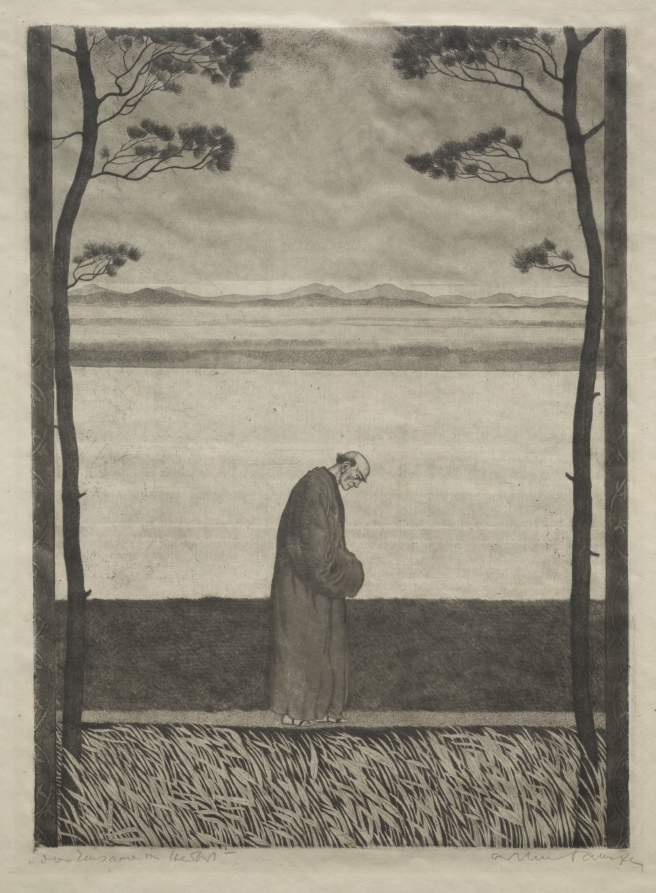
Arthur Paunzen · The Cleveland Museum of Art · Seventy-fifth anniversary gift of Phyllis Sloane · CC0
- Born
- 1890. · Vienna.
- Died
- 1940. · Isle of Man.
- Nationality
- Austria.
Reference Check
Propose documentary evidence for Arthur Paunzen. A contribution is never written directly as fact: identity, source, rights and evidence gates still decide.
Sign in to contribute
World of VALÉORINE
Documentary connections
Only confirmed graph relationships appear here. Images are shown only when their identity and reuse rights both pass the documentary gate.
Documentary evidence
Documentary basis
Authority files
wikidata · Q4799930 · wikipedia · Arthur Paunzen
VALÉORINE Encyclopedia
The documentary record
Statements marked “Documentary record” are set in the article beside the passage they confirm. Each is read from the authority records of the institutions named here; select “Prove” to see the record it was read from, where in that record, and when.
Institutions cited
Deutsche Nationalbibliothek
Not stated by the sources cited: nationality
Complete reading chain (JSON)In this article
Biography
Biography
He was born on 4 February in Vienna, to Leopold Paunzen and his wife Hermine, née Kuhn, who were Jewish. He studied with Ludwig Koch in Vienna and in France, at the Académie Julian, under Jean-Pierre Laurens. Later, he traveled throughout Italy, studying art and architecture. In 1918, shortly after he began exhibiting, he married Cornelia Westreich (1894–1971), who was also Jewish, in Vienna. An interest in music led him to create a number of works that convey music as symbolic images. For instance, depicting Beethoven's Eroica Symphony as nude horse-backed lancers, surrounded by clouds and flanked by a trumpeter who might be Death. He also created a series based on Gustav Mahler's song cycle, "Das Lied von der Erde". His interests extended to literature, including a series of etchings depicting Raskolnikov, from Dostoevsky's Crime and Punishment. In 1938, when Hitler annexed Austria, he and his wife moved to Great Britain.
Documentary record
Arthur Paunzen was born in 1890.
Later life and death
Later life and death
In May 1940, the British authorities interned all German and Austrian citizens in the country. He was among them and died on 9 August 1940, in the Central Internment Camp, Douglas, Isle of Man. His friend and fellow-internee, the composer Hans Gál, kept a detailed diary. In it, he describes Paunzen's cause of death as severe bronchial pneumonia, made worse by neglect on the part of the camp's medical workers. He is buried in the Jewish section of the Douglas Borough Cemetery. Many of his pieces were collected by the British Museum, the Stockholm Engraving Collection at the Nationalmuseum, and the Albertina Museum in Vienna.
Documentary record
Arthur Paunzen appears in the authority records of the Deutsche Nationalbibliothek as a painter, graphic artist and artist (1890 – 1940). Arthur Paunzen died in 1940.
Identity
Identity
Arthur Paunzen is recorded with the occupation lithographer. Recorded as artist, etcher, exlibrist, painter and illustrator.
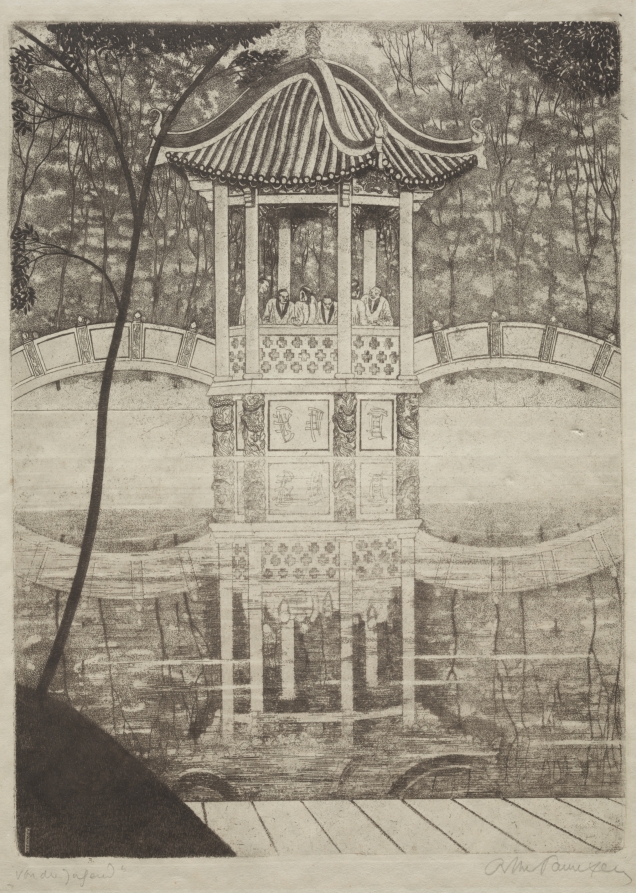
Untitled, 1900–1910, by Arthur Paunzen
Arthur Paunzen · The Cleveland Museum of Art · Seventy-fifth anniversary gift of Phyllis Sloane
Life and career
Dated record
Life and career
The full dated record · 2 entries
1890
Arthur Paunzen was born on 4 February 1890.
1940
Arthur Paunzen died on 1 January 1940.
Places
Named by the record
Places
Only places the record itself states, plotted where the house gazetteer settles their coordinates. Nothing is inferred from a name or a nationality.
Vienna.
Birth place
Isle of Man.
Death place
Primary material
Documents and archives
authority record
- Wikidata, structured authority record Q4799930: Arthur Paunzen
General reference · Wikidata
reference work
- “Arthur Paunzen”, English Wikipedia, consulted as further reading
Reputable secondary · Wikipedia
Text attribution
Licensing
Text attribution
Part of the biographical narrative on this page reuses licensed material. Its origin, revision and licence are recorded here.
The biographical narrative on this page is based on the Wikipedia article Arthur Paunzen, revision 1354317555 (EN edition), by its contributors. VALÉORINE has edited that text and built its own documentary record around it. The reused material is available under CC BY-SA 4.0, and this page's reuse of it is offered under the same licence. Everything else on this page — the chronology, the holdings, the evidence, the plates and the connections — is VALÉORINE's own record. Sources and licences.
Notes from the source article
Cited by Wikipedia
Notes from the source article
These works are cited by the source article, in its own numbering. They are recorded as its citations, not as sources VALÉORINE has verified.
- 1.Vienna index of Jewish records
- 2.'Musik hinter Stacheldraht', Peter Lang, Bern, 2003, p. 103
- 3.Isle of Man Jewish Community
References
Citations
References
Each reference names the institution holding it, so a reader may go to the document itself.
authority record
Secondary witnessreference work
Secondary witness
The Encyclopedia exists whether or not anything is for sale. Corrections are recorded rather than overwritten, and every version of this record is kept. Published 17 August 2026.
Elsewhere in Illustration
5,224 published records in this field, each with its sources named.
- Arthur Heygate MackmurdoIllustrator
- Arthur HughesIllustrator
- Arthur Humphreys FoordIllustrator
- Arthur LanghammerIllustrator
- Arthur RackhamIllustrator
- Arthur RansomeIllustrator
- Arthur SiebelistIllustrator
- Arthur ThieleIllustrator
Best supported in this field
For owners
Own a work by Arthur Paunzen?
A specialist will read what you send and tell you what the house can establish, what it cannot, and whether the object is suited to sale. There is no charge and no obligation. The object stays with you throughout; nothing is shipped to us unless it is arranged in writing beforehand.