
Armand Guillaumin
Armand Guillaumin (French: [aʁmɑ̃ ɡijomɛ̃]; 16 February 1841 – 26 June 1927) was a French Impressionist painter and lithographer.
Also recorded as Jean-Baptiste-Armand Guillaumin · Jean-Baptiste Armand Guillaumin · Jean Baptiste Armand Guillaumin · a. guillaumin
Armand Guillaumin
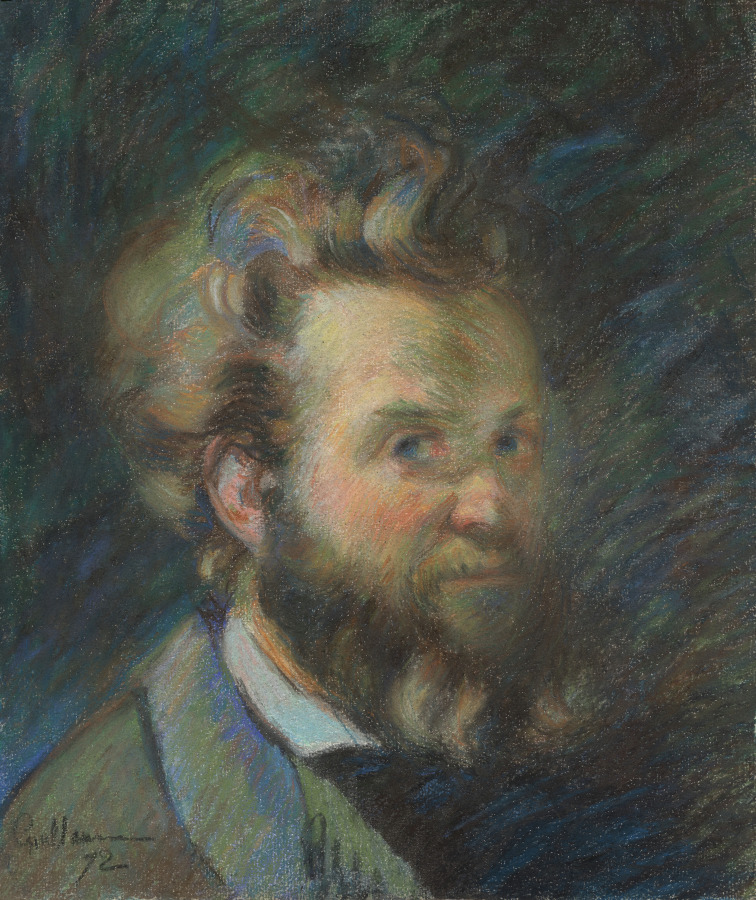
Armand Guillaumin · The Cleveland Museum of Art · Nancy F. and Joseph P. Keithley Collection Gift · CC0
- Born
- 1841.
- Died
- 1927.
- Nationality
- France.
- Fields
- portrait.
- Movements
- Impressionism.
- Known for
- Soleil couchant à Ivry and Crozant School.
VALÉORINE Encyclopedia
VALÉORINE documentary reading
Documentary summary
Armand Guillaumin (French: [aʁmɑ̃ ɡijomɛ̃]; 16 February 1841 – 26 June 1927) was a French Impressionist painter and lithographer.
Admitted source layer · organised and presented by VALÉORINE
Note VALÉORINE
Armand Guillaumin was a national of France. Armand Guillaumin was born in 1841. Armand Guillaumin died in 1927. Its genre is portrait. Among the works is Crozant School and Soleil couchant à Ivry.
Composed from admitted, traceable facts · 26 September 2026
VALÉORINE
Reference Check
Propose documentary evidence for Armand Guillaumin. A contribution is never written directly as fact: identity, source, rights and evidence gates still decide.
Sign in to contribute
Documentary evidence
Evidence Panel
technical hold · checked 25 September 2026
- Identity
- resolved
- Independent source families
- 0
- Admitted assertions
- 0
- Open conflicts
- 0
Authority files
gnd · 1091489858 · wikidata · Q436844 · wikipedia · Armand Guillaumin
In this article
Early years
Early years
Born Jean-Baptiste Armand Guillaumin in Paris, he worked at his uncle's lingerie shop while attending evening drawing lessons. He also worked for a French government railway before studying at the Académie Suisse in 1861. There, he met Paul Cézanne and Camille Pissarro, with whom he maintained lifelong friendships. While he never achieved the stature of these two, his influence on their work was significant. With these two friends, Guillaumin exhibited at the Salon des Refusés in 1863.The three artists frequently painted in each other's company in the 1870s; for a time, Guillaumin and Cézanne had studios next door to each other on the Île Saint-Louis in Paris. In 1873, Cézanne made the only etchings of his career, one of them depicting Guillaumin (see Gallery below). Guillaumin was a member of the Société anonyme des artistes peintres, sculpteurs et graveurs (later dubbed Impressionistes) from the start and he participated in six of the eight Impressionist exhibitions: 1874, 1877, 1880, 1881, 1882 and 1886. In the eyes of contemporary critics, he became known for his assured brushstroke and use of bold colours. In 1886, an astute critic, Félix Fénéon, called him a "furious colourist"; By the 1890s, his palette had grown even bolder, less faithful to nature. He was a Fauve a decade before Fauvism.
Full-time painter
Full-time painter
In 1886, he became a friend of Vincent van Gogh, whose brother, Theo, exhibited and sold some of his works. Vincent held Guillaumin's work in high regard, commenting on it in at least 36 letters written from 1888 to 1890. In the mid 1880s, Guillaumin's studio was a meeting place for young artists such as Paul Gauguin, Paul Signac and Georges Seurat. Guillaumin was finally able to quit his government job and concentrate on painting full-time in 1891, when he won 100,000 francs in the state lottery.
Death
Death
Armand Guillaumin died in 1927 in Orly, Val-de-Marne just south of Paris.
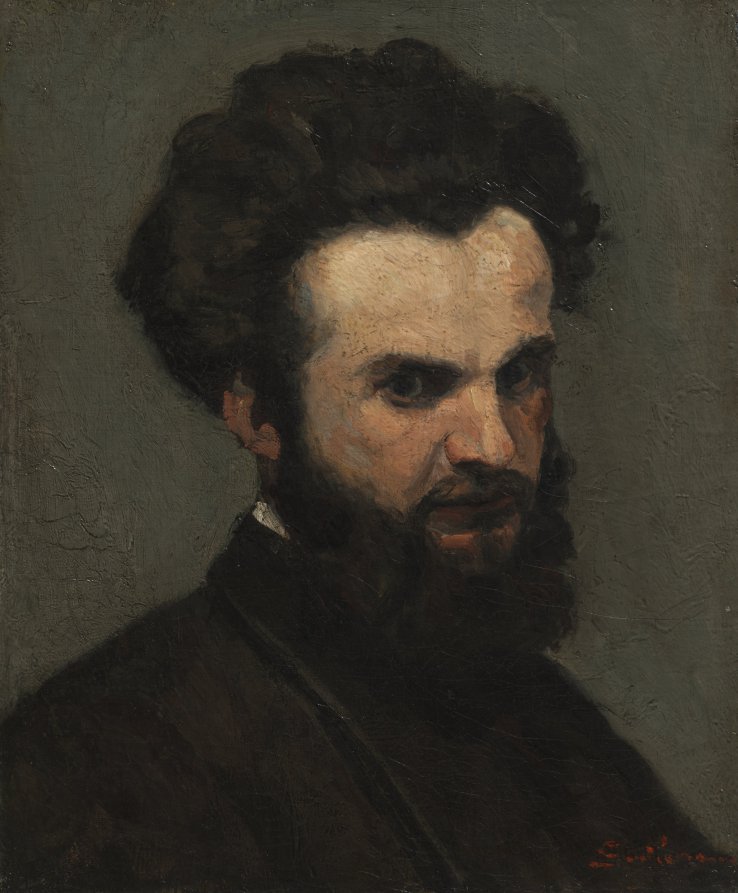
Self-Portrait, c. 1872–74, by Armand Guillaumin
Armand Guillaumin · The Cleveland Museum of Art · Bequest of Noah L. Butkin
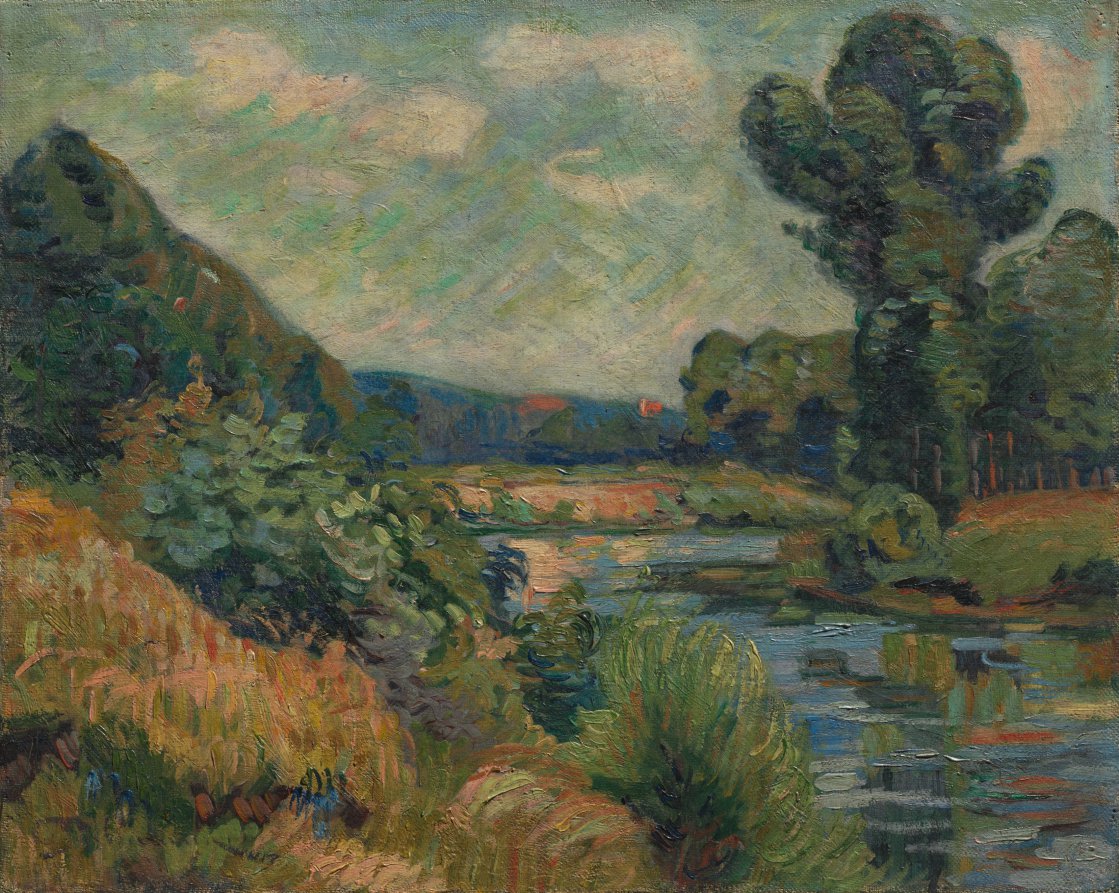
The Banks of the Marne at Charenton, c. 1895, by Armand Guillaumin
Armand Guillaumin · The Cleveland Museum of Art · Gift of Mr. and Mrs. Lewis B. Williams from The Blair Trust
Life and career
Dated record
Life and career
The full dated record · 2 entries
1841
Armand Guillaumin was born in 1841.
1927
Armand Guillaumin died at Orly.
Legacy
Guillaumin is best remembered for his landscapes of Paris, the Creuse département, and the area around Les Adrets-de-l'Estérel near the Mediterranean coast in the Provence-Alpes-Côte d'Azur region of France. Guillaumin was called the leader of the École de Crozant, a diverse group of painters who came to depict the landscape in the region of the Creuse around the village of Crozant. One of these depictions, titled Landscape in Crozant, is housed in the Art Institute of Chicago. His bust is in the square near the village church in Crozant.
Exhibitions and collections
Exhibitions and collections
Armand Guillaumin was given large solo exhibitions at many of the top Parisian galleries, including Galeries Durand-Ruel in 1895, Galerie Ambroise Vollard in 1897, Galerie Bernheim-Jeune in 1901 and 1906, and Galerie Paul Rosenberg in 1908. Noted for their intense colours, Guillaumin's paintings are represented in major museums around the world. These include the Musée d’Orsay (48 works) and Petit Palais (91 works) in Paris, the Tate Britain in London, major museums in Germany, Russia, the Netherlands and Spain, the Metropolitan Museum of Art in New York, the National Gallery of Art in Washington DC, the Art Institute of Chicago, and many others in the U.S.A, Canada, Israel and Japan. Private collectors, many of whom owned dozens of works, bought up his production through the 1920s. Noteworthy among these are Count Armand Doria, Dr. Paul Gachet, Théodore Duret, Gustave Geffroy, Louis Vauxcelles, Tadamasa Hayashi, Sergei Shchukin, Chester Dale and Paul Mellon.
Documents and archives
Primary material
Documents and archives
reference work
- Wikidata, structured authority record Q436844: Armand Guillaumin
Reputable secondary · Wikimedia Foundation
- “Armand Guillaumin”, English Wikipedia, consulted as further reading
Reputable secondary · Wikipedia
authority file
- Gemeinsame Normdatei 1091489858, Armand Guillaumin 1841-1927: Un Maître de l'Impressionnisme Français (1996 : Lausanne).
Unverified · Deutsche Nationalbibliothek
Notes from the source article
Cited by Wikipedia
Notes from the source article
These works are cited by the source article, in its own numbering. They are recorded as its citations, not as sources VALÉORINE has verified.
- 1.Rewald, John. The history of impressionism. Secker & Warburg. 1980. 0-436-41149-0.
- 2.Gray, Christopher. Armand Guillaumin. Brush-Mill Books. 33. 1991.
- 3.Vincent van Gogh Letters.
- 4."Armand Guillaumin", Oxford Art Online
- 5.Montgomery, Blair. Collections. Armand Guillaumin, From the Shadows into the Light. March 2, 2022.
- 6.Art Institute of Chicago Collections. The Art Institute of Chicago.
- 7.Jean-Paul Labourdette, Dominique Auzias. Best of France 2008-2009 Petit Fute. Petit Futé. 606. 3 September 2008. 978-2-7469-2225-9.
References
Citations
References
Each reference names the institution holding it, so a reader may go to the document itself.
authority file
Gemeinsame Normdatei 1091489858, Armand Guillaumin 1841-1927: Un Maître de l'Impressionnisme Français (1996 : Lausanne).Deutsche Nationalbibliothek
Partially resolvedreference work
Wikidata, structured authority record Q436844: Armand GuillauminWikimedia Foundation
Partially resolvedreference work
Partially resolved
The Encyclopedia exists whether or not anything is for sale. Corrections are recorded rather than overwritten, and every version of this record is kept. Published 14 August 2026.
Elsewhere in Illustration
5,224 published records in this field, each with its sources named.
- Arild RosenkrantzIllustrator
- Aristide DelannoyIllustrator
- Arline GénéreuxIllustrator
- ArmanIllustrator
- Armstrong SperryIllustrator
- Arnaldo FerragutiIllustrator
- Arne MattssonIllustrator
- Arne NøstIllustrator
Best supported in this field
For owners
Own a work by Armand Guillaumin?
A specialist will read what you send and tell you what the house can establish, what it cannot, and whether the object is suited to sale. There is no charge and no obligation. The object stays with you throughout; nothing is shipped to us unless it is arranged in writing beforehand.