
Appius Claudius Caecus
Illustration — Appius Claudius Caecus is led into the Curia Hostilia by his sons. 19th century painting by Cesare Maccari. • Illustration — Memorial inscription of Appius Claudius C. Caecus, "Appius Claudius Caecus, son of Gaius." • Illustration — The first Roman road, the Via Appia. Via Appia within the ancient Minturno Appius Claudius Caecus (c.
Also recorded as Caecus · Appius Claudius Crassus
Appius Claudius Caecus
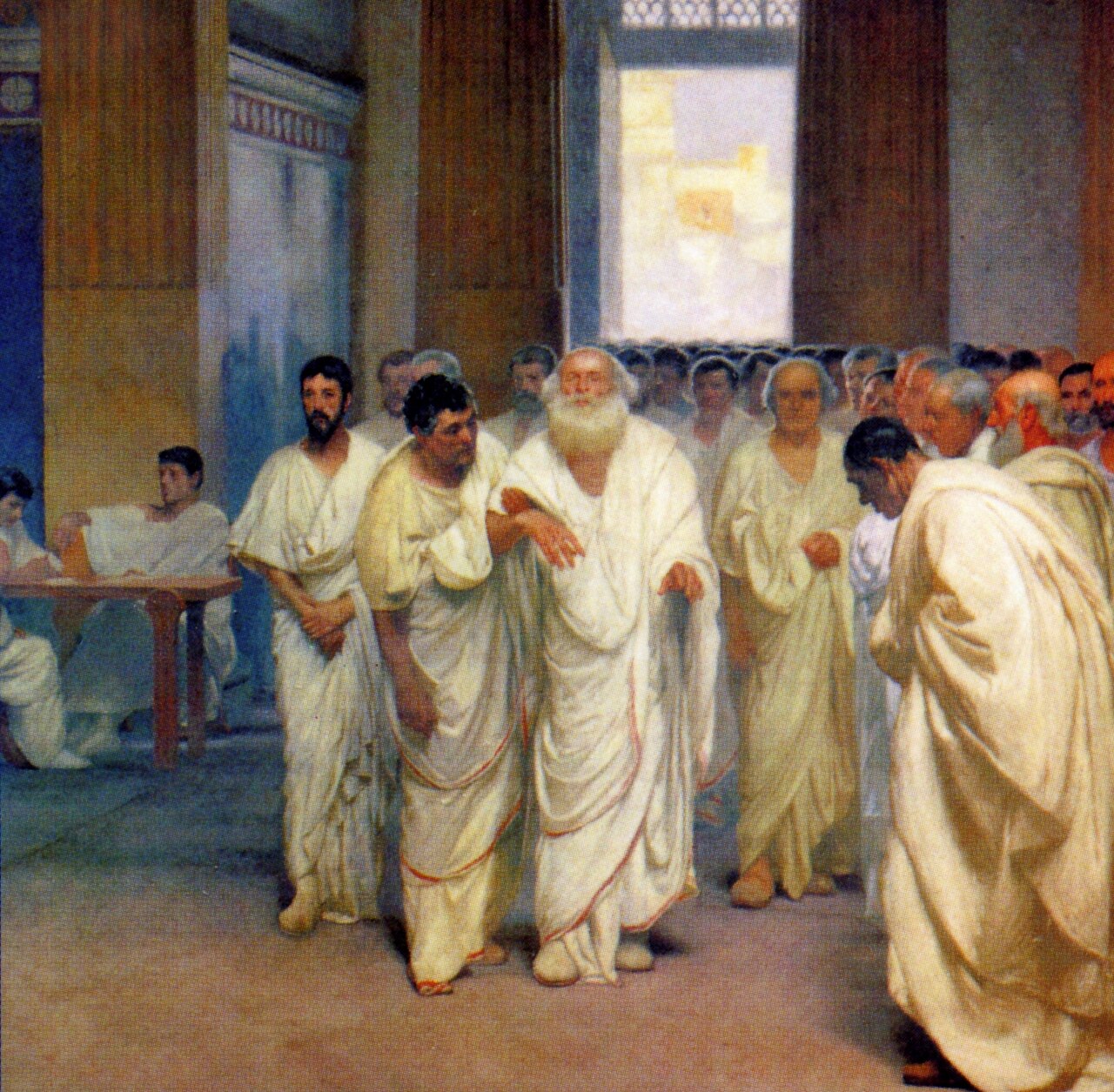
Cesare Maccari · https: voce_sommario=15 · Public domain
- Died
- 300.
- Nationality
- Ancient Rome.
- Occupation
- writer, poet, politician and military personnel.
- Languages
- Latin.
VALÉORINE Encyclopedia
VALÉORINE documentary reading
Documentary summary
Illustration — Appius Claudius Caecus is led into the Curia Hostilia by his sons. 19th century painting by Cesare Maccari. • Illustration — Memorial inscription of Appius Claudius C. Caecus, "Appius Claudius Caecus, son of Gaius." • Illustration — The first Roman road, the Via Appia. Via Appia within the ancient Minturno Appius Claudius Caecus (c.
Admitted source layer · organised and presented by VALÉORINE
Note VALÉORINE
Appius Claudius Caecus (died 300) was a military personnel, poet and politician, among other activities, a national of Ancient Rome. The military personnel was born in Ancient Rome. Appius Claudius Caecus held the positions of aedile and Roman censor, among others. Languages used include Latin.
Composed from admitted, traceable facts · 26 September 2026
VALÉORINE
Reference Check
Propose documentary evidence for Appius Claudius Caecus. A contribution is never written directly as fact: identity, source, rights and evidence gates still decide.
Sign in to contribute
World of VALÉORINE
Documentary connections
Only confirmed graph relationships appear here. Images are shown only when their identity and reuse rights both pass the documentary gate.
Documentary evidence
Evidence Panel
technical hold · checked 25 September 2026
- Identity
- resolved
- Independent source families
- 0
- Admitted assertions
- 0
- Open conflicts
- 0
Authority files
gnd · 11942598X · wikidata · Q297783 · wikipedia · Appius Claudius Caecus
In this article
Family background
Family background
312–279 BC) was a statesman and writer from the Roman Republic. He is best known for two major building projects: the Appian Way (Latin: Via Appia), the first major Roman road, and the first aqueduct in Rome, the Aqua Appia. He is the first Roman public figure whose life can be traced with some historical certainty. He also instigated controversial popular-minded reforms and is also credited with the authorship of a juristic treatise, a collection of moral essays, and several poems, making him one of Rome's earliest literary figures. A patrician of illustrious lineage, Caecus first came to prominence with his election to the position of censor in 312 BC, which he held for five years. During Caecus's time in office, aside from his building projects, he introduced several controversial but poorly-understood constitutional reforms: he increased the voting power of the poor and landless in the legislative assemblies, and admitted lower-class citizens to the Roman Senate, though these measures were partially undone by the resentful nobility. In addition, Caecus was the first censor to draw up a formal list of senators. These reforms massively increased the prestige of the censorship, which had previously only been a minor magistracy. Later in life, having become blind (caecus, whence the surname) from old age, he delivered a speech to the Senate successfully opposing peace with the Epirote king Pyrrhus. His reforms did trigger some outrage, as he broke a number of established traditions. Appius embroiled himself in several bitter political feuds, especially with the Fabii (a powerful Roman family). Fabius Pictor, who was the earliest Roman historian and a member of the Fabian family, may have been the source for a significant amount of smear against Caecus, accusing him of being a corrupted, immoral demagogue, and an inept general. Owing to the wide divergence in the sources, modern scholars have had very different interpretations of Caecus' deeds: he has been described as a revolutionary, a reactionary, a would-be tyrant, or a great reformer, comparable to Athenian figures like Cleisthenes and Pericles.
Caecus, who was originally called Appius Claudius Crassus, was born into the patrician clan of the Claudii, one of the most important Roman families of the time, whose members had held executive offices of state since the beginning of the Republic. The family were widely described in Roman sources as haughty aristocrats with arch-conservative views, though this stereotype was likely only created long after Caecus's death. Caecus's father was called Gaius Claudius Inregillensis, known only for being appointed dictator in 337 BC and immediately resigning after the augurs had found a religious fault in his appointment. His mother is not known, but he had a much younger brother, Appius Claudius Caudex, who became consul in 264, four years after Caecus' elder son. Since Caecus' sons became consuls over a period of 28 years and long after his own time, he probably married at least twice, even though none of his wives is known.
Early career
Early career
The only information known about Caecus' early career before his censorship is from his eulogy, formerly displayed on the Roman Forum. This summary of his career lists all the responsibilities he held, including some junior offices, while literary sources only record upper magistracies (censor, consul, and praetor); however it does not provide any date and the offices are not ordered chronologically. The eulogy tells that he was the military tribune three times, the quaestor one time, and curule aedile twice. These junior magistracies were standard and found in the career of every Roman politician, but the number of times he held these positions is much more unusual. Endre Ferenczy thought Caecus held them all before his censorship because of his family's decline, which forced him to repeat them to build his popularity (especially as aedile, because this magistrate organised games), therefore explaining his early censorship. However, his thesis has been criticised, notably by Stephen Oakley, who notes that there is not enough evidence to know whether iterations of the military tribuneship and aedileship were really exceptional for this period, during which most careers are unknown. It is nonetheless certain that Caecus was military tribune before his censorship, because it was a requirement for being elected consul, which he became immediately after his censorship. As military tribune, he certainly served during the Second Samnite War (326–304 BC), the main conflict in Italy at the time.
Censorship (312–308 BC)
Censorship (312–308 BC)
Appius Claudius Caecus was a Roman censor from 312 BC to 308 BC, He was not a consul beforehand which later became a prerequisite for the office. During his time as censor he sought support from the lower classes, by allowing sons of freedmen to serve in the Senate, and extending voting privileges to men in the rural tribes who did not own land. During the Second Samnite War, he advocated the founding of Roman colonies (colonia) throughout Latium and Campania to serve as fortifications against the Samnites and Etruscans. Appius is best known for two construction undertakings as censor: the Appian Way (Via Appia), the first major Roman road, running between Rome and Beneventum to the south; and the first aqueduct in Rome, the Aqua Appia.
Legal contributions
Legal contributions
Appius' major legal contribution came from him starting the publication of legis actiones ("methods of legal practice"). This publication served as a guide for Roman Legal procedure. The publication also included a list of days that court was to be held on.
Later career (307–280 BC)
Later career (307–280 BC)
During this time period he served as consul twice; in 307 BC and 296 BC, he was also appointed Dictator in 285 BC. Appius gave a famous speech in this period against Cineas, an envoy of Pyrrhus of Epirus, declaring that Rome would never surrender. The speech is the source of the saying "every man is the architect of his own fortune" (quisque faber suae fortunae), and was still known in the time of Cicero In 279 BC, Appius went blind due to a curse, according to Livy.
Notable quotes
Notable quotes
"Every man is the architect of his destiny" (Homo faber suae quisque fortunae/Est ūnus quisque faber ipsæ suæ fortūnæ)
Descendants
Descendants
Caecus had four sons and five daughters who reached adulthood. His four sons were Appius Claudius Russus (consul in 268), Publius Claudius Pulcher (consul in 249), Gaius Claudius Centho (consul in 240), and Tiberius Claudius Nero (grandfather of the consul of 202). Appius Claudius Caecus is used in Cicero's Pro Caelio as a stern and disapproving ancestor to Clodia. Cicero assumes the voice of Caecus in a scathing prosopopoeia, where Caecus is incensed at Clodia for associating with Caelius, a member of the middle equestrian class instead of the upper patrician class. Caecus's achievements, such as the building of the Appian Way and the Aqua Appia, are mentioned as being defiled by Clodia's actions.
Family tree of Appius Caecus
Family tree of Appius Caecus
style="border-spacing: 2px; border: 1px solid darkgray;" Legend • DICT — Dictator — CENS — Censor — CONS — Consul
Life and career
Dated record
Life and career
The full dated record · 1 entries
300
Appius Claudius Caecus died.
Literary output
Appius wrote several books over his life. He wrote a book called Sententiae, which was based upon a verse of Greek model. It was "the first Roman book of literary character". Appius also wrote treatise, De Usurpationibus ("Concerning Usurpations"), which is lost and the content is unknown. In addition Appius was one of the earliest known Roman prose and verse authors whose name is still known today. He was also concerned with literature and rhetoric, and instituted reforms in Latin orthography, allegedly ending the use of the letter Z.
Primary material
Documents and archives
reference work
- Wikidata, structured authority record Q297783: Appius Claudius Caecus
Reputable secondary · Wikidata
- “Appius Claudius Caecus”, English Wikipedia, consulted as further reading
Reputable secondary · Wikipedia
authority file
- Gemeinsame Normdatei 11942598X, Appius Claudius, Caecus.
Unverified · Deutsche Nationalbibliothek
References ==== Bibliography ===== Ancient sources =
• Diodorus Siculus, Bibliotheca Historica. • Fasti Capitolini, Fasti Triumphales. • Livy, Ab Urbe Condita (English translation by Rev. Canon Roberts on Wikisource), Periochae (English translation by Jona Lendering on Livius.org). • Valerius Maximus, Factorum ac Dictorum Memorabilium (English translation by Samuel Speed on EEBO).
Modern sources
Modern sources
* * * * * * * * *
Notes from the source article
Cited by Wikipedia
Notes from the source article
These works are cited by the source article, in its own numbering. They are recorded as its citations, not as sources VALÉORINE has verified.
- 1.Bispham, Edward. M. Humm, Appius Claudius Caecus. La République Accomplie (Befar 322). Rome: École Française de Rome, 2005. Pp. X + 779, 10 PLS, 14 illus, 2 tables. ISBN 978-2-72830-682-4. €112.00. Journal of Roman Studies. 98. 188–189. 2008. 10.1017/S0075435800001787.
- 2.Briscoe, John. Appius Claudius Caecus. Oxford Classical Dictionary. 2016. 9780199381135.
- 3.Livy, viii. 15.
- 4.Livy, ix.29.
- 5.Grout, James. Appius Claudius Caecus and the Letter Z. Encyclopædia Romana.
- 6.Boak, Arthur E. R. History of Rome to A.D. 565. Macmillan. 95. 1965.
- 7.Appius Claudius Caecus. Encyclopædia Britannica. Feb 22, 2024.
- 8.Hempl, George. The Origin of the Latin Letters G and Z. Transactions and Proceedings of the American Philological Association. 30. 24–41. 1899. 10.2307/282560.
- 9.Rawson, Elizabeth. More on the "Clientelae" of the Patrician Claudii. Historia: Zeitschrift für Alte Geschichte. 26. 3. 349. 1977. 4435564.
Bibliography printed in the source article · 6
- Briscoe, John. Valerius Maximus, Facta et dicta memorabilia, Book 8 Text, Introduction, and Commentary. De Gruyter. 2019.
- Loud, G. A. The crusade of Frederick Barbarossa: The history of the expedition of the emperor Frederick and related texts. Ashgate. 2010.
- Münzer, Friedrich. Roman Aristocratic Parties and Families. Johns Hopkins University Press. 1999.
- Oakley, S.P. A Commentary on Livy, Books VI–X, Volume IV: Book X. Clarendon Press. 2005b. 0-19-927256-5.
- Taylor, Lily Ross. The Order of the Two Consuls' Names in the Yearly Lists. Memoirs of the American Academy in Rome. 19. 3–14. 1949. 10.2307/4238618.
- Overview Appius Claudius Caecus (fl. 312–279), Oxford Reference
References
Citations
References
Each reference names the institution holding it, so a reader may go to the document itself.
authority file
Gemeinsame Normdatei 11942598X, Appius Claudius, Caecus.Deutsche Nationalbibliothek
Partially resolvedreference work
Partially resolvedreference work
Partially resolved
The Encyclopedia exists whether or not anything is for sale. Corrections are recorded rather than overwritten, and every version of this record is kept. Published 14 August 2026.
Elsewhere in Books
38,558 published records in this field, each with its sources named.
- Apostolo ZenoAuthor
- Appachcha KaviAuthor
- Appar TirunavukkarasarAuthor
- AppianAuthor
- Apple Color EmojiTerminology
- Apple SymbolsTerminology
- April BernardAuthor
- April BulmerAuthor
Best supported in this field
For owners
Own a work by Appius Claudius Caecus?
A specialist will read what you send and tell you what the house can establish, what it cannot, and whether the object is suited to sale. There is no charge and no obligation. The object stays with you throughout; nothing is shipped to us unless it is arranged in writing beforehand.