
Antony Beevor
Sir Antony James Beevor FRSL FRHistS (born 14 December 1946) is a British military historian and author. He has published several popular historical works, mainly on the Second World War, the Spanish Civil War, and most recently the Russian Revolution and the Russian Civil War. Educated at Abberley Hall School, Winchester College, and the Royal Military Academy Sandhurst, Beevor commanded a troop of tanks in the 11th Hussars in Germany before deciding in 1970 to leave the British Army and become a writer.
Also recorded as Antony James Beevor · Sir Antony Beevor · Sir Antony James Beevor
Antony Beevor

Bjørn Erik Pedersen · CC BY 2.5
- Birth Name
- Antony James Beevor
- Born
- 14 December 1946
- Birthplace
- Kensington, London, England
- Occupation
- Author, historian
- Education
- Abberley Hall School Winchester College Royal Military Academy Sandhurst
- Awards
- Samuel Johnson Prize
- Nationality
- United Kingdom.
- Fields
- history, contemporary history and military history.
- Honours
- Baillie Gifford Prize, Knight Bachelor, Wolfson History Prize, Fellow of the Royal Society of Literature, honorary doctor of the University of Kent and Runciman Award.
- Languages
- English.
VALÉORINE Encyclopedia
VALÉORINE documentary reading
Documentary summary
Sir Antony James Beevor FRSL FRHistS (born 14 December 1946) is a British military historian and author. He has published several popular historical works, mainly on the Second World War, the Spanish Civil War, and most recently the Russian Revolution and the Russian Civil War. Educated at Abberley Hall School, Winchester College, and the Royal Military Academy Sandhurst, Beevor commanded a troop of tanks in the 11th Hussars in Germany before deciding in 1970 to leave the British Army and become a writer.
Admitted source layer · organised and presented by VALÉORINE
Note VALÉORINE
No house-authored Note is published until its assertions and sources pass the VALÉORINE evidence contract. The documentary article remains available in full while that enrichment is being consolidated.
Documentary enrichment in progress · no unsupported statement published
Reference Check
Propose documentary evidence for Antony Beevor. A contribution is never written directly as fact: identity, source, rights and evidence gates still decide.
Sign in to contribute
World of VALÉORINE
Documentary connections
Only confirmed graph relationships appear here. Images are shown only when their identity and reuse rights both pass the documentary gate.
Documentary evidence
Evidence Panel
not yet certified
- Identity
- resolved
- Independent source families
- 0
- Admitted assertions
- 0
- Open conflicts
- 0
Authority files
wikidata · Q380229 · wikipedia · Antony Beevor
In this article
Biography
Biography
He became a visiting professor at Birkbeck, University of London, and the University of Kent. His best-selling books, Stalingrad (1998) and Berlin: The Downfall 1945 (2002), have been acclaimed for their detailed coverage of the battles between the Soviet Union and Germany, and their focus on the experiences of ordinary people. Berlin proved very controversial in Russia because of the information it contained from former Soviet archives about the mass rapes carried out by the Red Army in 1945. Beevor's works have been translated into many languages and have sold millions of copies. He has lectured at numerous military headquarters, staff colleges and establishments in Britain, the United States, Europe and Australia. He has also written for many major newspapers.
Antony Beevor studied at Winchester College, Royal Military Academy Sandhurst and Abberley Hall School. The recorded working language is English. The field of work recorded is history, contemporary history and military history. Employment is recorded with Birkbeck, University of London. Distinctions recorded are Baillie Gifford Prize, Knight Bachelor, Wolfson History Prize and Fellow of the Royal Society of Literature.
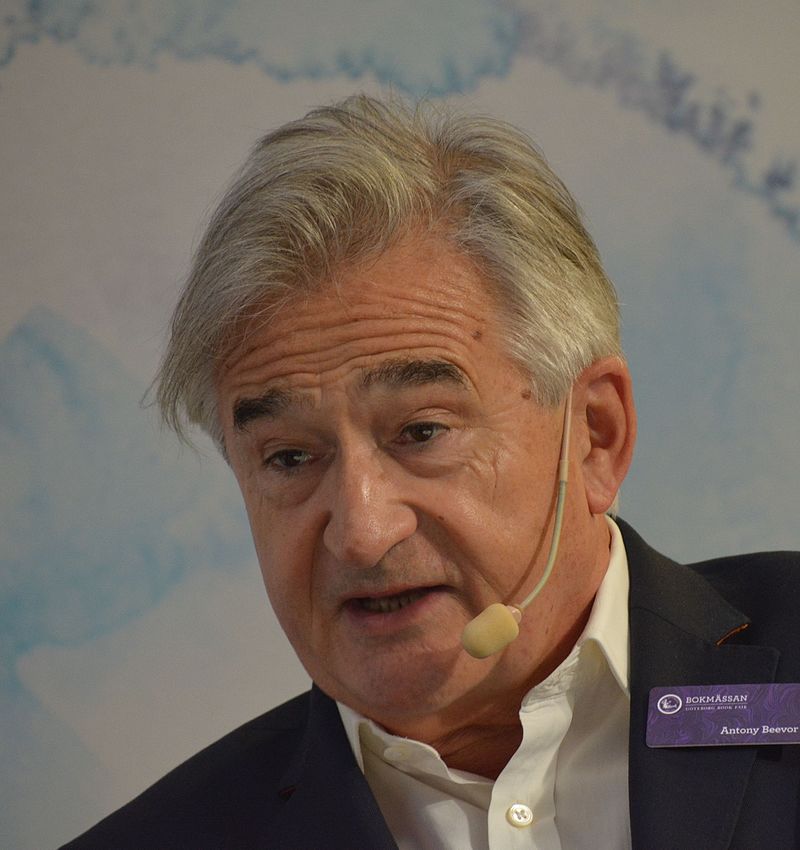
Antony Beevor at the Gothenburg Book Fair in 2015.
Bengt Oberger
Key facts
Key facts
• Honorific Prefix — Sir • Birth Name — Antony James Beevor • Born — 14 December 1946 • Birthplace — Kensington, London, England • Occupation — Author, historian • Language — English • Education — Abberley Hall School Winchester College Royal Military Academy Sandhurst • Subject — Modern history • Children — 2 • Relatives — John Julius Norwich (father-in-law) • Awards — Samuel Johnson Prize • Website — https: www.antonybeevor.com
Early life and career
Early life and career
Antony James Beevor was born in Kensington, London, on 14 December 1946. He was educated at two independent schools: Abberley Hall School in Worcestershire, and then Winchester College in Hampshire from 1960 to 1964. He attended the University of Grenoble from 1964 to 1965. He joined the British Army as a cadet at the Royal Military Academy Sandhurst in 1965. As well as the usual cadet activities, he was able to study under the military historian John Keegan. On graduation he was commissioned in the 11th Hussars on 28 July 1967. Beevor served in England and Germany. He was promoted to lieutenant on 28 January 1969. He resigned his commission on 5 August 1970, having spent five years as a regular officer. He was a freelance journalist in the Middle East in 1970, before moving to London to work in marketing and advertising from 1971 to 1972, and marketing and publishing from 1974 to 1975. After publishing his first novel, a political thriller, with John Murray in 1975, he dedicated himself to writing. According to his own account, he was persuaded to turn to military history by a publisher.
Later career
Later career
Beevor has been a visiting professor at the School of History, Classics and Archaeology at Birkbeck, University of London, and at the University of Kent. He was the 2002–2003 Lees-Knowles Lecturer at the University of Cambridge. He has lectured at military colleges and staff headquarters in various countries from 1998 onwards. He worked with Jacqueline Kennedy Onassis as his editor for his 1994 book Paris After the Liberation, 1944–1949, co-written with his wife. He began a long-term research partnership with the Russian historian Lyuba Vinogradova (then a biology PhD student) in Volgograd in 1994, while preparing his first, commissioned book on Soviet history; she initially extracted material from the archives for him. His best-known works, the best-selling Stalingrad (1998) and Berlin: The Downfall 1945 (2002), recount the Second World War battles between the Soviet Union and Nazi Germany. They have been praised for their vivid, compelling style, their treatment of the ordinary lives of combatants and civilians, and the use of newly disclosed documents from Soviet archives. Berlin proved hugely controversial in Russia because of the information it contained from former Soviet archives about, the mass rapes carried out by the Red Army in 1945, among other Soviet war crimes. He was criticised for "lies, slander and blasphemy" against the Red Army by the Russian ambassador at the time, Grigory Karasin, and was frequently described as "the chief slanderer of the Red Army" by Kremlin-supporting media. Numerous Russian academic theses and books have been published that dispute his claim as exaggerations, misattributions, or direct citations of propaganda used by Joseph Goebbels, including The Red Army “Rape of Germany” was Invented by Goebbels by the Russian author Anatoly Karlin. His The Spanish Civil War (1982) was later re-written as The Battle for Spain (2006), keeping the structure and some content from the earlier work, but using the updated narrative style of his Stalingrad book and also adding characters and new archival research from German and Russian sources. Beevor's book The Second World War (2012) is notable for its focus on the conditions and grief faced by women and civilians and for its coverage of the war in East Asia, which has been called "masterful". Beevor's expertise has been the subject of some commentary; his publications have been praised as revitalising interest in Second World War topics and have allowed readers to reevaluate events such as D-Day from a new perspective. He has also appeared as an expert in television documentaries related to World War II. As of 2014 his works had been translated into 35 languages, with more than 8.5 million copies sold. In August 2015 the Yekaterinburg region considered banning Beevor's books, accusing him of Nazi sympathies and citing his lack of Russian sources when writing about Russia, and claiming he had promoted false stereotypes introduced by Nazi Germany during the war. Beevor responded by calling the banning "a government trying to impose its own version of history", comparing it to other "attempts to dictate a truth", such as denial of the Holocaust and the Armenian genocide. In January 2018 Beevor's book about the Battle of Stalingrad was banned in Ukraine for its description of war crimes committed by Ukrainian nationalists collaborating with Nazi forces (namely the execution of children). The official in charge of the decision, Serhiy Oliynyk, denied the event in question and called it a "provocation" likely emanating from Soviet historical sources. Beevor refuted the claims of an alleged anti-Ukrainian bent in the book, and pointed out that the source for the passage in question was an Abwehr officer named Helmuth Groscurth, demanding "an immediate apology from Oliynyk and a reversal of the decision by the 'expert council.'" Beevor has been described as a "popular historian" and as a "respected military historian" whose work is "not strictly … academic". He has been credited with using his thriller writer's technique to achieve success as a historian, and has insisted himself that history is "a branch of literature" without scientific pretences. He has also written for The Times, The Telegraph and Guardian, the New York Times, Washington Post, The Atlantic, Foreign Affairs, Le Monde, Libération, Le Figaro, as well as El País and ABC in Spain.
Personal life
Personal life
Beevor's father John was a solicitor who served with the Special Operations Executive during the World War II, and his mother Kinta was initially selected by Ian Fleming at the Naval Intelligence Division for a spying operation in Fascist Italy in 1940. Beevor is descended from a long line of writers, starting with the legal philosopher John Austin and his wife, Sarah, their daughter Lucie, Lady Duff-Gordon (Letters from Egypt), his grandmother Lina Waterfield, (Observer correspondent and Castle in Italy), and his mother Kinta Beevor (A Tuscan Childhood). According to himself, five generations of his mother's family had published with John Murray before him. He is married to Artemis Cooper, a writer. They have two children, Nella and Adam.
Fiction
Fiction
• Violent Brink. London: John Murray, 1975. • For Reasons of State. London: Jonathan Cape, 1980. • The Faustian Pact. London: Jonathan Cape, 1983. • The Enchantment of Christina von Retzen. London: Weidenfeld & Nicolson, 1989.
Nonfiction
Nonfiction
• The Spanish Civil War. London: Orbis, 1982. • Inside the British Army. London: Chatto and Windus, 1990. • Crete 1941: The Battle and the Resistance. London: John Murray, 1991. • with Artemis Cooper. Paris After the Liberation, 1944–1949. London: Penguin, 1994. • Stalingrad. London: Viking Press, 1998. • Berlin: The Downfall 1945. London: Penguin, 2002. (Published as The Fall of Berlin 1945 in the U.S.) • The Mystery of Olga Chekhova. London: Penguin, 2004. • The Battle for Spain: The Spanish Civil War 1936–1939. London: Weidenfeld & Nicolson, 2006. • D-Day: The Battle for Normandy. London: Penguin, 2009. • The Second World War. London: Weidenfeld & Nicolson, 2012. • Ardennes 1944: Hitler's Last Gamble. Viking, 2015. • Arnhem: The Battle for the Bridges, 1944. Viking, 2018. • Russia: Revolution and Civil War, 1917—1921. London: Weidenfeld & Nicolson, 2022. • Rasputin: And the Downfall of the Romanovs. London: Weidenfeld & Nicolson, 2026.
Edited volumes
Edited volumes
• A Writer at War: Vasily Grossman with the Red Army 1941–1945 by Vasily Grossman.
Book contributions
Book contributions
• The British Army, Manpower and Society into the Twenty-First Century, ed by Hew Strachan • What Ifs? of American History: Eminent Historians Imagine What Might Have Been, by Robert Cowley (Editor), Antony Beevor and Caleb Carr. (2003)
Life and career
Dated record
Life and career
The full dated record · 2 entries
1945
Berlin The Downfall 1945 - Antony Beevor (2007) is digitised and catalogued by Internet Archive.
1946
Antony Beevor born at Kensington.
Other activities
Beevor was a committee member for the London Library, and served as an academic advisory group member of the European Council on Tolerance and Reconciliation from 2018 to 2021 (alongside Timothy Snyder, Bernard-Henri Lévy and Aleksandr Dynkin). In November 2019, he was among the signatories of a letter refusing to endorse Jeremy Corbyn's Labour Party in the 2019 United Kingdom general election due to its "association with antisemitism". A former chair and member of the Council of the Society of Authors, he resigned alongside the author Philip Pullman in 2022 in protest against the actions of the CEO and the leadership of the management committee.
Honours and awards
Beevor was elected a Fellow of the Royal Society of Literature in 1999 and a Fellow of the Royal Historical Society in 2017. He was recognised with the 2014 Pritzker Military Museum & Library's Literature Award for Lifetime Achievement in Military Writing. Tim O'Brien, the 2013 recipient, made the announcement on behalf of the selection committee. The award carried a purse of US$100,000. Beevor was awarded Honorary D.Litt. degrees from the University of Kent in 2004, from the University of Bath in 2010, the University of East Anglia in 2014, and the University of York in 2015. He was elected an honorary Fellow of King's College London in July 2016. Also in July 2016, Beevor was awarded the Medlicott Medal for services to history by the UK-based Historical Association. Beevor was knighted in the 2017 New Year Honours for "services in support of Armed Forces Professional Development". He is also a Chevalier de l'Ordre des Arts et des Lettres (1997), a Member of Estonia's Order of the Cross of Terra Mariana (2008) and a Commander of the Belgian Order of the Crown (2016). Awards for his works include: • Crete: The Battle and the Resistance • Runciman Prize, administered by the Anglo-Hellenic League for stimulating interest in Greek history and culture • Stalingrad • The first Samuel Johnson Prize for Non-Fiction • Wolfson History Prize • Hawthornden Prize for Literature • Berlin: The Downfall 1945 • Longman-History Today Trustees' Award • The Battle for Spain: The Spanish Civil War 1936–1939 (Spanish Edition) • La Vanguardia Prize for Non-Fiction
Notes from the source article
Cited by Wikipedia
Notes from the source article
These works are cited by the source article, in its own numbering. They are recorded as its citations, not as sources VALÉORINE has verified.
- 1.The London Gazette (Supplement) no. 61803. p. N2
- 2.Richard Evans: Vollendete Unfähigkeit. Antony Beevor unterzieht fast alle Militärführer des Zweiten Weltkrieges scharfer Kritik. In: Süddeutsche Zeitung, 30. September 2014, S. 15.
- 3.Antony Beevor: Der Zweite Weltkrieg. Aus dem Engl. von Helmut Ettinger. Bertelsmann, München 2014, S. 894.
- 4.Webarchiv http://www.3sat.de/3sat.php?http%3A%2F%2Fwww.3sat.de%2Fkulturzeit%2Flesezeit%2F41604%2Findex.html 20070930184553 3sat Brutaler Beutezug, 10. Januar 2003 archiv-bot=2022-10-04 07:55:02 InternetArchiveBot
- 5.Webarchiv http://www.mdr.de/doku/931679.html 20031018015145 MDR Antony Beevor - Fachberater und Autor, 15. September 2003
- 6.Webarchiv http://www.mdr.de/doku/archiv/931875-hintergrund-925460.html 20040509085522 MDR Interview 2003
- 7.Rainer Blasius: Der Preis der Befreiung. Am Ende des Zweiten Weltkrieges mussten die Westmächte eine Hälfte Europas dem Stalinismus überlassen. In: Frankfurter Allgemeine Zeitung, 2. September 2014.
- 8.Richard Evans: Vollendete Unfähigkeit. Antony Beevor unterzieht fast alle Militärführer des Zweiten Weltkrieges scharfer Kritik. In: Süddeutsche Zeitung, 30. September 2014, S. 15.
- 9.OT The Spanish Civil War.
- 10.Ebenfalls in diesem Jahr gewann Julie McMahon den Historical Picture Researcher of the Year für John Beevors „Stalingrad“
- 11.Rezensionen in: Die Welt, Frankfurter Allgemeine, Hamburger Abendblatt, Berliner Morgenpost, 2002.
- 12.Rezension von Niels Beintker, Deutschlandfunk, 11. August 2014.
References
Citations
References
Each reference names the institution holding it, so a reader may go to the document itself.
reference work
Wikidata, structured authority record Q380229: Antony BeevorWikimedia Foundation
Partially resolvedreference work
Partially resolved
The Encyclopedia exists whether or not anything is for sale. Corrections are recorded rather than overwritten, and every version of this record is kept. Published 14 August 2026.
Elsewhere in Books
39,285 published records in this field, each with its sources named.
- Antonis FostierisAuthor
- Antonis SamarakisAuthor
- Antonius DiogenesAuthor
- Antonius MusaAuthor
- Antony DeschampsAuthor
- Antony DunnAuthor
- Antony KokAuthor
- Antony PogorelskyAuthor
Best supported in this field
For owners
Own a work by Antony Beevor?
A specialist will read what you send and tell you what the house can establish, what it cannot, and whether the object is suited to sale. There is no charge and no obligation. The object stays with you throughout; nothing is shipped to us unless it is arranged in writing beforehand.