
Antonio Cavallucci
Antonio Cavallucci (21 August 1752 – 18 November 1795) was an eighteenth-century Italian painter of religious scenes and portraits. One of the leading Roman Neoclassical painters, Cavallucci was influenced by Pompeo Batoni and Anton Raphael Mengs. There is in his art some of the northern European feeling that had made its way into Rome at the end of the eighteenth century.
Also recorded as Antonio Cavalucci · Cavalier Cavallucci · Cavallucci
Antonio Cavallucci
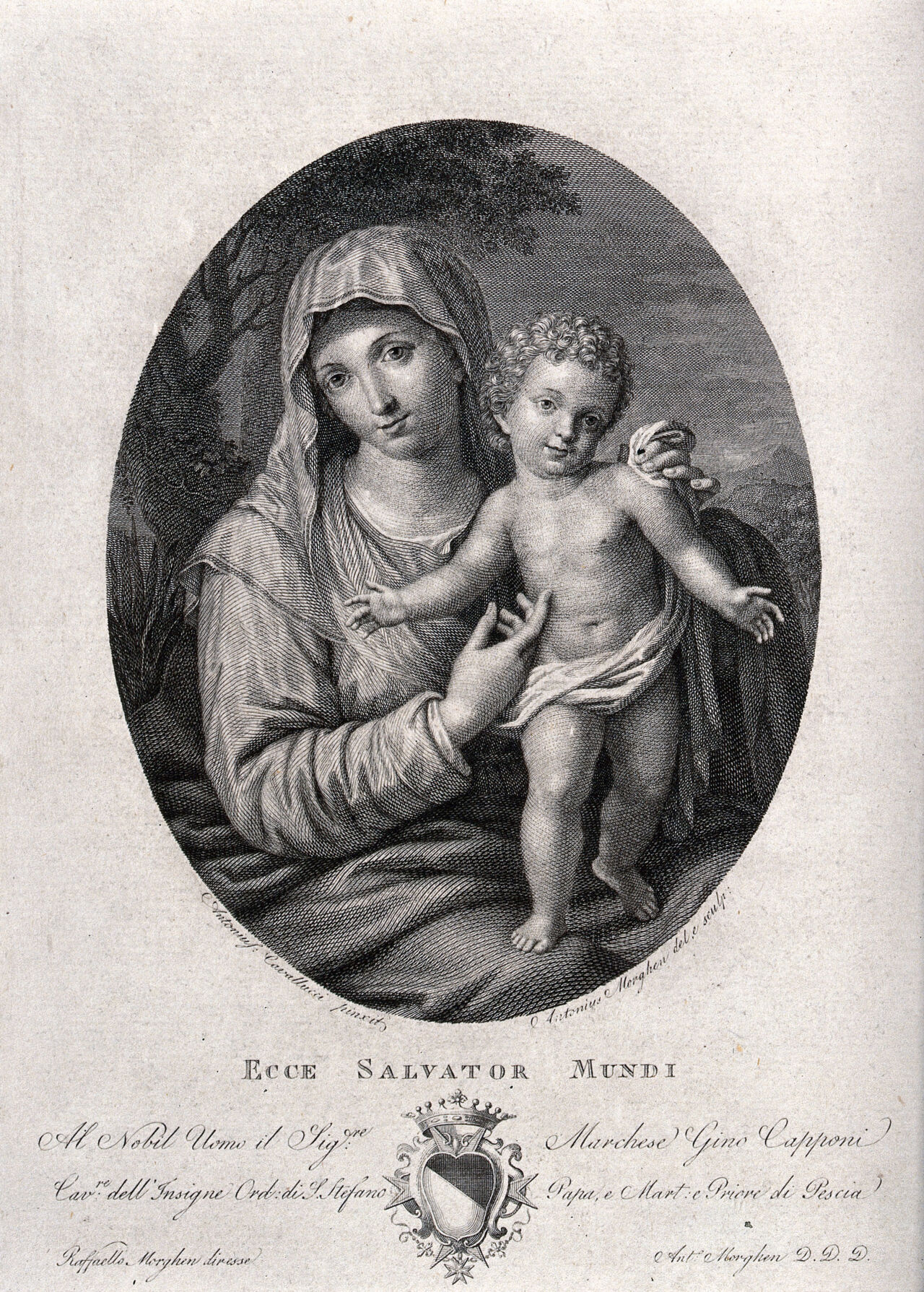
Antonio Cavallucci · Wellcome Collection, London · Wellcome Collection · Public Domain Mark
- Born
- 1752 · Sermoneta.
- Died
- 1795 · Rome.
- Occupation
- painter
- Fields
- portrait
- Languages
- Italian
VALÉORINE Encyclopedia
VALÉORINE documentary reading
Documentary summary
Antonio Cavallucci (21 August 1752 – 18 November 1795) was an eighteenth-century Italian painter of religious scenes and portraits. One of the leading Roman Neoclassical painters, Cavallucci was influenced by Pompeo Batoni and Anton Raphael Mengs. There is in his art some of the northern European feeling that had made its way into Rome at the end of the eighteenth century.
Admitted source layer · organised and presented by VALÉORINE
Note VALÉORINE
Antonio Cavallucci (1752–1795) was a painter. Born in Sermoneta, the painter died in Rome.
Genres include portrait. Languages used include Italian. Works by Antonio Cavallucci are held at Belvedere, Kunsthistorisches Museum and Museo del Prado, among others.
Composed from admitted, traceable facts · 26 September 2026
VALÉORINE
Reference Check
Propose documentary evidence for Antonio Cavallucci. A contribution is never written directly as fact: identity, source, rights and evidence gates still decide.
Sign in to contribute
World of VALÉORINE
Documentary connections
Only confirmed graph relationships appear here. Images are shown only when their identity and reuse rights both pass the documentary gate.
Documentary evidence
Documentary basis
Authority files
wikidata · Q2274754 · wikipedia · Antonio Cavallucci
In this article
Early career
Early career
• Illustration — Antonio Cavallucci, Benedict Joseph Labre, before 1783. Museum of Fine Arts, Boston Cavallucci was born in Sermoneta in the Lazio. His artistic talents were recognized in an early stage by Francesco Caetani, Duke of Sermoneta in 1738-1810. In 1765, he brought the 13-year-old Cavallucci to Rome, where he became a pupil of Stefano Pozzi and three years later of Gaetano Lapis. He also studied drawing at the Accademia di San Luca (c. 1769-1771). His earliest work dates from the mid-1760s. It is a tempera frieze in the Casa Cavallucci in Sermoneta. His first portrait was of his benefactor Duke Francesco Caetani. This portrait is only preserved as an engraving in 1772 by Pietro Leone Bombelli (1737–1809). His first major commission was the decoration of five audience chambers in the Caetani Palace in Rome in 1776. He painted mythological scenes and allegories appropriate for each room. Three pictures from 1773Abigail before David (Rome, Palazzo Caetani), the Departure of Hector and Andromache (Rome, Galleria dell'Accademia Nazionale di San Luca) and the Crucifixion with Saints (Rome, Palazzo Corsini)all demonstrate a tempered academic style, fluid plasticity and delicate manner.
Mature career
Mature career
• Illustration — Madonna Embracing the Christ Child (attributed to Cavallucci). Cavallucci’s most distinguished work for the Caetani began in 1776 when he was commissioned to decorate five audience chambers in the Palazzo Caetani, Rome, with canvases showing mythological scenes and familial allegories appropriate to the individual theme of each room. The assured style of these pictures confirms Cavallucci’s reputation as one of the foremost Neoclassical artists in Rome in the late 18th century, but they equally reveal a new, neo-Baroque tendency in the reformulation of 16th-century precedents, especially those derived from Raphael. During the 1770s and early 1780s Cavallucci continued to produce portraits, notably those of Francesco Caetani and his first wife Teresa Corsini, Duchess of Sermoneta (both 1777; Rome, Palazzo Caetani). In 1786 he painted the Presentation of the Virgin for Spoleto Cathedral and was admitted to the Accademia di San Luca. The most outstanding picture of this period was the Origin of Music (1786–7; Rome, Palazzo Caetani), its iconographic inspiration drawn from Cesare Ripa’s Iconologia (Rome, 1593).
Later career
Later career
In his later years Cavallucci frequently travelled in Italy, in 1787 notably in the retinue of his patron, the nephew of pope Pius VI Cardinal Romoaldo Braschi-Onesti. In Rome he received numerous commissions from members of the Braschi family, including Pius VI, whose portrait he is said to have executed c. 1788 along with that of Romoaldo Braschi-Onesti (Tivoli, Braschi Theodoli priv. col.). By 1788 Cavallucci belonged to the Academy of Arcadia and in that year was also admitted to the Pontifical Academy of Fine Arts and Letters of the Virtuosi al Pantheon. In 1791 he painted the Investiture of St. Bona for Pisa Cathedral and in 1793 was in Naples, where he portrayed the Principe del Belvedere (Naples, Museo di Capodimonte). He also worked for Cardinal Francesco Saverio de Zelada, who collected many of his paintings and for whom in 1793 he decorated the Cappella del Carmelo in the Cardinal’s titular church, San Martino ai Monti, Rome (e.g. Elijah on Mount Carmel). Cavallucci died in Rome in 1795. Among his pupils were the Portuguese painter Domingos Sequeira and the Roman painters Giovanni Micocca and Tommaso Sciacca. Cavallucci is said to have painted St Benedict Joseph Labre while the saint was in ecstasy, or (as is perhaps more plausible), having seen the saint in ecstasy, to have brought him to his studio and painted his portrait there.
Selected works
Selected works
• Abigail before David (1773) • Departure of Hector and Andromache (1773) • Crucifixion with Saints (1773) • Presentation of the Virgin (1786) in Spoleto Cathedral • Thomas of Cori (levitation) (1786), Eucharistic museum of Hieron, Paray-le-Monial, France • Venus with Ascanius, at the Palazzo Cesarini in Rome • Investiture of St. Bona (1791), Cathedral of Pisa • Principe del Belvedere (1793), Gallerie di Capodimonte, Naples • St. Elias and the Purgatory (1793) S. Martino ai Monti, Rome • Altar piece in the Church of San Nicolò in Catania, Sicily • St. Francis announces the Pardon to the people in the Chapel of St Diego d’Alcalà in the Basilica of Santa Maria degli Angeli in Assisi. • Illustration — Caritas with three children, Vienna, Kunsthistorisches Museum • Illustration — Head of an Angel, Los Angeles, Los Angeles County Museum of Art • Illustration — Portrait of Saint Benedict Joseph Labre, private collection • Illustration — Sorrowing Charity, London, National Trust • Illustration — Portrait of Luigi Braschi-Onesti (Detail) • Illustration — The Levitation of Saint Thomas of Cori (Detail), Paray-le-Monial, Musée du Hiéron • Illustration — Head of a boy, Copenhagen, National Gallery of Denmark
Places
Named by the record
Places
Only places the record itself states, plotted where the house gazetteer settles their coordinates. Nothing is inferred from a name or a nationality.
Sermoneta.
Birth place
Rome.
Death place
Notes from the source article
Cited by Wikipedia
Notes from the source article
These works are cited by the source article, in its own numbering. They are recorded as its citations, not as sources VALÉORINE has verified.
- 1.Seubert, Adolf. Allgemeines Künstlerlexicon, oder, Leben und Werke der berühmtesten bildenden Künstler. Ebner & Seubert. 249. 1878.
- 2.Vita di Antonio Cavallucci da Sermoneta pittore; by Giovanni Gherardo De Rossi; Venice 1796, page 13.
Bibliography printed in the source article · 5
- cite book
- Farquhar, Maria. Biographical catalogue of the principal Italian painters. Woodfall & Kinder. 44. 1855.
- CAVALLUCCI, Antonio. Stefi. Roettgen. 23.
- Macmillan Publishers. Grove Dictionary of Art. 1996. 1-884446-00-0.
- Addenda all'opera di Antonio Cavallucci. Annali della Pontificia Insigne Accademia di Belle Arti e Lettere dei Virtuosi al Pantheon. 415–420. 2016.
References
Citations
References
Each reference names the institution holding it, so a reader may go to the document itself.
reference work
Secondary witnessreference work
Secondary witness
The Encyclopedia exists whether or not anything is for sale. Corrections are recorded rather than overwritten, and every version of this record is kept. Published 17 August 2026.
Elsewhere in Paintings
19,261 published records in this field, each with its sources named.
- António Carvalho de Silva PortoArtist
- Antonio CastrejonArtist
- Antonio CatalaniArtist
- Antonio CatalanoArtist
- Antonio CifrondiArtist
- Antonio CimatoriArtist
- Antonio CiseriArtist
- Antonio ConcioliArtist
Best supported in this field
For owners
Own a work by Antonio Cavallucci?
A specialist will read what you send and tell you what the house can establish, what it cannot, and whether the object is suited to sale. There is no charge and no obligation. The object stays with you throughout; nothing is shipped to us unless it is arranged in writing beforehand.