
Anton Romako
Illustration — Anton Romako (ca. 1875) Anton Romako (20 October 1832 – 8 March 1889) was an Austrian painter.
Also recorded as romako a. · Romako · romako anton · a. romako
Anton Romako
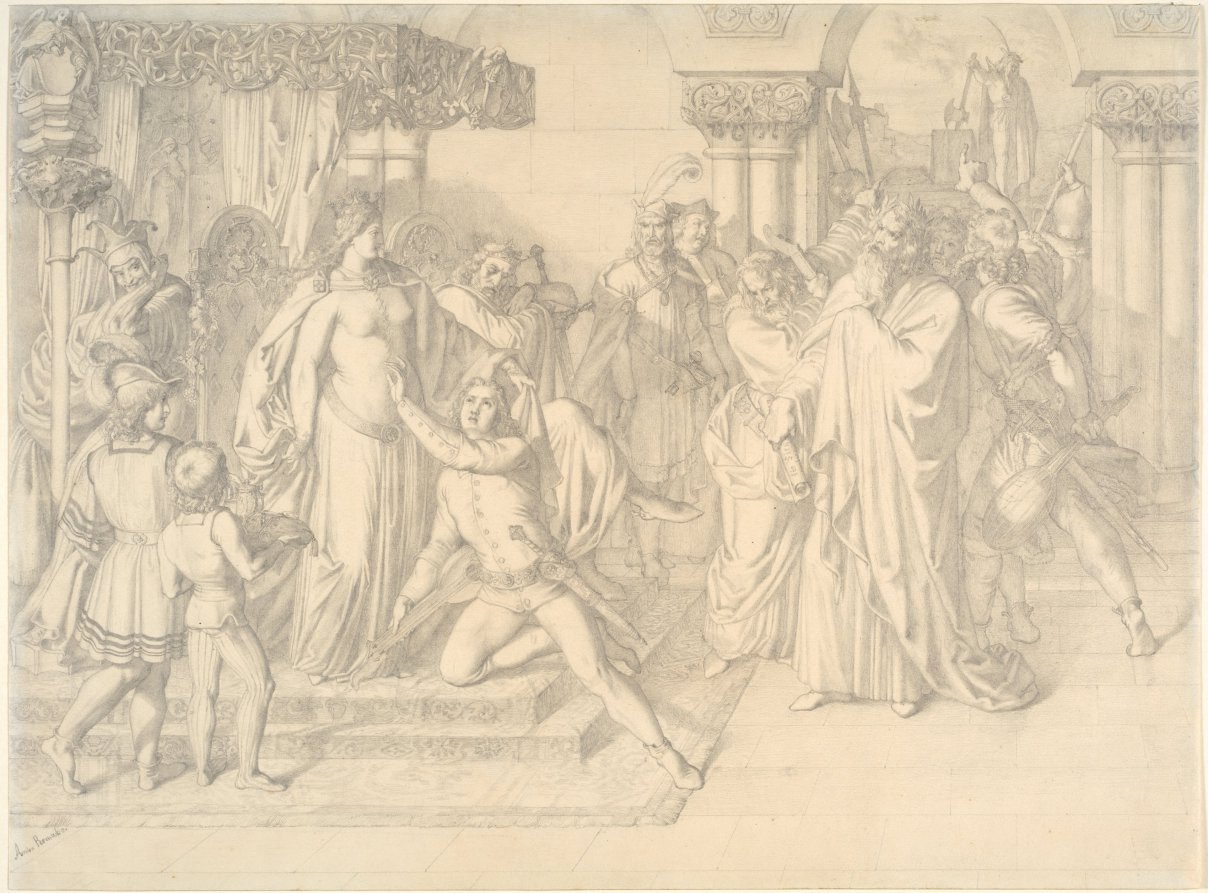
Anton Romako · The Cleveland Museum of Art · Mr. and Mrs. Richard W. Whitehill Art Purchase Endowment Fund · CC0
- Born
- 1832 · Atzgersdorf.
- Died
- 1889 · Vienna.
- Nationality
- Austrian Empire · Austria–Hungary
- Occupation
- painter
- Fields
- painting · visual arts
- Education
- Academy of Fine Arts Vienna
- Languages
- German
VALÉORINE Encyclopedia
VALÉORINE documentary reading
Documentary summary
Illustration — Anton Romako (ca. 1875) Anton Romako (20 October 1832 – 8 March 1889) was an Austrian painter.
Admitted source layer · organised and presented by VALÉORINE
Note VALÉORINE
Anton Romako (1832–1889) was a painter, of Austro-Hungarian and Austrian nationality. The painter was born in Atzgersdorf and died in Vienna.
Anton Romako was educated at Academy of Fine Arts Vienna. The painter worked in London, Munich and Spain, among others. Activity centred on painting and visual arts.
Languages used include German. Works are held at Bavarian State Painting Collections, Belvedere and Hepworth Wakefield, among others.
Composed from admitted, traceable facts · 28 September 2026
VALÉORINE
Reference Check
Propose documentary evidence for Anton Romako. A contribution is never written directly as fact: identity, source, rights and evidence gates still decide.
Sign in to contribute
World of VALÉORINE
Documentary connections
Only confirmed graph relationships appear here. Images are shown only when their identity and reuse rights both pass the documentary gate.
Documentary evidence
Documentary basis
Authority files
wikidata · Q562614 · wikipedia · Anton Romako
In this article
Biography
Biography
Anton Romako studied at Academy of Fine Arts Vienna. The recorded working language is German. The field of work recorded is painting and visual arts. Places of work recorded in the authority are Vienna, London and Munich. Work by Anton Romako is recorded in the collections of Belvedere, Bavarian State Painting Collections, Hungarian National Gallery, Museum of Fine Arts, Budapest and Leopold Museum.
Anton Romako was born in Atzgersdorf (now a cadastral commune of Liesing, Vienna), as an illegitimate son of factory owner Josef Lepper and his Czech housemaid Elisabeth Maria Anna Romako (Rhomako, Romakho, née Hromádko). His brother, Josef von Romako, became a Naval Architect-Inspector of Austro-Hungarian Navy. Romako studied painting at the Academy of Fine Arts Vienna (1847–49), but his teacher, Ferdinand Georg Waldmüller, considered him talentless. Later, he studied in Munich (1849) under Wilhelm Kaulbach, and subsequently in Venice, Rome and London. In the early 1850s, he studied privately in Vienna under Carl Rahl, whose style Romako adopted. In 1854 he began travels to Italy and Spain, and in 1857 settled in Rome as the favourite portrait, genre, and landscape painter for the local colony of foreigners. In 1862 Romako married Sophie Köbel, the daughter of architect Karl Köbel, and the pair had five children before Sophie left Romako in 1875 for her lover. In 1876 Romako returned to Vienna but failed to re-establish himself against the style represented by Hans Makart and increasingly relied on the charity of such wealthy patrons as Count Kuefstein. He made study trips to Hungary, Italy and France, and during the years 1882 to 1884 he alternated between Paris and Geneva. Two daughters, Mathilde and Mary, committed suicide in 1887; Romako never recovered from the shock. His last years were spent living in neglect near Vienna, where he died in poverty in 1889. Romako was buried at the Central cemetery in Vienna.
Works
Works
Romako painted a large number of landscape scenes (for example from Bad Gastein), influenced by the Barbizon school, but is known mostly for his portraits and historical scenes. His early works display the influence of Biedermeier realism, while the late works are painted in a nervous expressionist style which disturbed his contemporaries. More than a decade passed before his works were reconsidered and appreciated. Nowadays Romako is seen as a trailblazing artist of the "Ringstraßenepoche" era. Many paintings of Anton Romako are shown in the Belvedere gallery in Vienna. His famous portrait of empress Elisabeth, showing her eccentric personality, was generally rejected at the time. His best-known work, the portrait of Admiral Wilhelm von Tegetthoff during the naval Battle of Lissa, shows the admiral and a few sailors without the usual heroism at the moment when his ship Ferdinand Max is going to ram an Italian flagship. • Illustration — Example of his successful period in Rome (1860) • Illustration — Neapolitan bar (Neapolitanische Schenke), before 1889 • Illustration — Tegethoff during the Battle of Lissa (Admiral Tegetthoff in der Seeschlacht bei Lissa II), 1878-1880 • Illustration — Empress Elisabeth (Kaiserin Elisabeth mit Bernhardinerhund), 1883
List of works
List of works
• Illustration — S.M.S. Erzherzog Ferdinand Max coin inspired by a painting of Anton Romako. • Die Eitelkeit - Porträt seiner Brau Sophie Köbel (Salzburg, Residenzgalerie), around 1860, oil on canvas, 124 x 91 cm • Fischerknabe am Meeresstrand (Fisherboy at seashore) (Wien, Österreichische Galerie), around 1873–75, oil on wood, 90 x 70 cm • Mädchen mit Kaninchen (Girl with a rabbit) (St. Pölten, Niederösterreichisches Landesmuseum), about 1877, oil on canvas, 72,7 x 60,6 cm • Admiral Tegethoff in der Seeschlacht bei Lissa (Admiral Tegethoff at the 1866 naval battle of Lissa) (Wien, Österreichische Galerie), 1878–80, oil on wood, 110 x 82 cm • Am Wasserfall (At the waterfall) (Wien, Leopold Museum), 1881, oil on canvas, 89,3 x 63 cm • Kaiserin Elisabeth (Empress Elisabeth) (Wien, Österreichische Galerie), 1883 • Die Rosenpflückerin (Wien, Österreichische Galerie), 1883, oil on canvas, 89 x 66 cm • Mutter und Kind (private collection), 1883, oil on canvas, 161 x 130 cm • Junge Frau vor Bildstock (private collection), 1883, oil on wood, 54,4 x 45,5 cm • Südfranzösische/Bretonische Bäuerin (Graz, Landesmuseum Joanneum), 1884, oil on canvas, 50,5 x 38,5 cm • Mädchen, einen Fink anlockend (St. Pölten, Niederösterreichisches Landesmuseum), around 1884/85, oil on wood, 45,2 x 28 cm • Bildnis Isabella Reisser (Wien, Leopold Museum), 1885, oil on canvas, 130.5 x 90 cm • Salon der Familie Römer (Museen der Stadt Wien), 1887, oil on wood • Dame in rotem Kleid (Wien, Österreichische Galerie), 1889, oil on canvas • Portrait of August Wassermann (Budapest, Museum of Fine Arts) • Girl on a Swing (Olga von Wassermann) (Northampton, MA, USA, Smith College Museum of Art), ca. 1882, oil on canvas, 160 x 122 cm
Places
Named by the record
Places
Only places the record itself states, plotted where the house gazetteer settles their coordinates. Nothing is inferred from a name or a nationality.
Atzgersdorf.
Birth place
Vienna.
Death place
Legacy
Dr. Oskar Reichel was essential in promoting Romako after his death, particularly with his 1913 show of collected works from his private collection. Reichel framed Romako as the “father” of a later artist, Oskar Kokoschka, stating that “the path from Romako leads to Kokoschka, the visionary amongst the young Viennese” in the show's introduction. Reichel also created the ongoing perception of Romako as an artist who connected the late-18th-century French school and the early-19th-century Viennese school by displaying his works between art from these two schools at the 1913 show. Several paintings by Romako are confirmed or suspected of having been stolen from their Jewish owners in Nazi Germany, as they were purchased by art dealer Wolfgang Gurlitt, who bought several paintings from Jewish owners during this time period, and claimed to have lost his provenance records from 1933 to 1945. Paintings by Romako sold to Gurlitt include Ruine Liechtenstein, Don Quichotte, Barcarole, Herbst und Winter, Italiensche Landschaft mit Baurenhaus, The Spring, Nike With Wreath, and Nude of a Young Girl. In 1953 a street in Atzgersdorf was named after the painter: Romakogasse. Anton Romako's painting The Battle of Lissa was selected as a motive for a recent commemorative coin: the 20 euro S.M.S. Erzherzog Ferdinand Max minted on September 15, 2004.
Primary material
Documents and archives
reference work
- “Anton Romako”, English Wikipedia, consulted as further reading
Reputable secondary · Wikipedia
authority record
- Wikidata, structured authority record Q562614: Anton Romako
General reference · Wikidata
Notes from the source article
Cited by Wikipedia
Notes from the source article
These works are cited by the source article, in its own numbering. They are recorded as its citations, not as sources VALÉORINE has verified.
- 1.City of Vienna.
- 2.Blackshaw, Gemma. Rediscovering Anton Romako. Austrian Studies. 16. 105–122. 2008. 10.1353/aus.2008.0002.
- 3.Foradini, Flavia. The Other Gurlitt. January 16, 2015.
Bibliography printed in the source article · 3
- Blackshaw, Gemma (2008)."Rediscovering Anton Romako", in From "Ausgleich to "Jahrhundertwende": Literature and Culture, 1867–1890, Austrian Studies, vol. 16: 105–122.
- Esau, Erika (1985). Anton Romako's portraits and the beginnings of Modernism in Vienna, (PhD diss., Bryn Mawr College), Ann Arbor, Michigan.
- Reiter, Cornelia (2010). Anton Romako - Pionier und Außenseiter der Malerei des 19. Jahrhunderts, (monograph and catalogue raisonné), Belvedere, Vienna.
References
Citations
References
Each reference names the institution holding it, so a reader may go to the document itself.
reference work
Secondary witnessauthority record
General reference
The Encyclopedia exists whether or not anything is for sale. Corrections are recorded rather than overwritten, and every version of this record is kept. Published 17 August 2026.
Elsewhere in Paintings
18,623 published records in this field, each with its sources named.
- Anton PaulsenArtist
- Anton PetterArtist
- Anton RäderscheidtArtist
- Anton Raphael MengsArtist
- Anton SchallerArtist
- Anton SchrodlArtist
- Anton SederArtist
- Anton van den WyngaerdeArtist
Best supported in this field
For owners
Own a work by Anton Romako?
A specialist will read what you send and tell you what the house can establish, what it cannot, and whether the object is suited to sale. There is no charge and no obligation. The object stays with you throughout; nothing is shipped to us unless it is arranged in writing beforehand.