
Anton Mauve
Anthonij "Anton" Rudolf Mauve (18 September 18385 February 1888) was a Dutch realist painter who was a leading member of the Hague School. He signed his paintings 'A. Mauve' or with a monogrammed 'A.M.'. A master colorist, he was a very significant early influence on his cousin-in-law Vincent van Gogh.
Also recorded as Anthonij Mauve · Antonij Mauve · mauve a. · Mauve
Anton Mauve
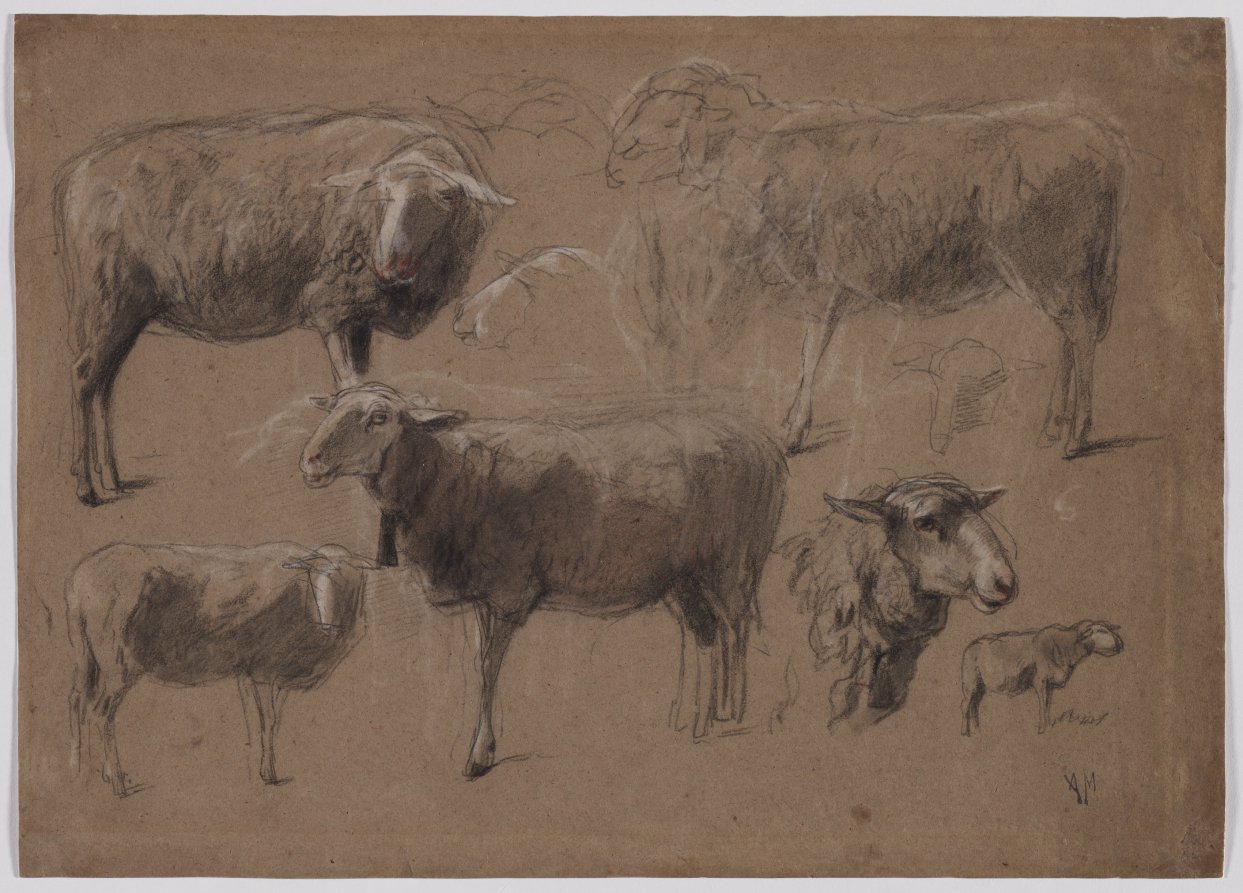
Anton Mauve · The Cleveland Museum of Art · Bequest of Carl F. Clarke · CC0
- Name
- Anton Mauve
- Born
- 18 September 1838
- Birthplace
- Zaandam, Netherlands
- Died
- 5 February 1888
- Place of death
- Arnhem, Netherlands
- Field
- Painting
- Movement
- Realism
- Nationality
- Kingdom of the Netherlands
- Occupation
- painter · watercolorist · artist · exlibrist · draftsperson · etcher
- Fields
- painting · visual arts
- Movements
- Hague School
- Known for
- Morning Ride on the Beach · Launching a fishing boat (type Pink) in the sea · The milking corner.
VALÉORINE Encyclopedia
VALÉORINE documentary reading
Documentary summary
Anthonij "Anton" Rudolf Mauve (18 September 18385 February 1888) was a Dutch realist painter who was a leading member of the Hague School. He signed his paintings 'A. Mauve' or with a monogrammed 'A.M.'. A master colorist, he was a very significant early influence on his cousin-in-law Vincent van Gogh.
Admitted source layer · organised and presented by VALÉORINE
Reference Check
Propose documentary evidence for Anton Mauve. A contribution is never written directly as fact: identity, source, rights and evidence gates still decide.
Sign in to contribute
World of VALÉORINE
Documentary connections
Only confirmed graph relationships appear here. Images are shown only when their identity and reuse rights both pass the documentary gate.

Documentary evidence
Documentary basis
Authority files
wikidata · Q591907 · wikipedia · Anton Mauve
In this article
Biography
Biography
His best-known paintings depict peasants working in the fields. His paintings of flocks of sheep were especially popular with American patrons, so popular that a price differential developed between scenes of "sheep coming" and "sheep going".
Vincent van Gogh is recorded as having studied under Anton Mauve. The recorded working language is Dutch. The field of work recorded is painting and visual arts. Subjects and genres recorded for the work are portrait. Places of work recorded in the authority are Haarlem, Amsterdam and The Hague. Residence is recorded at Zaanstad and Zaandam. Works named in the authority record are Morning Ride on the Beach, Launching a fishing boat (type 'Pink') in the sea and The milking corner. Work by Anton Mauve is recorded in the collections of Museum Boijmans Van Beuningen, Minneapolis Institute of Art, Art Institute of Chicago, Thyssen-Bornemisza Museum and Tate.
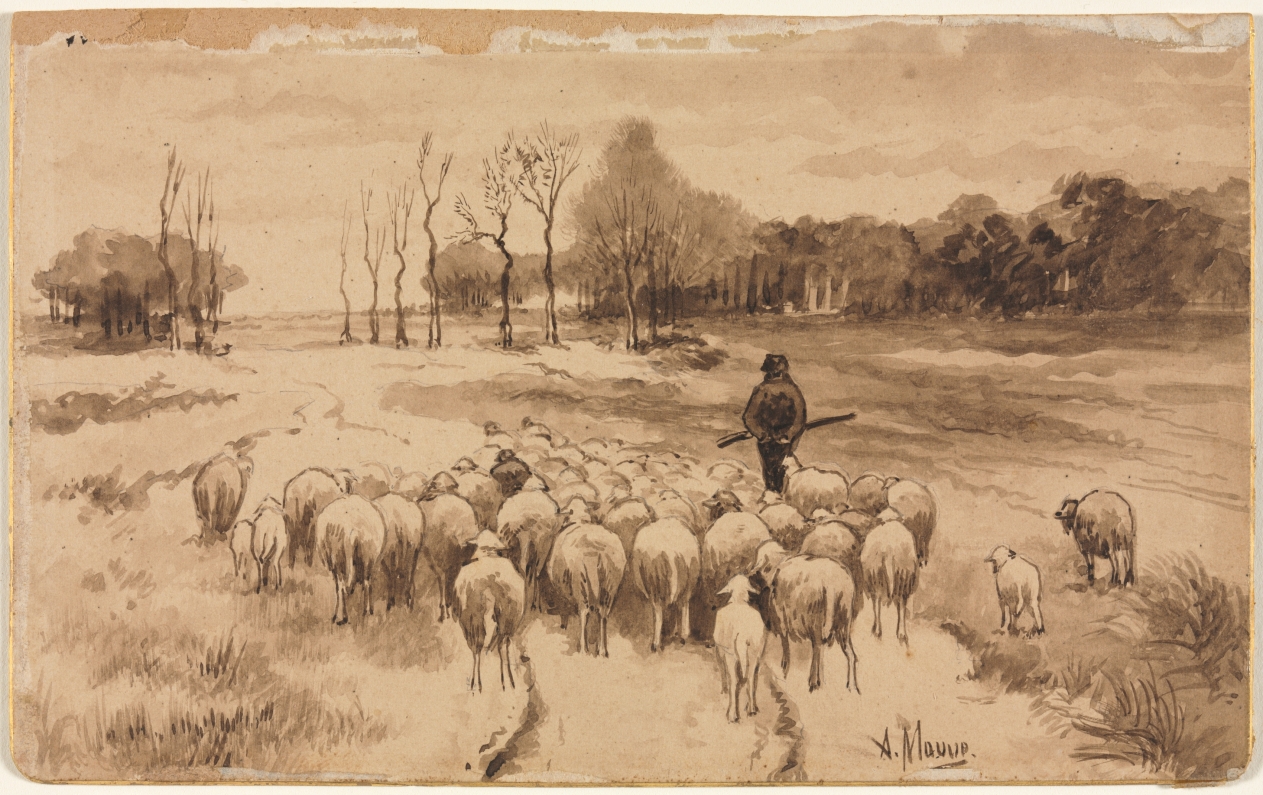
Shepherd with His Flock, c. 1870, by Anton Mauve
Anton Mauve · The Cleveland Museum of Art · Gift of Mr. and Mrs. Theodore Alfred in memory of Carey Croneis
Key facts
Key facts
• Name — Anton Mauve • Born — 18 September 1838 • Birthplace — Zaandam, Netherlands • Died — 5 February 1888 • Place of death — Arnhem, Netherlands • Field — Painting • Movement — Realism • Patrons — Goupil & Cie
Life and work
Life and work
• Illustration — Morning Ride on the Beach (1876), oil on canvas, Rijksmuseum Anton Mauve was born on 18 September 1838 in Zaandam, a town in the Dutch province of North Holland. A year after his birth, his father Willem Carel Mauve, a Mennonite chaplain, was sent to Haarlem, the capital city of the province where Mauve grew up. He was apprenticed to the painter Pieter Frederik van Os followed by Wouter Verschuur. In his further development he worked with Paul Gabriël, painting from nature, and they regularly stayed and worked together at Oosterbeek, the 'Dutch Barbizon'. He was a friend of renowned Dutch landscape painters Jozef Israëls and Willem Maris and, encouraged by their example, he abandoned his early highly finished manner for a freer, looser method of painting, and the brilliant palette of his youthful work for a tender lyric harmony which is generally restricted to delicate greys, greens, and light blue. Most of Mauve's work depicts people and animals in outdoor settings. In his Morning Ride in the Rijksmuseum, for example, fashionable equestrians at the seacoast are seen riding away from the viewer. An unconventional detail, horse droppings in the foreground, attests his commitment to realism. In 1872, Mauve settled in The Hague where he became a leading member of the Hague School of painters and one of the founders of the Hollandsche Teekenmaatschappij in 1876, as well as playing a leading role in the development of the Pulchri Studio, The Hague's most influential art society at the time. In November 1874 he married Ariëtte (Jet) Carbentus (1856–1894), and together they had a son, Anton (1876–1962), who also became a painter. Around 1900, Mauve's work was highly admired internationally, particularly in the United States. During the American Gilded Age, paintings of the Hague School were actively collected by wealthy American collectors and industrialists. Through art dealers such as M. Knoedler & Co., works by Anton Mauve entered important American collections and museums, including The Timber Truck, now in the Carnegie Museum of Art in Pittsburgh. In the last two years of his life, Mauve settled in the village of Laren in the region surrounding Hilversum called the Gooi area. The group of painters who settled there, including Jozef Israëls and Albert Neuhuys, came to be known collectively as the Larense School and the region around the Gooi was dubbed 'Mauve land' as far afield as the United States. Mauve influenced many other painters one of whom was the Scottish painter, Robert McGregor (1847–1922). Mauve died suddenly in Arnhem on 5 February 1888.
Relationship with Vincent van Gogh
Relationship with Vincent van Gogh
• Illustration — Ariëtte (Jet) Carbentus, the Artist's Wife, in the Dunes. She was a cousin of van Gogh on his mother's side. Mauve was married to van Gogh's cousin Ariëtte (Jet) Sophia Jeannette Carbentus, and he was a major influence on van Gogh, who revered him. He is mentioned, directly or indirectly, in 152 of van Gogh's surviving letters. Van Gogh spent three weeks at Mauve's studio at the end of 1881 and during that time he made his first experiments in painting under Mauve's tutelage, first in oils and then early the next year in watercolour (previously he had concentrated on drawing). Mauve continued to encourage him and lent him money to rent and furnish a studio, but later grew cold towards him and did not return a number of letters. In a letter to his brother Theo van Gogh dated 7 May 1882, van Gogh describes "a very regrettable conversation" in which Mauve told him their association was "over and done with" adding by way of explanation that van Gogh had a vicious character. Van Gogh continued his letter by expressing his sorrow, and then launches defiantly into a passionate defence of his relationship with Clasina "Sien" Maria Hornik (Sien), a pregnant prostitute he had befriended. The presumption must be that Mauve had heard of the relationship (although van Gogh's letter does not say so expressly) and broke off the association because of it. However, their relationship had already become strained by late January. Nevertheless, van Gogh continued to hold Mauve in very high esteem and dedicated one of his most iconic paintings to Mauve's memory after hearing of his sudden death. Mauve's mother Elisabeth Margaretha Hirschig was a first cousin twice removed of Anton Hirschig, the young Dutch artist who was a fellow lodger with van Gogh at the Auberge Ravoux at the time of van Gogh's death.
Selected works
Selected works
• Illustration — Landscape with cattle • Illustration — The Return of the Flock, Laren • Illustration — The Timber Truck (c. 1880), Carnegie Museum of Art • Entering the Fold (c. 1885–8), drawing and watercolour, Tate Gallery • Milking Time (c. 1875), oil on canvas, National Gallery • The Timber Truck (c. 1880), oil on canvas, Carnegie Museum of Art, Pittsburgh. • Landscape with cattle, chalk on paper, Courtauld Institute of Art • Landscape with Cattle, oil on canvas, Museum of Fine Arts, Houston • Shepherdess, oil on canvas, National Museum of Wales • Morning Ride along the Beach (1876), oil on canvas, Rijksmuseum Amsterdam • Riders in the Snow in the Haagse Bos (1879), watercolour and gouache, Rijksmuseum Amsterdam • De Torenlaan te Laren (1886), oil on canvas, Rijksmuseum, Amsterdam • Ariëtte Carbentus, wife of the artist, sitting in the dunes (c. 1876), oil on canvas, Rijksbureau voor Kunsthistorische Documentatie, The Hague (private collection) • Gathering Seaweed, oil on canvas, Musée d'Orsay, Paris • Changing Pasture (c. 1880s), oil on canvas, Metropolitan Museum of Art, New York • The Return of the Flock, Laren (c. 1886 -1887), oil on canvas, Philadelphia Museum of Art, Philadelphia • Digging up a Tree, watercolor, Museum of Fine Arts, Boston • Returning Home, oil on wood, Art Gallery of New South Wales • A Shepherdess and Her Flock, oil on canvas, Metropolitan Museum of Art
Identity and origins
Identity and origins
The authorities additionally record the headings Anthonij Mauve, Antonij Mauve, mauve a. Mauve and anthony mauve. His recorded language was Dutch. He was the child of Willem Carel Mauve. One child is recorded: Anton Rudolf Mauve.
Life and career
Dated record
Life and career
The full dated record · 2 entries
1838
Anton Mauve born at Zaandam.
1888
Anton Mauve died at Arnhem.
Places
Named by the record
Places
Only places the record itself states, plotted where the house gazetteer settles their coordinates. Nothing is inferred from a name or a nationality.
Zaanstad and Zaandam
Residences
Zaandam.
Birth place
Arnhem.
Death place
Context
Primary material
Context
The circumstances in which Anton Mauve stands.
Documents and archives
Primary material
Documents and archives
authority record
- Wikidata, structured authority record Q591907: Anton Mauve
General reference · Wikidata
reference work
- “Anton Mauve”, English Wikipedia, consulted as further reading
Reputable secondary · Wikipedia
References
Citations
References
Each reference names the institution holding it, so a reader may go to the document itself.
authority record
Secondary witnessreference work
Secondary witness
People, houses and institutions
Knowledge graph
People, houses and institutions
Teachers, collaborators, publishers and institutions recorded against this person, each on a stated basis.
Associated with
1- Hague SchoolMovement
Established from a fact already recorded on a verified source.
Further particulars
Held on the record
Further particulars
Open the remaining particulars
Formation and teaching. Each of those relationships is stated by the authority record rather than inferred from style. Mauve worked in painting and visual arts. His work is associated with Hague School. He belonged to Arti et Amicitiae and Hague School. He worked at Haarlem, Amsterdam, The Hague, Oosterbeek, Zaanstad and Zaandam. Work and production. Works recorded as notable number 3: Morning Ride on the Beach, Launching a fishing boat (type 'Pink') in the sea and The milking corner. His recorded genre is portrait. Recorded as painter, watercolorist, artist, exlibrist and draftsperson. Works and catalogued output. Connected to 1 other published record in the VALÉORINE Encyclopedia.
Career and activity
Recognition and collections
Work by Anton Mauve is
Museum Boijmans Van Beuningen, Minneapolis Institute of Art, Art Institute of Chicago and Thyssen-Bornemisza Museum
Cow in the pasture
Frans Hals Museum
Within the Encyclopedia
The Encyclopedia exists whether or not anything is for sale. Corrections are recorded rather than overwritten, and every version of this record is kept. Published 17 August 2026.
Elsewhere in Paintings
19,261 published records in this field, each with its sources named.
- Anton KernArtist
- Antón LamazaresArtist
- Anton LegashovArtist
- Anton LosenkoArtist
- Anton MirouArtist
- Anton MitovArtist
- Anton MöllerArtist
- Anton NowakArtist
Best supported in this field
For owners
Own a work by Anton Mauve?
A specialist will read what you send and tell you what the house can establish, what it cannot, and whether the object is suited to sale. There is no charge and no obligation. The object stays with you throughout; nothing is shipped to us unless it is arranged in writing beforehand.