
Andrea Mantegna
Andrea Mantegna (lang; c. 1431September 13, 1506) was an Italian Renaissance painter, a student of Roman archaeology, and the son-in-law of Jacopo Bellini. Like other artists of the time, Mantegna experimented with perspective, e.g. by lowering the horizon in order to create a sense of greater monumentality.
Also recorded as Andrea di Biagio · Andrea Blaise · Andrea Blasii · Andrea Montegna
Andrea Mantegna
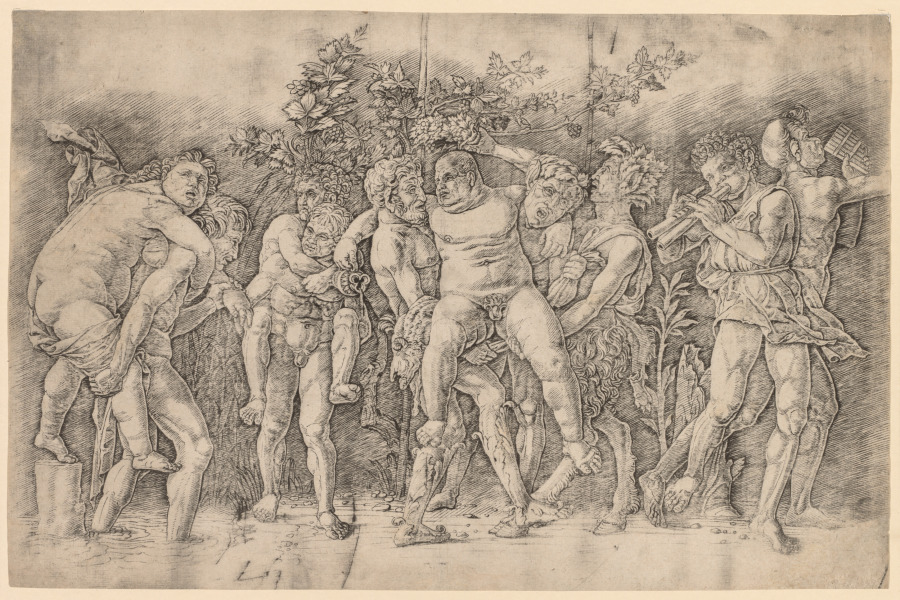
Andrea Mantegna · The Cleveland Museum of Art · Gift of Ralph King · CC0
- Name
- Andrea Mantegna
- Born
- c. 1431
- Birthplace
- Isola di Carturo, Venetian Republic (now Italy)
- Died
- 13 September 1506
- Place of death
- Mantua (now Italy)
- Spouse
- Nicolosia Bellini
- Field
- Painting, fresco
- Training
- Francesco Squarcione
- Movement
- Italian Renaissance
- Nationality
- Republic of Venice.
- Occupation
- painter, copper engraver, illuminator, sculptor, draftsperson, printmaker and visual artist.
- Fields
- history painting, religious art, allegory, animal painting, mythological painting, portrait and religious painting.
VALÉORINE Encyclopedia
VALÉORINE documentary reading
Documentary summary
Andrea Mantegna (lang; c. 1431September 13, 1506) was an Italian Renaissance painter, a student of Roman archaeology, and the son-in-law of Jacopo Bellini. Like other artists of the time, Mantegna experimented with perspective, e.g. by lowering the horizon in order to create a sense of greater monumentality.
Admitted source layer · organised and presented by VALÉORINE
Note VALÉORINE
No house-authored Note is published until its assertions and sources pass the VALÉORINE evidence contract. The documentary article remains available in full while that enrichment is being consolidated.
Documentary enrichment in progress · no unsupported statement published
Reference Check
Propose documentary evidence for Andrea Mantegna. A contribution is never written directly as fact: identity, source, rights and evidence gates still decide.
Sign in to contribute
World of VALÉORINE
Documentary connections
Only confirmed graph relationships appear here. Images are shown only when their identity and reuse rights both pass the documentary gate.
Documentary evidence
Evidence Panel
not yet certified
- Identity
- resolved
- Independent source families
- 0
- Admitted assertions
- 0
- Open conflicts
- 0
Authority files
gnd · 10148775-7 · wikidata · Q5681 · wikipedia · Andrea Mantegna
In this article
Biography
Biography
Mantegna worked between 1431 and 1506 across painter, copper engraver, illuminator, sculptor and draftsperson and 2 further recorded occupations. The registers place that work in history painting, religious art, allegory, animal painting, mythological painting and portrait. Every statement below returns to a source shown in the evidence panel; where the record is silent or divided, the article says so instead of resolving it.
Key facts
Key facts
• Name — Andrea Mantegna • Birth Name — Andrea Mantegna • Born — c. 1431 • Birthplace — Isola di Carturo, Venetian Republic (now Italy) • Died — 13 September 1506 • Place of death — Mantua (now Italy) • Spouse — Nicolosia Bellini • Field — Painting, fresco • Training — Francesco Squarcione • Movement — Italian Renaissance • Works — St. Sebastian Camera degli Sposi The Agony in the Garden The Lamentation over the Dead Christ • Illustration — St. Sebastian, 1480; panel; Musée du Louvre
Youth and education
Youth and education
• Illustration — The Agony in the Garden (1459) National Gallery, London, is the pinnacle of Mantegna's early style Mantegna was born in Isola di Carturo, close to Padua, in the Venetian Republic. He was the second son of a carpenter, Biagio. At the age of 11, he became apprenticed to Paduan painter Francesco Squarcione. Squarcione, whose original profession was tailoring, appears to have had a remarkable enthusiasm for ancient art, and a faculty for acting. Like his famous compatriot Petrarca, Squarcione was an ancient Rome enthusiast: he traveled in Italy, and perhaps also in Greece, collecting antique statues, reliefs, vases, etc., making his own drawings from them, then making available his collection for others to study. All the while, he continued undertaking works on commission, to which his pupils, no less than he, contributed. As many as 137 painters and pictorial students passed through Squarcione's school, which had been established around 1440 and which became famous all over Italy. Padua attracted artists not only from the Veneto, but also from Tuscany, such as Paolo Uccello, Filippo Lippi, and Donatello. Mantegna's early career was shaped by impressions of Florentine works. At the time, Mantegna was said to be a favorite pupil of Squarcione, who taught him Latin and instructed him to study fragments of Roman sculpture. The master also preferred forced perspective, recollection of which may account for some of Mantegna's later innovations. However, at the age of 17, Mantegna left Squarcione's workshop. He later claimed that Squarcione had profited from his work without sufficient payment. Mantegna's first work, now lost, was an altarpiece for the church of Santa Sofia in 1448. The same year he was called, together with Nicolò Pizolo, to work with a large group of painters entrusted with the decoration of the Ovetari Chapel in the transept of the Sant'Agostino degli Eremitani. It is probable, however, that before this time some of the pupils of Squarcione, including Mantegna, had already begun the series of frescoes in the chapel of S. Cristoforo, in the church of the Eremitani, which are today considered a masterpiece. After a series of coincidences, Mantegna finished most of the work alone, although Ansuino, who collaborated with Mantegna in the Ovetari Chapel, brought his style from the Forlì school of painting. The now critical Squarcione carped about the earlier works of this series, illustrating the life of St. James; he said the figures were like men made of stone, and should have been painted stone color. This series was almost entirely lost in the 1944 Allied bombings of Padua. The most dramatic work of the fresco cycle was the work set in the worm's-eye view perspective, St. James Led to His Execution. Although much less dramatic in its perspective than the St. James painting, the San Zeno altarpiece was executed around 1455 not long after the St. James cycle was finished, and uses many of the same techniques, including an architectural structure based on Classical antiquity. The sketch for the St. Stephen fresco has survived and is the earliest known preliminary sketch that still survives to compare with the corresponding fresco. The drawing shows proof that nude figures—which were later painted as clothed—were used in the conception of works during the Early Renaissance. In the preliminary sketch, the perspective is less developed and closer to a more average viewpoint however. Despite the authentic Classical look of the monument, it is not a copy of any known Roman structure. Mantegna also adopted the wet drapery patterns of the Romans, who took the form from the Greek invention, for the clothing of his figures, although the tense figures and interactions are derived from Donatello. Among the other early Mantegna frescoes are the two saints above the entrance porch of the church of Sant'Antonio in Padua, 1452, and the 1453 San Luca Altarpiece, with St. Luke and other saints, for the church of S. Giustina and now in the Brera Gallery in Milan. As the young artist progressed in his work, he came under the influence of Jacopo Bellini, father of the celebrated painters Giovanni and Gentile, as well as where Mantegna met Bellini's daughter Nicolosia. In 1453, Jacopo consented to a marriage between Nicolosia and Mantegna.
Work in Mantua
Work in Mantua
• Illustration — Judith and Holofernes, by Andrea Mantegna or possibly Giulio Campagnola, c. 1495 The Marquis Ludovico III Gonzaga of Mantua had for some time been pressing Mantegna to enter his service; and the following year, 1460, Mantegna was appointed court artist. He resided at first from time to time at Goito, but, from December 1466 onward, he moved with his family to Mantua. His engagement was for a salary of 75 lire a month, a sum so large for that period as to mark conspicuously the high regard in which his art was held. In fact, he was the first painter of any eminence to be based in Mantua. His Mantuan masterpiece was painted for the court of Mantua, in the apartment of the Castle of the city, today known as Camera degli Sposi (literally, "Wedding Chamber") of Palazzo Ducale, Mantua: a series of full compositions in fresco including various portraits of the Gonzaga family and some figures of genii and others. The innovative spatial construction of the frescoes, particularly the oculus in the ceiling, had a profound effect on Antonio da Correggio. • Illustration — Detail of Camera degli Sposi The decoration of the Chamber was finished presumably in 1474. The ten years that followed were not happy ones for Mantegna and Mantua: Mantegna grew irritable, his son Bernardino died, as well as the Marchese Ludovico, his wife Barbara, and his successor Federico (who had dubbed Mantegna cavaliere, "knight"). Only with the election of Francesco II of the House of Gonzaga did artistic commissions in Mantua recommence. He built a stately house in the area of the church of San Sebastiano, and adorned it with a multitude of paintings. The house can still be seen today, although the paintings no longer survive. In this period he began to collect some ancient Roman busts (that were given to Lorenzo de' Medici when the Florentine leader visited Mantua in 1483), painted some architectonic and decorative fragments, and finished the intense St. Sebastian now in the Louvre (box at top). In 1488, Mantegna was called by Pope Innocent VIII to paint frescoes in a chapel Belvedere in the Vatican. This series of frescoes, including a noted Baptism of Christ, was later destroyed by Pius VI in 1780. The pope treated Mantegna with less liberality than he had been used to at the Mantuan court; but all things considered, their connection, which ceased in 1500, was not unsatisfactory to either party. Mantegna also met the famous Turkish hostage Jem and carefully studied Rome's ancient monuments, but his impression of the city was a disappointing one overall. Returned to Mantua in 1490, he embraced again his more literary and bitter vision of antiquity, and entered in strong connection with the new Marchesa, the cultured and intelligent Isabella d'Este. However, Isabella was not pleased with his attempt of a portrait of her in 1493. She said that "the painter did it so badly that it has no features like our own". In what was now his city, he went on with the nine tempera pictures of the Triumphs of Caesar, which he had probably begun before his leaving for Rome, and which he finished around 1492. These superbly invented and designed compositions are gorgeous with the splendor of their subject matter, and with the classical learning and enthusiasm of one of the masters of the age. Considered Mantegna's finest work, they were sold in 1628 along with the bulk of the Mantuan art treasures to King Charles I of England.
Later years
Later years
• Illustration — The Madonna of the Cherubim (1485) Despite his declining health, Mantegna continued to paint. Other works of this period include the Madonna of the Caves, the St. Sebastian, and the famous Lamentation over the Dead Christ, probably painted for his personal funerary chapel. Another work of Mantegna's later years was what is known as the Madonna della Vittoria, now in the Louvre. It was painted in tempera about 1495, in commemoration of the Battle of Fornovo, whose questionable outcome Francesco Gonzaga was eager to show as an Italian League victory; the church that originally housed the painting was built from Mantegna's own design. The Madonna is here depicted with various saints, the archangel Michael, and St. Maurice holding her mantle, which is extended over the kneeling Francesco Gonzaga, amid a profusion of rich festooning and other accessories. Although not in all respects of his highest order of execution, this counts among the most obviously beautiful of Mantegna's works in which the qualities of beauty and attractiveness are less marked than those other excellences more germane to his severe genius, tense energy passing into haggard passion. After 1497, Mantegna was commissioned by Isabella d'Este to translate the mythological themes written by the court poet Paride Ceresara into paintings for her private apartment (studiolo) in the Palazzo Ducale. These paintings were dispersed in the following years: one of them, the legend of the God Comus, was left unfinished by Mantegna and completed by his successor as court painter in Mantua, Lorenzo Costa. The other painters commissioned by Isabella for her studiolo were Perugino and Correggio. After the death of his wife and at an advanced age Mantegna became the father of an illegitimate son, Giovanni Andrea; and, finally, although he continued embarking on various expenses and schemes, he had serious tribulations, such as the banishment from Mantua of his son Francesco, who had incurred the displeasure of the Marchese. The difficult situation of the aged master and connoisseur required the hard necessity of parting with a beloved antique bust of Faustina. Very soon after this transaction, he died in Mantua, on September 13, 1506. In 1516, a handsome monument was set up to him by his sons in the church of Sant'Andrea, where he had painted the altarpiece of the mortuary chapel. The dome is decorated by Correggio.
Engravings
Engravings
Mantegna was no less eminent as an engraver, although his history in that respect is somewhat obscure, partly because he never signed or dated any of his plates, except for a single disputed instance of 1472. The account that has come down to us from Vasari (who was, as usual, keen to assert that everything flows from Florence) is that Mantegna began engraving in Rome, prompted by the engravings produced by the Florentine Baccio Baldini after Sandro Botticelli. This is now considered most unlikely as it would consign all the numerous and elaborate engravings made by Mantegna to the last sixteen or seventeen years of his life, which seems a brief period for them. Besides, the earlier engravings reflect an earlier period of his artistic style. It is possible that Mantegna may have begun engraving while still in Padua, under the tuition of a distinguished goldsmith, Niccolò. He and his workshop engraved approximately thirty plates, according to the usual reckoning; large, full of figures, and highly studied. It is now considered that either he only engraved seven, or none. Another artist from the workshop who made several plates is usually identified as Giovanni Antonio da Brescia (aka Zoan Andrea). Among the principal examples are: Battle of the Sea Monsters, Virgin and Child, a Bacchanal Festival, Hercules and Antaeus, Marine Gods, Judith with the Head of Holofernes, the Deposition from the Cross, the Entombment, the Resurrection, the Man of Sorrows, the Virgin in a Grotto, and several scenes from the Triumph of Julius Caesar after his paintings. Several of his engravings are supposed to be executed on some metal less hard than copper. The technique he and his followers used is characterized by the strongly marked forms of the design, and by the parallel hatching used to produce shadows. The closer the parallel marks, the darker the shadows were. The prints are frequently to be found in two states, or editions. In the first, the prints have been produced using a roller, or even, by hand pressing, and they are weak in tint; in the second, a printing press has been used, and the ink is stronger. Neither Mantegna or his workshop are now believed to have produced the so-called Mantegna Tarocchi cards. • Illustration — Bacchanal with a wine vat engraving by Andrea Mantegna, c. 1475, 278 × 422 mm • Illustration — The Lamentation over the Dead Christ by Andrea Mantegna Tempera on canvas, 68×81 cm, 1490; Pinacoteca di Brera, Milan
Major works
Major works
• Illustration — The Virgin Mary in Andrea Mantegna's San Zeno Altarpiece combines pseudo-Arabic halos and garment hems, with an Oriental carpet at her feet (1456–1459) • St. Jerome in the Wilderness (c. 1448–1451) - Tempera on wood, 48 × 36 cm, São Paulo Museum of Art, São Paulo, Brazil • The Adoration of the Shepherds (c. 1451–1453) - Tempera on canvas transferred from wood, 40 × 55,6 cm, Metropolitan Museum of Art, New York City • San Luca Altarpiece (1453) - Panel, 177 × 230 cm, Pinacoteca di Brera, Milan • St Euphemia (1454) - Glue on tempera on canvas, 171 × 78 cm, Museo nazionale di Capodimonte, Naples • Presentation at the Temple (c. 1455) - Tempera on wood, 68.9 × 86.3 cm, Staatliche Museen, Berlin, Germany • Madonna and Child with Saint Jerome and Saint Louis of Toulouse (c. 1455) - Tempera on panel, Musée Jacquemart-André, Paris • Crucifixion (1457–1459) - Wood, 67 × 93 cm, Louvre, Paris • Christ as the Suffering Redeemer (1495–1500) - Tempera on wood, 78 × 48 cm, Statens Museum for Kunst, Copenhagen, Denmark • Agony in the Garden (c. 1459) - Tempera on wood, 63 × 80 cm, National Gallery, London • Portrait of Cardinal Ludovico Trevisan, (c. 1459–1460) - Tempera on wood, 44 × 33 cm, Staatliche Museen, Berlin • St. Bernardino of Siena between Two Angels, (attributed, 1460) - Tempera on canvas, 385 × 220 cm, Pinacoteca di Brera, Milan • Portrait of a Man (c. 1460–1470) - Wood, 24.2 × 19 cm, National Gallery of Art, Washington, D.C., US • Death of the Virgin (c. 1461) - Panel, 54 × 42 cm, Museo del Prado, Madrid • Portrait of Francesco Gonzaga (c. 1461) - Panel, 25 × 18 cm, Capodimonte Museum, Naples • Madonna with Sleeping Child (c. 1465–1470) - Distemper on canvas, 43x32 cm, Staatliche Museen, Berlin • St. George (c. 1460) - Tempera on panel, 66 × 32 cm, Gallerie dell'Accademia, Venice • San Zeno Altarpiece (1457–1460) - Panel, 480 × 450 cm, San Zeno, Verona • St. Sebastian (c. 1457–1459) - Wood, 68 × 30 cm, Kunsthistorisches Museum, Vienna • St. Sebastian - Panel, 255 × 140 cm, Louvre, Paris • Adoration of the Magi (1462) - Tempera on panel, 76 × 76.5 cm, Uffizi, Florence • The Ascension (1462) - Tempera on panel, 86 × 42.5 cm, Uffizi, Florence • The Circumcision (1462–1464) - Tempera on panel, 86 × 42.5 cm, Uffizi, Florence • Portrait of Carlo de' Medici (c. 1459–1466) - Tempera on panel, 40.6 × 29.5 cm, Uffizi, Florence • The Madonna of the Cherubim (c. 1485) - Panel, 88 × 70 cm, Pinacoteca di Brera, Milan • Triumphs of Caesar (c. 1486) - Hampton Court Palace, England • The Lamentation over the Dead Christ (c. 1490) - Tempera on canvas, 68 × 81 cm, Pinacoteca di Brera, Milan • Madonna of the Caves (1489–1490) - Uffizi, Florence • St. Sebastian (1490) - Panel, 68 × 30 cm, Ca' d'Oro, Venice • Madonna della Vittoria (1495) - Tempera on canvas, 285 × 168 cm, Louvre, Paris • Ecce homo (1500)- Tempera on canvas, 54 × 72 cm, Musée Jacquemart-André, Paris • Holy Family (c. 1495–1500) - Tempera on canvas, 75.5 × 61.5 cm, The Dresden Gallery, Dresden • Judith and Holofernes (1495) - Egg-tempera on wood, National Gallery of Art, Washington, D.C. • Trivulzio Madonna (1497) - Tempera on canvas, 287 × 214 cm, Museo Civico d'Arte Antica, Milan • Parnassus (Mars and Venus) (1497) - Canvas, 160 × 192 cm, Louvre, Paris • Minerva Chases the Vices from the Garden of Virtue (c. 1502) Oil on canvas, 160 × 192 cm, Louvre, Paris Mantegna's only known sculpture is a Sant'Eufemia in the Cathedral of Irsina, Basilicata.
Life and work
Life and work
Andrea Mantegna was born on 1 January 1431 in Isola Mantegna. Mantegna held the nationality of Republic of Venice. Mantegna studied under Francesco Squarcione. Married to: Nicolosia Bellini. Recorded child: Francesco Mantegna, Ludovico Mantegna and Bernardino Mantegna. Mantegna worked as painter, copper engraver, illuminator and sculptor, and the authority record catalogues a further 3 occupations under the same name, among them draftsperson, printmaker and visual artist. Mantegna worked in Venice, Padua, Mantua, Florence, Pisa, Rome and Verona. The fields Mantegna worked in include history painting, religious art, allegory, animal painting, mythological painting, portrait and religious painting. Mantegna worked in Italian. Mantegna is placed by the collections within Italian Renaissance and Renaissance. Mantegna died on 13 September 1506 in Mantua. Mantegna is buried at Basilica of Sant'Andrea.
Life and career
Dated record
Life and career
Explore 1431–1506
The full dated record · 5 entries
1431
Andrea Mantegna born at Isola Mantegna.
1460
Recorded as position held: court painter.
1468
Recorded as position held: court painter.
1506
Dies at Mantua.
1506
Andrea Mantegna died at Mantua.
Aesthetic
Mantegna was criticized for creating body forms that were too statuesque. His art, however, differentiates between ancient classical aesthetics in nude forms and purposeful depictions of sculptural illusion. The age-old criticism stems from Mantegna's master teacher Francesco Squarcione of Padua, described in Giorgio Vasari's The Lives of the Most Excellent Painters, Sculptors, and Architects. Pertaining to the Ovetari Chapel frescoes in the Church of Eremitani, Vasari writes that Squarcione stingingly remarked that "Andrea would have done much better with those figures if he had given them the tint of marble and not all those colours; they would have been nearer to perfection since they had no resemblance to life." This is ironic since, according to Vasari, it was Squarcione's love of ancient Roman art that influenced Mantegna. Mantegna is believed to have studied reproduced castings of these sculptures at Squarcione's studio. He was also influenced by the work of Donatello as well as models he sculpted to capture anatomy. Later in life, he was in Rome from 1488 to 1490 where he also studied sculptural masterpieces. • Illustration — Christ as the Suffering Redeemer. Christ resurrecting, depicted according to Luke 24:1–2, praising the Lord with a hymn (c. 1488–1500) Andrea seems to have been influenced by his old preceptor's strictures, although his later subjects, for example, those from the legend of St. Christopher, combine his sculptural style with a greater sense of naturalism and vivacity. Trained as he had been in the study of marbles and the severity of the antique, Mantegna openly avowed that he considered ancient art superior to nature as being more eclectic in form. As a result, the painter exercised precision in outline, privileging the figure. Overall, Mantegna's work thus tended toward rigidity, demonstrating an austere wholeness rather than graceful sensitivity of expression. His draperies are tight and closely folded, being studied (it is said) from models draped in paper and woven fabrics gummed in place. His figures are slim, muscular, and bony; the action impetuous, but of arrested energy. Finally, tawny landscape, gritty with littering pebbles, marks the athletic hauteur of his style. Mantegna never changed the manner that he had adopted in Padua, although his coloring—at first neutral and undecided—strengthened and matured. Throughout his works there is more balancing of color than fineness of tone. One of his great aims was optical illusion, carried out by a mastery of perspective which, although not always mathematically correct, attained an astonishing effect for the times. Successful and admired while he was there, Mantegna left his native Padua at an early age, and never returned there; the hostility of Squarcione has been cited as the cause. He spent the rest of his life in Verona, Mantua, and Rome; belief that he also stayed in Venice and Florence has not been confirmed. In Verona between 1457 and 1459, he painted a grand altarpiece for the church of San Zeno Maggiore, depicting a Madonna and angels, with four saints on each side on the San Zeno Altarpiece, central panel, San Zeno, Verona. It was probably the first good example of Renaissance art in Verona, and inspired a similar painting by the Veronese artist Girolamo dai Libri.
Catalogued output
Works documented in more than one form
12 titles are catalogued under more than one form, which is to say the registers hold them both as a work and as a distinct object, score, recording or edition. Where a title is documented in several forms the evidence behind it is correspondingly wider, and the article treats those forms as separate records of the same work rather than as separate works. San Zeno Altarpiece, dated 1457 — catalogued as reredos, triptych, polyptych and painting. Frescoes, Camera degli Sposi, Castle of San Giorgio, dated 1465 — catalogued as work of art, visual artwork and group of works.
Crucifixion
1500 — catalogued as painting and altarpiece
Madonna and Child
1480 — catalogued as painting and print
Saint Sebastian
1460 — catalogued as painting series and painting
Camera degli Sposi
1500 — catalogued as exhibition space and cycle of frescoes
Monogram of Christ between two saints
1452 — catalogued as lunette and fresco
Saint James Led to His Execution
1453 — catalogued as painting and destroyed artwork
Triptych
1464 — catalogued as triptych and painting
Writings and published texts, 1795–2008
Catalogued output
Writings and published texts, 1795–2008
These are catalogued publications carrying the name — editions and printings, distinct from the works they contain and from writing about the subject. The 1960s are the densest part of the run, with 7 titles, and that concentration is a fact about what the registers have catalogued rather than a judgement on the work itself. They belong to a run of 37 titles in all, from 1795 to 2008.
36 editions carry dates between 1795 and 2008
The run opens with Disegni del Mantegna and closes with Mantegna, 1431-1506
The entries follow Open Library
The work of Andrea Mantegna
1913
Andrea Mantegna et les graveurs pré-Raphaélites Italiens
1914
Andrea Mantegna et les graveurs pré-raphélites italiens
1914
The triumph of Caesar, by Andrea Mantegna, in the Orangery at Hampton Court
1930
Die reliquienschreine des Grazer doms und ihre beziehung zu Andrea Mantegna
1931
Die Madonna della Vittoria
1947
The Triumph of Caesar
1949
Gemälde, Zeichnungen, Kupferstiche
1956
La Cappella Ovetari nella Chiesa degli Eremitani
1957
Writings and published texts without a settled date
Catalogued output
Writings and published texts without a settled date
1 further edition are catalogued under Mantegna's name without a date the collections agree on, which is why they are set apart from the dated run rather than placed in it.
Tout l'oeuvre peint de Mantegna
Paintings, drawings and prints, 1400–1489
Catalogued output
Paintings, drawings and prints, 1400–1489
These are objects catalogued as visual works, each held or recorded by the institution named against it. 63 works carry dates between 1400 and 1489. The 1450s are the densest part of the run, with 20 titles, and that concentration is a fact about what the registers have catalogued rather than a judgement on the work itself. They belong to a run of 118 titles in all, from 1400 to 1506. A selection is set out below and the complete run may be opened beneath it. Martyrdom and transport of the decapitated body of St.
Christopher
1454
Bacchanal with a Wine Vat
1475
The run opens with Presentation at the Temple and closes with Madonna of the Caves
Presentation at the Temple
1400
Saint Mark
1449
Saint Jerome in the desert
1449
Serafino
1449
Three Studies for the Dead Christ
1450
Camera picta - The Meeting
1450
San Luca Altarpiece
1450
Adoration of the Shepherds
1450
The Agony in the Garden
1450
Assumption of the Virgin
1453
Saint Euphemia
1454
The complete catalogue · 58
The run opens with Presentation at the Temple and closes with Madonna of the Caves
Presentation at the Temple
1400
Saint Mark
1449
Saint Jerome in the desert
1449
Serafino
1449
Three Studies for the Dead Christ
1450
Camera picta - The Meeting
1450
San Luca Altarpiece
1450
Adoration of the Shepherds
1450
The Agony in the Garden
1450
Assumption of the Virgin
1453
Christopher
1454
Saint Euphemia
1454
Infant Savior
1455
Madonna and Child with saints Jerome and Louis
1455
Two Standing Male Figures (recto); A Man Reclining and Other Studies (verso)
1456
San Zeno Altarpiece
1457
Ovetari Chapel
1457
Madonna and sleeping child
1457
Portrait of Cardinal Ludovico Trevisan
1457
Peter, Paul, John the Apostle with St
Zeno
1459
Agony in the Garden
1459
The Resurrection
1459
A Bird Perched on a Branch with Fruit
1460
Christ Welcoming the Virgin in Heaven
1460
Virgin and Child
1460
Saint George
1460
Circumcision of Jesus
1461
Portrait of Francesco Gonzaga
1461
Christ with the Soul of the Virgin
1462
Death of the Virgin
1462
Adoration of the Magi
1463
The Entombment
1465
Frescoes, Camera degli Sposi, Castle of San Giorgio
1465
Portrait of Carlo de' Medici
1466
Ceiling Oculus
1469
Grotesque Selbstporträt
1469
Saint Bernardino of Siena Between Two Angels
1469
Descent into the limbo
1470
Portrait of a Man
1470
Risen Christ between Saints Andrew and Longinus
1472
Bacchanal with a Wine Vat
1475
Flagellation of Christ, with the Pavement
1475
Bacchanal with Silenus
1475
Battle of the Sea Gods - left portion
1480
Battle of the Sea Gods
1480
Battle of the Sea Gods - left part
1480
Lamentation over the Dead Christ
1483
Lamentation of Christ
1483
Battle of the Sea Gods [right half]
1485
Battle of the Sea Gods [left half]
1485
Madonna of the Cherubim
1485
The Madonna and Child with Saints Joseph, Elizabeth, and John the Baptist
1485
Triumph of the Virtues
1487
Christ as the Suffering Redeemer
1488
The Triumphs of Caesar — 9 catalogued parts
1488
Madonna of the Caves
1489
Paintings, drawings and prints, 1490–1506
Catalogued output
Paintings, drawings and prints, 1490–1506
46 works carry dates between 1490 and 1506. The 1490s are the densest part of the run, with 26 titles, and that concentration is a fact about what the registers have catalogued rather than a judgement on the work itself.
The run opens with The Triumphs of Caesar II: The Bearers of Standards and Siege Equipment and closes with St
The Triumphs of Caesar II: The Bearers of Standards and Siege Equipment
1490
The Triumphs of Caesar IV: The Vase-Bearers
1490
The Triumphs of Caesar V: The Elephants
1490
Madonna with child and three saints
1490
Madonna and Child with Saints
1490
The Descent of Christ into the Limbo
1492
Triumphs of Caesar
1492
The Resurrection of Christ
1492
Sacrifice of Isaac
1492
Christ the Redeemer
1493
Madonna della Vittoria
1495
The complete catalogue · 48
The run opens with The Triumphs of Caesar II: The Bearers of Standards and Siege Equipment and closes with St
The Triumphs of Caesar II: The Bearers of Standards and Siege Equipment
1490
The Triumphs of Caesar IV: The Vase-Bearers
1490
The Triumphs of Caesar V: The Elephants
1490
Madonna with child and three saints
1490
Madonna and Child with Saints
1490
The Descent of Christ into the Limbo
1492
Triumphs of Caesar
1492
The Resurrection of Christ
1492
Sacrifice of Isaac
1492
Christ the Redeemer
1493
Madonna della Vittoria
1495
The Adoration of the Magi
1495
Dido
1495
Judith
1495
Judith and Holofernes
1495
The Holy Family with Saint Mary Magdalen
1495
Holy Family with St
Elizabeth and St
John the Baptist as a Child
1495
The Holy Family and Mary Magdalene
1495
Samson and Delilah
1495
A Sibyl and a Prophet
1495
A Woman Drinking
1495
The Vestal Virgin Tuccia with a sieve
1495
The Virgin and Child with the Magdalen and Saint John the Baptist
1497
Trivulzio Madonna
1497
Judith with the Head of Holofernes
1497
The Virgin and Child with Infant Saint John the Baptist and Six Female Saints
1498
Saint Christopher
1500
Battle of the Sea Gods - right portion
1500
Man of Sorrows
1500
A faun, semi-nude and wearing a cloak, attacking a snake
1500
Hercules wrestling with Antaeus
1500
Ecce Homo
1500
Parnassus
1500
Virgin and Child with Saints
1500
Occasio and Poenitentia
1500
The Holy Family with Saint John
1500
Camera degli Sposi - 1
Court Scene
1500
Holy Family and the Family of Saint John the Baptist
1504
Noli me Tangere
1505
The Introduction of the Cult of Cybele at Rome
1505
The Maries at the Sepulchre
1505
Baptism of Christ
1506
The Reign of Comus
1506
Sebastian
1506
Paintings, drawings and prints without a settled date
Catalogued output
Paintings, drawings and prints without a settled date
9 further works are catalogued under Mantegna's name without a date the collections agree on, which is why they are set apart from the dated run rather than placed in it.
The Virgin and Child
Christ as the Man of Sorrows
Madonna with Child and angels
Camera picta, East Wall
Central panel of altarpiece of San Zeno
The Risen Christ with Saint Andrew and Saint Longinus
Exemplary Women of Antiquity. Engravings by Andrea Mantegna
Bacchanal with Silen
Assessment and legacy
Giorgio Vasari eulogizes Mantegna, although pointing out his litigious character. He had been fond of his fellow pupils in Padua: and with two of them, Dario da Trevigi and Marco Zoppo, he retained steady friendships. Mantegna became very extravagant in his habits, fell at times into financial difficulties, and had to press his valid claims for payment upon the attention of the Marchese. In terms of Classical taste, Mantegna distanced all contemporary competition. Although substantially related to the fifteenth century, his influence on the style and trends of his age was very marked over Italian art generally. Giovanni Bellini, in his earlier works, obviously followed the lead of his brother-in-law Andrea. Albrecht Dürer was influenced by his style during his two trips in Italy, reproducing several of his engravings. Leonardo da Vinci took from Mantegna the use of decorations with festoons and fruit. Mantegna's main legacy is considered the introduction of spatial illusionism, both in frescoes and in sacra conversazione paintings: his tradition of ceiling decoration was followed for almost three centuries. Starting from the faint cupola of the Camera degli Sposi, Correggio built on the research of his master and collaborator into perspective constructions, eventually producing a masterwork such as the dome of Cathedral of Parma.
Primary material
Documents and archives
authority file
- Gemeinsame Normdatei 10148775-7, Comitato Nazionale per le Celebrazioni del V Centenario della Morte di Andrea Mantegna.
Unverified · Deutsche Nationalbibliothek
institutional register
- Wikidata, structured authority record Q5681: Andrea Mantegna
Unverified · Wikimedia Foundation
reference work
- “Andrea Mantegna”, English Wikipedia, consulted as further reading
Reputable secondary · Wikipedia
Literature
Further cited scholarship
3 scholarly and reference publications are cited here, each one identified by title and by the publication, publisher or institution that carried it, with its year where the register states one. The cited literature runs from 1934 to 1998, which is a measure of how long Mantegna has been a subject of scholarship rather than of how much has been written. The publications represented include Choice Reviews Online, The Rijksmuseum Bulletin and The British Museum Quarterly. The Encyclopedia cites this literature and does not summarise the arguments of works it has not read in full. Prenten naar Andrea Mantegna in verband gebracht met een wandtapijt, The Rijksmuseum Bulletin, 1975.
The Adoration of the Magi, Choice Reviews Online, 1998
Engraving after Andrea Mantegna, The British Museum Quarterly, 1934
Authority records
Notes from the source article
Cited by Wikipedia
Notes from the source article
These works are cited by the source article, in its own numbering. They are recorded as its citations, not as sources VALÉORINE has verified.
- 1.Decker, Heinrich. The Renaissance in Italy: Architecture • Sculpture • Frescoes. The Viking Press. 109. 1969.
- 2.Oxford University Press. Mantegna, Andrea.
- 3.Cite Merriam-Webster Mantegna access-date=June 1, 2019
- 4.Vasari, Giorgio. Lives of The Most Eminent Painters Sculptors & Architects. Macmillan and Co. Ltd. and The Medici Society Ltd. 281. 1912.
- 5."Andrea Mantegna", National Gallery of Art, Washington, D.C.
- 6.Bacchanal with a Wine Vat. The Metropolitan Museum of Art.
- 7.christ-as-the-suffering-redeemer.
- 8.metmuseum Madonna and Child with Saints Girolamo dai Libri (Italian, Verona 1474–1555 Verona) edit:2000 2012
- 9.Shemek, Deanna (ed., trans.). Isbella d'Este: Selected Letters. 2017. Iter Press, Toronto, Ontario. p. 56
- 10.Campbell, Angela. Remaking Dürer: Investigating the Master Engravings by Masterful Engraving. Art in Print. 2. 4. November–December 2012.
- 11.St. Sebastian by Mantegna (at Kunsthistorisches Museum). Web Gallery of Art.
- 12.The Lamentation over the Dead Christ by Andrea Mantegna. Web Gallery of Art.
References
Citations
References
Each reference names the institution holding it, so a reader may go to the document itself.
authority file
Gemeinsame Normdatei 10148775-7, Comitato Nazionale per le Celebrazioni del V Centenario della Morte di Andrea Mantegna.Deutsche Nationalbibliothek
Partially resolvedinstitutional register
Wikidata, structured authority record Q5681: Andrea MantegnaWikimedia Foundation
Partially resolvedreference work
Partially resolved
A further 1 witness is held back from this article because the person or object named in it is not yet resolved to this record. They are kept, not discarded, and return once the identity is established.
Further particulars
Held on the record
Further particulars
Open the remaining particulars
He trained under Francesco Squarcione. Each of those relationships is stated by the authority record rather than inferred from style.
Those registers additionally record the forms Comitato Nazionale per le Celebrazioni del Quinto Centenario della Morte di Andrea Mantegna and Comitato nazionale per le celebrazioni del quinto centenario della morte di Andrea Mantegna.
The Encyclopedia exists whether or not anything is for sale. Corrections are recorded rather than overwritten, and every version of this record is kept. Published 14 August 2026.
Elsewhere in Prints
4,138 published records in this field, each with its sources named.
- André MassonEngraver
- André ThévetEngraver
- André VilleboeufEngraver
- Andrea BüttnerEngraver
- Andrea Pasqualino MariniEngraver
- Andrea ProcacciniEngraver
- Andrea SchiavoneEngraver
- Andrea ZucchiEngraver
Best supported in this field
For owners
Own a work by Andrea Mantegna?
A specialist will read what you send and tell you what the house can establish, what it cannot, and whether the object is suited to sale. There is no charge and no obligation. The object stays with you throughout; nothing is shipped to us unless it is arranged in writing beforehand.