
Amitav Ghosh
Amitav Ghosh (ɔmitabʱo ɡʱoʃ; born 11 July 1956) is an American writer. He won the 54th Jnanpith award in 2018, India's highest literary honour. Ghosh's ambitious novels use complex narrative strategies to probe the nature of national and personal identity, particularly of the people of India and South Asia.
Amitav Ghosh

Gage Skidmore from Peoria, AZ, United States of America · Amitav Ghosh · CC BY-SA 2.0
- Name
- Amitav Ghosh
- Born
- 11 July 1956
- Birthplace
- Calcutta, West Bengal, India
- Occupation
- Writer
- Spouse
- Deborah Baker (wife)
- Awards
- Jnanpith Award Sahitya Akademi Award Ananda Puraskar Dan David Prize Padma Shri Erasmus Prize Park Kyong-ni Prize
- Nationality
- India.
- Education
- The Doon School, St. Stephen's College, University of Delhi and St Edmund Hall.
- Known for
- The Glass Palace, Sea of Poppies, River of Smoke, The Calcutta Chromosome and The Great Derangement.
- Honours
- Sahitya Akademi Award in English, Ananda Puraskar, Prix Médicis étranger, Arthur C. Clarke Award, Asian American Literary Awards and Dan David Prize.
- Languages
- English.
VALÉORINE Encyclopedia
VALÉORINE documentary reading
Documentary summary
Amitav Ghosh (ɔmitabʱo ɡʱoʃ; born 11 July 1956) is an American writer. He won the 54th Jnanpith award in 2018, India's highest literary honour. Ghosh's ambitious novels use complex narrative strategies to probe the nature of national and personal identity, particularly of the people of India and South Asia.
Admitted source layer · organised and presented by VALÉORINE
Note VALÉORINE
Amitav Ghosh (born 1956) is a journalist, literary critic and novelist, among other activities, of Indian nationality. The journalist was born in Kolkata.
Amitav Ghosh was educated at St Edmund Hall, The Doon School and University of Delhi. The journalist worked for City University of New York and Harvard University and is a member of American Academy of Arts and Sciences and Royal Society of Literature. Amitav Ghosh worked in New York City and lived in Kolkata.
Among the works are River of Smoke, Sea of Poppies, The Calcutta Chromosome and The Glass Palace, among others. Languages used include English. Honours include Ananda Puraskar, Asian American Literary Awards and Dan David Prize, among others.
Composed from admitted, traceable facts · 27 September 2026
VALÉORINE
Reference Check
Propose documentary evidence for Amitav Ghosh. A contribution is never written directly as fact: identity, source, rights and evidence gates still decide.
Sign in to contribute
World of VALÉORINE
Documentary connections
Only confirmed graph relationships appear here. Images are shown only when their identity and reuse rights both pass the documentary gate.
Documentary evidence
Evidence Panel
not yet certified
- Identity
- resolved
- Independent source families
- 0
- Admitted assertions
- 0
- Open conflicts
- 0
Authority files
wikidata · Q336125 · wikipedia · Amitav Ghosh
In this article
Biography
Biography
He has written historical fiction and non-fiction works discussing topics such as colonialism and climate change. Ghosh studied at The Doon School, Dehradun, and earned a doctorate in social anthropology at the University of Oxford. He worked at the Indian Express newspaper in New Delhi and several academic institutions. His first novel, The Circle of Reason, was published in 1986, which he followed with later fictional works, including The Shadow Lines and The Glass Palace. Between 2004 and 2015, he worked on the Ibis trilogy, which revolves around the build-up and implications of the First Opium War. His non-fiction work includes In an Antique Land (1992) and The Great Derangement: Climate Change and the Unthinkable (2016). Ghosh holds two Lifetime Achievement awards and four honorary doctorates. In 2007, he was awarded the Padma Shri, one of India's highest honours, by the President of India. In 2010, he was a joint winner, along with Margaret Atwood, of a Dan David prize, and in 2011, he was awarded the Grand Prix of the Blue Metropolis festival in Montreal. He was the first English-language writer to receive the award. In 2019, Foreign Policy magazine named him one of the most important global thinkers of the preceding decade.
Amitav Ghosh studied at The Doon School, St. Stephen's College and University of Delhi. The recorded working language is English. Places of work recorded in the authority are New York City. Residence is recorded at Kolkata. Employment is recorded with Harvard University and City University of New York. Works named in the authority record are The Glass Palace, Sea of Poppies, River of Smoke, The Calcutta Chromosome and The Great Derangement. Distinctions recorded are Sahitya Akademi Award in English, Ananda Puraskar, Prix Médicis étranger and Arthur C.
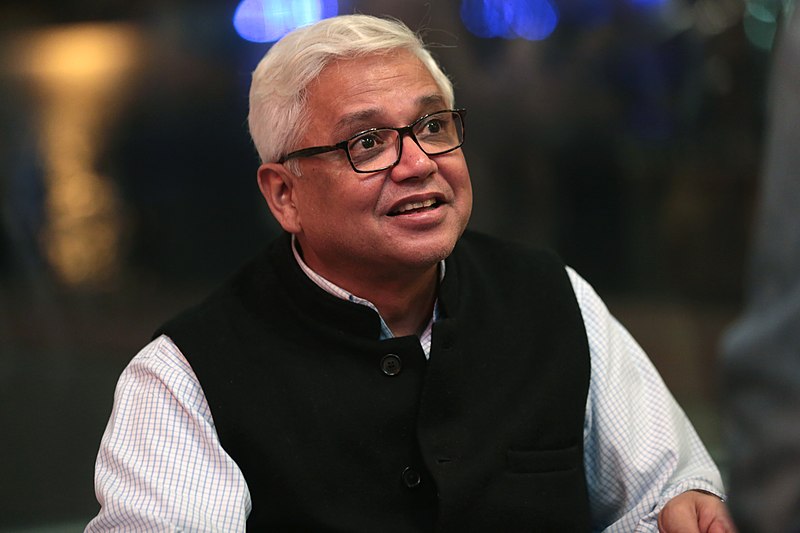
Amitav Ghosh speaking with attendees at a book signing following an event titled "War, Race and Empire in the Anthropocene" hosted by the Virginia G. Piper Center for Creative Writing at the Tempe Center for the Arts in Tempe, Arizona. Please attribute to Gage Skidmore if used elsewhere.
Gage Skidmore from Peoria, AZ, United States of America · Amitav Ghosh

Amitav Ghosh speaking with attendees at a book signing following an event titled "War, Race and Empire in the Anthropocene" hosted by the Virginia G. Piper Center for Creative Writing at the Tempe Center for the Arts in Tempe, Arizona. Please attribute to Gage Skidmore if used elsewhere.
Gage Skidmore from Peoria, AZ, United States of America · Amitav Ghosh
Key facts
Key facts
• Name — Amitav Ghosh • Born — 11 July 1956 • Birthplace — Calcutta, West Bengal, India • Occupation — Writer • Alma Mater — University of Delhi (BA, MA) University of Oxford (PhD) • Genre — Historical fiction • Notable Works — The Shadow Lines, The Glass Palace, Ibis trilogy, The Great Derangement • Spouse — Deborah Baker (wife) • Awards — Jnanpith Award Sahitya Akademi Award Ananda Puraskar Dan David Prize Padma Shri Erasmus Prize Park Kyong-ni Prize • Website — www.amitavghosh.com • Honorific Suffix — FRSL
Life
Life
Ghosh was born in Calcutta on 11 July 1956 and was educated at the all-boys boarding school The Doon School in Dehradun. He grew up in India, Bangladesh, and Sri Lanka. His contemporaries at Doon included author Vikram Seth and historian Ram Guha. While at school, he regularly contributed fiction and poetry to The Doon School Weekly (then edited by Seth) and founded the magazine History Times along with Guha. After Doon, he received degrees from St Stephen's College and the Delhi School of Economics, both part of Delhi University. Ghosh then won the Inlaks Foundation scholarship to complete a D. Phil. in social anthropology at St Edmund Hall, Oxford, under the supervision of British social anthropologist Peter Lienhardt. His thesis, undertaken in the Faculty of Anthropology and Geography, was entitled, "Kinship in relation to economic and social organization in an Egyptian village community", and submitted in 1982. Ghosh returned to India to begin working on the Ibis trilogy, which includes Sea of Poppies (2008), River of Smoke (2011), and Flood of Fire (2015). In 2007, Ghosh was awarded the Padma Shri by the Indian government. In 2009, he was elected a Fellow of the Royal Society of Literature. In 2015, he was named a Ford Foundation Art of Change Fellow. Ghosh currently lives in New York with his wife, Deborah Baker, author of the Laura Riding biography In Extremis: The Life of Laura Riding (1993) and a senior editor at Little, Brown and Company. They have two children, Lila and Nayan.
Fiction
Fiction
• Illustration — Ghosh promoting River of Smoke in 2011 Ghosh's historical fiction novels include The Circle of Reason (his 1986 debut novel), The Shadow Lines (1988), The Calcutta Chromosome (1996), The Glass Palace (2000), The Hungry Tide (2004), and Gun Island (2019). Ghosh began working on the Ibis trilogy in 2004. Set in the 1830s, its story follows the build-up of the First Opium War across China and the Indian Ocean region. Its consists of Sea of Poppies (2008), River of Smoke (2011), and Flood of Fire (2015). Most of Ghosh's work deals with historical settings, especially in the Indian Ocean periphery. In an interview with historian Mahmood Kooria, he said: It was not intentional, but sometimes things are intentional without being intentional. Though it was never part of a planned venture and did not begin as a conscious project, I realise in hindsight that this is really what always interested me most: the Bay of Bengal, the Arabian Sea, the Indian Ocean, and the connections and the cross-connections between these regions. The Shadow Lines, according to one blogger, "throws light on the phenomenon of communal violence and the way its roots have spread deeply and widely in the collective psyche of the Indian subcontinent". Gun Island, published in 2019, deals with climate change and human migration, drew praise from critics. According to a review in the Columbia Journal, This is Ghosh at his tenacious, exhausted best—marrying a mythical tale from his homeland with the plight of the human condition, all the while holding up a mirror to the country that he now calls home, as well as providing a perhaps too optimistic perspective on the future of our climate! The novel creates a world of realistic fiction, challenging the agency of its readers to act upon the demands of the environment. The use of religion, magical realism, coincidences, and climate change come together to create a wholesome story of strife, trauma, adventure, and mystery. The reader takes on the journey to solve the story of "the Gun Merchant" and launches themselves into the destruction of nature and the effects of human actions. Ghosh transforms the novel through his main character, his story, and the very prevalent climate crisis. The novel is advertently a call to action intertwined in an entertaining plot. The Guardian however, noted Ghosh's tendency to go on tangents, calling it "a shaggy dog story" that "can take a very roundabout path towards reality, but it will get there in the end". In 2021, Ghosh published his first book in verse, Jungle Nama, which explores the Sundarbans legend of Bon Bibi.
Non-fiction
Non-fiction
Ghosh's notable non-fiction writings include In an Antique Land (1992), Dancing in Cambodia and at Large in Burma (1998), Countdown (1999), and The Imam and the Indian (2002), a collection of essays on themes such as fundamentalism, the history of the novel, Egyptian culture, and literature. His writings have appeared in newspapers and magazines in India and abroad. In The Great Derangement: Climate Change and the Unthinkable (2016), Ghosh accuses modern literature and art of failing to adequately address climate change. In The Nutmeg's Curse: Parables for a Planet in Crisis (2021), Ghosh follows the journey of nutmeg from its native Banda Islands to many other parts of the world, using the spice as a lens through which to understand the historical influence of colonialism upon attitudes towards Indigenous cultures and environmental change. In his latest work, Smoke and Ashes: A Writer's Journey Through Opium's Hidden Histories (2023), Ghosh discusses the history of opium, focusing on its colonial history and legacy in India and China and its connection to modern corporate practices, such as Purdue Pharma's role in the ongoing US opioid epidemic. Its discussion of the lead-up to the First Opium War in the 1830s also serves as background to Ghosh's fictional Ibis trilogy.
Novels
Novels
• The Circle of Reason (1986) • The Shadow Lines (1988) • The Calcutta Chromosome (1995) • The Glass Palace (2000) • The Hungry Tide (2004) • Ibis trilogy: • Sea of Poppies (2008) • River of Smoke (2011) • Flood of Fire (2015) • Gun Island (2019) • Jungle Nama (2021) • Ghost-Eye (2025)
Non-Fiction
Non-Fiction
• In an Antique Land (1992) • Dancing in Cambodia and at Large in Burma (1998; Essays) • Countdown (1999) • The Imam and the Indian (2002; Essays) • Incendiary Circumstances (2006; Essays) • The Great Derangement: Climate Change and the Unthinkable (2016) • The Nutmeg's Curse (2021) • Uncanny and Improbable Events (2021) • The Living Mountain (2022) • Smoke and Ashes (2023) • Wild Fictions (2025; Essays)
Identity
Identity
Amitav Ghosh is recorded as writer, novelist, journalist, literary critic and university teacher.
Life and career
Dated record
Life and career
The full dated record · 1 entries
1956
Amitav Ghosh born at Kolkata.
Holdings and surviving copies
Where the work is held
Holdings and surviving copies
Where material relating to Amitav Ghosh is held.
Documents and archives
Primary material
Documents and archives
reference work
- Wikidata, structured authority record Q336125: Amitav Ghosh
Reputable secondary · Wikimedia Foundation
- “Amitav Ghosh”, English Wikipedia, consulted as further reading
Reputable secondary · Wikipedia
scholarly publication
- Beyond the Commonwealth: Amitav Ghosh and Indian Writing in English, Amitav Ghosh, 2005
Scholarly · Crossref registry · 2005
Awards and recognition
• Illustration — Ghosh speaking at an event with Joni Adamson in 2017. The Circle of Reason (1986) won the Prix Médicis étranger, one of France's top literary awards. The Shadow Lines (1988) won the Sahitya Akademi Award and the Ananda Puraskar. The Calcutta Chromosome (1996) won the Arthur C. Clarke Award in 1997. Sea of Poppies (2008), the first installment of the Ibis trilogy, was shortlisted for the 2008 Man Booker Prize. It was the co-winner of the Vodafone Crossword Book Award in 2009, as well as co-winner of the 2010 Dan David Prize. River of Smoke (2011), the second Ibis installment, was shortlisted for the Man Asian Literary Prize 2011. Ghosh famously withdrew his novel The Glass Palace (2000) from consideration for the Commonwealth Writers' Prize, where it was awarded the best novel in the Eurasian section, citing his objections to the term "Commonwealth" and the unfairness of the English-language requirement specified in the rules. The government of India awarded Ghosh the civilian honour of Padma Shri in 2007. He received a lifetime achievement award at Tata Literature Live, the Mumbai LitFest, on 20 November 2016. He was conferred the 54th Jnanpith award in December 2018 and is the first Indian writer in English to have been chosen for this honour. Ghosh was awarded the Erasmus Prize 2024, specifically for his writing on climate change: "His work offers a remedy by making an uncertain future palpable through compelling stories about the past. He also wields his pen to show that the climate crisis is a cultural crisis that results from a dearth of the imagination." His book Smoke and Ashes: Opium’s Hidden Histories, made the 2024 British Academy Book Prize shortlist. In 2025, Ghosh received the fourteenth Park Kyong-ni Prize in recognition of his contribution to postcolonial and ecological writing, and for highlighting the voices of marginalised communities and the natural world. In August 2025 Ghosh was selected as the 12th author to contribute to the Future Library project. He joins other prominent authors whose unpublished manuscripts will be locked away until the year 2114 in a specially designed repository in Oslo, Norway. On 12 February 2026, Amitav Ghosh won The Wise Owl Literary Award 2026 Non Fiction category, for his book Wild Fictions: Essays.
Notes from the source article
Cited by Wikipedia
Notes from the source article
These works are cited by the source article, in its own numbering. They are recorded as its citations, not as sources VALÉORINE has verified.
- 1.Ghosh, Amitav , Encyclopædia Britannica
- 2.Srivastava, Deepali. Indian-American Novelist Amitav Ghosh Challenges Western Thinking On Climate Change. Forbes.
- 3.Britannica.
- 4.Amitav Ghosh : Biography. www.amitavghosh.com.
- 5.Nicholas Wroe. Amitav Ghosh: 'There is now a vibrant literary world in India – it all began with Naipaul'. The Guardian. 2015-05-23.
- 6.The Pioneer. 'Dosco' Amitav Ghosh celebrates his 60th Birthday. Dailypioneer.com.
- 7.Of nature, cricket, literature and history. The Statesman. 29 October 2017.
- 8.Ramachandra Guha. Ramachandra Guha on Twitter: "On the 25th anniversary of Amitav Ghosh's superb The Shadow Lines, a toast to History Times, the school magazine we worked on together.". Twitter.com. 2013-09-12.
- 9.A scholarship worth going after. The Times of India. 2002-01-17.
- 10.Srivastava, Neelam, "Amitav Ghosh's enthographic fictions: Intertextual links between In An Antique Land and his doctoral thesis", Journal of Commonwealth Literature, 2001, Vol.36(2), pp.45-64.
- 11.National Portal of India. May 2016.
- 12.Royal Society of Literature. Royal Society of Literature All Fellows.
- 13.The Art of Change: Meet our visiting fellows. Ford Foundation. 7 April 2015.
- 14.Clark, Alex. Gun Island by Amitav Ghosh review – climate and culture in crisis. The Guardian. 2019-06-05.
- 15.Salam, Ziya Us. 'The trilogy is over'. The Hindu. 2015-06-06. 0971-751X.
- 16.A Clash Of Civilizations: The Ibis Trilogy By Amitav Ghosh. Culture Trip. 2013-02-28.
- 17.Clark, Alex. Flood of Fire by Amitav Ghosh review – the final instalment of an extraordinary trilogy. The Guardian. 2015-06-05.
- 18.'Flood of Fire' brings the astounding, exceptional 'Ibis Trilogy' to a close. Christian Science Monitor. 2015-08-04. 0882-7729.
- 19.Between the Walls of Archives and Horizons of Imagination - An Interview with Amitav Ghosh. Cambridge Core.
- 20.rajnishmishravns. Amitav Ghosh's The Shadow Lines as an Indian English Novel | rajnishmishravns. Rajnishmishravns.wordpress.com. 2013-01-26.
- 21.Alam, Rumaan. Review The protagonist in this novel, Dinanath "Deen" Datta, is an antique and rare book collector who goes on a journey to realize the supernatural within his life. Datta travels from New York to India to Los Angeles to Venice in search of understanding an old Bengali folk tale of the "Gun Merchant" with his growing knowledge from his companions. Gun Island, in 2019, was named a Best Book of Fall by Vulture, Chicago Review of Books, and Amazon. With 'Gun Island,' Amitav Ghosh turns global crises into engaging fiction. Washington Post. September 8, 2019.
- 22.Sinha, Arushi Sinha and Arushi. Review: Gun Island by Amitav Ghosh. Columbia Journal. 2019-11-16.
- 23.Clark, Alex. Gun Island by Amitav Ghosh review – climate and culture in crisis. The Guardian. 2019-06-05.
- 24.Rakshit, Nobonita. Abstract Knowledge, Embodied Experience: Towards a Literary Fieldwork in the Humanities. Rupkatha Journal on Interdisciplinary Studies in Humanities. 13. 3. 2021-10-08. 0975-2935.
- 25.Mishra, Pankaj. Easternisation by Gideon Rachman and The Great Derangement by Amitav Ghosh – review. The Guardian. 2016-11-03.
- 26.Amitav Ghosh's new book 'The Nutmeg's Curse' to release in October - Times of India. The Times of India. June 16, 2021.
- 27.Planetary crisis is a kind of bio-political war, akin to those of the past: Amitav Ghosh. The Hindu. 2021-11-18. 0971-751X.
- 28.Nothing has worked against incredibly powerful agent opium: Amitav Ghosh. The Indian Express. 2023-07-17.
- 29.Amitav Ghosh re-emerges with Sea of Poppies. The Hindu. 24 May 2008.
- 30.Fantasticfiction.co.uk. Amitav Ghosh.
- 31.Clarkeaward.com. Arthur C. Clarke Award |. September 2019.
- 32.First-timers Seeking Booker glory. BBC News. 9 September 2008.
- 33.Dan David Prize : Amitav Ghosh. www.dandavidprize.org.
- 34.Lalmalsawma, David. Amitav Ghosh joint winner of $1 million Israeli prize. Reuters. 2010-04-28.
- 35.Wild West at the London Book Fair. 24 March 2001.
- 36.Ghosh, Amitav. Ghosh Letter to Administrators of Commonwealth Writers Prize. ezipangu.org. 2001-03-18.
- 37.Ministry of Home Affairs, Government of India. Padma Awards. 2015.
- 38.Amitav Ghosh gets life-time achievement award at Lit Fest.
- 39.Author Amitav Ghosh honoured with 54h Jnanpith award. The Times of India. 14 December 2018.
- 40.Amitav Ghosh - Laureate Erasmus Prize 2024. Praemium Erasmianum Foundation.
- 41.Anderson, Porter. London's British Academy Book Prize: The 2024 Shortlist. Publishing Perspectives. 2024-09-20.
- 42.Staff, Scroll. Writer Amitav Ghosh wins Korea’s top literary honour, the $100,000 Pak Kyongni Prize, for 2025. Scroll.in. 2025-09-19.
- 43.Creamer, Ella. Next manuscript by Amitav Ghosh to be kept sealed for 89 years. The Guardian. 2025-08-13.
- 44.Chandigarh: Poets, authors honoured at Wise Owl Literary Awards. Hindustan Times. 13 February 2026.
Bibliography printed in the source article · 3
- Frost, Mark R. Amitav Ghosh and the Art of Thick Description: History in the Ibis Trilogy. The American Historical Review. 121. 5. 1537–1544. 5 December 2016. 10.1093/ahr/121.5.1537.
- Kalpaklı, Fatma. Amitav Ghosh ile Elif Şafak’ın Romanlarında Öteki/leştirme/Us and Them Attitude in the Works of Amitav Ghosh and Elif Şafak . Konya: Çizgi Kitabevi, 2016.
- Thomas, Julia Adeney. JAS Round Table on Amitav Ghosh, The Great Derangement: Climate Change and the Unthinkable. The Journal of Asian Studies. 75. 4. 929–955. 15 November 2016. 0021-9118.
References
Citations
References
Each reference names the institution holding it, so a reader may go to the document itself.
scholarly publication
Beyond the Commonwealth: Amitav Ghosh and Indian Writing in English, Amitav Ghosh, 2005Crossref registry
Verifiedreference work
Wikidata, structured authority record Q336125: Amitav GhoshWikimedia Foundation
Partially resolvedreference work
Partially resolved
Further particulars
Held on the record
Further particulars
Open the remaining particulars
He was employed by Harvard University and City University of New York. He belonged to Royal Society of Literature and American Academy of Arts and Sciences. He worked at New York City and Kolkata. Work and production. Works recorded as notable number 5: The Glass Palace, Sea of Poppies, River of Smoke, The Calcutta Chromosome and The Great Derangement. Ghosh received Sahitya Akademi Award in English, Ananda Puraskar, Prix Médicis étranger, Arthur C. Clarke Award, Asian American Literary Awards and Dan David Prize.
Career and activity
Recognition and collections
The Encyclopedia exists whether or not anything is for sale. Corrections are recorded rather than overwritten, and every version of this record is kept. Published 14 August 2026.
Elsewhere in Books
38,960 published records in this field, each with its sources named.
- Amit MajmudarAuthor
- Amit RayAuthor
- Amitabh BachchanAuthor
- Amitabh MitraAuthor
- Amittai ben ShephatiahAuthor
- Amiya ChakravartyAuthor
- Amjad HyderabadiAuthor
- Amjad NajmiAuthor
Best supported in this field
For owners
Own a work by Amitav Ghosh?
A specialist will read what you send and tell you what the house can establish, what it cannot, and whether the object is suited to sale. There is no charge and no obligation. The object stays with you throughout; nothing is shipped to us unless it is arranged in writing beforehand.