
Alfred Wordsworth Thompson
Alfred Wordsworth Thompson (May 26, 1840 – August 28, 1896) was an American landscape and history painter.
Also recorded as Wordsworth Thompson · A. Wordsworth Thompson
Alfred Wordsworth Thompson
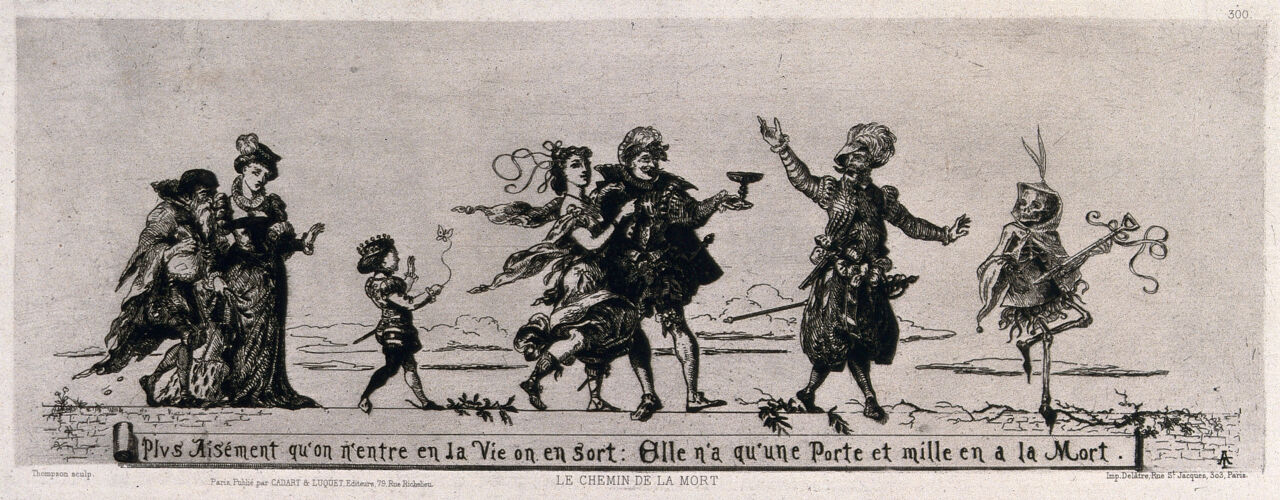
Alfred Wordsworth Thompson · Wellcome Collection, London · Wellcome Collection · Public Domain Mark
- Name
- Alfred Wordsworth Thompson
- Born
- 26 May 1840
- Birthplace
- Baltimore, Maryland
- Died
- 28 August 1896
- Place of death
- Summit, New Jersey
- Occupation
- Painter
Reference Check
Propose documentary evidence for Alfred Wordsworth Thompson. A contribution is never written directly as fact: identity, source, rights and evidence gates still decide.
Sign in to contribute
Documentary evidence
Documentary basis
Authority files
wikidata · Q21994015 · wikipedia · Alfred Wordsworth Thompson
VALÉORINE Encyclopedia
The documentary record
Statements marked “Documentary record” are set in the article beside the passage they confirm. Each is read from the authority records of the institutions named here; select “Prove” to see the record it was read from, where in that record, and when.
Institutions cited
Bibliothèque nationale de France · Library of Congress · Getty Union List of Artist Names
Complete reading chain (JSON)In this article
Key facts
Key facts
• Name — Alfred Wordsworth Thompson • Born — 26 May 1840 • Birthplace — Baltimore, Maryland • Died — 28 August 1896 • Place of death — Summit, New Jersey • Occupation — Painter
Documentary record
Alfred Wordsworth Thompson (1840 – 1896) is described as a genre artist and painter in the authority records of the Bibliothèque nationale de France, the Library of Congress and the Getty Union List of Artist Names.
Biography
Biography
• Illustration — Monks and Ducks • Illustration — Advance of the Enemy Alfred Wordsworth Thompson was born in Baltimore on May 26, 1840. After completing his secondary education, he was enrolled at Newton University, to prepare him for a career in his father's law practice. His interest in art prevailed, however, and not long before the Civil War began, he had established his own art studio, where he created illustrations for Harper's Weekly and the Illustrated London News. His contributions to Harper's included a sketch of the abolitionist John Brown, whom he had visited in prison. When the war broke out, he went to work for them as a type of special correspondent; spending much of his time in Virginia. After holding that position for less than a year, and possibly fearing conscription, he quit and went to Paris, where he would remain until 1868. He was able to enter the École des Beaux-Arts in 1864; studying with Charles Gleyre, Alberto Pasini and Émile Lambinet. He also studied horse anatomy with the sculptor, Antoine-Louis Barye. In 1865, he exhibited a landscape at the Salon. Later, before returning home, he visited Germany and Austria and took a walking tour from Heidelberg to Calabria. He chose to establish a studio in New York City, instead of Baltimore. Not long after, he exhibited some works at the National Academy of Design; becoming a member there in 1875. The academy would be his major venue, with over 125 paintings sold there; 40 of them depicting scenes from the Revolutionary War. Despite this, in 1878, he joined the Society of American Artists, an organization formed in opposition to the academy's conservative approach. He married Mary Pumpelly in 1876. He was an avid traveller throughout his life, visiting Turkey, Morocco and Spain. In the 1870s, during the Reconstruction era, he made several what were then risky trips into Virginia and North Carolina, where he painted rural genre scenes. Some of those paintings were exhibited at the Brooklyn Art Association and at the Centennial Exhibition in Philadelphia. His last twelve years were spent in semi-retirement in Summit, New Jersey. Many of his works may be seen at the New York Historical Society, the Union League Club, the Albright-Knox Art Gallery in Buffalo and at the Chrysler Museum of Art. His Civil War painting Cannonading on the Potomac is in the art collection of the White House. Alfred Wordsworth Thompson died in Summit on August 28, 1896.
Documentary record
Alfred Wordsworth Thompson was born in Baltimore (1840) and died in Summit (1896).
Text attribution
Licensing
Text attribution
Part of the biographical narrative on this page reuses licensed material. Its origin, revision and licence are recorded here.
The biographical narrative on this page is based on the Wikipedia article Alfred Wordsworth Thompson, revision 1366255903 (EN edition), by its contributors. VALÉORINE has edited that text and built its own documentary record around it. The reused material is available under CC BY-SA 4.0, and this page's reuse of it is offered under the same licence. Everything else on this page — the chronology, the holdings, the evidence, the plates and the connections — is VALÉORINE's own record. Sources and licences.
Notes from the source article
Cited by Wikipedia
Notes from the source article
These works are cited by the source article, in its own numbering. They are recorded as its citations, not as sources VALÉORINE has verified.
References
Citations
References
Each reference names the institution holding it, so a reader may go to the document itself.
reference work
Secondary witnessreference work
Secondary witness
The Encyclopedia exists whether or not anything is for sale. Corrections are recorded rather than overwritten, and every version of this record is kept. Published 25 August 2026.
Elsewhere in Paintings
19,456 published records in this field, each with its sources named.
- Alfred Wierusz-KowalskiArtist
- Alfred William HuntArtist
- Alfred William RichArtist
- Alfred WolmarkArtist
- Alfred ZoffArtist
- Alfred-Arthur Brunel de NeuvilleArtist
- Alfred-Georges RegnerArtist
- Alfred-Henri BramtotArtist
Best supported in this field
For owners
Own a work by Alfred Wordsworth Thompson?
A specialist will read what you send and tell you what the house can establish, what it cannot, and whether the object is suited to sale. There is no charge and no obligation. The object stays with you throughout; nothing is shipped to us unless it is arranged in writing beforehand.