
Alfred Rethel
Illustration — Self portrait, 1832 Alfred Rethel (May 15, 1816December 1, 1859) was a German history painter.
Alfred Rethel
Alfred Rethel · The Cleveland Museum of Art · Gift of Robert Hays Gries · CC0
- Born
- 1816 · Aachen.
- Died
- 1859 · Düsseldorf.
- Nationality
- Kingdom of Prussia
- Occupation
- painter · draftsperson
- Fields
- history
- Languages
- German
Reference Check
Propose documentary evidence for Alfred Rethel. A contribution is never written directly as fact: identity, source, rights and evidence gates still decide.
Sign in to contribute
World of VALÉORINE
Documentary connections
Only confirmed graph relationships appear here. Images are shown only when their identity and reuse rights both pass the documentary gate.
Documentary evidence
Documentary basis
Authority files
wikidata · Q67036 · wikipedia · Alfred Rethel
VALÉORINE Encyclopedia
The documentary record
Statements marked “Documentary record” are set in the article beside the passage they confirm. Each is read from the authority records of the institutions named here; select “Prove” to see the record it was read from, where in that record, and when.
Institutions cited
Bibliothèque nationale de France · Deutsche Nationalbibliothek
Complete reading chain (JSON)In this article
Early life and education
Early life and education
Wilhelm Camphausen is recorded as having studied under Alfred Rethel. The recorded working language is German. Subjects and genres recorded for the work are history. Places of work recorded in the authority are Düsseldorf, Aachen and Frankfurt. Work by Alfred Rethel is recorded in the collections of Städel Museum, Minneapolis Institute of Art, National Gallery of Victoria, National Gallery of Canada and Hermitage Museum.
Documentary record
Places of activity recorded by the Deutsche Nationalbibliothek: Düsseldorf, Aachen, Frankfurt am Main and Dresden.
Rethel was born in Aachen in 1816. He showed an interest in art in his early life, and at the age of thirteen he executed a drawing which procured his admission to the Kunstakademie Düsseldorf. Here he studied for several years, and produced, among other works, a figure of St Boniface, which attracted much attention.
Documentary record
Alfred Rethel (15 May 1816 – 1 December 1859) is described as an artist, illustrator, painter and graphic artist in the authority records of the Bibliothèque nationale de France and the Deutsche Nationalbibliothek. The birth of Alfred Rethel is recorded on 15 May 1816, and the death on 1 December 1859. For the birthplace of Alfred Rethel, Aachen is recorded by the Deutsche Nationalbibliothek and Diepenbend (Allemagne) by the Bibliothèque nationale de France. Alfred Rethel died in Düsseldorf, Germany, according to the Deutsche Nationalbibliothek and the Bibliothèque nationale de France.
Career
Career
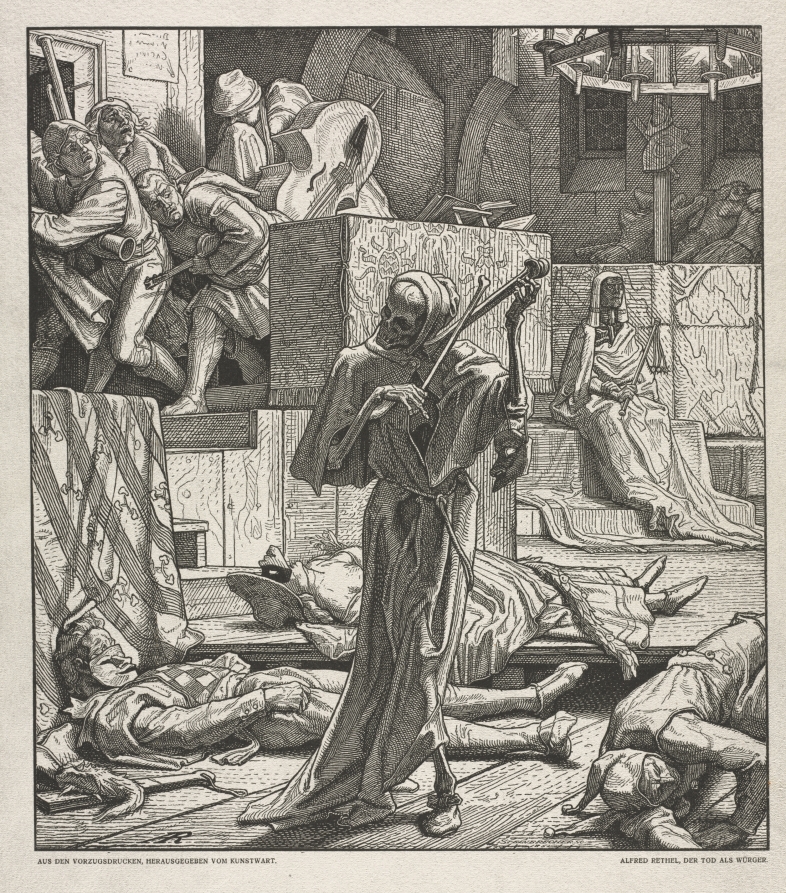
• Illustration — Nemesis, 1837 • Illustration — Dance of Death, 1848 At the age of twenty, Rethel moved to Frankfurt, and was selected to decorate the walls of the imperial hall in the Römer with Fresco paintings of figures of famous men. At the same period he produced a series of designs illustrative of Old Testament history. Four years later, Rethel was the successful competitor for the work of ornamenting the restored council house of his native city with frescoes depicting prominent events in the career of Charlemagne, but the execution of this work was delayed for some six years. Meanwhile, Rethel occupied himself with the production of easel pictures and of drawings. In 1842, he began a striking series of designs dealing with the Crossing of the Alps by Hannibal, in which the weird power which animates his later art becomes first apparent. In 1844, Rethel visited Rome, executing, along with other subjects, an altar-piece for one of the churches of his native land. In 1846, he returned to Aachen, and commenced his Charlemagne frescoes. But mental derangement, attributed, it is believed, to an accident that he suffered in childhood, began to manifest itself. While he hovered between madness and sanity, Rethel produced some of the most striking, individual, and impressive of his works. Strange legends are told of the effect produced by some of his weird subjects. He painted Nemesis pursuing a murderer across a flat stretch of landscape. A slaughtered body lies on the ground, while in front is the assassin speeding away into the darkness, and above an angel of vengeance. The picture, so the story goes, was won in a lottery at Frankfurt by a personage of high rank, who had been guilty of an undiscovered crime, and the contemplation of his prize drove him mad. Another design which Rethel executed was "Death the Avenger," a skeleton appearing at a masked ball, scraping daintily, like a violinist, upon two human bones. The drawing haunted the memory of his artist friends and disturbed their dreams; and, in expiation, he produced his pathetic design of "Death the Friend." Rethel also executed a powerful series of drawings "The Dance of Death" suggested by the Belgian insurrections of 1848. It is by such designs as these, executed in a technique founded upon that of Albrecht Dürer, and animated by an imagination akin to that of the elder master, that Rethel is most widely known.
Death
Death
Alfred Rethel died on December 1, 1859, in Düsseldorf from the effects of a brain disease. In his last years, his brother Otto Rethel (1822–1892) took care of him, as well as his young wife Marie Grahl, the daughter of August Grahl, and their daughter Else Sohn-Rethel. Rethel's picture of "Peter and John at the Beautiful Gate of the Temple" is preserved in the Leipzig Museum, and his picture of "St Boniface" and several of his cartoons for the frescoes are preserved in the Berlin National Gallery. Rethel's Life by Wolfgang Müller von Königswinter was published in 1861.
Places
Named by the record
Places
Only places the record itself states, plotted where the house gazetteer settles their coordinates. Nothing is inferred from a name or a nationality.
Aachen.
Birth place
Düsseldorf.
Death place
Literature
• Auch ein Todtentanz. Elischer, Leipzig 1891. Digitalisierte Ausgabe - DFG-Viewer, University Library Düsseldorf
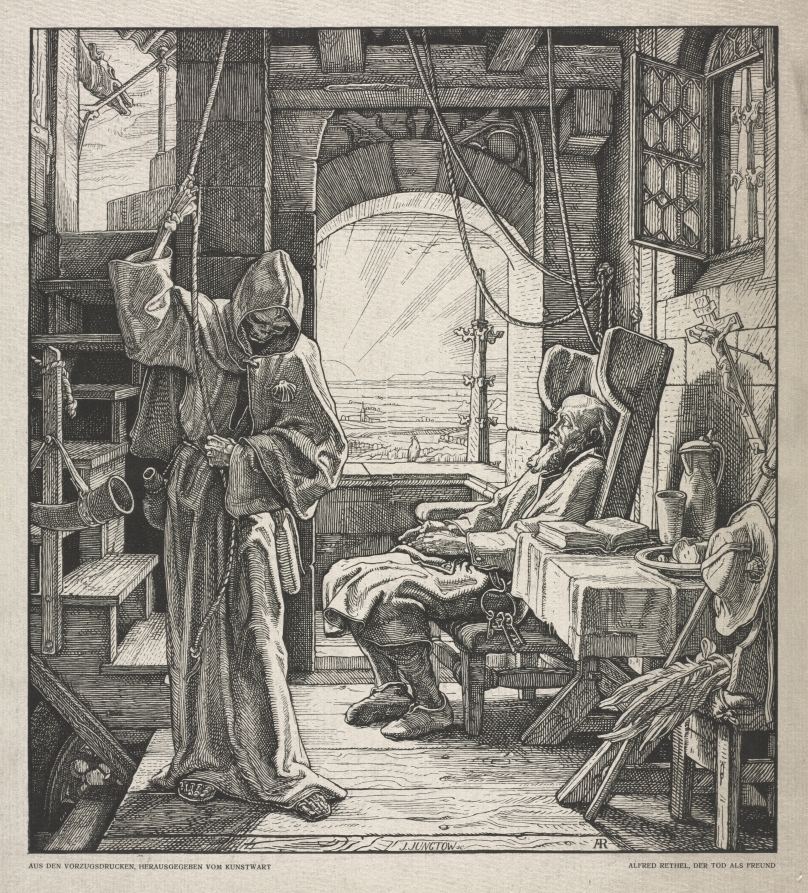
Dance of Death: Death as a Friend, 1850, by Alfred Rethel
Alfred Rethel · The Cleveland Museum of Art · Gift of Robert Hays Gries
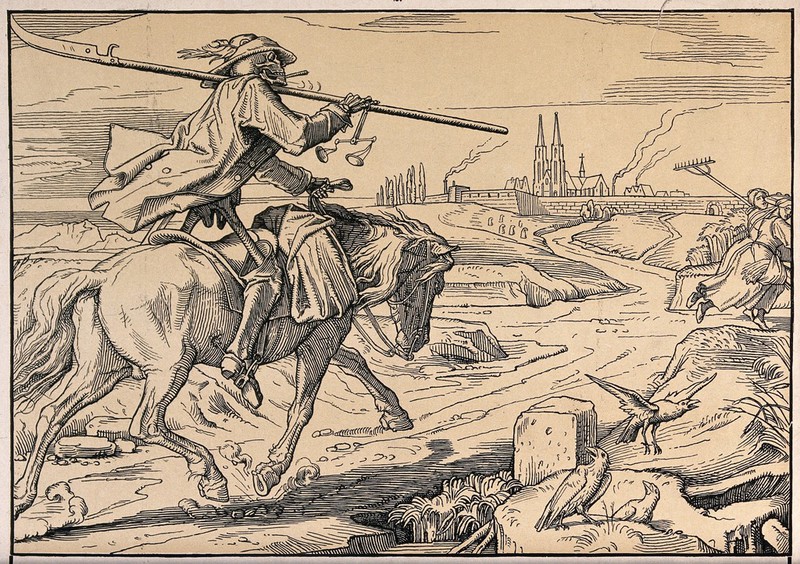
The dance of death: Death on horseback approaches the city. Woodcut after Alfred Rethel, 1848., 1848, by Alfred Rethel
Alfred Rethel · Wellcome Collection, London · Wellcome Collection
Text attribution
Licensing
Text attribution
Part of the biographical narrative on this page reuses licensed material. Its origin, revision and licence are recorded here.
The biographical narrative on this page is based on the Wikipedia article Alfred Rethel, revision 1338731492 (EN edition), by its contributors. VALÉORINE has edited that text and built its own documentary record around it. The reused material is available under CC BY-SA 4.0, and this page's reuse of it is offered under the same licence. Everything else on this page — the chronology, the holdings, the evidence, the plates and the connections — is VALÉORINE's own record. Sources and licences.
Notes from the source article
Cited by Wikipedia
Notes from the source article
These works are cited by the source article, in its own numbering. They are recorded as its citations, not as sources VALÉORINE has verified.
References
Citations
References
Each reference names the institution holding it, so a reader may go to the document itself.
reference work
Secondary witnessreference work
Secondary witness
The Encyclopedia exists whether or not anything is for sale. Corrections are recorded rather than overwritten, and every version of this record is kept. Published 17 August 2026.
Elsewhere in Paintings
19,456 published records in this field, each with its sources named.
- Alfred MunningsArtist
- Alfred PalArtist
- Alfred PartikelArtist
- Alfred Philippe RollArtist
- Alfred RiocreuxArtist
- Alfred Robert QuintonArtist
- Alfred RoloffArtist
- Alfred SchouppéArtist
Best supported in this field
For owners
Own a work by Alfred Rethel?
A specialist will read what you send and tell you what the house can establish, what it cannot, and whether the object is suited to sale. There is no charge and no obligation. The object stays with you throughout; nothing is shipped to us unless it is arranged in writing beforehand.