
Alfred Dehodencq
Alfred Dehodencq (23 April 1822 – 2 January 1882; born Edmé-Alexis-Alfred Dehodencq) was a French Orientalist painter known for his vivid oil paintings of Andalusian and North African scenes.
Also recorded as Edmé-Alexis-Alfred Dehodencq · Edme-Alexis-Alfred Dehodencq · Edme Alfred Alexis Dehodencq · Edme-Alfred-Alexis Dehodencq
Alfred Dehodencq
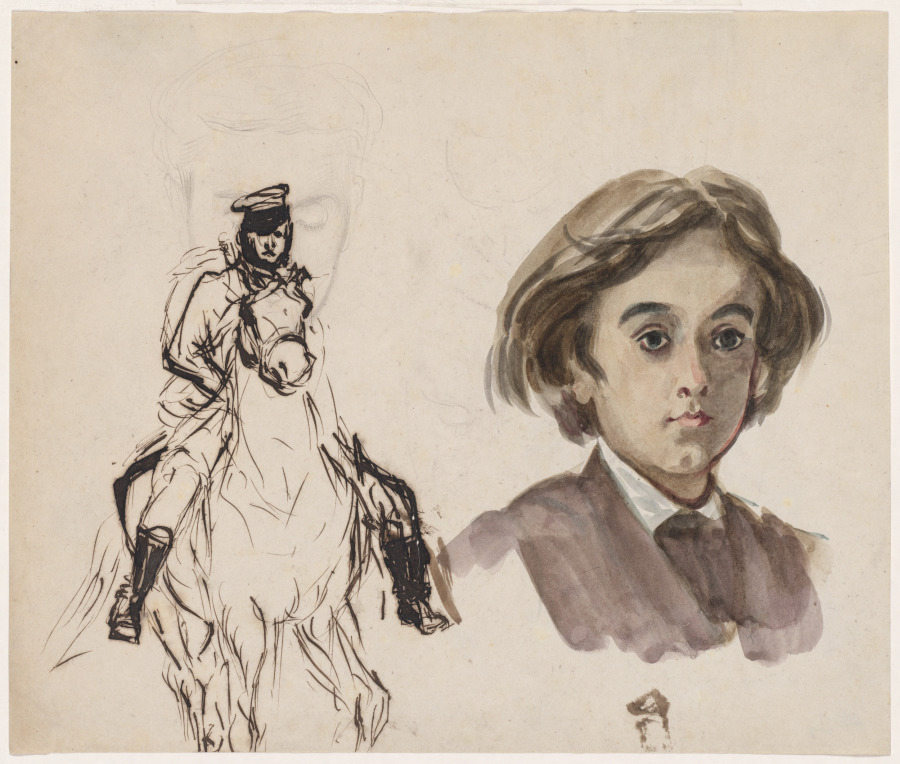
Alfred Dehodencq · The Cleveland Museum of Art · Bequest of Muriel Butkin · CC0
- Name
- Alfred Dehodencq
- Birth Name
- Edmé-Alexis-Alfred Dehodencq
- Birthplace
- Paris, France
- Field
- Painting
- Awards
- Legion of Honour
- Born
- 1822
- Died
- 1882
- Nationality
- France
- Occupation
- painter · draftsperson
- Fields
- history painting
- Movements
- Orientalism
- Known for
- Boabdil’s Farewell to Granada
VALÉORINE Encyclopedia
VALÉORINE documentary reading
Documentary summary
Alfred Dehodencq (23 April 1822 – 2 January 1882; born Edmé-Alexis-Alfred Dehodencq) was a French Orientalist painter known for his vivid oil paintings of Andalusian and North African scenes.
Admitted source layer · organised and presented by VALÉORINE
Note VALÉORINE
Alfred Dehodencq (1822–1882) was a draftsperson and painter, of French nationality. The draftsperson was born Edme Alfred Alexis Dehodencq in former 2nd arrondissement of Paris and died in 5th arrondissement of Paris.
Alfred Dehodencq was educated at Beaux-Arts de Paris. Activity centred on painting. Alfred Dehodencq was associated with Orientalism.
Among the works is Boabdil’s Farewell to Granada. The work spans history painting. Languages used include French. Honours include Knight of the Legion of Honour.
Composed from admitted, traceable facts · 27 September 2026
VALÉORINE
Reference Check
Propose documentary evidence for Alfred Dehodencq. A contribution is never written directly as fact: identity, source, rights and evidence gates still decide.
Sign in to contribute
Documentary evidence
Documentary basis
Authority files
wikidata · Q323496 · wikipedia · Alfred Dehodencq
In this article
Key facts
Key facts
• Name — Alfred Dehodencq • Birth Name — Edmé-Alexis-Alfred Dehodencq • Birthplace — Paris, France • Place of death — Paris, France • Field — Painting • Awards — Legion of Honour
Life
Life
• Illustration — Execution of a Jewess in Morocco, c. 1861; one of several versions of this painting by the artist. Dehodencq was born in Paris on 23 April 1822. During his early years, Dehodencq studied in Paris at the École des Beaux Arts under the tutelage of French artist Leon Cogniet. During the French Revolution of 1848 he was wounded in his right arm, and thereafter painted with his left hand. He was sent to convalesce in Spain, where he remained for five years.[1] Dehodencq became acquainted with the works of Spanish painters Diego Velázquez and Francisco Goya, which had a strong influence on his approach to painting. In 1853 he travelled to Morocco, where for the following ten years he produced many of his most famous paintings depicting scenes of the world he encountered. Dehodencq was the first foreign artist known to have lived in Morocco for an extended number of years. He frequently drew and painted the Jews of Morocco. His painting A Jewish Woman with her Negro Maid (1867), as well as over 30 of his drawings, are in the collection of the Israel Museum, Jerusalem. While he considered himself to be the "Last of the Romantics," his work is generally categorized with the mid-19th-century Orientalist artistic movement. In the 1860s, Dehodencq painted multiple versions of a work depicting the public execution of a young Jewish woman in Morocco, for the crime of converting to, and then renouncing, Islam; one of these paintings was exhibited at the Paris Salon of 1861 under the title Exécution d'une juive, au Maroc. Some scholars say that Dehodencq was inspired by the story of Sol Hachuel (beheaded in 1834 in Fez), but the artist's friend and biographer, Gabriel Séailles, states explicitly, in two books, that Dehodencq was an eye-witness to the execution he depicted, which took place in Tangiers. Dehodencq married Maria Amelia Calderon in 1857 in Cádiz, Spain. They had five children, three of whom (Emmanuel, Armand, and Marie) died as children, before their father.[2] Their son Edmond, born in Cádiz in 1862, was called the Mozart of painting because he debuted at the Paris Salon at age eleven.[3][4] At age 18 he sculpted the bust that later adorned his father's gravesite. In 1863, after 15 years abroad, Dehodencq returned with this family to Paris. He was decorated with the Legion of Honour in 1870. He committed suicide on 2 January 1882,[5] having been sick for a long time. He was buried in the Montmartre Cemetery.
Selected works
Selected works
• Bullfight, or Novillada at El Escorial, 1850, Musée des Beaux-Arts de Pau[6] • Illustration — Confraternity in Procession along Calle Génova • Illustration — A Gypsy Dance in the Gardens of the Alcázar • Jewish concert at the palace of the Moroccan Qaid, 1854, special collection • The Execution of a Jewess, in Morocco, ca. 1860, Musée d'Art et d'Histoire du Judaïsme, Marais district of Paris[7] • The justice of the Pasha, 1866, Musée Salies, Bagnères-de-Bigorre • Jewish bride in Morocco, 1867, Musée Saint-Denis, Reims • Boabdil's Farewell to Granada, 1869, Musée d'Orsay, Paris • Jewish celebration in Tanger, 1870, Musée de Poitiers[8] • Portrait of Mrs. Dehodencq, Musée Magnin, Dijon • Prince Piscicelli, 1850, Musée des Beaux-Arts de Bordeaux • Portrait de Marie au nœud rouge, 1872, special collection • A Confraternity in Procession along Calle Génova, Carmen Thyssen Museum, Málaga • A Gypsy Dance in the Gardens of the Alcázar, in front of Charles V Pavilion 1851, Carmen Thyssen Museum, Málaga • Gypsies on the road, Musée d'Orsay, Paris • Jewish bride, Palais des Beaux-Arts de Lille • Danse of negroes in Tanger, 1874, Musée d'Orsay, Paris • Jesus raises the daughter of Jairus, Musée Magnin, Dijon • Paris cafe scene, National Gallery, Washington, D.C. • Little gypsy, Baltimore Museum of Art, Baltimore • The arrest of Charlotte Corday after the murder of Marat, July 13, 1793, Musée de la Révolution française, Vizille
Identity and origins
Identity and origins
Alfred Dehodencq was recorded at birth as Edme Alfred Alexis Dehodencq. The authorities additionally record the headings Edmé-Alexis-Alfred Dehodencq, Edme-Alexis-Alfred Dehodencq, Edme Alfred Alexis Dehodencq, Edme-Alfred-Alexis Dehodencq and Dehodencq. His recorded language was French. One child is recorded: Edmond Dehodencq.
Identity
Identity
Alfred Dehodencq is recorded as painter and draftsperson.
Life and career
Dated record
Life and career
Explore 1822–1882
The full dated record · 4 entries
1822
Alfred Dehodencq born at former 2nd arrondissement of Paris.
1865
Jewish Festival in Tetuan is dated 1865.
1870
The little Moroccan with the tray / Portrait of Edmond, son of the artist, as a Moroccan servant is dated 1870.
1882
Alfred Dehodencq died at 5th arrondissement of Paris.
Primary material
Documents and archives
reference work
- “Alfred Dehodencq”, English Wikipedia, consulted as further reading
Reputable secondary · Wikipedia
- Wikidata, structured authority record Q323496: Alfred Dehodencq
Reputable secondary · Wikimedia Foundation
authority file
- VIAF cluster 42741727 for Alfred Dehodencq, aggregating national library name authorities.
General reference · OCLC
Notes from the source article
Cited by Wikipedia
Notes from the source article
These works are cited by the source article, in its own numbering. They are recorded as its citations, not as sources VALÉORINE has verified.
- 1.Edmé-Alexis-Alfred Dehodencq (French, 1822-1882), Christopher Columbus at the Monastery of Rabida. Christie's.
- 2.Séailles 1910, p. 155, quoting the poem by Théodore de Banville on Dehodencq's grave monument: Ils se sont réveillés dans la clarté des cieux Avec Emmanuel, Armand et ce doux ange La petite Marie aux yeux mystérieux.
- 3.Larousse, p. 1008
- 4.While Larousse says that Edmond was born in 1862, the Musée Goya says he was born in 1860; the Joconde site also says 1860, but appears to add a question mark.
- 5.Lemaire, Gérard-Georges. Orientalismus. Das Bild des Morgenlandes in der Malerei. H. F. Ullmann. 338. 2000. 3-8331-1433-9.
- 6.Françoise Cachin, Charles S. Moffett, Juliet Wilson Bareau, « Manet 1832–1883 », Réunion des Musées Nationaux, Paris,1983. . p.237.
- 7.Website of the Musée d'Art et d'Histoire du Judaïsme
- 8.Exhibited at Salon de Paris in 1870
Bibliography printed in the source article · 8
- Catalogue des tableaux, esquisses, études et dessins par feu Alfred Dehodencq, catalogue for the posthumous sale of the artist's work at the Hôtel Drouot on June 1, 1885, with an introduction by Gabriel Séailles; Paris: Imprimerie de l'Art, 1885.
- Gotlieb, Matt (2009). "Figures of Sublimity in Orientalist Painting" in Studies in the History of Art, Vol. 74, Symposium Papers LI: Dialogues in Art History, from Mesopotamian to Modern: Readings for a New Century; National Gallery of Art, 2009, pp. 316–341.
- Hamel, Maurice. "Alfred Dehodencq", Revue de l'art ancien et moderne, v. 28, no. 163, October, 1910, pp. 269–284.
- Larousse, Pierre. "Dehodencq" entries in Grand dictionnaire universel du XIXe siècle: français, historique, géographique, mythologique, bibliographique..., vol. 17, suppl. 2, 1866–1877, p. 1008.
- Séailles, Gabriel. Alfred Dehodencq: histoire d'un coloriste. P. Ollendorff. 1885.
- Séailles, Gabriel. Alfred Dehodencq: l'homme & l'artiste. Société de Propagation des Livres d'Art. 1910.
- Sigal-Klagsbald, Laurence. Les Juifs dans l'orientalisme. Skira Flammarion. 2012. 978-2-08-127712-0.
- Wright, Barbara and Lloyd, Rosemary. "Amis de jeunesse: Théodore de Banville, Armand Du Mesnil, Eugène Fromentin, Alfred Dehodencq: avec des lettres inédites et des illustrations par Eugène Fromentin et Alfred Dehodencq," Nineteenth-Century French Studies, Vol. 21, No. 3/4 (Spring—Summer 1993), pp. 322–338.
References
Citations
References
Each reference names the institution holding it, so a reader may go to the document itself.
reference work
Secondary witnessauthority file
Secondary witnessreference work
Wikidata, structured authority record Q323496: Alfred DehodencqWikimedia Foundation
Secondary witness
Further particulars
Held on the record
Further particulars
Open the remaining particulars
Alfred Dehodencq studied at Beaux-Arts de Paris. He trained under Léon Cogniet. Each of those relationships is stated by the authority record rather than inferred from style.
Alfred Dehodencq received Knight of the Legion of Honour.
Recognition and collections
Work by Alfred Dehodencq is
Minneapolis Institute of Art, Art Institute of Chicago, National Gallery of Canada and Palais des Beaux-Arts de Lille
The Encyclopedia exists whether or not anything is for sale. Corrections are recorded rather than overwritten, and every version of this record is kept. Published 14 August 2026.
Elsewhere in Paintings
18,717 published records in this field, each with its sources named.
- Alfred DarjouArtist
- Alfred de BreanskiArtist
- Alfred de CurzonArtist
- Alfred de DreuxArtist
- Alfred DistonArtist
- Alfred DuriauArtist
- Alfred EastArtist
- Alfred Edward ChalonArtist
Best supported in this field
For owners
Own a work by Alfred Dehodencq?
A specialist will read what you send and tell you what the house can establish, what it cannot, and whether the object is suited to sale. There is no charge and no obligation. The object stays with you throughout; nothing is shipped to us unless it is arranged in writing beforehand.