
Alexandre-Gabriel Decamps
Alexandre-Gabriel Decamps (March 3, 1803August 22, 1860) was a French painter noted for his Orientalist works.
Also recorded as Gabriel-Alexandre Decamps · Alexandre Gabriel Decamps · Alexander Decamps · Alexander G. De Camps
Alexandre-Gabriel Decamps
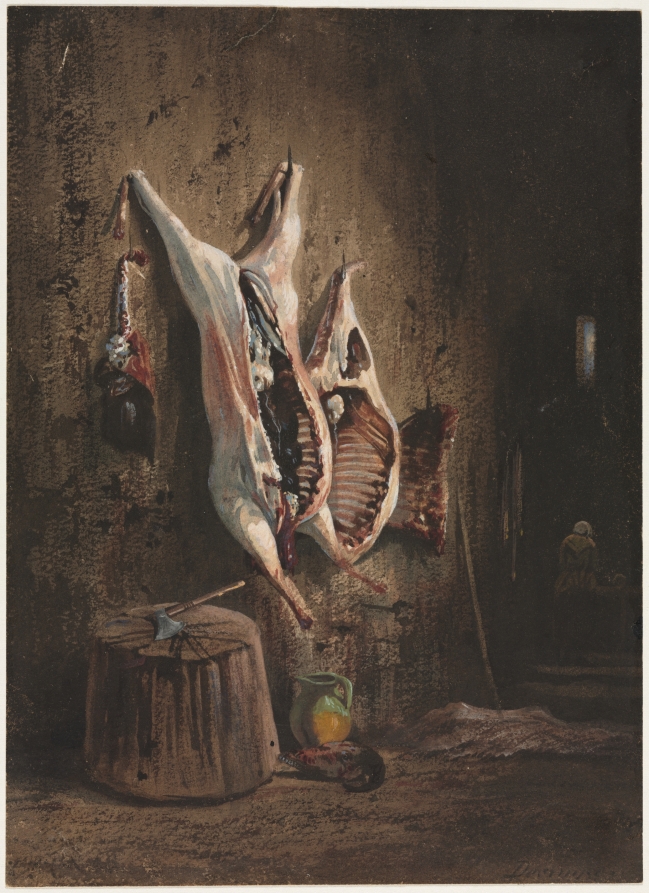
Alexandre-Gabriel Decamps · The Cleveland Museum of Art · Bequest of Muriel Butkin · CC0
- Name
- Alexandre-Gabriel Decamps
- Born
- March 3, 1803
- Birthplace
- Paris, France
- Died
- August 22, 1860
- Place of death
- Fontainebleau, France
- Field
- Painting, drawing
- Movement
- Orientalist
- Nationality
- France.
- Fields
- Orientalism.
- Movements
- Romanticism and Orientalism.
- Known for
- Searching for Truffles and Christ on trial.
VALÉORINE Encyclopedia
VALÉORINE documentary reading
Documentary summary
Alexandre-Gabriel Decamps (March 3, 1803August 22, 1860) was a French painter noted for his Orientalist works.
Admitted source layer · organised and presented by VALÉORINE
Note VALÉORINE
No house-authored Note is published until its assertions and sources pass the VALÉORINE evidence contract. The documentary article remains available in full while that enrichment is being consolidated.
Documentary enrichment in progress · no unsupported statement published
Reference Check
Propose documentary evidence for Alexandre-Gabriel Decamps. A contribution is never written directly as fact: identity, source, rights and evidence gates still decide.
Sign in to contribute
Documentary evidence
Evidence Panel
not yet certified
- Identity
- resolved
- Independent source families
- 0
- Admitted assertions
- 0
- Open conflicts
- 0
Authority files
wikidata · Q458288 · wikipedia · Alexandre-Gabriel Decamps
In this article
Key facts
Key facts
• Name — Alexandre-Gabriel Decamps • Born — March 3, 1803 • Birthplace — Paris, France • Died — August 22, 1860 • Place of death — Fontainebleau, France • Field — Painting, drawing • Movement — Orientalist
Life
Life
Decamps was born in Paris. In his youth he travelled in the East, and reproduced Oriental life and scenery with a bold fidelity to nature that puzzled conventional critics. His powers, however, soon came to be recognized, and he was ranked along with Delacroix and Ingres as one of the leaders of the French school. At the Paris Exhibition of 1855 he received the grand or council medal. Most of his life was passed in the neighborhood of Paris. He was fond of animals, especially dogs, and indulged in all kinds of field sports. He died in 1860 in consequence of being thrown from a horse while hunting at Fontainebleau.
Founding father of Orientalism
Founding father of Orientalism
Decamps was the founding father of Orientalism since he revealed everyday Oriental life in the 1831 Salon in Paris. His subjects and style with strong contrast of light and thick material became the reference for painters but also photographers and writers. He was the most influential painter on Orientalism and was proclaimed the chief of the new Orientalist School. Delacroix referred to him in the Women of Algiers (1834), and the Fanatics of Tangiers (1838). Théophile Gautier's Constantinople (1853) was described as an “immense verbal Decamps” by Henry James. Maxime Du Camp named him the Christopher Columbus of the Orient and Théophile Gautier compared his role as the discoverer of the Orient to the role of Jean-Jacques Rousseau as the discoverer of nature in the eighteenth century. Christine Peltre concludes that the only equivalent to his fame were the Arabian Nights (One Thousand and One Nights).
Works
Works
Decamps' style was characteristically and intensely French. It was marked by vivid dramatic conception, bold and even rough brushstrokes, and startling contrasts of color and of light and shade. His subjects embraced an unusually wide range. He availed himself of his travels in the East in dealing with scenes from Scripture history, which he was probably the first of European painters to represent with their true and natural local background. Of this class were his Joseph sold by his Brethren, Moses taken from the Nile, and his scenes from the life of Samson, nine vigorous sketches in charcoal and white. • Illustration — A version of The Turkish Patrol (1831) Perhaps the most impressive of his historical pictures is Defeat of the Cimbri, representing the conflict between a horde of barbarians and a disciplined army. Decamps produced a number of genre pictures, chiefly scenes from French and Turkish domestic life, the most marked feature of which is humour. The same characteristic attaches to many of his numerous animal paintings; Decamps was especially fond of painting monkeys. His well-known painting The Monkey Connoisseurs satirizes the jury of the French Academy of Painting, which had rejected several of his earlier works on account of their divergence from any known standard. His paintings and drawings were first made familiar to the English public through the lithographs of Eugene le Rouit.
Gallery
Gallery
• Illustration — Albanian Duel (circa 1828) • Illustration — Bird Hunting (1830), oil on canvas, 13 11/16 x 20 in. (34.8 x 50.8 cm), Clark Art Institute • Illustration — The Watering Place (1832) • Illustration — The Defeat of the Cimbri (1833) • Illustration — The Albanian dancer (1835) • Illustration — The Suicide (circa 1836). The Walters Art Museum. • Illustration — Cat, Weasel, and Rabbit (1836), oil on canvas, 9 1/2 x 13 1/2 in. (24.1 x 34.3 cm), Clark Art Institute • Illustration — The Experts, 1837, oil on canvas, Metropolitan Museum of Art • Illustration — The Punishment of the Hooks (1837) • Illustration — Italian Peasant (1842), oil on canvas, 15 5/8 x 12 1/2 in. (39.7 x 31.8 cm), Clark Art Institute • Illustration — The Poacher (1847), oil on canvas, 9 1/2 x 7 5/16 in. (24.1 x 18.6 cm), Clark Art Institute
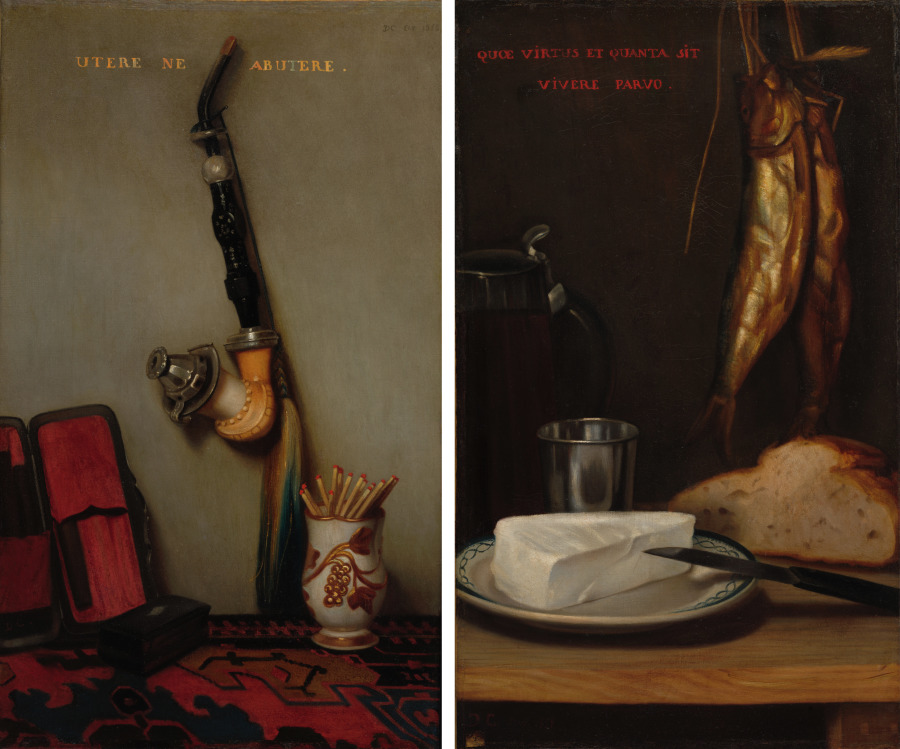
Still Life with Pipe and Matches and Still Life with Herring, Bread, and Cheese (pair), 1858, by Alexandre-Gabriel Decamps
Alexandre-Gabriel Decamps · The Cleveland Museum of Art · Bequest of Noah L. Butkin
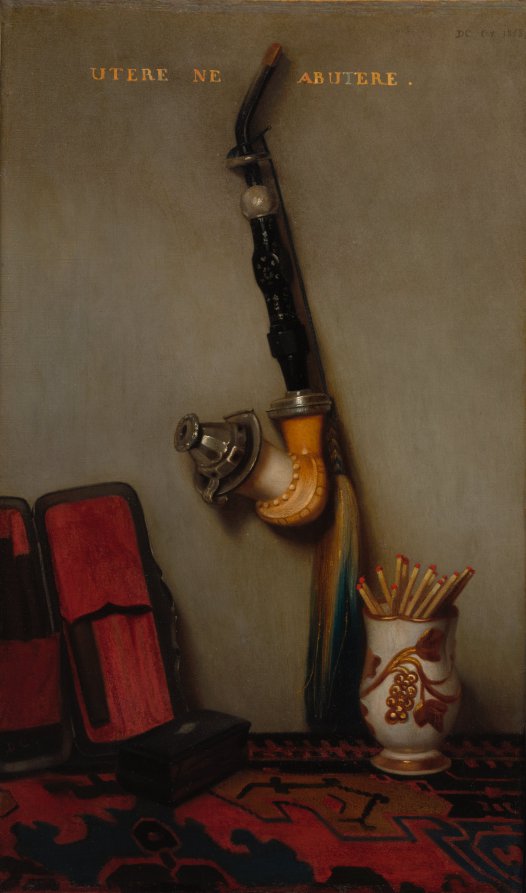
Still Life with Pipe and Matches, 1858, by Alexandre-Gabriel Decamps
Alexandre-Gabriel Decamps · The Cleveland Museum of Art · Bequest of Noah L. Butkin
Life and career
Dated record
Life and career
The full dated record · 2 entries
1803
Alexandre-Gabriel Decamps was born in 1803.
1860
Alexandre-Gabriel Decamps died at Fontainebleau.
Notes from the source article
Cited by Wikipedia
Notes from the source article
These works are cited by the source article, in its own numbering. They are recorded as its citations, not as sources VALÉORINE has verified.
- 1.Endnote: *Adolphe Moreau, Decamps et son oeuvre (Paris, 1869)
- 2.Garnier, Nicole. Delacroix et l'aube de l'orientalisme, de Decamps à Fromentin. Somogy Editions d'art - Domaine de Chantilly. 40. 2012. 978-2-7572-0609-6.
- 3.James, Henry. French Poets and Novelists. Macmillan and Co. 54. 1878.
- 4.Du Camp, Maxime. Les Beaux-Arts à l'Exposition universelle de 1855. Librairie nouvelle. 150. 1855.
- 5.Gautier, Théophile. Les Beaux-Arts en Europe. Michel Lévy frères. 193 of 217. 1855.
- 6.Peltre, Christine. L'Atelier du voyage. Le Promeneur. 89; 90. 1995.
References
Citations
References
Each reference names the institution holding it, so a reader may go to the document itself.
reference work
Partially resolvedreference work
Partially resolved
Further particulars
Held on the record
Further particulars
Open the remaining particulars
He trained under Étienne Bouhot and Abel de Pujol. Each of those relationships is stated by the authority record rather than inferred from style.
The authorities additionally record the headings Gabriel-Alexandre Decamps, Alexandre Gabriel Decamps, Alexander Decamps, Alexander G. De Camps and Alexandre Decamps. His recorded language was French. Decamps worked in painting and printmaking. His work is associated with Romanticism and Orientalism. He was employed by Le Charivari. Decamps received Knight of the Legion of Honour.
Identity and origins
Career and activity
Recognition and collections
Work by Alexandre-Gabriel Decamps is
Minneapolis Institute of Art, Finnish National Gallery, Nationalmuseum and National Gallery of Canada
The Encyclopedia exists whether or not anything is for sale. Corrections are recorded rather than overwritten, and every version of this record is kept. Published 14 August 2026.
Elsewhere in Prints
4,138 published records in this field, each with its sources named.
- Alexandre AlexeieffEngraver
- Alexandre BarrièreEngraver
- Alexandre CalameEngraver
- Alexandre GirardetEngraver
- Alexandru BassarabEngraver
- Alexej von JawlenskyEngraver
- Alexis François GirardEngraver
- Alfred FrankEngraver
Best supported in this field
For owners
Own a work by Alexandre-Gabriel Decamps?
A specialist will read what you send and tell you what the house can establish, what it cannot, and whether the object is suited to sale. There is no charge and no obligation. The object stays with you throughout; nothing is shipped to us unless it is arranged in writing beforehand.