
Alexandre Calame
Alexandre Calame (28 May 1810 – 19 March 1864) was a Swiss landscape painter, associated with the Düsseldorf School.
Also recorded as Alexander Calame · alex calame · Calame A. · alex. calame
Alexandre Calame

Jules Hébert · Public domain
- Born
- 1810.
- Died
- 1864.
- Nationality
- Switzerland.
- Occupation
- painter, printmaker, visual artist, graphic artist and draftsperson.
- Fields
- landscape painting.
- Known for
- Landscape and Mountain Landscape.
VALÉORINE Encyclopedia
VALÉORINE documentary reading
Documentary summary
Alexandre Calame (28 May 1810 – 19 March 1864) was a Swiss landscape painter, associated with the Düsseldorf School.
Admitted source layer · organised and presented by VALÉORINE
Note VALÉORINE
No house-authored Note is published until its assertions and sources pass the VALÉORINE evidence contract. The documentary article remains available in full while that enrichment is being consolidated.
Documentary enrichment in progress · no unsupported statement published
Reference Check
Propose documentary evidence for Alexandre Calame. A contribution is never written directly as fact: identity, source, rights and evidence gates still decide.
Sign in to contribute
Documentary evidence
Evidence Panel
not yet certified
- Identity
- resolved
- Independent source families
- 0
- Admitted assertions
- 0
- Open conflicts
- 0
Authority files
wikidata · Q621994 · wikipedia · Alexandre Calame
In this article
Biography
Biography
He was born in Arabie at the time belonging to Corsier-sur-Vevey, today a part of Vevey. He was the son of a skillful marble worker in Vevey, but because his father lost the family fortune, Calame could not concentrate on art, but rather he was forced to work in a bank from the age of 15. When his father fell from a building and then died, it was up to the young Calame to provide for his mother. In his spare time he began to practice drawing small views of Switzerland. In 1829 he met his patron, the banker Diodati, who made it possible for him to study under landscape painter François Diday. After a few months he decided to devote himself fully to art. In 1835 he began exhibiting his Swiss-Alps and forest paintings in Paris and Berlin. He became quite well known, especially in Germany, although Calame was more a draughtsman than an illustrator. He is associated with the Düsseldorf school of painting. In 1842 he went to Paris and displayed his works Mont Blanc, the Jungfrau, the Brienzersee, the Monte Rosa and Mont Cervin. He taught in Geneva, where Adolf Mosengel was one of his pupils. He went to Italy in 1844 and brought back from Rome and Naples countless paintings, among them one of the ruins of Paestum (in the city museum in Leipzig). He showed that he was capable of understanding Italian nature; but the Alps remained his speciality. The glaciers, emerald-green, white foaming mountain water, which split the trees during the storm, and the whipped clouds, the multi-colored rocks, half masked from fog, in the rays of the gleaming sun, are those things, which he knew to be true to nature. The Handeckfall from Bernese upper country, in Tirol, Lake Lucerne, the forest tower (in the urban museum of Leipzig), the forest stream (Dresdener gallery) etc. One of his most ingenious works is the representation of the four seasons and times of the day in four landscapes, a spring morning in the south, a summer midday in the Nordic flatlands, an Autumn evening, and a winter night on a mountain. He became popular with these large works, and his popularity grew with smaller pieces and lithographs, namely 18 studies of Lauterbrunnen and Meiringen and the 24 sheets of Alpine passes. These were widespread in France, England, and Germany and are still today used to teach this style of painting. Calame became a correspondent of the Royal Institute of the Netherlands in 1850, he resigned the next year. He died in Menton, France, in 1864. An exhibition featuring more than thirty of Calame's paintings was held at the Sterling and Francine Clark Art Institute in Williamstown, Massachusetts in 2006.
Selected works
Selected works
Blick von Petit Saconnex auf Genf und den Montblanc, 1834, Leinwand, 31×44 cm. (Winterthur, Stiftung Oskar Reinhart) Die Tempelruinen von Paestum, 1847, Leinwand, 195×260 cm.(Leipzig, Museum of Art) Oak Trees. Philadelphia Museum of Art
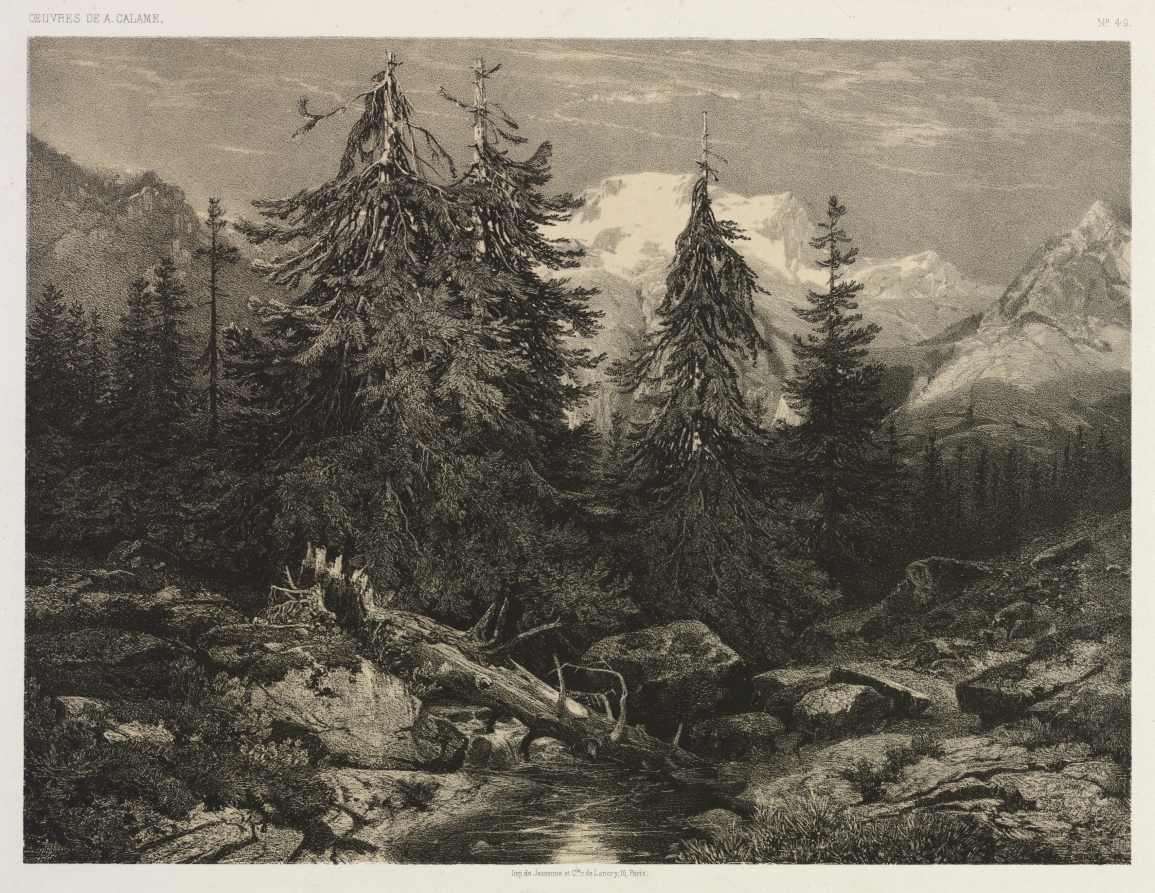
Alpine Stream, mid-1800s, by Alexandre Calame
Alexandre Calame · The Cleveland Museum of Art · Gift of The Print Club of Cleveland
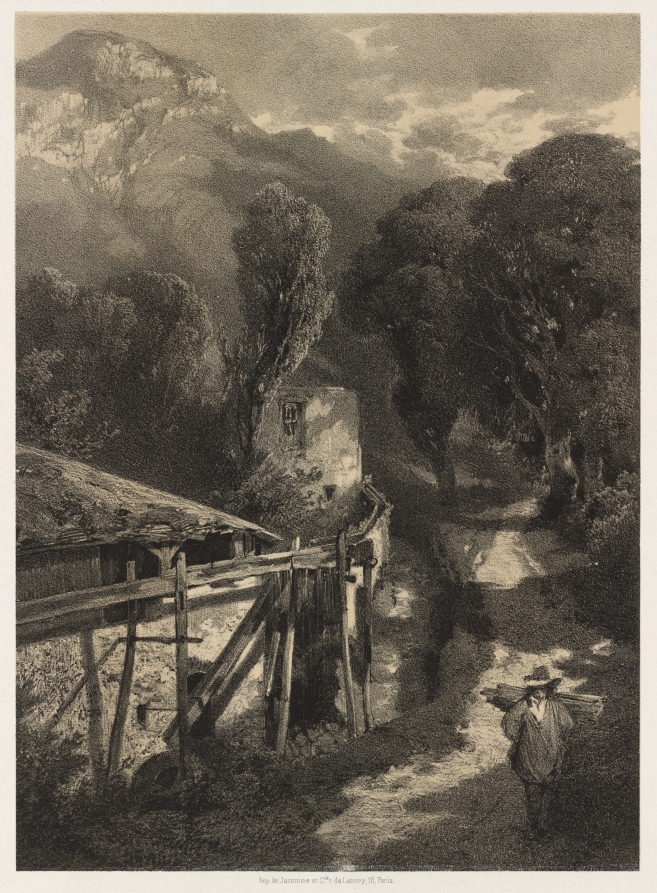
The Simplon Road, Meillerie, France, mid-1800s, by Alexandre Calame
Alexandre Calame · The Cleveland Museum of Art · Mr. and Mrs. Lewis B. Williams Collection
Life and career
Dated record
Life and career
The full dated record · 2 entries
1810
Alexandre Calame was born in 1810.
1864
Alexandre Calame died at Menton.
Notes from the source article
Cited by Wikipedia
Notes from the source article
These works are cited by the source article, in its own numbering. They are recorded as its citations, not as sources VALÉORINE has verified.
References
Citations
References
Each reference names the institution holding it, so a reader may go to the document itself.
reference work
Wikidata, structured authority record Q621994: Alexandre CalameWikimedia Foundation
Partially resolvedreference work
Partially resolved
The Encyclopedia exists whether or not anything is for sale. Corrections are recorded rather than overwritten, and every version of this record is kept. Published 14 August 2026.
Elsewhere in Prints
4,138 published records in this field, each with its sources named.
- Alexander Ver HuellEngraver
- Alexander Voet the YoungerEngraver
- Alexandre AlexeieffEngraver
- Alexandre BarrièreEngraver
- Alexandre GirardetEngraver
- Alexandre-Gabriel DecampsEngraver
- Alexandru BassarabEngraver
- Alexej von JawlenskyEngraver
Best supported in this field
For owners
Own a work by Alexandre Calame?
A specialist will read what you send and tell you what the house can establish, what it cannot, and whether the object is suited to sale. There is no charge and no obligation. The object stays with you throughout; nothing is shipped to us unless it is arranged in writing beforehand.