
Alexandre Bigot
Alexandre Bigot (5 November 1862 – 27 April 1927) was a French ceramicist. He was primarily a ceramics manufacturer, producing the designs of many artists and architects of the French-Belgian Art Nouveau movement, including: Jules Lavirotte, Hector Guimard, Louis Majorelle, Henri Sauvage, Henry van de Velde, Auguste Perret, Andre Arfvidson, Anatole de Baudot and more. Bigot was a physics and chemistry instructor who became interested in ceramics in 1889 after viewing Chinese porcelain at the Exposition Universelle in Paris.
Alexandre Bigot
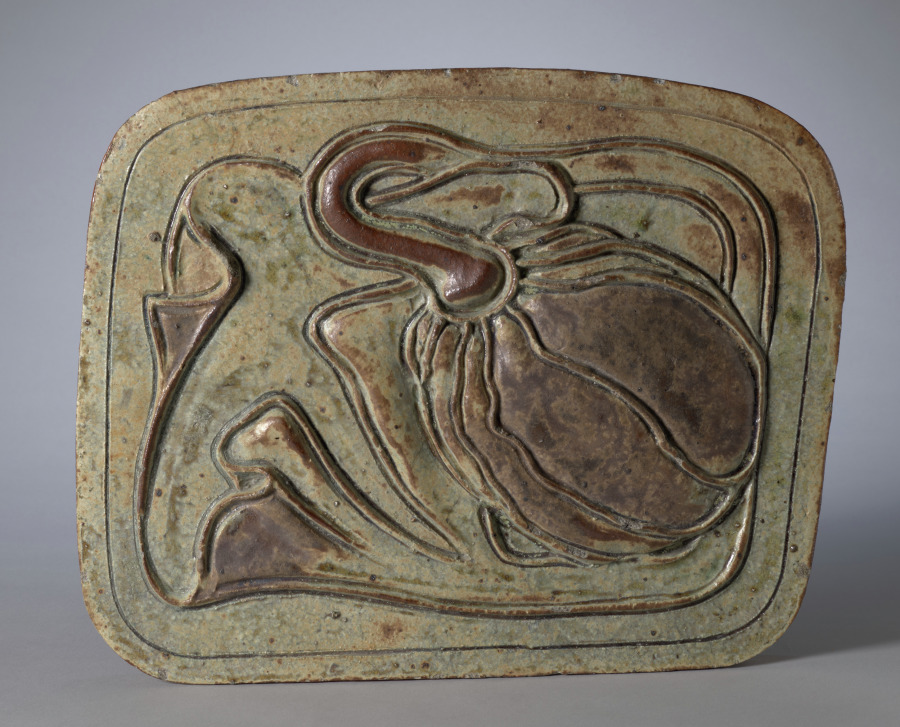
Alexandre Bigot · The Cleveland Museum of Art · Gift of George Vassos and Effie Oulas in memory of Stelios and Sofia Vassos · CC0
- Name
- Alexandre Bigot
- Born
- 5 November 1862
- Birthplace
- Mer, Loir-et-Cher, France
- Died
- 27 April 1927
- Place of death
- Paris, France
- Known for
- Ceramics
- Training
- Université Caen-Normandie
- Movement
- Art Nouveau
- Nationality
- France
- Occupation
- ceramicist · chemist
- Education
- University of Caen Normandy
- Languages
- French
VALÉORINE Encyclopedia
VALÉORINE documentary reading
Documentary summary
Alexandre Bigot (5 November 1862 – 27 April 1927) was a French ceramicist. He was primarily a ceramics manufacturer, producing the designs of many artists and architects of the French-Belgian Art Nouveau movement, including: Jules Lavirotte, Hector Guimard, Louis Majorelle, Henri Sauvage, Henry van de Velde, Auguste Perret, Andre Arfvidson, Anatole de Baudot and more. Bigot was a physics and chemistry instructor who became interested in ceramics in 1889 after viewing Chinese porcelain at the Exposition Universelle in Paris.
Admitted source layer · organised and presented by VALÉORINE
Reference Check
Propose documentary evidence for Alexandre Bigot. A contribution is never written directly as fact: identity, source, rights and evidence gates still decide.
Sign in to contribute
World of VALÉORINE
Documentary connections
Only confirmed graph relationships appear here. Images are shown only when their identity and reuse rights both pass the documentary gate.
Documentary evidence
Documentary basis
Authority files
wikidata · Q2833468 · wikipedia · Alexandre Bigot
In this article
Biography
Biography
Bigot's firm was based at Rue des Petites Ecuries, Paris and he also created a ceramics factory in Mer in 1889 which employed as many as 150 people. Siegfried Bing, a German art dealer in Paris, displayed works by Bigot, among others, and was responsible for introducing the Art Nouveau style. Bigot’s Parisian firm closed in 1914 due to a decline in the popularity of Art Nouveau.
Alexandre Bigot studied at University of Caen Normandy. The recorded working language is French. Work by Alexandre Bigot is recorded in the collections of Design Museum Gent, Museum of Sologne, Adrien Dubouché National Museum (Limoges), Musée des Beaux-Arts de la ville de Paris and Musée d'Orsay.
Key facts
Key facts
• Name — Alexandre Bigot • Born — 5 November 1862 • Birthplace — Mer, Loir-et-Cher, France • Died — 27 April 1927 • Place of death — Paris, France • Known for — Ceramics • Training — Université Caen-Normandie • Movement — Art Nouveau
Early life and discovery of ceramics
Early life and discovery of ceramics
• Illustration — Fireplace designed by Hector Guimard and manufactured by Alexandre Bigot, in the collection of the Philadelphia Museum of Art (United States), ca. 1895 Alexandre Bigot was trained in the sciences before eventually excelling in the arts. He obtained a degree in physics in 1884. He also held a doctorate in chemistry and was interested very early on in creating enamels resembling natural gems. After a brief stint in the studio of Paul Beyer (1873–1945) in Switzerland, and recognizing the limits imposed on setting up a laboratory in Paris, in 1889, Bigot set up his first kiln in Aunay, his hometown (today called Aulnay, now a district within the city limits of Mer). The same year, he became one of many artists of his generation who were attracted to the eastern ceramic wares that they saw at the Exposition Universelle of 1889 in Paris. Among Bigot's contemporaries who found inspiration in Asian ceramics was Jean-Joseph Carriès, who, like Bigot, had his own studio and was engaged in research on ceramics, knowledge that he began to refine upon meeting Bigot. The two artists began a correspondence on the subject, and Bigot became extremely interested in Carriès' work. Bigot's knowledge of chemistry allowed him to become an adviser to Ernest Chaplet for his sculpture and Carriès as well as a collaborator with the chemist Henry Le Chatelier. On the practical side (turning and modeling), he benefitted from the advice of Raphaël Tessier (1860–1937).
Career in ceramics
Career in ceramics
• Illustration — Bigot's ceramics factory in Mer, France, southwest of Paris, ca. 1910 • Illustration — Breezeway of the Castel Beranger in Paris, with wall plates by Bigot (1898) In 1894, Bigot presented his pieces for the first time at the Salon of the Société nationale des Beaux-Arts. The ceramics used a simple form ornamented with matte enamel using shades of yellow, green, and brown, often with the effect of crystallization. In 1895, he participated in the inaugural exposition of Siegfried Bing's La Maison de l'Art Nouveau, which gave its name to the style. The year 1897 marked a turning point. Architectural ceramics were reaching the pinnacle of their popularity and Bigot took the opportunity to found his own company, A. Bigot et Cie. This enterprise, which employed up to 150 workers and counted 10 industrial kilns, produced numerous trinkets, vases and vessels which were on display in his shop, which he transferred in Paris from the rue d'Assas to the rue des Petites-Écuries. Along with Emile Muller, Bigot thus became the principal figure in architectural ceramics in France, and from 1898 he worked to integrate ceramics with façades of reinforced concrete. This architectural outlet explains, by implication, the membership of his company in the Union Syndicale des architectes, but also the relaxation of the urban regulations of 1882 which favored the appearance of projecting elements, such as oriel bays, that broke up the uniformity of façades. The collaboration with Hector Guimard at the end of the decade marked the beginning of Bigot's fame with architectural ceramics. Before then his work had been confined essentially to baths and restaurants. But in 1898, Guimard's Castel Beranger emerged as the manifesto of Art Nouveau in architecture and its ceramics were commissioned from Bigot, who decorated the façade with picturesque details and covered the entrance breezeway with highly plastic molded panels designed to evoke the atmosphere of a grotto. The material became thus emblematic of the new style before Art Nouveau's decline about 1910. Bigot's work was rewarded with a Grand Prix at the Exposition Universelle of 1900 in Paris for which he collaborated with Paul Jouve and René Binet on the main entrance gate on the Champs-Elysées. The ensemble of wings enclosing the grand arch of the gate, designed by Binet, was ornamented with two superimposed friezes, executed in multicolored ceramic. The one above represented the triumph of work by the sculptor Emile Muller based on a model by Anatole Guillot; the one below was composed of a suite of animals in an Assyrian style, by Jouve and Bigot.
Collaboration with Jules Lavirotte
Collaboration with Jules Lavirotte
• Illustration — 29, avenue Rapp, the most famous collaboration between Bigot and Jules Lavirotte (1901) Beginning in 1900, the commissions multiplied for Bigot when he found an architect with whom he could showcase his talent: Jules Lavirotte. The latter was an Art Nouveau designer who espoused an eclecticisme with a pronounced taste for daring ornament and was, at the time, just as famous as Guimard. Bigot worked first on the building at 12, rue Sédillot for which his participation was still limited (a few ceramic balusters). He next worked on 3, square Rapp, the edifice on which Lavirotte turned him loose with an eclecticism that was much less restrained than the previous one. It was there that he realized these stunning lintels with suspended heads and the decoration of the staircase with the figure of an infant naiad. • Illustration — Balcony at 3, square Rapp, manufactured by Bigot (1900–01) The apartment house at 29 avenue Rapp, built in 1901, was truly the construction which best married the talents of Bigot and Lavirotte. In the age of the development of concrete, they searched for a substitute, comparable material for the ashlar revetment normally employed because the latter was heavy and burdensome. The crown of modernity in England and the United States was to use ceramic as a revetment, but the idea came to France later on. The first to experiment with this in France was François Hennebique (the inventor of the Hennebique system of reinforced concrete), for his own company's headquarters in 1898. In fact, when 29 avenue Rapp was built, the use of ceramic as revetment was still a novelty. This construction was the fruit of the collaboration between Lavirotte, Bigot, and Cottancin, the inventor of the process of construction in reinforced concrete using a very fine skeletal framework. The building was experimental and probably financed by the three men themselves who saw it as a showcase of their respective talents. The objective of Bigot in the building was to show that the ceramic could replace masonry, and he had recourse in this to a framework entirely of reinforced concrete. The trick lay in the weighted hollow pieces of concrete and the reinforcing iron rods in order to guarantee the solidity of the ensemble. then the edifice was covered in plates of ceramic which imitated the traditional manufacture in carved stone. Wishing to show off the talents of the artisan, Bigot produced the head of the woman surmounting the main entrance without creating a mold, firing the original work of Jean-Baptiste Larrivé directly in the kiln. This building served as a manifesto of technique and it was imitated in the coming years, definitively assuring Bigot's reputation. The same trio (Bigot, Lavirotte and Cottancin) reunited in 1903 for the apartment house at 34, avenue de Wagram, also known as the Ceramic Hôtel and also integrally revetted with ceramic. The sculptures were completed by Camille Alaphilippe. It received the grand prize for the Concours des Façade of Paris in 1905. The jury of the contest, however, declared: The principal interest in this house is the use of brick and the enameled faïence which covers the construction from its sub-basement to the summit. The architect displays to the passers-by an ensemble of which the color is harmonious but the framework is less agreeable, seemingly made in order to defy the most free aesthetic. The jury, in declaring the author of the façade as the winner, is stuck on the question of greater freedom. One should not altogether view its decision as an encouragement of the beastly forms of the architecture...the decor in majolica can give material form to the happy effects without which there would be need to resort to the dispositions little in agreement with the genius of our French art, the most beautiful productions of which are characterized by simplicity and logical sanity. In 1914, Bigot ceded direction of the company Bigot et Cie to Camille Alaphilippe in order to become a technical advisor to the ceramics industry. In the interwar period, the thirty-some employees at the plant produced mostly conduits for the canal and drainage industry.
Castel Béranger, 1894–95
Castel Béranger, 1894–95
Architect: Hector Guimard
Paris Exhibition of 1900
Paris Exhibition of 1900
Bigot fabricated René Binet’s designs for the main gateway to the Paris Exhibition of 1900. Bigot's work was acquired in its entirety by Jenő Radisics, the director of the Budapest Museum of Applied Arts and remained in store until 2013, when much of it was displayed at the Museum.
Avenue Rapp No. 29, 1901
Avenue Rapp No. 29, 1901
The Lavirotte Building, designed by Jules Lavirotte, Avenue Rapp no. 29, Paris was the residence of Alexandre Bigot. In 1901, Jules Lavirotte’s design for this won a municipal competition as the year’s best. Its extraordinary portal is the ultimate in Art Nouveau exuberance. The carved elements feature a central bust of a woman with flowing hair, balanced by carved naked figures rising above the sides.
Rue d'Abbeville No. 14, 1901
Rue d'Abbeville No. 14, 1901
Architects: Alexandre & Edouard Autant Source
Avenue De Wagram No. 34 (Ceramic Hotel), 1904
Avenue De Wagram No. 34 (Ceramic Hotel), 1904
This reinforced concrete building, built by Jules Lavirotte, was nicknamed "Ceramic Hotel" for its glazed earthenware façade, created by Alexandre Bigot and sculpted by [Camille Alaphilippe]. Exemplifying the sensual Art Nouveau style of turn-of-the-century Paris, this residence won the city prize for the best façade of 1905.
Saint Jean de Montmartre
Saint Jean de Montmartre
Architect: Anatole de Baudot
Rue Franklin No. 25, 1904
Rue Franklin No. 25, 1904
Architect: Auguste Perret Info
Rue Campagne-Premiere No. 31, 1911
Rue Campagne-Premiere No. 31, 1911
Architect: Andre Arfidson Ceramic detailing gives this industrial façade charm and helped the architect win an award for its frontage in 1911 from the Town of Paris. The sandstone tiling by ceramist Alexandre Bigot covers this reinforced concrete duplex of twenty workshops with residences. The three-dimensional floral elements add geometric patterning to the piers and around the window borders.
Smaller works
Smaller works
• Illustration — Ceramic tiles by Alexandre Bigot, rue Mademoiselle, Paris • Illustration — Detail from rue Mademoiselle • Illustration — Detail from rue Mademoiselle
United States patents
United States patents
Patent No. 838,496. Application Filed: February 17, 1903. Patented: December 11, 1906. Link • A process for the manufacturing of glazed or enameled ceramic ware. Patent No. 1,497,084. Application Filed: October 6, 1920. Patented: June 10, 1924. Link • A drying kiln for the production of ceramic ware.
Identity
Identity
Alexandre Bigot is established in Library of Congress under no2016099062. Recorded as ceramicist and chemist. Recognition and collections.
Life and career
Dated record
Life and career
Explore 1862–1927
The full dated record · 7 entries
1862
Alexandre Bigot born at Mer.
1900
Immeuble Hennebique is dated 1900.
1900
Lavirotte Building is dated 1900.
1903
25 bis rue Benjamin-Franklin is dated 1903.
1904
Céramic Hôtel is dated 1904.
1927
Dies at 15th arrondissement of Paris.
1927
Alexandre Bigot died at 15th arrondissement of Paris.
Places
Named by the record
Places
Only places the record itself states, plotted where the house gazetteer settles their coordinates. Nothing is inferred from a name or a nationality.
Mer.
Birth place
15th arrondissement of Paris.
Death place
Bigot and sculpture
• Illustration — Alexandre Bigot, Vase, 1895, stoneware, acquired by Siegfried Bing in 1896, Hamburg Museum of Arts and Crafts At the end of the nineteenth century, sculpture was dominated by an overarching interest in polychromy. Ceramic thus came to play a considerable role in the field, replacing faïence, as notably seen in the Salons of 1896, 1897, and 1899, which featured numerous works made of the material. Artists were enthusiastic about this turn, most notably Alexandre Falguière, who boasted about his work La Sortie de l'École ("Leaving the School"): It's prodigious, you see, not a crack or a small deformation. That's my own work, as it left my hands, with the cuts made by my thumb and fewer by the cutting tool! And how beautiful is the bronze, more sincere, less sad and of a sweetness. The principal actors in this new development are the studios of Emile Muller and Alexandre Bigot and the greatest names in sculpture preach the technique: Falguière, Mercié, Coutan, Fagel, Marqueste, Boucher, Ringel, Injalbert, Roche, Bourdelle, Rodin... We know little about the links between Rodin and Bigot. Rodin was very interested in ceramic and Japanese art, which he had pioneered in displays at Bing's shop and had worked on with the ceramicists such as Ernest Chapelet, Edomond Lachenal, Paul Jeaneney and Jean Carriès. Carriès was a mutual friend of Bigot and Rodin. A single letter signed by Bigot is conserved at the Musée Rodin and it consists simply of a note of congratulations on Bigot's part. It seems nonetheless that Rodin was well known by the Bigot family as eight cards were exchanged between them. While Rodin left no traces of his work with Bigot, however, the same could not be said of his student Antoine Bourdelle. the latter was extremely interested in the new developments in ceramic at the beginning of the century and created casts of his works in porcelain and in ceramic. For the ceramics, Bourdelle called on Bigot and cast his extant works with a series of works entitled Le Baiser (The Kiss), Aphrodite, and Sleeping Infant. Camille Alaphilippe, inspired by the possibilities of ceramics during his stay at the Villa Médicis in Rome in 1901, produced La Femme au Singe (Woman with Monkey) in 1908. It is composed of a daring assemblage of elements of gilded bronze (head and hands) and of plates of enameled ceramics, mounted on a wood and iron structure held together by a clay mortar, with the joints fabricated from colored plaster. It is likely that the work was executed in Bigot's studio as the signature is not evident, and moreover, Alaphilippe had already collaborated with Bigot on the Ceramic Hôtel in 1903 and he would assume control of A. Bigot & Cie in 1914.
Primary material
Documents and archives
scholarly publication
- Alexandre Bigot (1863-1953), Bulletin de la Société Géologique de France, 1954
Scholarly · Crossref registry · 1954
authority record
- Wikidata, structured authority record Q2833468: Alexandre Bigot
General reference · Wikidata
reference work
- “Alexandre Bigot”, English Wikipedia, consulted as further reading
Reputable secondary · Wikipedia
Notes from the source article
Cited by Wikipedia
Notes from the source article
These works are cited by the source article, in its own numbering. They are recorded as its citations, not as sources VALÉORINE has verified.
- 1.Turner 1996, pp. 47–48
- 2.Alexandre Bigot céramiste.
- 3.La biographie d'Alexandre Bigot par Hélène Bedague - Club des collectionneurs de céramique.
- 4.B, thierry. Alexandre Bigot - Céramique Art nouveau. le blog de thierry B.
- 5.Sur les pas d'Alexandre Bigot, céramiste des rues de Paris. Dossier de l'Art. 259. La sculpture polychrome. 76–79. May 2018.
- 6.Librairie générale française. Encyclopédie de l'art. 186–187. 1991. 2-253-05303-1.
- 7.Arlette Barré-Despond. Dictionnaire international des arts appliqués et du design. Éditions du Regard. 1996. 2-84105-024-6.
- 8.Madsen 1967, p. 116
- 9.Borrus 2003, p. 254-255
- 10.Borrus 2003, pp. 294–95
- 11.Borrus 2003, p. 433
References
Citations
References
Each reference names the institution holding it, so a reader may go to the document itself.
scholarly publication
Institutional witnessauthority record
Secondary witnessreference work
Secondary witness
The Encyclopedia exists whether or not anything is for sale. Corrections are recorded rather than overwritten, and every version of this record is kept. Published 16 August 2026.
Elsewhere in Ceramics
1,104 published records in this field, each with its sources named.
- Alberto ChianconeArtist
- Alberto IsselArtist
- Alena KupčíkováArtist
- Aleš LamrArtist
- Alfred AguilarArtist
- Alfred BeauArtist
- Alfred Le ChatelierArtist
- Alfred William FinchArtist
Best supported in this field
For owners
Own a work by Alexandre Bigot?
A specialist will read what you send and tell you what the house can establish, what it cannot, and whether the object is suited to sale. There is no charge and no obligation. The object stays with you throughout; nothing is shipped to us unless it is arranged in writing beforehand.