
Albert Pinkham Ryder
Albert Pinkham Ryder (March 19, 1847 – March 28, 1917) was an American painter best known for his poetic and moody allegorical works and seascapes, as well as his eccentric personality. While his art shared an emphasis on subtle variations of color with tonalist works of the time, it was unique for accentuating form in a way that some art historians regard as a precursor to modernism.
Also recorded as Albert P. Ryder · ryder a.p. · Ryder · Albert Ryder
Albert Pinkham Ryder
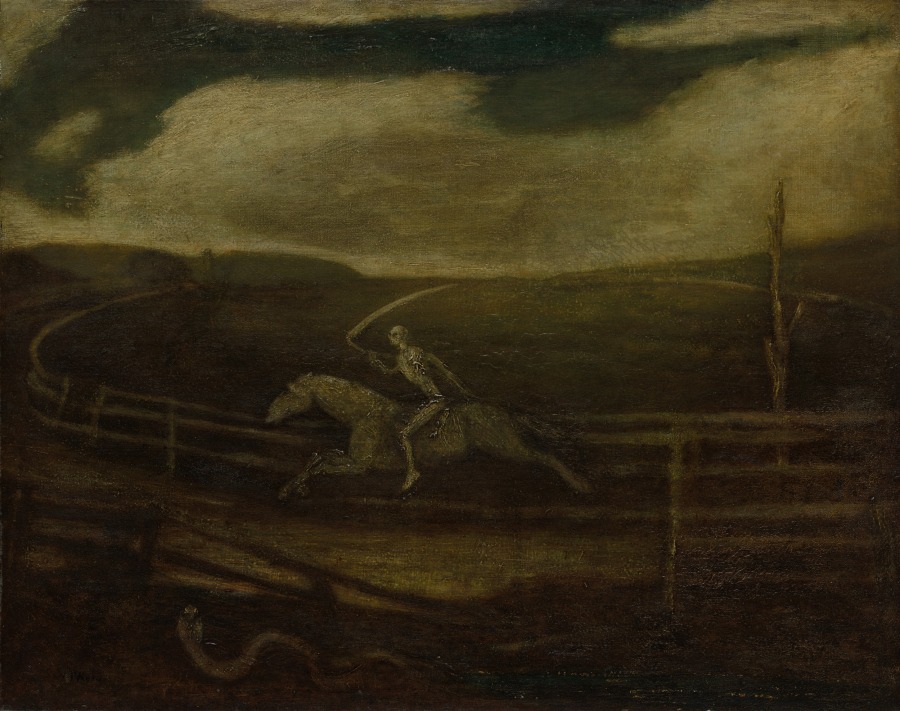
Albert Pinkham Ryder · The Cleveland Museum of Art · Purchase from the J. H. Wade Fund · CC0
- Born
- 1847. · New Bedford.
- Died
- 1917. · New York City.
- Nationality
- United States.
- Occupation
- painter.
- Fields
- painting.
- Movements
- Romanticism and Symbolism.
- Education
- National Academy of Design.
- Known for
- The Canal.
- Languages
- English.
VALÉORINE Encyclopedia
VALÉORINE documentary reading
Documentary summary
Albert Pinkham Ryder (March 19, 1847 – March 28, 1917) was an American painter best known for his poetic and moody allegorical works and seascapes, as well as his eccentric personality. While his art shared an emphasis on subtle variations of color with tonalist works of the time, it was unique for accentuating form in a way that some art historians regard as a precursor to modernism.
Admitted source layer · organised and presented by VALÉORINE
Note VALÉORINE
Albert Pinkham Ryder (1847–1917) was a painter, of American nationality. The painter was born in New Bedford and died in New York City.
Albert Pinkham Ryder was educated at National Academy of Design. The painter was a member of American Academy of Arts and Letters and worked in Kingdom of the Netherlands and London. Albert Pinkham Ryder lived in New Bedford and New York City. Activity centred on painting. Albert Pinkham Ryder was associated with Romanticism and Symbolism.
Among the works is The Canal. The work spans genre and landscape. Languages used include English. Works are held at Arizona State University Art Museum, Art Institute of Chicago and Fine Arts Museums of San Francisco, among others.
Composed from admitted, traceable facts · 27 September 2026
VALÉORINE
Reference Check
Propose documentary evidence for Albert Pinkham Ryder. A contribution is never written directly as fact: identity, source, rights and evidence gates still decide.
Sign in to contribute
Documentary evidence
Evidence Panel
not yet certified
- Identity
- resolved
- Independent source families
- 0
- Admitted assertions
- 0
- Open conflicts
- 0
Authority files
gnd · 5029481-7 · wikidata · Q948598 · wikipedia · Albert Pinkham Ryder
In this article
Early life
Early life
Albert Pinkham Ryder studied at National Academy of Design. The recorded working language is English. The field of work recorded is painting. Subjects and genres recorded for the work are landscape and genre. Places of work recorded in the authority are New York City, Kingdom of the Netherlands and London. Residence is recorded at New Bedford and New York City. Works named in the authority record are The Canal. Work by Albert Pinkham Ryder is recorded in the collections of Minneapolis Institute of Art, Art Institute of Chicago, Metropolitan Museum of Art, Arizona State University Art Museum and Fine Arts Museums of San Francisco.
Ryder was born in New Bedford, Massachusetts. New Bedford, a bustling whaling port during the 19th century, had an intimate connection with the sea that probably supplied artistic inspiration for Ryder later in life. He was the youngest of four sons; little else is known of his childhood. He began to paint landscapes while in New Bedford. The Ryder family moved to New York City in 1867 or 1868 to join Ryder's elder brother, who had opened a successful restaurant. His brother also managed the Hotel Albert, which became a Greenwich Village landmark. Ryder took his meals at this hostelry for many years, but it was named for the original owner, Albert Rosenbaum, not the painter. Ryder applied to the National Academy of Design but his application got rejected.
Training and early career
Training and early career
The early view of Ryder was that he was a recluse, holding that he developed his style in isolation and without influence from contemporary American or European art, but this view has been contradicted by later scholarship that has revealed his many associations and exposures to other artists. Ryder's first training in art was with the painter William Edgar Marshall in New York. From 1870 to 1873, and again from 1874 to 1875, Ryder studied art at the National Academy of Design. He exhibited his first painting there in 1873 and met artist J. Alden Weir, who became his lifelong friend. In 1877, Ryder made the first of four trips to Europe throughout his life, where his studying of the paintings of the French Barbizon school and the Dutch Hague School would have a significant impact on his work. Also in 1877, he became a founding member of the Society of American Artists. The Society was a loosely organized group whose work did not conform to the academic standards of the day, and its members included Augustus Saint-Gaudens, Robert Swain Gifford (also from New Bedford), Ryder's friend Julian Alden Weir, John LaFarge, and Alexander Helwig Wyant. Ryder exhibited with this group from 1878 to 1887. His early paintings of the 1870s were often tonalist landscapes, sometimes including cattle, trees and small buildings.
Artistic maturity
Artistic maturity
The 1880s and 1890s are thought of as Ryder's most creative and artistically mature period. During the 1880s, Ryder exhibited frequently and his work was well received by critics. His art became more poetic and imaginative, and Ryder wrote poetry to accompany many of his works. His paintings sometimes depicted scenes from literature, opera, and religion. Ryder's signature style is characterized by broad, sometimes ill-defined shapes or stylized figures situated in a dream-like land or seascape. His scenes are often illuminated by dim sunlight or glowing moonlight cast through eerie clouds. The shift in Ryder's art from pastoral landscapes to more mystical, enigmatic subjects is believed to have been influenced by Robert Loftin Newman, with whom Ryder shared a studio.
Later years
Later years
After 1900, around the time of his father's death, Ryder's creativity fell dramatically. For the rest of his life he spent his artistic energy on occasionally re-working existing paintings, some of which lay scattered about his New York apartment. Visitors to Ryder's home were struck by his slovenly habits—he never cleaned, and his floor was covered with trash, plates with old food, and a thick layer of dust, and he would have to clear space for visitors to stand or sit. He was shy and did not seek the company of others, but received company courteously and enjoyed telling stories or talking about his art. He gained a reputation as a loner, but he maintained social contacts, enjoyed writing letters, and continued to travel on occasion to visit friends. While Ryder's creativity fell after the turn of the century, his fame grew. Important collectors of American art sought Ryder paintings for their holdings and often lent choice examples for national art exhibitions, as Ryder himself had lost interest in actively exhibiting his work. In 1913, ten of his paintings were shown together in the historic Armory Show, an honor reflecting the admiration felt towards Ryder by modernist artists of the time who saw his work as a harbinger of American modernist art. By 1915 Ryder's health deteriorated, and he died on March 28, 1917, at the home of a friend who was caring for him. He was buried at the Rural Cemetery in his birthplace of New Bedford, Massachusetts. A memorial exhibition of his work was held in the Metropolitan Museum of Art in New York in 1918.
Forgeries
Forgeries
In their book, Albert Pinkham Ryder: Painter of Dreams, William Innes Homer and Lloyd Goodrich wrote, "There are more fake Ryders than there are forgeries of any other American artist except his contemporary Ralph Blakelock." The authors, experts on Ryder, estimate the number of forged works at over one thousand. They also claimed (as of 1989) that some remained in private and museum collections, in addition to being offered through art dealers and auction houses. Part of the reason why so many fake Ryders exist is that his style is easily copied. Forgers can go to great lengths to fabricate the age of a painting, including painting it on antique canvas and baking it to add cracks. Forgeries can be discovered through visual and chemical examination, and through a provable provenance—a collection of written documentation detailing a painting's ownership history. For instance, Ryder's piece, Elegy, while on loan to the Whitney Museum, was examined by Lloyd Goodrich, then a curator at the Whitney. A layer of consistent brushstrokes was revealed through an x-ray examination, which was uncharacteristic of Ryder's often generously layered pieces. It was concluded that Elegy was likely painted to be an imitation of The Lone Horseman, a genuine Ryder piece.
In popular culture
In popular culture
The Angel of Darkness by Caleb Carr. Ryder and his work are written about at length in Teju Cole’s novel Open City.
Life and career
Dated record
Life and career
The full dated record · 2 entries
1847
Albert Pinkham Ryder born at New Bedford.
1917
Albert Pinkham Ryder died at New York City.
Places
Named by the record
Places
Only places the record itself states, plotted where the house gazetteer settles their coordinates. Nothing is inferred from a name or a nationality.
New Bedford and New York City.
Residences
New Bedford.
Birth place
New York City.
Death place
Work and legacy
Ryder completed fewer than two hundred paintings, nearly all of which were created before 1900. He rarely signed and never dated his paintings. While the works of many of Ryder's contemporaries were partly or mostly forgotten through much of the 20th century, Ryder's artistic reputation has remained largely intact owing to his unique and forward-looking style. Artists whose work was influenced by Ryder include Marsden Hartley, who befriended him, and Jackson Pollock. Ryder used his materials liberally and with little regard for sound technical procedures. His paintings, which he often worked on for ten years or more, were built up of layers of paint, resin, and varnish applied on top of each other. He would use a wet-on-wet technique, and would often paint into wet varnish, or apply a layer of fast-drying paint over a layer of slow-drying paint. He incorporated unconventional materials, such as candle wax, bitumen, and non-drying oils, into his paintings. By these means, Ryder achieved a luminosity that his contemporaries admired—his works seemed to "glow with an inner radiance, like some minerals"—but the result was short-lived. Paintings by Ryder remain unstable and become much darker over time; they develop wide fissures, do not fully dry even after decades, and sometimes completely disintegrate. Many of Ryder's paintings deteriorated significantly even during his lifetime, and he tried to restore them in his later years. Some of his pieces were reworked so many times that they are still soft even a century later. Because of his own restorations, and because some Ryder paintings were completed or reworked by others after his death, many Ryder paintings appear very different today than they did when first created.
Primary material
Documents and archives
scholarly publication
- Ryder, Albert Pinkham (1847–1917), Historical Dictionary of Romantic Art and Architecture, 2019
Scholarly · Crossref registry · 2019
- Ryder, Albert Pinkham (19 March 1847–28 March 1917), artist, American National Biography Online, 2000
Scholarly · Crossref registry · 2000
reference work
- Wikidata, structured authority record Q948598: Albert Pinkham Ryder
Reputable secondary · Wikimedia Foundation
- “Albert Pinkham Ryder”, English Wikipedia, consulted as further reading
Reputable secondary · Wikipedia
authority file
- Gemeinsame Normdatei 5029481-7, Exhibition Albert Pinkham Ryder (1990-1991 : Washington, DC; New York, NY).
Unverified · Deutsche Nationalbibliothek
Notes from the source article
Cited by Wikipedia
Notes from the source article
These works are cited by the source article, in its own numbering. They are recorded as its citations, not as sources VALÉORINE has verified.
- 1.Columbus Museum of Art. The American Collections. 20. 1988. 0-8109-1811-0.
- 2.The Hotel Albert. Albert Pinkham Ryder. 1911-03-11.
- 3.Albert Pinkham Ryder.
- 4.The Metropolitan Museum of Art. Loan exhibition of the works of Albert P. Ryder, New York, March 11 to April 14, MCMXVIII. 1918.
- 5.Albert Pinkham Ryder , on Metropolitan Museum of Art Collection Database (June 28, 2017)
- 6.Craven, Thomas. An American Master. The American Mercury. 490–497. December 1927.
- 7.Ludington, Townsend (1992). Marsden Hartley: The Biography of an American Artist. Cornell University Press. pp. 62, 63. .
- 8.Naifeh, Steven. Jackson Pollock: An American Saga. Clarkson N. Potter, Inc. 250–251, 254. 1989. 0-517-56084-4.
- 9.Smithsonian. In the Stable. Smithsonian American Art Museum.
- 10.Mayer, Lance, and Gay Myers (2013). American Painters on Technique: 1860–1945. Los Angeles, CA: J. Paul Getty Museum. p. 91. .
- 11.Kelly, Franklin, Jr., Nicolai Cikovsky, Deborah Chotner, John Davis, Robert Wilson Torchia, and Ellen G. Miles. (1996). American Paintings of the Nineteenth Century, Part 2. Washington: National Gallery of Art. p. 96. .
- 12.Smithsonian. Jonah. Smithsonian American Art Museum.
- 13.Things Aren't What They Seem: Forgeries and Deceptions from the UD Collections. University of Delaware.
Bibliography printed in the source article · 1
References
Citations
References
Each reference names the institution holding it, so a reader may go to the document itself.
scholarly publication
Ryder, Albert Pinkham (1847–1917), Historical Dictionary of Romantic Art and Architecture, 2019Crossref registry
Verifiedscholarly publication
Ryder, Albert Pinkham (19 March 1847–28 March 1917), artist, American National Biography Online, 2000Crossref registry
Verifiedauthority file
Gemeinsame Normdatei 5029481-7, Exhibition Albert Pinkham Ryder (1990-1991 : Washington, DC; New York, NY).Deutsche Nationalbibliothek
Partially resolvedreference work
Wikidata, structured authority record Q948598: Albert Pinkham RyderWikimedia Foundation
Partially resolvedreference work
Partially resolved
The Encyclopedia exists whether or not anything is for sale. Corrections are recorded rather than overwritten, and every version of this record is kept. Published 14 August 2026.
Elsewhere in Paintings
18,705 published records in this field, each with its sources named.
- Albert MuisArtist
- Albert NamatjiraArtist
- Albert NeuhuysArtist
- Albert Nikolayevitch BenoisArtist
- Albert Porta i MuñozArtist
- Albert R. ThayerArtist
- Albert Ràfols-CasamadaArtist
- Albert ReussArtist
Best supported in this field
For owners
Own a work by Albert Pinkham Ryder?
A specialist will read what you send and tell you what the house can establish, what it cannot, and whether the object is suited to sale. There is no charge and no obligation. The object stays with you throughout; nothing is shipped to us unless it is arranged in writing beforehand.