
George de Forest Brush
George de Forest Brush (September 28, 1855 – April 24, 1941) was an American painter and Georgist. In collaboration with his friend, the artist Abbott H. Thayer, he made contributions to military camouflage, as did his wife, aviator and artist Mary (called Mittie) Taylor (Whelpley) Brush, and their son, the sculptor Gerome Brush.
Also recorded as George De Forest Brush · George Deforest Brush · George de Forest Brusch · brush g. de f.
George de Forest Brush

This image is available from the United States Library of Congress 's Prints and Photographs division under the digital ID cph.3a45964. This tag does not indicate the copyright status of the attached · Public domain
- Name
- George de Forest Brush
- Born
- 28 September 1855
- Birthplace
- Shelbyville, Tennessee
- Died
- 24 April 1941
- Place of death
- Hanover, New Hampshire
- Occupation
- Artist
- Nationality
- United States
- Fields
- portrait · genre
- Movements
- academic art
- Education
- National Academy of Design · Beaux-Arts de Paris
- Honours
- Hallgarten Prize
- Languages
- English
VALÉORINE Encyclopedia
VALÉORINE documentary reading
Documentary summary
George de Forest Brush (September 28, 1855 – April 24, 1941) was an American painter and Georgist. In collaboration with his friend, the artist Abbott H. Thayer, he made contributions to military camouflage, as did his wife, aviator and artist Mary (called Mittie) Taylor (Whelpley) Brush, and their son, the sculptor Gerome Brush.
Admitted source layer · organised and presented by VALÉORINE
Note VALÉORINE
George de Forest Brush (1855–1941) was an American painter. Born in Tennessee, the painter died in Hanover (NH).
George de Forest Brush studied at Beaux-Arts de Paris and National Academy of Design. The painter was a member of American Academy of Arts and Letters and worked in Montana, New York City and Paris, among others. George de Forest Brush was associated with academic art.
Genres include genre and portrait. Languages used include English. Works by the painter are held at Fine Arts Museums of San Francisco, Metropolitan Museum of Art and National Portrait Gallery, among others. George de Forest Brush received Hallgarten Prize.
Composed from admitted, traceable facts · 26 September 2026
VALÉORINE
Reference Check
Propose documentary evidence for George de Forest Brush. A contribution is never written directly as fact: identity, source, rights and evidence gates still decide.
Sign in to contribute
World of VALÉORINE
Documentary connections
Only confirmed graph relationships appear here. Images are shown only when their identity and reuse rights both pass the documentary gate.

Documentary evidence
Documentary basis
Authority files
wikidata · Q5546688 · wikipedia · George de Forest Brush
In this article
Biography
Biography
George de Forest Brush studied at National Academy of Design and Beaux-Arts de Paris. Helen Damrosch Tee-Van is recorded as having studied under George de Forest Brush. The recorded working language is English. Subjects and genres recorded for the work are portrait and genre. Places of work recorded in the authority are Paris, Montana and New York City. Work by George de Forest Brush is recorded in the collections of The Nelson-Atkins Museum of Art, Fine Arts Museums of San Francisco, Smithsonian American Art Museum, Metropolitan Museum of Art and Philadelphia Museum of Art. Distinctions recorded are Hallgarten Prize.
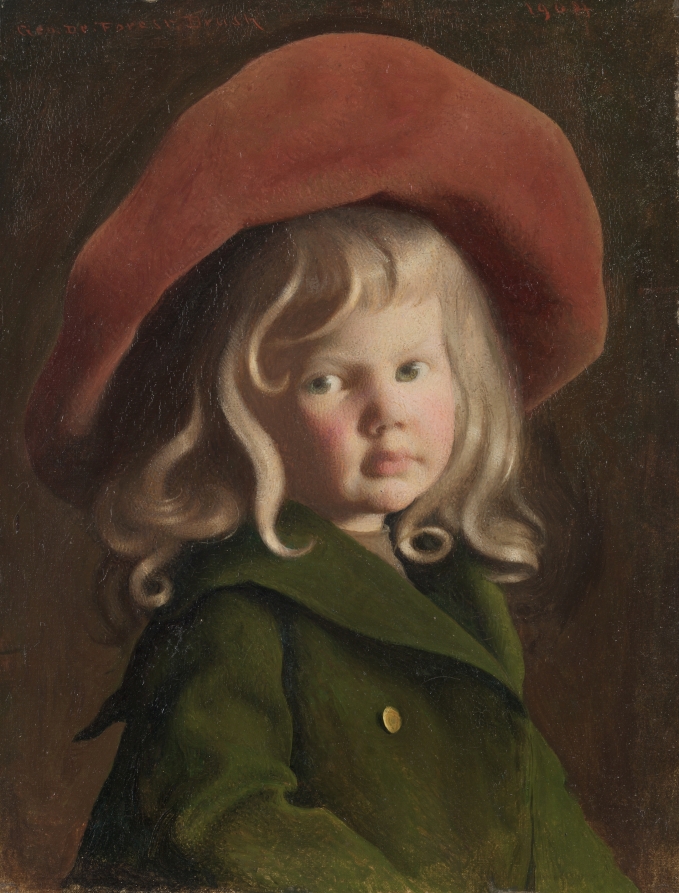
The Little Cavalier, 1904, by George de Forest Brush
George De Forest Brush · The Cleveland Museum of Art · Bequest of Mrs. Henry A. Everett for the Dorothy Burnham Everett Memorial Collection
Key facts
Key facts
• Name — George de Forest Brush • Born — 28 September 1855 • Birthplace — Shelbyville, Tennessee • Died — 24 April 1941 • Place of death — Hanover, New Hampshire • Father — Alfred Clark Brush • Mother — Nancy Douglas • Occupation — Artist • Relatives — Nancy Brush (daughter) activists
Background
Background
Although Brush was born in Shelbyville, Tennessee, his parents, Nancy (Douglas) and Alfred Clark Brush, were New Englanders, and he grew up in Danbury, Connecticut. He attended the National Academy of Design in New York, and also studied in Paris under Jean-Léon Gérôme at the Ecole des Beaux Arts, where Thayer was also a student. Brush was a supporter of women's suffrage, serving as the Honorary Vice-president of the Cornish Equal Suffrage League in New Hampshire.
Native American interests
Native American interests
He returned from Paris in 1880, and soon after accompanied his brother on a business excursion to Wyoming. He remained in that part of the country for some months, and lived among various Native Americans, including Arapahoes, Crows and Shoshones. When he returned East, he developed a series of paintings derived from his drawings of Indian life. In the early 1880s, some of these were published in prominent periodicals, such as Harper's Weekly and Century Magazine, sometimes as illustrations for his own eyewitness accounts. Even years later, he still enjoyed living occasionally in a tepee. It was partly because of such "wildness" that his future in-laws refused to approve of his marriage to their daughter, née Mittie Taylor Whelpley, which took place by elopement in 1886.
Artistic career
Artistic career
• Illustration — Artist: George de Forest Brush, Sitter: Henry George, Date: 1888 Around the same time period, the subjects of Brush's paintings evolved from heroic depictions of Indian life to Renaissance-inspired portraits, some of which were modeled by his wife and his children. Among his many awards were gold medals at the Columbian Exposition (Chicago, 1893), Exposition Internationale (Paris, 1900), Pan-American Exposition (Buffalo, 1901), and Louisiana Purchase Exposition (St. Louis, 1904). He was elected to the Society of American Artists, the National Academy of Design (1908), and the American Academy of Arts and Letters (1910). He encouraged and tutored the young Black American landscapist Richard Lonsdale Brown after the youth went to Brush's studio to show him his portfolio in the Spring of 1911. A moving account of their meeting was published in 1912 in The Crisis and the New York Times.
Camouflage
Camouflage
Brush and his family often spent the summer in Dublin, New Hampshire, where there was a thriving artists colony, and where they eventually settled. Among the other residents was Thayer, who was intensely interested in protective coloration in nature or what later became known as camouflage. According to Brush's daughter, as early as 1898 Brush and Thayer worked together on devising ways to use natural camouflage principles for military purposes. For example, they suggested that countershading (a natural protective device that Thayer had discovered in 1896) could be used as a way of reducing the visibility of a ship. This was later patented (by Thayer and Gerome Brush) as U.S. Patent No. 715013, "Process of Treating the Outside of Ships, etc., For Making Them Less Visible". In 1916, Brush acquired a small Morane-Borel monoplane (also known as a Morane-Saulnier). He experimented with the possibility of making its wings and fuselage transparent, to reduce its visibility. His wife, who was an early woman aviator, also addressed the problem of airplane camouflage, as shown by her various patents.
Later life
Later life
• Illustration — Jane Addams, 1906, by George de Forest Brush Brush died in Hanover, New Hampshire, in 1941. Nearly thirty years later, his eldest daughter, a painter and theatre designer named Nancy Douglas Bowditch, published an account of his life. Brush is also well known as the "grandfather" of American art pottery. Having been inspired by the American Pueblo artisans, and learning their craft, he brought these techniques to Philadelphia, Pennsylvania, and more importantly Long Island and Manhattan, New York, where he started The Brush Guild Pottery Foundation. His students were mostly females, who would later go on to create decorative household works, jars with lids, urns and such. Many depicted animal stylings (bulls, cows, lions). He was also a personal friend of Author Mark Twain, whom he visited many times. He was a world traveler. His oil paintings (specifically of Indians, from the period 1888–1900) were important influences on the young illustrator N. C. Wyeth. Observe the similarities in shapes and symbols in his painting Mourning her Brave and Wyeth's Winter (of 1909). He led a fascinating life and was an important force in the arts at the turn of the 20th century.
Selected works
Selected works
• The Sculptor and the King (1888), Portland Museum of Art, Portland, Oregon. Awarded the 1888 First Hallgarten Prize by the National Academy of Design. • The Moose Chase (1888), Smithsonian American Art Museum, Washington, D.C. • Illustration — The Sculptor and the King (1888) • Illustration — The Moose Chase (1888)
Places
Named by the record
Places
Only places the record itself states, plotted where the house gazetteer settles their coordinates. Nothing is inferred from a name or a nationality.
Tennessee.
Birth place
Hanover (NH).
Death place
Primary material
Documents and archives
reference work
- “George de Forest Brush”, English Wikipedia, consulted as further reading
Reputable secondary · Wikipedia
authority record
- Wikidata, structured authority record Q5546688: George de Forest Brush
General reference · Wikidata
Notes from the source article
Cited by Wikipedia
Notes from the source article
These works are cited by the source article, in its own numbering. They are recorded as its citations, not as sources VALÉORINE has verified.
- 1.Caldwell, John. American paintings in the Metropolitan Museum of Art. The Museum in association with Princeton University Press. 1994. 0691037957.
- 2.Brush, George de Forest. The Artist's Wife, Mrs. George de Forest Brush (Mittie Taylor Whelpley). 1 January 1939.
- 3.Bowditch, Nancy Douglas (1970), George de Forest Brush: Recollections of a Joyous Painter. Peterborough NH: Noone House.
- 4.George de Forest Brush – American Master (1855-1941). www.monadnockart.org.
- 5.White, Nelson C. (1951). Abbott H. Thayer: Painter and Naturalist. Hartford CT: Connecticut Printers.
- 6.Colby, Virginia. Footprints of the Past: Women's Suffrage. The Windsor Chronicle. 12. 1986-12-12.
- 7.Brush, George de Forest (1885), "An Artist Among the Indians" in Century Magazine (May).
- 8.Bowditch 1970, pp. 30-31.
- 9.Negro Youth Amazes Artists by his Talent. The New York Times.
- 10.Behrens, Roy R. (2002), False Colors: Art, Design and Modern Camouflage. Dysart, Iowa: Bobolink Books, pp. 36-57. .
- 11.Behrens, Roy R. (2009), Camoupedia: A Compendium of Research on Art, Architecture and Camouflage. Dysart, Iowa: Bobolink Books, pp. 70-73.
References
Citations
References
Each reference names the institution holding it, so a reader may go to the document itself.
reference work
Secondary witnessauthority record
General reference
The Encyclopedia exists whether or not anything is for sale. Corrections are recorded rather than overwritten, and every version of this record is kept. Published 16 August 2026.
Elsewhere in Paintings
18,792 published records in this field, each with its sources named.
- George Clarkson StanfieldArtist
- George CopeArtist
- George CumberlandArtist
- George Dance the YoungerArtist
- George Demetrescu-MireaArtist
- George DesvallièresArtist
- George Duncan BeecheyArtist
- George E. RussellArtist
Best supported in this field
For owners
Own a work by George de Forest Brush?
A specialist will read what you send and tell you what the house can establish, what it cannot, and whether the object is suited to sale. There is no charge and no obligation. The object stays with you throughout; nothing is shipped to us unless it is arranged in writing beforehand.