
Xia Gui
Xia Gui (fl. 1195–1224), courtesy name Yuyu (禹玉), was a Chinese landscape painter of the Song dynasty. Very little is known about his life, and only a few of his works survive, but he is generally considered one of China's greatest artists.
Also recorded as Yuyu
Xia Gui

Gleb Simonov · CC BY-SA 4.0
- Name
- Xia Gui
- Born
- fl. 1195
- Died
- 1224
- Known for
- Painting
- Movement
- Southern Song Dynasty, Ma-Xia School Xia Gui (fl. 1195–1224), courtesy name Yuyu (禹玉), was a Chinese landscape painter of the Song dynasty.
- Nationality
- Song dynasty
- Occupation
- painter
VALÉORINE Encyclopedia
VALÉORINE documentary reading
Documentary summary
Xia Gui (fl. 1195–1224), courtesy name Yuyu (禹玉), was a Chinese landscape painter of the Song dynasty. Very little is known about his life, and only a few of his works survive, but he is generally considered one of China's greatest artists.
Admitted source layer · organised and presented by VALÉORINE
Note VALÉORINE
No house-authored Note is published until its assertions and sources pass the VALÉORINE evidence contract. The documentary article remains available in full while that enrichment is being consolidated.
Documentary enrichment in progress · no unsupported statement published
Reference Check
Propose documentary evidence for Xia Gui. A contribution is never written directly as fact: identity, source, rights and evidence gates still decide.
Sign in to contribute
Documentary evidence
Evidence Panel
not yet certified
- Identity
- resolved
- Independent source families
- 0
- Admitted assertions
- 0
- Open conflicts
- 0
In this article
Biography
Biography
He continued the tradition of Li Tang, further simplifying the earlier Song style to achieve a more immediate, striking effect. Together with Ma Yuan, he founded the so-called Ma-Xia (馬夏) school, one of the most important of the period. Although Xia was popular during his lifetime, his reputation suffered after his death, together with that of all Southern Song academy painters. Nevertheless, a few artists, including the Japanese master Sesshū, continued Xia's tradition for hundreds of years, until the early 17th century.
The field of work recorded is painting. Subjects and genres recorded for the work are landscape. Places of work recorded in the authority are Hangzhou. Works named in the authority record are Windswept Lakeshore. Work by Xia Gui is recorded in the collections of Ashmolean Museum, National Palace Museum, The Nelson-Atkins Museum of Art, Metropolitan Museum of Art and Yale University Art Gallery.
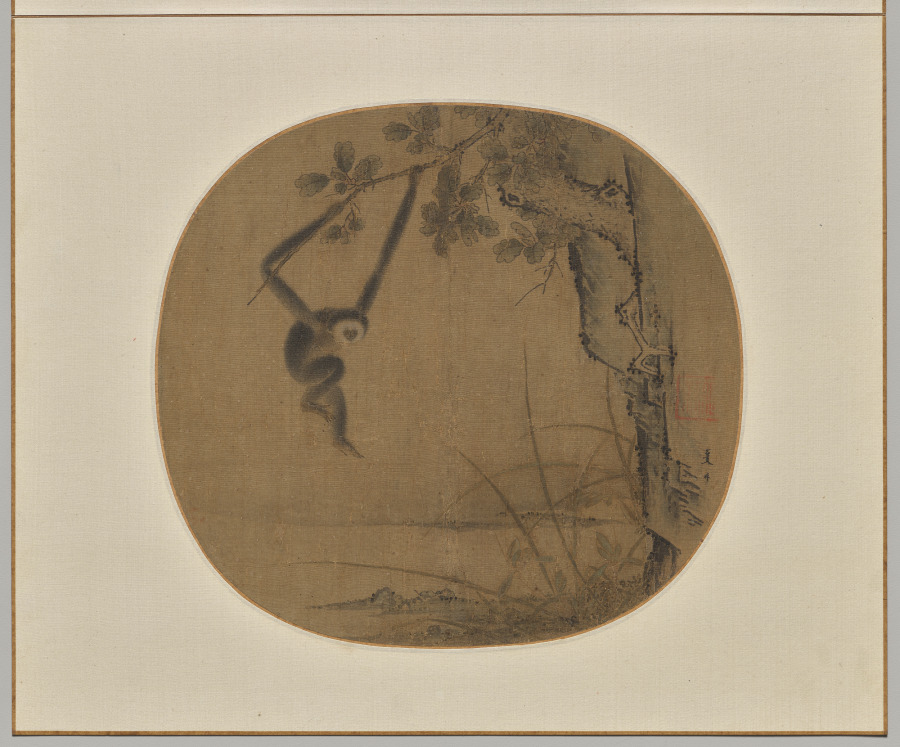
Swinging Gibbon, late 1100s–early 1200s, by Xia Gui
Xia Gui · The Cleveland Museum of Art · John L. Severance Fund
Key facts
Key facts
• Name — Xia Gui • Born — fl. 1195 • Died — 1224 • Known for — Painting • Movement — Southern Song Dynasty, Ma-Xia School Xia Gui (fl. 1195–1224), courtesy name Yuyu (禹玉), was a Chinese landscape painter of the Song dynasty. Very little is known about his life, and only a few of his works survive, but he is generally considered one of China's greatest artists. He continued the tradition of Li Tang, further simplifying the earlier Song style to achieve a more immediate, striking effect. Together with Ma Yuan, he founded the so-called Ma-Xia (馬夏) school, one of the most important of the period. Although Xia was popular during his lifetime, his reputation suffered after his death, together with that of all Southern Song academy painters. Nevertheless, a few artists, including the Japanese master Sesshū, continued Xia's tradition for hundreds of years, until the early 17th century.
Life
Life
• Illustration — An untitled album leaf by Xia Gui, from the collection of Tokyo National Museum No information survives on Xia's birth and death dates, background, or education. He was most probably born in Hangzhou, then capital of Southern Song. During the reign of Emperor Ningzong Xia served in the Imperial Painting Academy (Yuhuayuan 廷畫院) in the same city, the way most major artists did at the time. His teachers are unknown, but the surviving works suggest strong influence of Li Tang, a prominent academy painter whose style was a prominent influence on virtually all 12th-century Chinese landscape painters. Xia Gui and his contemporary, Ma Yuan, were among the most influential painters of their time; they had numerous followers who are now referred to as belonging to the Ma-Xia school. Academy art of the Southern Song was not so appreciated during later periods, i.e. during the later 16th century and afterwards; hence Xia's popularity declined. However, a few critics felt that his paintings were among the better works of the Song Dynasty, and some Chinese artists were still producing works inspired by Xia's idiom. Sesshū Tōyō visited China in the 15th century and was influenced by works and followers of Xia Gui. Sesshū Tōyō made himself fen-pen (draft copy/study copy of the old masterpieces) of Hua Kei landscape fans with Sesshū Tōyō's signature. Two of them survived in Japan. Sesshū's numerous followers, the so-called Unkoku-rin School, sometimes imitated the style their teacher adopted from Xia.
Work
Work
• Illustration — Xia Gui - Sailboat in Rainstorm. Boston The vast majority of Xia's surviving works are small album leaves, the favorite genre of Song academy painters. The genuine work all scholars in the Proceeding 1970 agreed is the album leaf, Sailboat in Rainstorm, in the Museum of Fine Arts, Boston. Instead of producing highly detailed, complex paintings, he limited his materials and thus achieved a more immediate effect. Li Tang had numerous followers, and Xia was one of them; however, as his works show, he soon developed a personal style. Examples of his work in the album leaf format include two ink on silk paintings in the Tokyo National Museum (one of which is from the famous Garden Plowed by the Brush (Hikkoen) collection): both feature perfectly balanced diagonal composition, in which the void and the solid mass play equally important roles, and a formidable ink technique. Xia's techniques are even more impressive in his hand scrolls; however, few of these have survived. The most well known is the 9 meter (30 feet) long Pure and Remote View of Streams and Mountains (ink on paper). This work is preserved incomplete, missing a final section which bore the artist's signature. Extremely subtle, graded ink washes and overlapping brushstrokes created complex atmospheric effects of mist, sky, and infinity. Pure and Remote View of Streams and Mountains. The full scroll measures 46.5 × 889.1 centimeters (18.309 × 350.04 inches) and is on display in the National Palace Museum, Taipei, Taiwan. Other hand scrolls by Xia Gui include Ten Thousand Miles of the Yangzi River, which only survives in an unreliable 16th century copy, and Twelve Views from a Thatched Hut. The latter survives in several copies; the original is probably the fragmentary scroll in the Nelson-Atkins Museum of Art in Kansas City, Missouri, United States. Hanging scrolls by Xia Gui are rare. the famous Rain Storm from the Kawasaki collection in Japan is now considered a copy. There are two possibly authentic hanging scrolls kept in the Freer Gallery of Art: Rapids in a Mountain Valley (also known as A Misty Gorge, survives without the top part which bore the signature) and Autumn Moonlight on Dongting Lake. Old documents describe Xia as a painter who worked very fast, and with great ease. Pure and Remote View of Streams and Mountains is a work on paper, which absorbs ink quickly, and so must be an example of such spontaneous creation. Xia was also praised for his technical skill in drawing architecture and similar objects freehand, rather than using a ruler. Some sources mention the painter's preference for brushes with worn tips, used to avoid excessive smoothness, and "split" brushes, which allowed making two or more strokes at the same time.
Life and career
Dated record
Life and career
The full dated record · 2 entries
1195
Xia Gui born at Hangzhou.
1224
Xia Gui died.
Literature
Scholarly footprint
A count of publications is evidence of attention, not of standing, and is given here only as a measure.
The Encyclopedia exists whether or not anything is for sale. Corrections are recorded rather than overwritten, and every version of this record is kept. Published 14 August 2026.
Elsewhere in Paintings
18,623 published records in this field, each with its sources named.
- Xawery DunikowskiArtist
- Xi AxingArtist
- Xi GangArtist
- Xi MurongArtist
- Xia ShuwenArtist
- Xia Xiao WanArtist
- Xiang ShengmoArtist
- Xiang YuanbianArtist
Best supported in this field
For owners
Own a work by Xia Gui?
A specialist will read what you send and tell you what the house can establish, what it cannot, and whether the object is suited to sale. There is no charge and no obligation. The object stays with you throughout; nothing is shipped to us unless it is arranged in writing beforehand.