
William Strang
William Strang (13 February 1859 – 12 April 1921) was a Scottish painter and printmaker, notable for illustrating the works of Bunyan, Cervantes, Coleridge, Kipling, and others.
William Strang
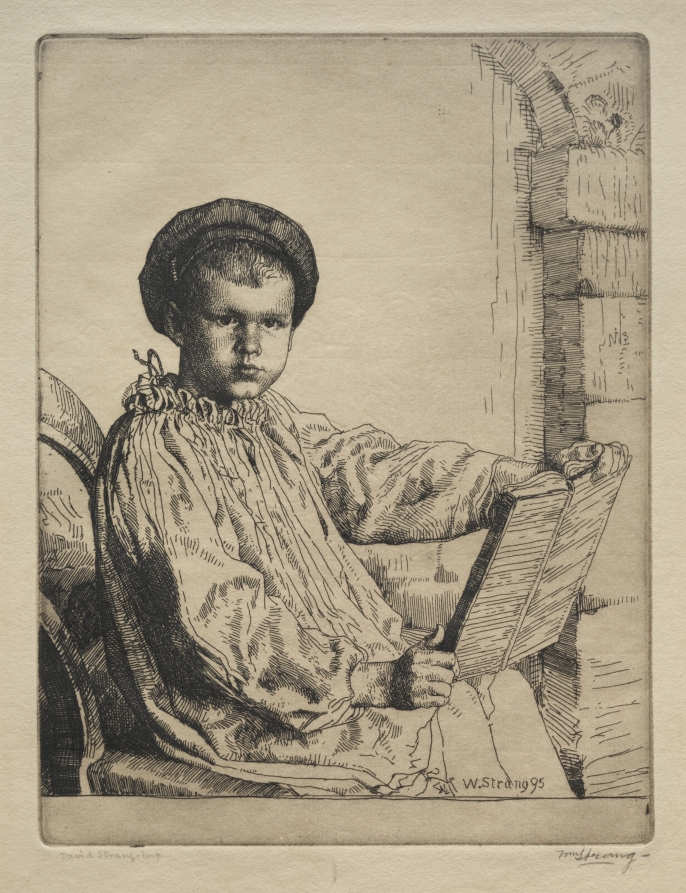
William Strang · The Cleveland Museum of Art · Gift of Moselle Taylor Meals · CC0
- Born
- 15 February 1859
- Birthplace
- Dumbarton, Dunbartonshire, Scotland
- Died
- 12 April 1921
- Place of death
- Bournemouth
- Education
- Alphonse Legros
- Spouse
- Agnes McSymon Rogerson
- Elected
- Master of the Art Workers' Guild, President of the International Society of Sculptors, Painters and Gravers, Engraver Member of the Royal Academy.
- Nationality
- United Kingdom of Great Britain and Ireland
- Occupation
- painter · etcher · graphic artist · illustrator · visual artist · writer · exlibrist · engraver · draftsperson
VALÉORINE Encyclopedia
VALÉORINE documentary reading
Documentary summary
William Strang (13 February 1859 – 12 April 1921) was a Scottish painter and printmaker, notable for illustrating the works of Bunyan, Cervantes, Coleridge, Kipling, and others.
Admitted source layer · organised and presented by VALÉORINE
Note VALÉORINE
William Strang (1859–1921) was a draftsperson, engraver and etcher, among other activities, of British nationality. The draftsperson was born in Dumbarton and died in Bournemouth.
William Strang was educated at Dumbarton Academy. The draftsperson was a member of Royal Academy of Arts. Activity centred on visual arts. Languages used include English.
Composed from admitted, traceable facts · 29 September 2026
VALÉORINE
Reference Check
Propose documentary evidence for William Strang. A contribution is never written directly as fact: identity, source, rights and evidence gates still decide.
Sign in to contribute
Documentary evidence
Documentary basis
Authority files
wikidata · Q2547129 · wikipedia · William Strang
In this article
Key facts
Key facts
• Honorific Suffix — RA • Born — 15 February 1859 • Birthplace — Dumbarton, Dunbartonshire, Scotland • Died — 12 April 1921 • Place of death — Bournemouth • Alma Mater — Slade School • Education — Alphonse Legros • Spouse — Agnes McSymon Rogerson • Children — Ian Strang, David Strang • Elected — Master of the Art Workers' Guild, President of the International Society of Sculptors, Painters and Gravers, Engraver Member of the Royal Academy. William Strang (13 February 1859 – 12 April 1921) was a Scottish painter and printmaker, notable for illustrating the works of Bunyan, Cervantes, Coleridge, Kipling, and others.
Early life
Early life
• Illustration — Potato Lifting, etching, 1892 Strang was born at Dumbarton, the son of Peter Strang, a builder, and was educated at the Dumbarton Academy. For fifteen months after leaving school he worked in the counting-house of a firm of shipbuilders, then in 1875, when he was sixteen, went to London. There, he was a pupil of Edward Poynter for three months, before studying drawing and etching under Alphonse Legros at the Slade School of Fine Art for six years. Strang had great success as an etcher and became assistant master in the etching class. He was one of the founding members of the Royal Society of Painter-Etchers, and his work was part of its first exhibition in 1881. Some of his early plates were published in The Portfolio and other art magazines.
Work
Work
He worked in many techniques: etching, drypoint, mezzotint, sand-ground mezzotint, burin engraving, lithography and woodcut. He cut a large wood engraving of a man ploughing, later published by the Art for Schools Association. A privately produced catalogue of his engraved work contained more than three hundred items. Amongst his earlier works were Tinkers, St. Jerome, A Woman Washing Her Feet, An Old Book-stall with a Man Lighting His Pipe from a Flare, and The Head of a Peasant Woman on sand-ground mezzotint. Later plates such as Hunger, The Bachelor's End and The Salvation Army were also important. Some of his best etchings were done as series—one of the earliest, illustrating poet William Nicholson's Ballad of Aken Drum, is remarkable for clear, delicate workmanship in the shadow tones, showing great skill and power over his materials, and for strong drawing. Another praised series was The Pilgrim's Progress, revealing austere sympathy with John Bunyan's teaching. Samuel Taylor Coleridge's Ancient Mariner and Strang's own Allegory of Death and The Plowman's Wife, have served him with suitable imaginative subjects. Some of Rudyard Kipling's stories were also illustrated by him, and his likeness of Kipling was one of his most successful portrait plates. Other etched portraits included those of Ernest Sichel and of his friend Joseph Benwell Clark, with whom Strang collaborated in illustrating Lucian's True History (1894) Baron Munchausen (1895) and Sinbad the Sailor and Ali Baba (1896). Thomas Hardy, Sir Henry Newbolt, and other distinguished men also sat for Strang. Proofs from these plates have been much valued. In 1913, Strang visited Spain with his friend the photographer James Craig Annan, both producing landscape work.
Painting
Painting
Strang produced many paintings, portraits, nude figures in landscapes, and groups of peasant families, which were exhibited at the Royal Academy, The International Society, and several German exhibitions. He painted a decorative series of scenes from the story of Adam and Eve for the library of a Wolverhampton landowner named Hodson; they were exhibited at the Whitechapel exhibition in 1910. He made some drawings of the nude figure in silver point and red and black chalk. He also painted landscapes, mostly small in size. In later years he developed a style of drawing in red and black chalk, with the whites and high lights rubbed out, on paper brushed with wash. His method gives qualities of delicate modelling and refined form and gradations akin to the drawings of Hans Holbein the Younger. He drew portraits in this manner of many members of the Order of Merit for the royal library at Windsor Castle. In 1902 Strang retired from the Royal Society of Painter-Etchers, as a protest against the inclusion in its exhibitions of etched or engraved reproductions of pictures. His work was subsequently seen principally in the exhibitions of the Royal Academy, the Society of Twelve and the International Society, to which he was elected in 1905. Strang was also elected an associate engraver of the Royal Academy when that degree was revived in 1906. William Strang was master of the Art Workers' Guild in 1907, where his portrait can be seen. He is buried at Kensal Green Cemetery, London. • Illustration — The Green Cloak (Barbara Horder) (1918) • Illustration — Lady with a Red Hat (Vita Sackville-West) (1918; Kelvingrove Museum and Art Gallery, Glasgow) • Illustration — The Temptation (1899; Tate Gallery)
Literary works
Literary works
Strang also ventured into literature, creating "Death and the Ploughman's Wife", an illustrated ballad in 1888 (published 1894 by Lawrence and Bullen). He also wrote short stories, but these were not published.
Recognition
Recognition
Strang was a member of the Art Workers' Guild, being elected as Master in 1907. In 1918, he became President of the International Society of Sculptors, Painters and Gravers and in 1921 was elected an Engraver Member of the Royal Academy.
Family
Family
• Illustration — The Artist's Wife, Agnes Strang, 1904 In 1885, William Strang married Agnes McSymon Rogerson (d. 1933), also from Dumbarton. They had four sons and one daughter, Nancy. Their sons Ian Strang (1886–1952) and David Strang (1887–1967) were both artists. William had at least one granddaughter, Joan Strang, born of David's short-lived marriage to the English soprano Dora Labbette. In 1955 David Strang gave impressions of the bulk of William Strang's etchings to the National Gallery of Scotland, many of which he had annotated for clarification of the subject matter.
Etchings
Etchings
• Illustration — The Cause of the Poor, 1890 • Illustration — Henry Austin Dobson, 1895 • Illustration — Rudyard Kipling, 1901 • Illustration — Montaigne and his cat, 1902 • Illustration — His son David Strang, c. 1915 • Illustration — The cover of Death and the Ploughman's Wife • Illustration — Death the Judge, from the twelve-image portfolio The Doings of Death (1901) • Illustration — alt=etching of houses, with viaduct in background on the right Old Walls And Roman Viaduct, Segovia • Illustration — alt=1913 Black and white mezzotint of Plaza Mayor, Ronda, by William Strang, depicting Plaza Mayor (now renamed Plaza Duquesa de Parcent), Ronda, in the province of Málaga, Andalusia, 1913. The church tower of Iglesia de Santa María la Mayor is visible on the right. The tower on the left belongs to Convento de la Caridad o Hermanas de la Cruz Plaza Mayor, Ronda, mezzotint by William Strang depicting Plaza Mayor (now renamed Plaza Duquesa de Parcent), Ronda, in the province of Málaga, Andalusia, 1913
Identity and overview
Identity and overview
The following is established of the heading itself. Institutional cataloguing adds that william Strang is recorded as United Kingdom of Great Britain and Ireland.
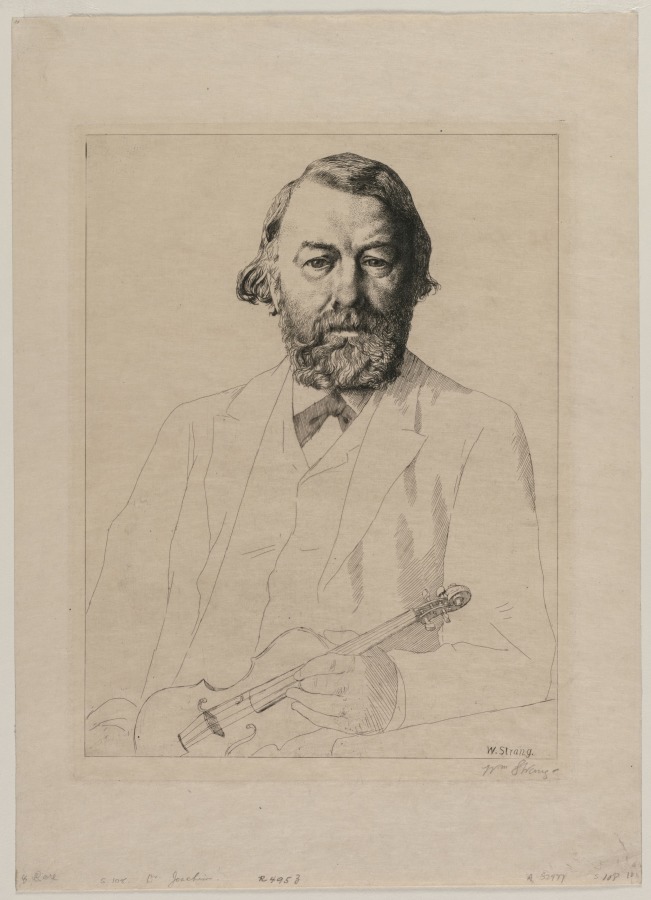
Dr. Joachim, 1887, by William Strang
William Strang · The Cleveland Museum of Art · Mr. and Mrs. Lewis B. Williams Collection
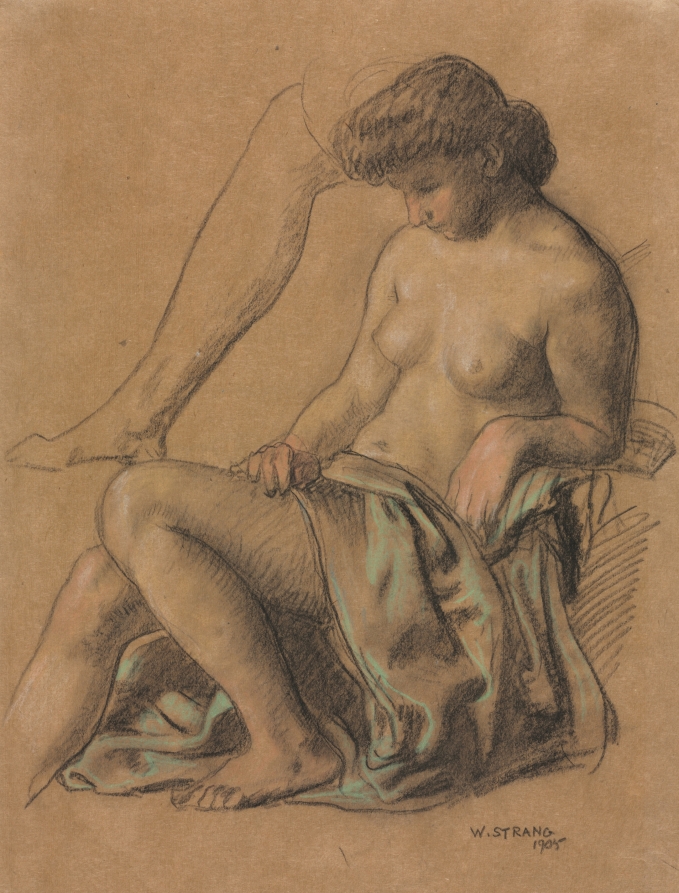
Draped Figure Seated, 1905, by William Strang
William Strang · The Cleveland Museum of Art · Gift of Ralph King
Collections and holdings
Where the work is held
Collections and holdings
Institutional holdings are recorded as follows.
Documents and archives
Primary material
Documents and archives
Institutional database
- Wikidata, structured authority record Q2547129: William Strang
Scholarly · Wikimedia Foundation
reference work
- “William Strang”, English Wikipedia, consulted as further reading
Reputable secondary · Wikipedia
Notes from the source article
Cited by Wikipedia
Notes from the source article
These works are cited by the source article, in its own numbering. They are recorded as its citations, not as sources VALÉORINE has verified.
- 1."Manoah's Offering, from the etching by William Strang" in The Magazine of Art, Vol. 1 (1903), p. 178
- 2.Jones, Sarah Urwin. William Strang's rare talent is etched in history. Glasgow Herald. 10 October 2014.
- 3."Beardsley (Aubrey Vincent)" in T. Bose, Paul Tiessen, eds., Bookman's Catalogue Vol. 1 A-L: The Norman Colbeck Collection (UBC Press, 1987), p. 41
- 4.James Craig Annan, On a Hill Road, Granada, nationalgalleries.org, accessed 26 July 2026
- 5.Goodchild, Anne. William Strang 1859–1921. Tate Etc.
- 6.Marsh, Jan. William Strang (1859–1921), Painter and etcher. National Portrait Gallery.
- 7.Friends of Kensal Green Cemetery. Paths of Glory. 95. 1997.
- 8.Art Workers' Guild. Past Master List.
- 9.Joseph Edwards, Frederick William Pethick-Lawrence Baron Pethick-Lawrence. The Reformers' Year Book. 14. 208. 1908.
- 10.William Strang. National Galleries.
- 11.Chilvers, Ian & John Glaves-Smith. A Dictionary of Modern and Contemporary Art. Oxford University Press. 1644. 2009. 978-0-19-923965-8.
- 12.International, MusicWeb. Charles A. Hooey – MusicWeb-International. musicweb-international.com.
- 13.National Gallery of Scotland: David Strang Gift, collection notes
References
Citations
References
Each reference names the institution holding it, so a reader may go to the document itself.
Institutional database
Wikidata, structured authority record Q2547129: William StrangWikimedia Foundation
Institutional witnessreference work
Secondary witness
The Encyclopedia exists whether or not anything is for sale. Corrections are recorded rather than overwritten, and every version of this record is kept. Published 14 August 2026.
Elsewhere in Prints
4,138 published records in this field, each with its sources named.
- William Sawrey GilpinEngraver
- William SherlockEngraver
- William SherwinEngraver
- William SkeltonEngraver
- William StricklandEngraver
- William T. WilliamsEngraver
- William Thomas FryEngraver
- William TillyerEngraver
Best supported in this field
For owners
Own a work by William Strang?
A specialist will read what you send and tell you what the house can establish, what it cannot, and whether the object is suited to sale. There is no charge and no obligation. The object stays with you throughout; nothing is shipped to us unless it is arranged in writing beforehand.