
William Quiller Orchardson
Sir William Quiller Orchardson (27 March 1832 – 13 April 1910) was a Scottish portraitist and painter of domestic and historical subjects who was knighted in June 1907, at the age of 75.
Also recorded as Sir William Quiller Orchardson · William Orchardson · Sir William Orchardson · Sir Orchardson
William Quiller Orchardson

Lock Whitfield · British Library Images Online · Public domain
- Name
- William Quiller Orchardson
- Born
- 27 March 1832
- Birthplace
- Edinburgh, Scotland
- Died
- 13 April 1910
- Place of death
- London, England
- Spouse
- Helen Moxon (m. 1873)
- Nationality
- United Kingdom of Great Britain and Ireland
- Occupation
- painter
- Education
- Edinburgh College of Art
- Honours
- Knight Bachelor
- Languages
- English
VALÉORINE Encyclopedia
VALÉORINE documentary reading
Documentary summary
Sir William Quiller Orchardson (27 March 1832 – 13 April 1910) was a Scottish portraitist and painter of domestic and historical subjects who was knighted in June 1907, at the age of 75.
Admitted source layer · organised and presented by VALÉORINE
Note VALÉORINE
William Quiller Orchardson (1832–1910) was a British painter. Born in Edinburgh, the painter died in London.
William Quiller Orchardson studied at Edinburgh College of Art. The painter was a member of Académie des beaux-arts and Royal Academy of Arts.
Languages used include English. Works by William Quiller Orchardson are held at Auckland Art Gallery, Hunterian Museum and Art Gallery and Musée d'Orsay, among others. The painter received Knight Bachelor.
Composed from admitted, traceable facts · 27 September 2026
VALÉORINE
Reference Check
Propose documentary evidence for William Quiller Orchardson. A contribution is never written directly as fact: identity, source, rights and evidence gates still decide.
Sign in to contribute
Documentary evidence
Documentary basis
Authority files
wikidata · Q8017160 · wikipedia · William Quiller Orchardson
In this article
Biography
Biography
William Quiller Orchardson studied at Edinburgh College of Art. The recorded working language is English. Work by William Quiller Orchardson is recorded in the collections of National Gallery of Victoria, Auckland Art Gallery, Tate, National Gallery of Ireland and Musée d'Orsay. Distinctions recorded are Knight Bachelor.
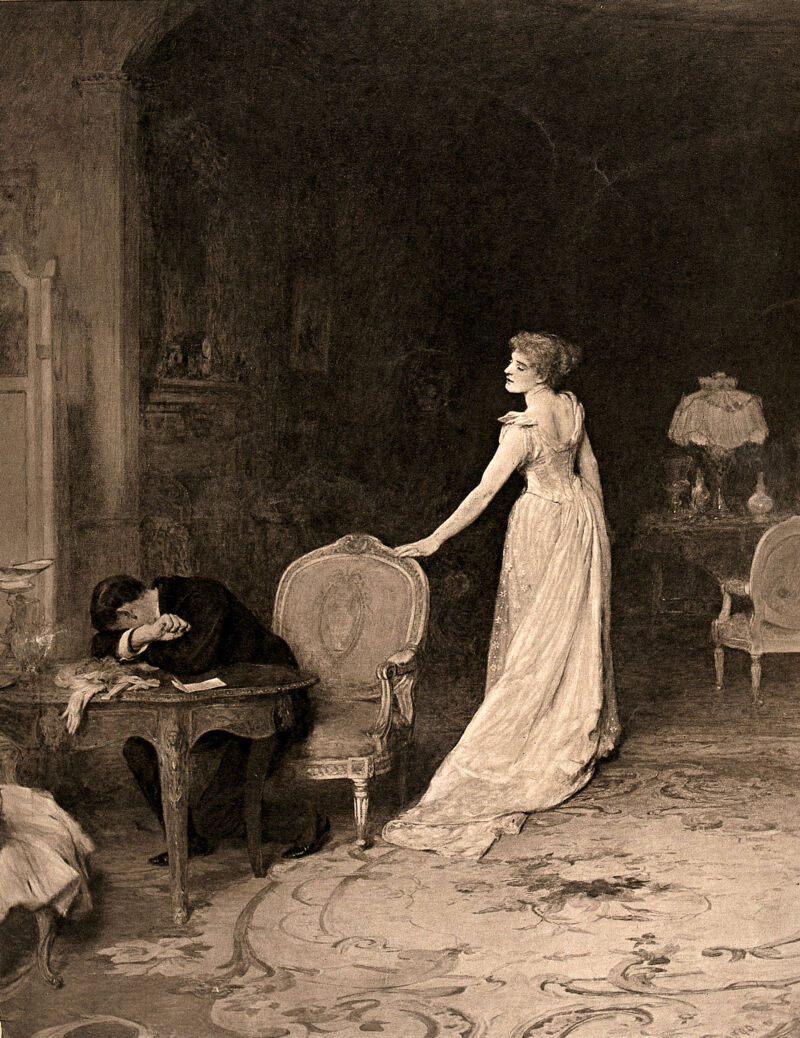
A young woman stands with her hand on the back of a chair, while a young man sitting at the table hides his face in despair. Process print after W.Q. Orchardson., 1898, by William Quiller Orchardson
William Quiller Orchardson · Wellcome Collection, London · Wellcome Collection
Key facts
Key facts
• Name — William Quiller Orchardson • Born — 27 March 1832 • Birthplace — Edinburgh, Scotland • Died — 13 April 1910 • Place of death — London, England • Spouse — Helen Moxon (m. 1873)
Early years
Early years
• Illustration — William Quiller Orchardson – The First Cloud Orchardson was born in Edinburgh, where his father was engaged in business. "Orchardson" is a variation of "Urquhartson", the name of a Highland sept settled on Loch Ness, from which the painter is descended. At the age of fifteen, Orchardson was sent to Edinburgh's renowned art school, the Trustees' Academy, then under the mastership of Robert Scott Lauder, where he had as fellow-students most of those who afterwards shed lustre on the Scottish school of the second half of the 19th century. As a student, he was not especially precocious or industrious, but his work was distinguished by a peculiar reserve and an unusual determination that his hand should be subdued to his eye, with the result that his early works reach their own ideal as surely as those of his maturity. By the time he was twenty, Orchardson had mastered the essentials of his art, and had produced at least one picture which might be accepted as representative, a portrait of sculptor John Hutchison. For the next seven years he worked in Edinburgh, some of his attention being given to a "black and white" style, his practice in which having been partly acquired at a sketch club, which, in addition to Hutchison, included among its members Hugh Cameron, George Hay and William McTaggart.
Years in London
Years in London
• Illustration — William Quiller Orchardson – Hard Hit In 1862, at the age of thirty, Orchardson moved to London, and established himself at 37 Fitzroy Square, where he was joined twelve months later by his friend John Pettie. The same house was afterwards inhabited by Ford Madox Brown. The English public was not immediately attracted to Orchardson's work. It was too quiet to compel attention at the Royal Academy, and Pettie, his junior by four years, stepped before him for a time and became the most readily accepted member of the school. Orchardson confined himself to the simplest themes and designs, to the most reticent schemes of colour. Among his most highly regarded pictures during the first eighteen years after his move to London were The Challenge, Christopher Sly, Queen of the Swords, Conditional Neutrality, Hard Hit – perhaps the best of all – and, within his own family, portraits of his wife and her father, Charles Moxon. In all these, good judgment and a refined imagination were united to a restrained but consummate technical dexterity. During these years he made a few drawings on wood, turning to account his early facility in this mode.
Later life
Later life
• Illustration — Sir William Quiller Orchardson by Henry Weigall The period between 1862 and 1880 was one of quiet ambitions, of a characteristic insouciance, of life accepted as a thing of many-balanced interests rather than as a matter of Sturm und Drang. In 1865 Pettie married, and the Fitzroy Square ménage was broken up. In 1868 Orchardson was elected A.R.A. (Associate of the Royal Academy). In 1870, he spent the summer in Venice, travelling home in the early autumn through a France overrun by the German armies. His marriage to Helen Moxon occurred on 6 April 1873, and in 1877 he was elected to the full membership of the Royal Academy. In this year he finished building Ivyside, a house at Westgate-on-Sea with an open tennis-court and a studio in the garden. In 1891 he appears in a group portrait of a Royal Society soiree between the actress Ellen Terry and the organiser of nurses Rachel Ward, Countess of Dudley. He died in London two and a half weeks after his 78th birthday, having been knighted less than three years previously. There is a memorial which mentions Orchardson within Margate Cemetery, Kent. Now fallen over, its inscription reads: In memory of William Quiller Orchardson (Knight) R.A., H.R.S.A, D.C.L, and Officer of the Legion of Honour. Born 27 March 1833, died 13 April 1910. Ellen Orchardson his wife born 5 May 1853, died 13 May 1917. Capt. Charles Moxon Quiller Orchardson born 24 December 1873, died of wounds in Egypt 26 April 1917. Celeste Orchardson born 24 December 1876, died 30 August 1877.
Works
Works
• Illustration — Voltaire • Illustration — Sir John Leng (1828–1906), • Illustration — St. Helena 1816: Napoleon dictating to Count Las Cases the Account of his Campaigns • Illustration — The Market Girl From The Lido (1870) • Illustration — William Quiller Orchardson - Toilers of the Sea (1870) • Illustration — Mrs Charles Moxon • Illustration — Master Baby • Illustration — alt= Portrait of Sir Peter Nicol Russell Peter Russell, Esq.
Places
Named by the record
Places
Only places the record itself states, plotted where the house gazetteer settles their coordinates. Nothing is inferred from a name or a nationality.
Edinburgh.
Birth place
London.
Death place
Legacy
• Illustration — Napoleon on Board the Bellerophon, 1880 Orchardson's wider popularity dates from 1880. To that year's Royal Academy summer exhibition he sent the large Napoleon on board the Bellerophon, which was acquired for the national collection by the Trustees of the Chantrey Bequest for Tate. For a decade or more, Orchardson's work was eagerly looked for at the Academy. He followed up the Napoleon on the Bellerophon, with Voltaire at the Academy of 1883. Technically, the "Voltaire" is, perhaps, his high-water mark; the subject does not explain itself, but requires a previous knowledge on the part of the spectator of how Voltaire was beaten by the servants of the Chevalier de Rohan-Chabot, and how the duc de Sully failed to avenge his guest. • Illustration — Orchardson caricatured by Spy for Vanity Fair, 1898 The Voltaire was followed, in 1884, by the "Marriage de convenance", perhaps the most popular of all Orchardson's pictures; in 1885, by "The Salon of Madame Récamier"; in 1886, by "After", the sequel to the "Marriage de convenance", and "A Tender Chord"; in 1887, by "The First Cloud"; in 1888, by "Her Mother's Voice"; and in 1889, by "The Young Duke", a canvas on which he returned to much the same pictorial scheme as that of the "Voltaire". Subsequently, he exhibited a series of pictures in which pictorial use was made of the Empire style, the subjects, as a rule, being only just enough to suggest a title. "An Enigma", "A Social Eddy", "Reflections", "If music be the food of love, play on!", "Music, when sweet voices die, vibrates on the memory", "Her First Dance" — in these, opportunities are made to introduce old keyboard instruments, Aubusson carpets, and short-waisted gowns. Orchardson in Master Baby connected subject-painting with portraiture. "Mrs Joseph", "Mrs Ralli", "Sir Andrew Walker, Bart.", "Charles Moxon, Esq.", "Mrs Orchardson", "Conditional Neutrality" (a portrait of Orchardson's eldest son as a boy of six), "Lord Rookwood", "The Provost of Aberdeen" and, notably, "Sir Walter Gilbey, Bart.", were distinguished portraits. The major commission received by Orchardson as a portrait-painter was that for the Royal group of Queen Victoria with her son (afterwards King Edward VII), grandson and great-grandson, to be painted on one canvas for the Royal Agricultural Society. He continued painting to the end of his life, and had three portraits ready for the Royal Academy in the final year of his life, 1910.
Notes from the source article
Cited by Wikipedia
Notes from the source article
These works are cited by the source article, in its own numbering. They are recorded as its citations, not as sources VALÉORINE has verified.
- 1.Encyclopædia Britannica, 15th ed., 2007. The 11th edition gives his birth year as 1835.
- 2.Gray, Hilda Orchardson. The Life of Sir William Quiller Orchardson. DigiCat. 2022-08-16.
- 3.Errington, Lindsay. Subversion in the sculpture gallery: An education experiment at the Trustees' Academy. Journal of the History of Collections. 3. 2. 279–291. 1991. 10.1093/jhc/3.2.279.
- 4.Fitzroy Square Pages 52–63 Survey of London: Volume 21, the Parish of St Pancras Part 3: Tottenham Court Road and Neighbourhood. Originally published by London County Council, London, 1949. British History Online.
- 5.The Royal Academy Conversazione, 1891
- 6.Voltaire (1694 - 1778). National Galleries of Scotland.
References
Citations
References
Each reference names the institution holding it, so a reader may go to the document itself.
reference work
Secondary witnessreference work
Secondary witness
The Encyclopedia exists whether or not anything is for sale. Corrections are recorded rather than overwritten, and every version of this record is kept. Published 17 August 2026.
Elsewhere in Paintings
18,717 published records in this field, each with its sources named.
- William Posey SilvaArtist
- William Powell FrithArtist
- William PowhidaArtist
- William Preston PhelpsArtist
- William R. ChristopherArtist
- William RanneyArtist
- William RaphaelArtist
- William Rickarby MillerArtist
Best supported in this field
For owners
Own a work by William Quiller Orchardson?
A specialist will read what you send and tell you what the house can establish, what it cannot, and whether the object is suited to sale. There is no charge and no obligation. The object stays with you throughout; nothing is shipped to us unless it is arranged in writing beforehand.