
William Morris Hunt
William Morris Hunt (March 31, 1824September 8, 1879) was an American painter. William Morris Hunt was born into the political Hunt family of Vermont, he trained in Paris with the realist Jean-François Millet and studied under him at the Barbizon artists’ colony, before founding a similar group on his return to America. He became Boston's leading portrait and landscape painter, also working as a lithographer and sculptor.
Also recorded as W. M. Hunt · William M. Hunt · wm morris hunt
William Morris Hunt
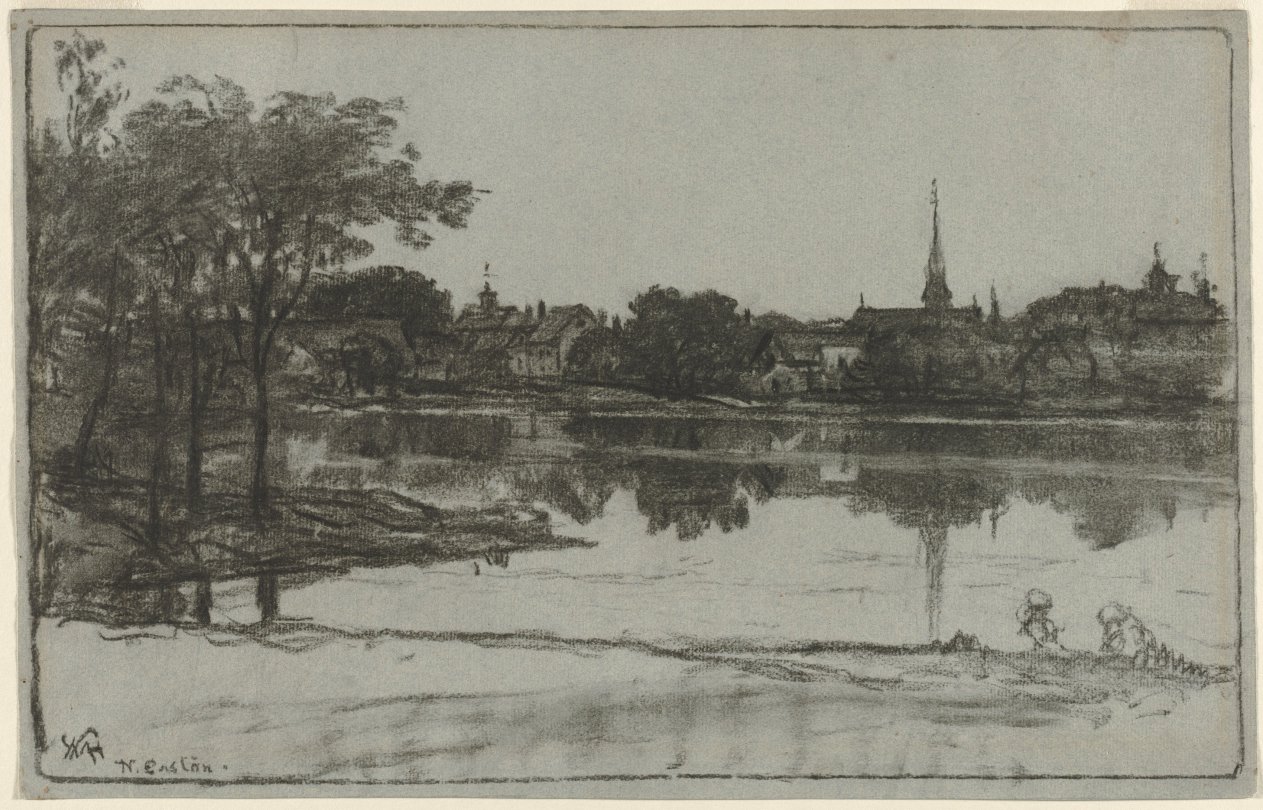
William Morris Hunt · The Cleveland Museum of Art · Gift of Mrs. G. Tappan Francis · CC0
- Name
- William Morris Hunt
- Born
- March 31, 1824
- Birthplace
- Brattleboro, Vermont, U.S.
- Died
- 8 September 1879
- Place of death
- Isles of Shoals, New Hampshire, U.S.
- Education
- Thomas Couture and Jean-François Millet
- Movement
- American Barbizon School
- Nationality
- United States.
- Fields
- portrait.
- Teachers
- Thomas Couture.
- Known for
- Madame Isaac Fenno.
VALÉORINE Encyclopedia
VALÉORINE documentary reading
Documentary summary
William Morris Hunt (March 31, 1824September 8, 1879) was an American painter. William Morris Hunt was born into the political Hunt family of Vermont, he trained in Paris with the realist Jean-François Millet and studied under him at the Barbizon artists’ colony, before founding a similar group on his return to America. He became Boston's leading portrait and landscape painter, also working as a lithographer and sculptor.
Admitted source layer · organised and presented by VALÉORINE
Note VALÉORINE
No house-authored Note is published until its assertions and sources pass the VALÉORINE evidence contract. The documentary article remains available in full while that enrichment is being consolidated.
Documentary enrichment in progress · no unsupported statement published
Reference Check
Propose documentary evidence for William Morris Hunt. A contribution is never written directly as fact: identity, source, rights and evidence gates still decide.
Sign in to contribute
World of VALÉORINE
Documentary connections
Only confirmed graph relationships appear here. Images are shown only when their identity and reuse rights both pass the documentary gate.
Documentary evidence
Evidence Panel
not yet certified
- Identity
- resolved
- Independent source families
- 0
- Admitted assertions
- 0
- Open conflicts
- 0
Authority files
wikidata · Q527599 · wikipedia · William Morris Hunt
In this article
Biography
Biography
Hunt worked between 1824 and 1879 across painter, sculptor, graphic artist, lithographer and draftsperson. The registers place that work in portrait. Every statement below returns to a source shown in the evidence panel; where the record is silent or divided, the article says so instead of resolving it.
William Morris Hunt studied at Harvard University, Phillips Academy and Harvard College. Training under Thomas Couture is recorded. William James is recorded as having studied under William Morris Hunt. Subjects and genres recorded for the work are portrait. Works named in the authority record are Madame Isaac Fenno. Work by William Morris Hunt is recorded in the collections of Minneapolis Institute of Art, The Nelson-Atkins Museum of Art, Whitney Museum of American Art, Smithsonian American Art Museum and Metropolitan Museum of Art.
Key facts
Key facts
• Name — William Morris Hunt • Born — March 31, 1824 • Birthplace — Brattleboro, Vermont, U.S. • Died — 8 September 1879 • Place of death — Isles of Shoals, New Hampshire, U.S. • Family — Hunt family of Vermont • Education — Thomas Couture and Jean-François Millet • Father — Jonathan Hunt • Resting Place — Prospect Hill Cemetery • Movement — American Barbizon School
Life and career
Life and career
William Morris Hunt was born into prominence. The family of Hunt's father Jonathan Hunt, were among Vermont's founders and largest landowners; his mother's a family of wealth and prominence in Connecticut. Hunt attended Harvard College but withdrew in his junior year. Having been denied the opportunity to paint and draw by an overbearing father, Jane Leavitt Hunt resolved that her children would be given the chance to study the arts in the best academies—even if it meant moving to Europe to attend them. Following the death of his congressman father from cholera in 1832 at the age of 44, Hunt's mother Jane took him and his brothers to Switzerland, the South of France and to Rome, where Hunt studied with Thomas Couture in Paris, coming under the influence of Jean-François Millet after being greatly inspired by Millet's The Sower at the 1851 Paris Salon. The Hunt family remained in Europe for a dozen years. During part of that time, William Morris Hunt and his brother Richard Morris Hunt shared an apartment at 1 rue Jacob, close by the École des Beaux-Arts, where William studied painting under Couture. "From the training and inspiration each of the brothers was to experience in the next several years in France would come great strides for each in his work," writes historian David McCullough. "'Mr. William Hunt is our most promising artist here,' reported Thomas Appleton to his father." Hunt then spent the next two years under the tutelage of Millet in Barbizon before his return to the states. The companionship of Millet had a lasting influence on Hunt's character and style, and his work grew in strength, in beauty and in seriousness. He was among the biggest proponents of the Barbizon school in America, and he more than any other turned the rising generation of American painters towards Paris. About his influence, S. G. W. Benjamin wrote in a posthumous assessment of Hunt: After leaving Paris, Hunt painted and used his family connections to establish art schools in Newport, Rhode Island, Brattleboro, Vermont, the Faial Island in the Azores, and finally in Boston, where he became a popular portrait painter. • Illustration — Portrait of William Morris Hunt by Emanuel Leutze (about 1845) Before his lauded return to America in 1855, Hunt was married in Paris to Louise Dumaresq Perkins, daughter of Thomas Handasyd Perkins Jr. (son of Thomas Handasyd Perkins), a Boston merchant, philanthropist and patron of the arts. Hunt was married to Perkins again upon his return to Boston in 1855, perhaps for legal reasons. Hunt was married for the second time in the influential King's Chapel in Boston by academic and clergyman Ephraim Peabody, shortly before Peabody's death in 1856. On his return, Hunt painted some of his most handsome canvases, all reminiscent of his life in France and of Millet's influence. Such works include The Belated Kid, Girl at the Fountain, Hurdy-Gurdy Boy, and others – but the public called for portraits, and it became the fashion to sit for Hunt; among his best paintings of this genre are those of William M. Evarts, Mrs. Charles Francis Adams, the Rev. James Freeman Clarke, Senator Charles Sumner, William H. Gardner, Chief Justice Shaw and Judge Horace Gray. Morris sat for a full-length portrait by the artist Emanuel Leutze in Düsseldorf in 1864. Formerly part of the collection of Col. Leavitt Hunt at Elmshome in Vermont, the portrait is now in the collection of the Museum of Fine Arts, Boston. Many of Hunt's paintings and sketches, together with five large Millets and other art treasures collected by him in Europe, were destroyed in the Great Boston Fire of 1872. Hunt owned many canvases by Millet, including Millet's The Sower, for which Millet somewhat unwillingly accepted a payment of $60 from Hunt. Among his later works, American landscapes predominated. In the summer of 1878, the year before his death, Hunt painted a series of sweeping views of Niagara Falls. His later works also include the "Bathers: Twice Painted" and "The Allegories" for the Assembly Chamber of the State Capitol at Albany, New York, now lost due to disintegration of the stone panels on which they were painted (some scholars trace Hunt's deepening depression that led to his suicide to his despair over the loss of the Albany murals). His book, Talks about Art (London, 1878), was especially well received. Nor did Hunt confine himself to oil painting. He was prolific, working as a lithographer and sculptor as well. From 1850 to 1877, the Vermont native was Boston's leading portrait and landscape painter; there was a backlog of Brahmins clamoring to be painted by him. Hunt is widely credited for having influenced the styles of Winslow Homer, Childe Hassam and John Joseph Enneking. Hunt's signature lively brushwork, partly derived from study of contemporary European painting, marked a new phase in 'oil sketching' that was carried on by Homer and others. Other friends and associates included artist Frank Hill Smith. • Illustration — William Morris Hunt self-portrait, 1866 "The greatest of Boston painters", writes art historian G. W. Sheldon in his American Painters, "and one of the few really great American painters, Mr. William Morris Hunt, was born in Brattleboro, Vermont." While a friend and student of Millet, "Hunt is an entirely original artist, and every picture of his is a spontaneous and independent product." In a bit of art history revisionism, some scholars are now re-examining Hunt's powerful pull on other early New England artists, many better-known. Hunt was an important figure in New England arts and society. Besides collecting himself, Hunt encouraged other Boston collectors to buy works by European artists such as Millet, Monet and others. After one early exhibition of French artists at the Boston Athenaeum, including works by Millet and Rousseau, for instance, an art professor at Harvard had written a condemnation in a Boston newspaper. Outraged, painter Hunt fired back a response in The Boston Daily Advertiser. "It is not our fault we inherit ignorance in art," Hunt wrote, "but we are not obliged to advertise it." In 1867, for instance, Hunt and his wife sailed to Paris to attend the opening of the Exposition Universelle. In his lectures and art classes, Hunt attracted large numbers of students, many of them from prominent Brahmin families. Starting in 1868, he began teaching women at the request of Helen M. Knowlton, facing backlash from his peers who thought he was wasting his time. The Boston philosopher and author William James studied with Hunt for a time, before turning away from painting to concentrate on his writing. In 1871 Hunt was elected to the National Academy of Design as an Associate Academician. Hunt's career owed a debt to Boston's intellectual ferment. A luncheon at his club on February 27, 1870, for instance, found these members of Hunt's circle dining together: Ralph Waldo Emerson; James Russell Lowell; Henry Wadsworth Longfellow; Edward Clarke Cabot; Martin Brimmer; Thomas Gold Appleton; William James; Francis Blackwell Forbes; and James T. Fields. Joining the group as guest was Erastus Brigham Bigelow, a founder of the Massachusetts Institute of Technology. William Morris Hunt died at the Isles of Shoals, New Hampshire, in 1879, apparently a suicide. Hunt had gone to the New Hampshire shore to recover from a crippling depression. But he continued to work, executing his last sketch three days before his death. His body was discovered by his friend, New Hampshire poet Celia Thaxter. His brother Richard Morris Hunt was a celebrated architect. Another brother, Leavitt Hunt, was a well-known photographer and attorney. A fourth brother, Jonathan, was a Paris physician who also committed suicide. The William Morris Hunt Library of the Boston Museum of Fine Arts is named in honor of this painter. (Hunt was a founding member of the Museum of Fine Arts' museum school). Following Hunt's death, his Harvard classmates and other Bostonians contributed to a fund to purchase many of his paintings and donate them to the Museum of Fine Arts. Aside from the Museum of Fine Arts, the Boston Athenaeum has a number of the artist's works in its collection, a gift of William Morris Hunt II. Also owning works by Hunt are New York City's Metropolitan Museum of Art, the Louvre Museum in Paris, the Musée d'Orsay in Paris, the Fine Arts Museums of San Francisco, the National Gallery of Art in Washington, D.C., the Addison Gallery of American Art at Hunt's alma mater Phillips Academy in Andover, Mass., the Bennington Museum, Vermont, the Bowdoin College Museum of Art, the Brooklyn Museum of Art, the Carnegie Museum of Art in Pittsburgh, the Currier Museum of Art in New Hampshire, the Harvard University Art Museums, Salem's Peabody Essex Museum, the Pennsylvania Academy of the Fine Arts and many others. In accordance with a long expressed desire, William Morris Hunt was buried at Prospect Hill cemetery in Brattleboro, Vermont, beside other family members. Two decades after Hunt's death, his former pupil Helen Mary Knowlton published her biography of the Boston painter entitled The Art-Life of William Morris Hunt.
Personal life
Personal life
William Morris Hunt and his wife, the former Louisa Dumaresq Perkins, had five children. His daughter Eleanor "Ellen" (1858–1941) married German officer of the Prussian Army Ernst Curt Sigismond Diederich (1851–1887). One of their children was the artist Wilhelm Hunt Diederich.
Gallery
Gallery
• Illustration — The Bathers, 1877, The Metropolitan Museum of Art • Illustration — Portrait of Morris Hunt, son of William Morris Hunt, 1857, Boston Museum of Fine Arts • Illustration — Niagara Falls, 1878, one of his last paintings • Illustration — Hunt's studio, 1879 • Illustration — The Drummer Boy, c. 1862, Museum of Fine Arts, Boston • Illustration — Wheaton Theodore King, 1865 • Illustration — Gloucester Harbor, c. 1877
Life and work
Life and work
William Morris Hunt was born on 31 March 1824 in Brattleboro. Hunt held the nationality of United States. Hunt was educated at Harvard University, Phillips Academy, Harvard College and Hopkins School. Hunt studied under Thomas Couture. Married to: Louisa Dumeresq Perkins. Recorded father: Jonathan Hunt. Recorded mother: Jane Maria Leavitt. Recorded child: Mabel De Carteret Slater, Enid Dumeresq Hunt and Elena Hunt Diederich. Recorded sibling: Richard Morris Hunt and Leavitt Hunt. Hunt worked as painter, sculptor, graphic artist and lithographer, and the authority record catalogues a further 1 occupations under the same name, among them draftsperson. Hunt was active from 1845 to 1879. The fields Hunt worked in include portrait. Hunt died on 8 September 1879 in Appledore Island. Hunt is buried at Prospect Hill Cemetery.
Life and career
Dated record
Life and career
Explore 1824–1879
The full dated record · 3 entries
1824
William Morris Hunt born at Brattleboro.
1879
Dies at Appledore Island.
1879
William Morris Hunt died at Appledore Island.
Places
Named by the record
Places
Only places the record itself states, plotted where the house gazetteer settles their coordinates. Nothing is inferred from a name or a nationality.
Brattleboro.
Birth place
Appledore Island.
Death place
Catalogued output
Writings and published texts
These are catalogued publications carrying the name — editions and printings, distinct from the works they contain and from writing about the subject. The run opens with W. Hunt's talks on art and closes with William Morris Hunt on painting and drawing.
William Morris Hunt on painting and drawing
1976
5 editions carry dates between 1875 and 1976
The entries follow Open Library
Talks on art
1887
Kurze gespraeche ueber kunst
1900
Paintings, drawings and prints, 1849–1879
Catalogued output
Paintings, drawings and prints, 1849–1879
These are objects catalogued as visual works, each held or recorded by the institution named against it. 94 works carry dates between 1849 and 1879. The 1870s are the densest part of the run, with 49 titles, and that concentration is a fact about what the registers have catalogued rather than a judgement on the work itself. They belong to a run of 112 titles in all, from 1849 to 1879. A selection is set out below and the complete run may be opened beneath it.
The run opens with Self Portrait and closes with Niagara
Self Portrait
1849
Head of a Girl
1849
The Hurdy-Gurdy Boy
1851
Landscape
1852
Girl at the Fountain
1852
Sheep Shearing at Barbizon
1852
Study for The Fortune Teller
1852
Girl Reading
1853
La Marguerite
1853
Sheep
1853
On the Edge of the Forest
1853
The complete catalogue · 60
The run opens with Self Portrait and closes with Niagara
Self Portrait
1849
Head of a Girl
1849
The Hurdy-Gurdy Boy
1851
Landscape
1852
Girl at the Fountain
1852
Sheep Shearing at Barbizon
1852
Study for The Fortune Teller
1852
Girl Reading
1853
La Marguerite
1853
Sheep
1853
On the Edge of the Forest
1853
French Peasant Woman with Pig
1853
The Little Gleaner
1854
Girl with Cat
1856
The Violet Girl
1856
Sheep Pasture
1857
The Belated Kid
1857
Portrait of Edward Wheelwright
1857
Stag in the Moonlight
1857
Violet Girl
1857
Francisca Paim da Terra Brum da Silveira
1858
The Snow Storm
1859
Landscape at Newport
1860
Girl with Cows
1860
The Prayer
1860
Winthrop (Frances Pickering Adams)
1861
The Wounded Drummer Boy
1862
The Drummer Boy
1862
Study for The Flight of Night
1863
Landscape, The Village Church
1863
Felix Regamy
1864
Hamlet
1864
Mother and Child
1865
The Gleaner
1865
Abraham Lincoln
1865
Susan Heard Oliver Dabney
1865
Italian Boy
1866
Italian Peasant Boy
1866
Farm Scene
1866
Mary Elizabeth Robbins
1866
Italian Girl
1867
The Spouting Whale
1870
Portrait of a Lady
1870
Marguerite
1870
Senator Charles Sumner
1870
Italian Girl (WAM)
1870
Evening, Farm Landscape
1870
Isaac Fenno
1872
Head of a Woman
1872
Judge John Lowell (1824-1897)
1872
Portrait of Agnes Elizabeth Claflin
1873
Lady with a White Collar
1873
Priscilla
1873
Barthold Schlesinger
1873
His First Model-Miss Russell
1873
Governor's Creek, Florida
1874
Beach Scene with Horses
1874
Portrait of Ellen M. Ellen Berry)
1874
Charles Sumner
1875
A further 30 recorded entries stand behind this article and are held on the record.
Paintings, drawings and prints without a settled date
Catalogued output
Paintings, drawings and prints without a settled date
18 further works are catalogued under Hunt's name without a date the collections agree on, which is why they are set apart from the dated run rather than placed in it.
Lewis William Tappan, Jr.)
The Fortune Teller
Pine Woods, Magnolia
Along the River
Man in Wheat Field
Reflections in the Water
Girl at Piano
Olivia Buckminster Lothrop (Mrs
Head -- Daughter of Concierge
Mother and Children
Portrait of a Woman
The Horses of Anahita or The Flight of Night
Upper Falls, Newton
Primary material
Documents and archives
reference work
- “William Morris Hunt”, English Wikipedia, consulted as further reading
Reputable secondary · Wikipedia
authority record
- Wikidata, structured authority record Q527599: William Morris Hunt
Unverified · Wikidata
Authority records
References
Citations
References
Each reference names the institution holding it, so a reader may go to the document itself.
reference work
Partially resolvedauthority record
Unverified
Further particulars
Held on the record
Further particulars
Open the remaining particulars
William Morris Hunt studied at Harvard University, Phillips Academy, Harvard College and Hopkins School. He trained under Thomas Couture. Each of those relationships is stated by the authority record rather than inferred from style.
William Morris Hunt is recorded as painter, sculptor, graphic artist, lithographer and draftsperson.
Recognition and collections
Work by William Morris Hunt is
Minneapolis Institute of Art, The Nelson-Atkins Museum of Art, Whitney Museum of American Art and Smithsonian American Art Museum
The Encyclopedia exists whether or not anything is for sale. Corrections are recorded rather than overwritten, and every version of this record is kept. Published 14 August 2026.
Elsewhere in Paintings
18,792 published records in this field, each with its sources named.
- William MeyerowitzArtist
- William MillerArtist
- William MontgomeryArtist
- William Moore DavisArtist
- William MulreadyArtist
- William Nichol CresswellArtist
- William Oliver StoneArtist
- William Otto EmersonArtist
Best supported in this field
For owners
Own a work by William Morris Hunt?
A specialist will read what you send and tell you what the house can establish, what it cannot, and whether the object is suited to sale. There is no charge and no obligation. The object stays with you throughout; nothing is shipped to us unless it is arranged in writing beforehand.