
William Butterfield
William Butterfield (7 September 1814 – 23 February 1900) was a British Gothic Revival architect and associated with the Oxford Movement (or Tractarian Movement). He is noted for his use of polychromy.
William Butterfield

William Butterfield · Available in the BEIC digital library and uploaded in partnership with BEIC Foundation. · Public domain
- Name
- William Butterfield
- Born
- 7 September 1814
- Birthplace
- London, England
- Died
- 23 February 1900
- Awards
- Royal Gold Medal (1884)
- Nationality
- United Kingdom of Great Britain and Ireland
- Occupation
- architect
- Known for
- St Paul's Cathedral · All Saints, Margaret Street · St James' Church and Christleton
- Honours
- Royal Gold Medal · Fellow of the Society of Antiquaries
- Languages
- English
VALÉORINE Encyclopedia
VALÉORINE documentary reading
Documentary summary
William Butterfield (7 September 1814 – 23 February 1900) was a British Gothic Revival architect and associated with the Oxford Movement (or Tractarian Movement). He is noted for his use of polychromy.
Admitted source layer · organised and presented by VALÉORINE
Reference Check
Propose documentary evidence for William Butterfield. A contribution is never written directly as fact: identity, source, rights and evidence gates still decide.
Sign in to contribute
World of VALÉORINE
Documentary connections
Only confirmed graph relationships appear here. Images are shown only when their identity and reuse rights both pass the documentary gate.

Born In · outgoing
London
Place
Pencil sketch by George Henry Harlow, 1814, http://www.npg.org.uk/collections/search/largerimage.php?mkey=mw05495
Died In · outgoing
London
Place
Pencil sketch by George Henry Harlow, 1814, http://www.npg.org.uk/collections/search/largerimage.php?mkey=mw05495
Awarded · outgoing
Royal Gold Medal
Term
Documentary evidence
Documentary basis
Authority files
wikidata · Q328252 · wikipedia · William Butterfield
In this article
Key facts
Key facts
• Name — William Butterfield • Born — 7 September 1814 • Birthplace — London, England • Died — 23 February 1900 • Place of death — London, England • Resting Place — Tottenham Cemetery • Significant Buildings — St Ninian's Cathedral, Perth in Scotland St Paul's Cathedral, Melbourne in Australia • Significant Projects — Keble College, Oxford • Awards — Royal Gold Medal (1884)
Biography
Biography
William Butterfield was born in London in 1814. His parents were strict non-conformists who ran a chemist's shop in the Strand. He was one of nine children and was educated at a local school. At the age of 16, he was apprenticed to Thomas Arber, a builder in Pimlico, who later became bankrupt. He studied architecture under E. L. Blackburne (1833–1836). From 1838 to 1839, he was an assistant to Harvey Eginton, an architect in Worcester, where he became articled. He established his own architectural practice at Lincoln's Inn Fields in 1840. From 1842 Butterfield was involved with the Cambridge Camden Society, later The Ecclesiological Society. He contributed designs to the Society's journal, The Ecclesiologist. His involvement influenced his architectural style. He also drew religious inspiration from the Oxford Movement and as such, he was very high church despite his non-conformist upbringing. He was a Gothic revival architect, and as such he reinterpreted the original Gothic style in Victorian terms. Many of his buildings were for religious use, although he also designed for colleges and schools. Butterfield's church of All Saints, Margaret Street, London, was, in the view of Henry-Russell Hitchcock, the building that initiated the High Victorian Gothic era. It was designed in 1850, completed externally by 1853 and consecrated in 1859. Flanked by a clergy house and school, it was intended as a "model" church by its sponsors, the Ecclesiological Society. The church was built of red-brick, a material long out of use in London, patterned with bands of black brick, the first use of polychrome brick in the city, with bands of stone on the spire. The interior was even more richly decorated, with marble and tile marquetry. In 1849, just before Butterfield designed the church, John Ruskin had published his Seven Lamps of Architecture, in which he had urged the study of Italian Gothic and the use of polychromy. Many contemporaries perceived All Saints' as Italian in character, though in fact it combines fourteenth century English details, with a German-style spire. Also in 1850 he designed, without polychromy, St Matthias' in Stoke Newington, with a bold gable-roofed tower. At St Bartholomew's, Yealmpton in the same year, Butterfield used a considerable amount of marquetry work for the interior, and built striped piers, using two colours of marble. • Illustration — Blue plaque, 42 Bedford Square, London At Oxford, Butterfield designed Keble College, in a style radically divergent from the university's existing traditions of Gothic architecture, its walls boldly striped with various colours of brick. Intended for clerical students, it was largely built in 1868–70, on a fairly domestic scale, with a more monumental chapel of 1873–6. In his buildings of 1868–72 at Rugby School, the polychromy is even more brash. Butterfield received the RIBA Gold Medal in 1884. He died in London in 1900, and was buried in a simple Gothic tomb (designed by himself) in Tottenham Cemetery, Haringey, North London. The grave can be easily seen from the public path through the cemetery, close to the gate from Tottenham Churchyard. There is a blue plaque on his house in Bedford Square, London.
Works
Works
• Illustration — Keble College Chapel, Oxford • Illustration — St Paul's Cathedral, Melbourne, Australia • Illustration — St Ninian's Cathedral, Perth, Scotland • Illustration — William Butterfield's original design for the new Anglican cathedral (St Paul's) in Melbourne, Australia • Illustration — All Saints, Margaret Street, London (detail of interior) • Illustration — St Mary's church, Brookfield • Illustration — St Andrew's Church, Rugby • Illustration — St Barnabas's Church, Horton-cum-Studley • Illustration — St Mark's Church, Dundela, Belfast • Illustration — Font of Ottery St Mary Parish Church, Devon • Illustration — Chalice designed by William Butterfield, 1856–1857 (hallmarked) V&A Museum no. CIRC.521–1962 • Illustration — Chapel, Rugby School Butterfield's buildings include: • 1842 • Highbury Congregational Chapel (Cotham Church), Bristol • 1843 • St John's Church, Jedburgh: lychgate • 1845 • St Saviour's Church and vicarage, Coalpit Heath, south Gloucestershire, 1845 (Butterfield's first Anglican work) • St Augustine's College, Canterbury, Kent, 1845 • St John the Baptist parish church, Hellidon, Northamptonshire: restoration, 1845–47 • 1846 • St Nicholas' Church, Thanington Without, Kent: restoration, 1846 • St Nicholas' Church, Ash, Kent: restoration, 1846 • Abbey Church of Saints Peter & Paul, Dorchester on Thames, Oxfordshire: restoration, 1846–53 • 1847 • St Andrew's parish church, Ogbourne St Andrew, Wiltshire: restoration, 1847–49 and vicarage, 1848 • Parish Church of the Holy Trinity with St Edmund, Horfield, Bristol, nave and aisles c1847 • 1849 • St Bartholomew's Church, Yealmpton, Devon, PL8 2HG, reconstruction 1849–1852 • The Cathedral of the Isles, Great Cumbrae, Scotland, started 1849 but still incomplete • St Edmund's Church, Thurlaston, Warwickshire. Built as a combined church and school. • St Mary's Church, Ottery St Mary, Devon restoration 1849–1850 • 1850 • Goldern Lion Hotel (1850) in the Norfolk sea-side town of Hunstanton. • St Mary Magdalene church, West Lavington, West Sussex, 1850 • St Ninian's Cathedral, Perth, Scotland, 1850 • St James & St Anne parish church and vicarage, Alfington, Devon, 1850 • Wantage Cemetery, Berkshire: chapel, 1850 • 1851 • St Mary's Church, Emmorton, Maryland: stained glass windows, 1851 • St Martin's Church, Great Mongeham, Kent: restoration, 1851 • 1853 • St Mary and St Melor parish church, Amesbury, Wiltshire: restoration, 1852–1853 • All Saints, Wykeham, 1853–1855 • Milton Ernest Hall, Bedfordshire, 1853–1858 • St Mary's Church, Langley, Kent, 1853 • 1854 • St Paul's Church, Hensall, North Yorkshire • The Red House, Hensall, North Yorkshire • Hutton Buscel Village Hall, North Yorkshire • St Nicholas' Hospital, Salisbury, Wiltshire: restoration, 1854 • Church of St John the Baptist, Pollington Cum Balne • Church of the Holy Trinity, Snaith • 1855 • St Mary's parish church, Marlston, Berkshire, 1855 • All Saints' Church, Braishfield, Hampshire, 1855 • 1856 • St John the Evangelist's parish church, Milton, Oxfordshire, 1856 • Balliol College, Oxford: chapel, 1856–57 • 1857 • St Michael's parish church, Gare Hill (Gaer Hill), near Trudoxhill, Somerset, 1857 • St James' church, school and village buildings, Baldersby St James, North Yorkshire, 1857 • Charlton-All-Saints, Wiltshire: school, 1857–58 • 1858 • St Mathew's chapel of ease, Easton, Bristol, 1858; demolished 1923 • St Andrew's parish church, Landford, Wiltshire, 1858 • Church of St John the Evangelist, better known as the Afghan Church, Mumbai: the reredos, the Afghan War Memorial mosaics, and the tiles, pews and screen, 1858 • St John the Evangelist parish church, Hammersmith, 1858–59 • St John the Baptist, Latton, Wiltshire: chancel, 1858–63 • Pitt Mission Church and School, Pitt, Hursley, Hampshire, 1858 • 1859 • All Saints, Margaret Street, London, 1859 • St Mary the Virgin, Etal, Northumberland 1859 • St Nicholas' school, Newbury, Berkshire, 1859 • Standlynch Chapel, Trafalgar House, Wiltshire: restoration, 1859–66 • 1860 • St Giles' Church, Tadlow, Bedfordshire, 1860 • Charlton All Saints, Wiltshire: vicarage, 1860–62 • Clergy house, St Alban the Martyr, Holborn • 1861 • St John the Baptist church, Bamford, Hope Valley, Derbyshire: restoration, 1861 • St Michael's parish church, Letcombe Bassett, Berkshire (now Oxfordshire): nave and south aisle, 1861 • St Mary the Virgin parish church, Castle Eaton, Wiltshire: restoration, 1861–63 • 1862 • Lych gate at St Michael & All Angels' Churchyard extension, Houghton-le-Spring, Durham, 1862 • St Martin's parish church, Bremhill, Wiltshire: restoration, 1862–63 • St Michael's parish church, Lyneham, Wiltshire: nave roof and chancel, 1862–65 • 1863 • Church of St Cross, Manchester, Clayton, Manchester, 1863–66 • St Margaret's parish church, Mapledurham, Oxfordshire: restoration, 1863 • St Mary Magdalene church, Enfield Chase, Middlesex, 1883 • St Michael's parish church, Aldbourne, Wiltshire: restoration, 1863–67 • 1864 • St Sebastian, Heathland, Wokingham, Berkshire, 1864 • Merton College, Oxford: Grove Building, 1864 • St Andrew's parish church, Blunsdon St Andrew, Wiltshire: restoration: 1864–68 • Christ Church, Emery Down, Hampshire, 1864 • 1865 • St George's parish church, Wootton, Northamptonshire: restoration, 1865 • St Lawrence's Church, Godmersham, Kent: restoration, 1865 • St Augustine's, Queen's Gate, London, 1865 • St Augustine's parish church, Penarth, Glamorgan, 1865–66. • SS. Peter & Paul parish church, Heytesbury, Wiltshire: restoration, 1865–67 • Holy Saviour church, Hitchin, Hertfordshire, 1865 • 1866 • St Anne's church, Dropmore, Littleworth, Buckinghamshire, 1866 • All Saints' parish church, Rangemore, Staffordshire, 1866–67 • St Peter's parish church, Highway, Wiltshire, 1866–67 • 1867 • Holy Trinity Chapel, Known as the 'Tait Chapel', Fulham Palace, London. • St Barnabas' parish church, Horton-cum-Studley, Oxfordshire, 1867 • St Mary's parish church, Beech Hill, Berkshire, 1867 • Little Faringdon, Oxfordshire: Rectory, 1867 • St Mary's parish, Lower Heyford, Oxfordshire: remodelling of Old Rectory, 1867 (now Tall Chimneys) • 1868 • The Royal Hampshire County Hospital, Winchester, Hampshire, 1868 • St John's Church, Dalton, North Yorkshire • St Paul's Church, Wooburn, Buckinghamshire: alterations, 1869 • 1869 • St Alban the Martyr church, Holborn, London, 1862; • St Mary Brookfield, Dartmouth Park Road, Tufnell Park, London NW5, 1869–75 • St Peter's Cathedral, Adelaide, South Australia, 1869–1902 • 1870 • All Saints' parish church, Whiteparish, Wiltshire: restoration, 1870 • St Leonard's parish church, Broad Blunsdon, Wiltshire: rebuilding, 1870 • Church of St Peter, Great Berkhamsted, Hertfordshire: restoration, 1870–71 • The Rectory (now Butterfield House), formerly attached to Church of St Mary the Virgin, Baldock, Hitchin Street, Baldock, Hertfordshire, 1870–1873 • 1871 • St Margaret of Antioch, Barley, Hertfordshire, 1871 additions • St Paul's, Covent Garden, London, 1871–2: interior alterations • 1872 • St Mary's Church, Milstead, Kent: restoration, 1872 • St Mary's parish church, Purton, Wiltshire: restoration, 1872 • Saint Mary at Stoke parish church, Ipswich, Suffolk, 1872 • 1873 • St Michael and All Angels' parish church & school, Poulton, Gloucestershire, 1873 • St Mary's parish church, Dinton, Wiltshire: restoration, 1873–75 • Church of St Peter, Clyffe Pypard, Wiltshire: restoration, 1873–75 • 1874 • All Saints' parish church, Braunston, Northamptonshire: restoration, 1874 • All Saints' church, Babbacombe, Devon 1874 • St Denis' church, East Hatley, Cambridgeshire: restoration, 1874 • St George's parish church, West Harnham, Salisbury, Wiltshire: restoration, 1874 • St George's Church, Morebath 1874–75 • St Mary's School, Wantage, Berkshire (now Oxfordshire), 1874–75 • St Margaret's parish church, Knook, Wiltshire: restoration, 1874–76 • 1875 • Rugby School, Warwickshire: Chapel and Quadrangle, 1875 • Shaw-cum-Donnington School, Shaw, Berkshire, 1875 • All Hallows Church, Tottenham, London: restoration, 1875-1877 • 1876 • Keble College, Oxford 1876 • St Andrew's Church, Buckland, Kent: restoration, 1876 • Holy Cross parish church, Ashton Keynes, Wiltshire: restoration: 1876–77 • St Catherine's parish church, Netherhampton, Wiltshire, 1876–77 • 1877 • Ascot Priory, Ascot, Berkshire: chapel, 1877 • St Andrew's parish church, Rugby, Warwickshire, 1877 with later additions of 1895 • St James' church, Christleton, Cheshire, rebuilt 1877 • 1878 • Exeter School, Exeter, Devon, 1878–1880 • St Mary Magdalene parish church, Winterbourne Monkton, Wiltshire: rebuilding, 1878 • St John the Baptist parish church, Foxham, Wiltshire: 1878–81 • St John the Evangelist church, Clevedon, Somerset, 1878 • St Mary's parish church, Donnington, Berkshire: chancel, 1878 • St Mary's Convent, Wantage, Berkshire (now Oxfordshire): Noviciate, 1878 • St Mary's parish church, Dodford, Northamptonshire: restoration, 1878–80 • 1880 • St Columba's College Chapel, Whitechurch, County Dublin, Ireland, 1880 • St Edith of Wilton parish church, Baverstock Lane, Dinton, Wiltshire: restoration 1880–93 • St Paul's Cathedral, Melbourne (except main tower and spire), Australia, 1880–1891 • 1881 • Sarum College, Salisbury, Wiltshire: chapel, 1881 • 1885 • St John the Baptist's Church, Ault Hucknall Restoration 1885–89. • Gordon's School, Surrey, designed the central buildings comprising the Assembly Hall and Reception Building together with the sanatorium and dormitories. • 1888 • St Michael's Church, Woolwich: nave, 1888 • 1891 • St Mark's Church, Dundela, Belfast, Northern Ireland, 1878 with later additions of 1891 • 1892 • St Augustin's Church, Bournemouth • 1895 • St Andrew's parish church, Rugby, Warwickshire, 1877 with later additions of 1895 • Awaiting date • Ottery St Mary parish church, Devon: south transept refurbishment and marble font • St Mawgan Old Rectory, Cornwall • St Peter's Church, Bont Goch, Ceredigion
Places
Named by the record
Places
Only places the record itself states, plotted where the house gazetteer settles their coordinates. Nothing is inferred from a name or a nationality.
William Butterfield was born in London.
Birthplace
William Butterfield died in London.
Deathplace
London.
Birth place
Publications
• Illustration — Instrumenta Ecclesiastica, 1847 *
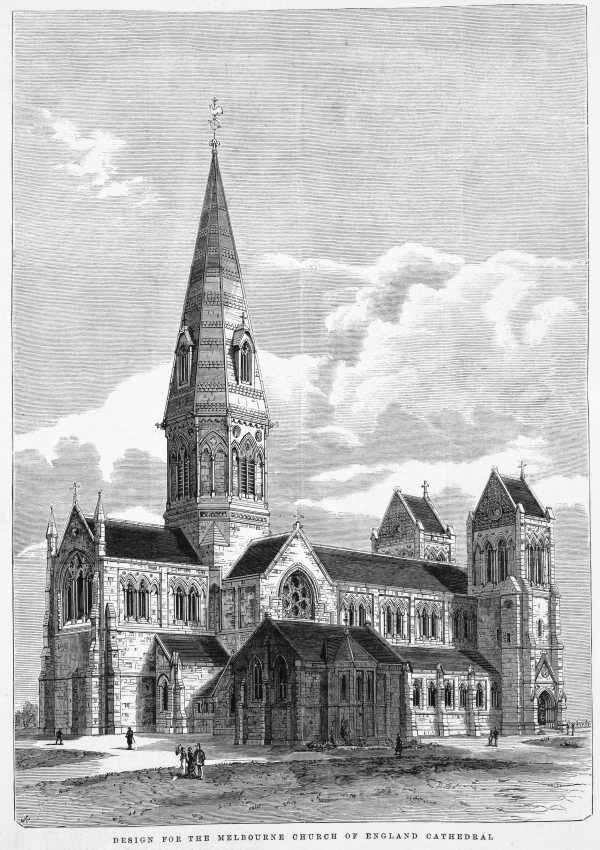
w:William Butterfield 's original design for the new w:St Paul's Cathedral, Melbourne (Church of England cathedral) in w:Melbourne.
w:William Butterfield (7 September 1814 – 23 February 1900) · State Library of Victoria

Baldersby St James
Gordon Hatton · Baldersby St James by Gordon Hatton · Geograph Britain and Ireland
Primary material
Documents and archives
reference work
- “William Butterfield”, English Wikipedia, consulted as further reading
Reputable secondary · Wikipedia
authority record
- Wikidata, structured authority record Q328252: William Butterfield
General reference · Wikidata
Notes from the source article
Cited by Wikipedia
Notes from the source article
These works are cited by the source article, in its own numbering. They are recorded as its citations, not as sources VALÉORINE has verified.
- 1.Hitchcock 1977, pages 247–8
- 2.Hitchock 1977, page 264
- 3.1084329. Tomb of William Butterfield in Tottenham Cemetery, Church Lane.
- 4.1282286. Cotham Church.
- 5.Pleasance, St John's Episcopal Church with Lych Gate and Boundary Wall, Jedburgh, Scottish Borders. britishlistedbuildings.co.uk.
- 6.St Saviour's Church. Beginnings. August 2008.
- 7.Homan 1984, page 106
- 8.Pevsner & Cherry, 1973, page 252
- 9.Sherwood & Pevsner, 1974, page 579–583
- 10.Pevsner & Cherry, 1975, page 365
- 11.Pevsner & Cherry, 1975, page 366
- 12.Ottery St Mary. Exeter and Plymouth Gazette. 30 March 1850.
- 13.1342241. Golden Lion Hotel.
- 14.Pevsner, 1966, page 253
- 15.Pevsner & Cherry, 1975, page 90
- 16.Rhea, Nicholas. Portrait of the North Yorkshire Moors. 1985.
- 17.1295734. Church of St Paul. yes.
- 18.1148401. The Red House. yes.
- 19.1148825. Village Hall and attached house, Hutton Buscel.
- 20.Pevsner & Cherry, 1975, page 458
- 21.Pevsner, 1966, page 177
- 22.O’Brien, Charles. The Buildings of England Hampshire: South. Yale University Press. 176. 2018. 9780300225037.
- 23.Sherwood & Pevsner, 1974, page705
- 24.Sherwood & Pevsner, 1974, page 101
- 25.Pevsner & Cherry, 1975, page 162
- 26.Pevsner & Cherry, 1975, page 291
- 27.St John the Evangelist Churchyard. London Gardens Online. 1 November 2011.
- 28.Pevsner & Cherry, 1975, page 293
- 29.1095781. Pitt Chapel School, Pitt. II.
- 30.History & architecture. All Saints Margaret Street website.
- 31.1042179. Church of St. Mary the Virgin.
- 32.Pevsner, 1966, page 182
- 33.Pevsner & Cherry, 1975, page 531
- 34.Pevsner & Cherry, 1975, page 82
- 35.1272352. St Alban's Clergy House and attached railings with lamp-holder. yes.
- 36.Pevsner, 1966, page 166
- 37.Pevsner & Cherry, 1975, page 160
- 38.Lanagan, Paul. Houghton-le-Spring: Hillside Cemetery Lych Gate Restoration. houghtonlespring.org.uk.
- 39.Pevsner & Cherry, 1975, page 140
- 40.Pevsner & Cherry, 1975, page 319
- 41.The Buildings of England: Lancashire – Manchester and the South East, 2004
- 42.Sherwood & Pevsner, 1974, page 693
- 43.Heywood, Joy. William Butterfield (1814–1900). Saint Mary Magdalene.
- 44.Pevsner, 1966, page 154
- 45.Sherwood & Pevsner, 1974, page 164
- 46.Pevsner & Cherry, 1975, page 118
- 47.British History Online. Parishes: Lyndhurst | British History Online. 1908-06-10.
- 48.Pevsner & Cherry, 1973, page 470
- 49.Pevsner & Cherry, 1975, page 266
- 50.Home. Holy Saviour Church Hitchin.
- 51.Pevsner, 1960, page 112
- 52.Pevsner & Cherry, 1975, page 268
- 53.National Churches Trust. The Tait Chapel. 1867.
- 54.Sherwood & Pevsner, 1974, page 656
- 55.Pevsner, 1966, page 84
- 56.Sherwood & Pevsner, 1974, page 685
- 57.Marsden, Susan, Paul Stark and Patricia Sumerling, Heritage of the City of Adelaide, Adelaide 1990, pp. 347-349
- 58.Pevsner & Cherry, 1975, page 571
- 59.Pevsner & Cherry, 1975, page 144
- 60.A Short History of Berkhamsted page=30
- 61.Sheppard, F.H.W. Survey of London: volume 36: Covent Garden. 98–128. 1970.
- 62.Pevsner & Cherry, 1975, page 374
- 63.Verey, 1970, pages 370–371
- 64.Pevsner & Cherry, 1975, page 182
- 65.Pevsner & Cherry, 1973, page 120
- 66.St Denis' East Hatley. Hatley.
- 67.Pevsner & Cherry, 1975, page 563
- 68.Pevsner, 1966, page 254
- 69.Pevsner & Cherry, 1975, page 283
- 70.Pevsner, 1966, page 357
- 71.Sherwood & Pevsner, 1974, pages 225–229
- 72.Pevsner & Cherry, 1975, page 95
- 73.Pevsner & Cherry, 1975, page 354
- 74.Pevsner, 1966, page 68
- 75.St. Andrew's parish church, Rugby.
- 76.Pevsner & Cherry, 1975, page 591
- 77.Pevsner & Cherry, 1975, page 251
- 78.A Community of Faith. stjohnsclevedon.org.uk.
- 79.Pevsner, 1966, page 213
- 80.Pevsner & Cherry, 1973, page 188
- 81.Pevsner & Cherry, 1975, page 105
- 82.Pevsner & Cherry, 1975, page 427
- 83.Church of St Peter, Ceulanamaesmawr, Ceredigion. britishlistedbuildings.co.uk.
Bibliography printed in the source article · 8
- Hitchcock, Henry Russell. Architecture:Nineteenth and Twentieth Centuries. Penguin Books. 1977. 978-0-14-056115-9.
- Homan, Roger. The Victorian Churches of Kent. Phillimore & Co. Ltd. 1984. 978-0-85033-466-1.
- Tyack, Geoffrey. The Buildings of England: Berkshire. Yale University Press. 800. 2010. 978-0-300-12662-4.
- Pevsner, Nikolaus. The Buildings of England: Buckinghamshire. Yale University Press. 832. 1994. 978-0-300-09584-5.
- Pevsner, Nikolaus. The Buildings of England: Northamptonshire. Yale University Press. 520. 1973. 978-0-300-09632-3.
- Pevsner, Nikolaus. The Buildings of England: Wiltshire. Yale University Press. 664. 1975. 978-0-300-09659-0.
- Sherwood, Jennifer. The Buildings of England: Oxfordshire. Yale University Press. 948. 1974. 978-0-300-09639-2.
- Verey, David. The Buildings of England: Gloucestershire: The Cotswolds. Yale University Press. 832. 1999. 978-0-300-09604-0.
References
Citations
References
Each reference names the institution holding it, so a reader may go to the document itself.
reference work
Secondary witnessauthority record
General reference
The Encyclopedia exists whether or not anything is for sale. Corrections are recorded rather than overwritten, and every version of this record is kept. Published 16 August 2026.
Elsewhere in Design
11,558 published records in this field, each with its sources named.
- William BruceDesigner
- William Bruce GingellDesigner
- William BucklandDesigner
- William BurnDesigner
- William C. AlbrantDesigner
- William C. BrocklesbyDesigner
- William C. CrowellDesigner
- William C. WeeksDesigner
Best supported in this field
For owners
Own a work by William Butterfield?
A specialist will read what you send and tell you what the house can establish, what it cannot, and whether the object is suited to sale. There is no charge and no obligation. The object stays with you throughout; nothing is shipped to us unless it is arranged in writing beforehand.