
Wang Mian
Wang Wang Mian (1287–1359), courtesy name Yuanzhang (元章), also known as Zhushi Shannong, was a Chinese painter and poet active during the Yuan dynasty. Initially aspiring to be a government official, Wang later earned considerable recognition as an artist who specialised in plum blossom paintings. Falling out of the public eye in his later years, he had a short stint as military adviser to Zhu Yuanzhang.
Also recorded as Zhushi shannong · Meihua Wuzhu · Yuanzhang
Wang Mian
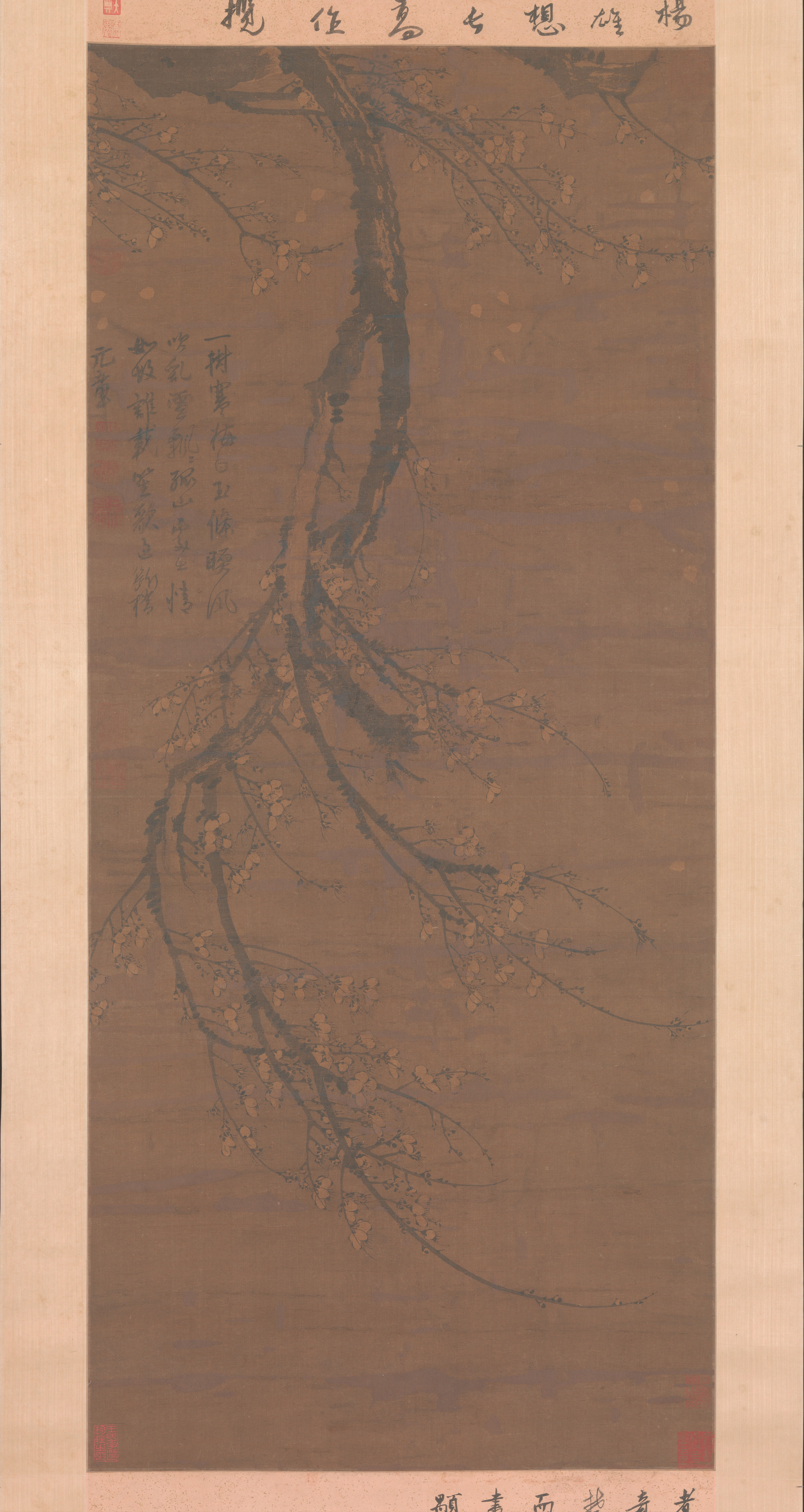
Wang Mian · The Metropolitan Museum of Art, New York · Ex coll.: C. C. Wang Family, Purchase, Gift of J. Pierpont Morgan, by exchange, 1973 · Public domain (CC0, Met Open Access)
- Born
- 1287. · Zhuji.
- Died
- 1359. · Zhuji.
- Nationality
- Yuan dynasty.
- Occupation
- painter, poet, farmer, teacher and writer.
- Languages
- Chinese.
VALÉORINE Encyclopedia
VALÉORINE documentary reading
Documentary summary
Wang Wang Mian (1287–1359), courtesy name Yuanzhang (元章), also known as Zhushi Shannong, was a Chinese painter and poet active during the Yuan dynasty. Initially aspiring to be a government official, Wang later earned considerable recognition as an artist who specialised in plum blossom paintings. Falling out of the public eye in his later years, he had a short stint as military adviser to Zhu Yuanzhang.
Admitted source layer · organised and presented by VALÉORINE
Note VALÉORINE
No house-authored Note is published until its assertions and sources pass the VALÉORINE evidence contract. The documentary article remains available in full while that enrichment is being consolidated.
Documentary enrichment in progress · no unsupported statement published
Reference Check
Propose documentary evidence for Wang Mian. A contribution is never written directly as fact: identity, source, rights and evidence gates still decide.
Sign in to contribute
Documentary evidence
Evidence Panel
not yet certified
- Identity
- resolved
- Independent source families
- 0
- Admitted assertions
- 0
- Open conflicts
- 0
Authority files
getty · 500327906 · gnd · 141755776 · wikidata · Q700068 · wikipedia · Wang Mian
In this article
Career
Career
Wang makes an appearance in the eighteenth-century novel The Scholars.
The recorded working language is Chinese. Places of work recorded in the authority are Shaoxing. Work by Wang Mian is recorded in the collections of Metropolitan Museum of Art, National Palace Museum, Yale University Art Gallery, Cleveland Museum of Art and Shanghai Museum.
Wang Mian (born 1287, in Zhuji, Zhejiang) was a Chinese painter and poet of the late Yuan dynasty. Born to a peasant family, he sought to improve his social status and initially prepared for the imperial examinations but failed to obtain the jinshi degree. He then turned to studying the "ancient military arts," though this pursuit was equally unfruitful. Rejecting several offers of government employment, Wang chose the life of a scholar in retirement, except for a brief period as a teacher. He later established himself as a freelance artist in cities such as Nanjing and Suzhou, specializing in paintings of plum and bamboo, often accompanied by his own poetry. For Wang, the plum blossom symbolized "his lonely stand in a barbarian-ruled world." He was known by several sobriquets, including "Zhushi Shannong" (煮石山農). Wang's reputation as a painter and poet grew, and he was hosted by the Yuan Court's Chief Secretary in Beijing. Following years of traversing China, Wang returned to his hometown in Zhejiang Province, and built a "Plum Blossom Retreat", which had some one thousand plum trees planted around it, at the Kuaiji Mountains, where "(h)e wore old clothes and became known as a mild eccentric". In 1359, in the midst of Zhu Yuanzhang campaign against the Mongols, Wang acted as a military adviser to Zhu's army, albeit an unsuccessful one, as evidenced by the failure of Wang's plan to seize Shaoxing. Wang died in the same year.
Life and career
Dated record
Life and career
The full dated record · 2 entries
1287
Wang Mian born at Zhuji.
1359
Wang Mian died at Zhuji.
Legacy
According to The New York Times, Wang Mian was one of the earliest artists to write poetry on their artworks. In addition, he was "one of the most distinguished practitioners of the reverse-saturation technique". In his lifetime, Wang penned an autobiography titled Mr Plum Blossom's Autobiography, in which he describes himself as "aloof and noble by temperament, hating to mix with the wealthy and powerful, and defending myself in bitterness and agony". After his death, Wang Mian became a "romantic, semilegendary figure". He is the protagonist of the eighteenth-century Chinese novel The Scholars by Wu Jingzi. In The Scholars, Wang's story is heavily dramatised, and his disillusionment with the private sector is attributed not to his failures at the examinations, but his realising "the empty vanity of officialdom". He is also anachronistically written to have become "an anonymous recluse in the mountains" shortly after the establishment of the Ming dynasty by Zhu Yuanzhang. Liu Shiru, who was also from Shaoxing and a respected painter in his own right who published his own plum painting manual, was said to have to have been "engrossed" with Wang Mian's works; he "practiced without eating or sleeping" to reach Wang's standards. Okada Hankō wrote a poem referencing Wang Mian to complement his 1838 painting Village Among Plum Trees. Wang's painting Prunus in Moonlight was displayed at the June 1985 Bones of Jade, Soul of Ice exhibition at the Yale University Art Gallery. The New York Times commented that the moon and the flowering plum tree in Prunus in Moonlight "play out the kind of male-female, mind-body, moon-earth drama that is not unfamiliar in 20th-century Western art, particularly after Surrealism", going further to compare Wang with Caspar David Friedrich. In his 1976 book Hills Beyond a River, James Cahill exalts Wang Mian as the "most famous of Yuan plum painters". However, art historian Maggie Bickford labels Wang Mian's art as "plain" and "ambitious" in her 1997 book Ink Plum.
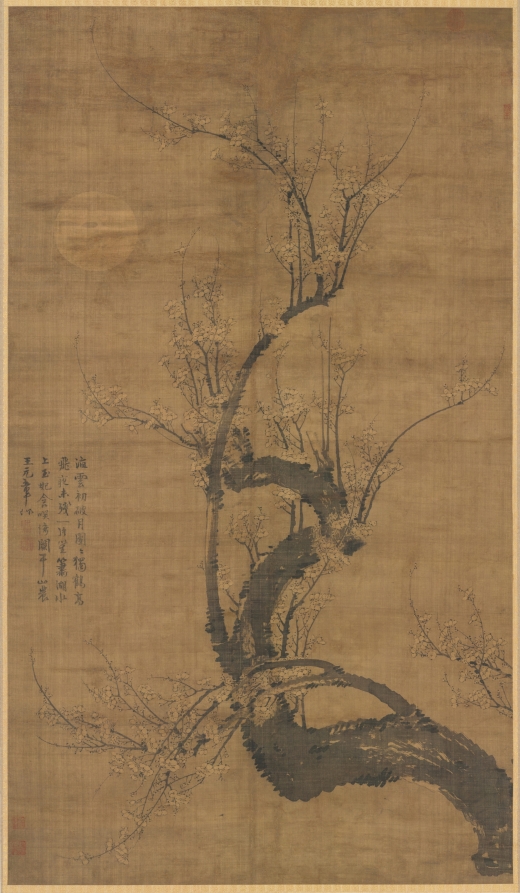
A Prunus in the Moonlight, 1300s, by Wang Mian
Wang Mian · The Cleveland Museum of Art · Leonard C. Hanna Jr. Fund
Context
Primary material
Context
The circumstances in which Wang Mian stands. Trace metals and infectious diseases / edited by Jerome O. Nriagu and Eric P.
Holdings and surviving copies
Where the work is held
Holdings and surviving copies
Where material relating to Wang Mian is held.
Documents and archives
Primary material
Documents and archives
authority file
- Gemeinsame Normdatei 141755776, Wang, Mian.
Unverified · Deutsche Nationalbibliothek
- Getty Union List of Artist Names 500327906, Wang Mian.
Unverified · The Getty Research Institute
Institutional database
- Wikidata, structured authority record Q700068: Wang Mian
Scholarly · Wikimedia Foundation
reference work
- “Wang Mian”, English Wikipedia, consulted as further reading
Reputable secondary · Wikipedia
References
Citations
References
Each reference names the institution holding it, so a reader may go to the document itself.
Institutional database
Wikidata, structured authority record Q700068: Wang MianWikimedia Foundation
Verifiedauthority file
Gemeinsame Normdatei 141755776, Wang, Mian.Deutsche Nationalbibliothek
Partially resolvedauthority file
Getty Union List of Artist Names 500327906, Wang Mian.The Getty Research Institute
Partially resolvedreference work
Partially resolved
Further particulars
Held on the record
Further particulars
Open the remaining particulars
The authorities additionally record the headings Zhushi shannong, Meihua Wuzhu and Yuanzhang. His recorded language was Chinese. Recorded as painter, poet, farmer, teacher and writer.
Identity and origins
Recognition and collections
Work by Wang Mian is
Metropolitan Museum of Art, National Palace Museum, Yale University Art Gallery and Cleveland Museum of Art
The Encyclopedia exists whether or not anything is for sale. Corrections are recorded rather than overwritten, and every version of this record is kept. Published 14 August 2026.
Elsewhere in Books
38,991 published records in this field, each with its sources named.
- Wang HanAuthor
- Wang JinAuthor
- Wang JingzhaiAuthor
- Wang JipengAuthor
- Wang RongAuthor
- Wang ShenAuthor
- Wang ShifuAuthor
- Wang ShiweiAuthor
Best supported in this field
For owners
Own a work by Wang Mian?
A specialist will read what you send and tell you what the house can establish, what it cannot, and whether the object is suited to sale. There is no charge and no obligation. The object stays with you throughout; nothing is shipped to us unless it is arranged in writing beforehand.