
Walter Ruttmann
Walter Ruttmann (28 December 1887 – 15 July 1941) was a German cinematographer and film director, an important German abstract experimental film maker, along with Hans Richter, Viking Eggeling and Oskar Fischinger. He is best known for directing the semi-documentary 'city symphony' silent film, with orchestral score by Edmund Meisel, in 1927, Berlin: Symphony of a Metropolis. His audio montage Wochenende (Weekend) (1930) is considered a major contribution in the development of sound collages and audio plays.
Also recorded as Walther Ruttmann
Walter Ruttmann
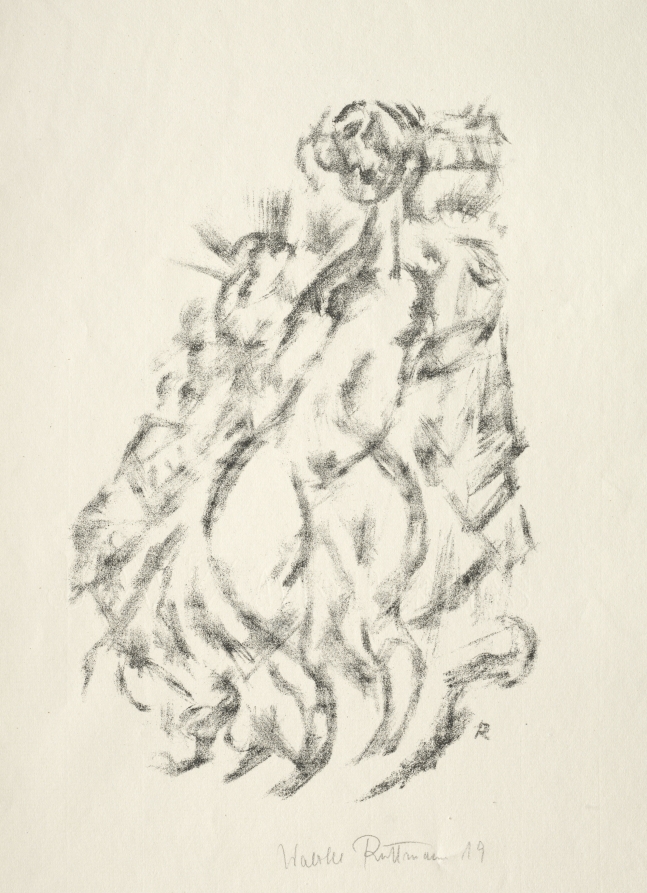
Walter Ruttmann · The Cleveland Museum of Art · Mr. and Mrs. Charles G. Prasse Collection · CC0
- Born
- 1887.
- Died
- 1941.
- Nationality
- German Reich.
- Occupation
- film director, screenwriter, cinematographer, animator, painter and illustrator.
VALÉORINE Encyclopedia
VALÉORINE documentary reading
Documentary summary
Walter Ruttmann (28 December 1887 – 15 July 1941) was a German cinematographer and film director, an important German abstract experimental film maker, along with Hans Richter, Viking Eggeling and Oskar Fischinger. He is best known for directing the semi-documentary 'city symphony' silent film, with orchestral score by Edmund Meisel, in 1927, Berlin: Symphony of a Metropolis. His audio montage Wochenende (Weekend) (1930) is considered a major contribution in the development of sound collages and audio plays.
Admitted source layer · organised and presented by VALÉORINE
Note VALÉORINE
Walter Ruttmann (1887–1941) was an animator, cinematographer and director, among other activities and a national of German Reich. Born in Frankfurt, the animator died in Berlin. Walter Ruttmann studied at ETH Zurich. Languages used include German.
Composed from admitted, traceable facts · 28 September 2026
VALÉORINE
Reference Check
Propose documentary evidence for Walter Ruttmann. A contribution is never written directly as fact: identity, source, rights and evidence gates still decide.
Sign in to contribute
Documentary evidence
Documentary basis
Authority files
wikidata · Q77365 · wikipedia · Walter Ruttmann
In this article
Biography
Biography
Ruttmann was born in Frankfurt am Main, the son of a wealthy mercantilist. He graduated from high school in 1905 and began architectural studies in Zürich in 1907. In 1909 Ruttmann began painting in Munich, where he befriended Paul Klee and Lyonel Feininger, and he would later paint in Marburg. Ruttmann was conscripted into the army in 1913, first serving in Darmstadt, and shortly after the outbreak of World War I he was sent to the Eastern Front, where he served as an artillery lieutenant and a gas defense officer. After spending 1917 in a hospital for post traumatic stress disorder, he began making films. Ruttmann had the financial means to work independently of the major German studios of the time. He founded Ruttmann-Film GmbH in Munich and patented an animation table, in June 1920. His first productions were the first fully animated German cartoons and abstract animated films. Lichtspiel: Opus I, produced between 1919 and 1921, premiered on 27 April 1921 at the Berlin Marmorhaus, and released for German theatrical distribution in 1922, is the "oldest fully abstract motion picture known to survive, using only animated geometric forms, arranged and shown without reference to any representational imagery". Opus I and Opus II, were experiments with new forms of film expression, and the influence of these early abstract films can be seen in some of the early work of Oskar Fischinger. Ruttmann and his colleagues of the avant garde movement enriched the language of film as a medium with new formal techniques. In 1926 he worked with Julius Pinschewer on Der Aufsteig, an experimental film advertising the GeSoLei trade fair in Düsseldorf. In 1926, Ruttmann licensed a Wax Slicing machine from Oskar Fischinger to create special effects for The Adventures of Prince Achmed, an animated fairy tale film, for Lotte Reiniger, making the moving backgrounds and magic scenes. Ruttmann was a prominent exponent of both avant-garde art and music. His early abstractions played at the 1929 Baden-Baden Festival to international acclaim despite their being almost eight years old. Together with Erwin Piscator, he worked on the film Melody of the World (1929), though he is best remembered for Berlin: Die Sinfonie der Großstadt (Berlin: Symphony of a Metropolis, 1927). Weekend (Wochenende), commissioned in 1928 by Berlin Radio Hour, and presented on 13 June 1930, is a pioneering work of musique concrète, a montage of sound clips, recorded using film optical sound track from the Tri-Ergon process. Ruttmann recorded the streets sounds of Berlin with a camera, but without images, this was before magnetic tape. Hans Richter called it “a symphony of sound, speech-fragments, and silence woven into a poem.” A pacifist, he traveled to Moscow in 1928 and 1929. During the Nazi period he was replaced by Leni Riefenstahl as director of the documentary which eventually became Triumph of the Will (1935), supposedly because Ruttmann's editing style was considered too "Marxist" and Soviet influenced. He died in Berlin 15 July 1941 due to complications following an embolism.
Culture and Media
Culture and Media
Segments from Ruttmann's experimental films Lichtspiel: Opus II (1923) and Lichtspiel: Opus IV (1925) are used in the credits of the German neo-noir television series Babylon Berlin.
Select filmography
Select filmography
Lichtspiel: Opus I (1920) Lichtspiel: Opus II (1921) Der Sieger (1922) Das Wunder (1922) Lichtspiel: Opus III (1924, with Lore Leudesdorff) Lichtspiel: Opus IV (1925, with Lore Leudesdorff) Das wiedergefundene Paradies (1925) Der Aufstieg (1926) Spiel der Wellen (1926) Dort wo der Rhein... (1927) Berlin: Die Sinfonie der Großstadt (1927) Melody of the World (Melodie der Welt) (1929) Wochenende (1930) [an experimental film with sound only, no image] Feind im Blut (1931) In der Nacht (1931) Steel (1933) Blut und Boden - Grundlagen zum neuen Reich Altgermanische Bauernkultur (1934) Metall des Himmels (1935) Schiff in Not (1936) Mannesmann (1937) Henkel, ein deutsches Werk in seiner Arbeit (1938) Waffenkammern Deutschlands (1940) Deutsche Panzer (1940) Krebs (1941)
Life and career
Dated record
Life and career
Explore 1887–1941
The full dated record · 3 entries
1887
Walter Ruttmann born at Frankfurt.
1921
Walter Ruttmann - Der Sieger (1921), Das Wunder (1922) - Experimental Abstract German Silent Film (1922) is digitised and catalogued by Internet Archive.
1941
Walter Ruttmann died at Berlin.
Primary material
Documents and archives
reference work
- “Walter Ruttmann”, English Wikipedia, consulted as further reading
Reputable secondary · Wikipedia
- Wikidata, structured authority record Q77365: Walter Ruttmann
Reputable secondary · Wikidata
scholarly publication
- Ruttmann, Walter (1889–1941), Routledge Encyclopedia of Modernism
Scholarly · Crossref registry
Notes from the source article
Cited by Wikipedia
Notes from the source article
These works are cited by the source article, in its own numbering. They are recorded as its citations, not as sources VALÉORINE has verified.
- 1.Betancourt, Michael. Walther Ruttmann's Lichtspiel Films. Cinegraphic.
- 2.Reiniger, Lotte. Shadow Theatres, Shadow Films. BT Batsford. 1970. 978-0-7134-2286-3.
- 3.Lotte Reiniger's Introduction to The Adventures of Prince Achmed. Milestone Films. 9–11. 2001.
- 4.Weekend - Walter Ruttmann. sfSound.
- 5.Born, Erik. Walter Ruttmann, Wochenende (1930). Erik Born. 30 January 2015.
- 6.Media Art Net | Ruttmann, Walter: Weekend. 23 October 2021.
- 7.Remes, Justin. Ten Masterpieces of Experimental Cinema. Columbia University Press Blog. Columbia University Press. 5 April 2020.
- 8.Ruttmann.
- 9.Vallen, Mark. The Truth About Babylon Berlin. Art For A Change. 2018-04-03.
- 10.Ruttmann, Walter. LICHTSPIEL: OPUS I, 11'43", Colour, Drawing, 1921. Punto y Raya Festival.
- 11.Lichtspiel Opus I. Centre Pompidou.
- 12.Moser, Jeffrey. Lichtspiel Opus I (1921). Fixation Database of Film and Animation. West Virginia University. 1 January 1921.
- 13.Munich Film Archive, German Federal Archives, Goethe-Institut. Berlin, die Sinfonie der Großstadt & Melodie der Welt Edition Filmmuseum 39. Edition Filmmuseum Shop.
- 14.Lichtspiel Opus 1. Close-Up Film Centre.
- 15.Moser, Jeffrey. Lichtspiel Opus II (1921). Fixation Database of Film and Animation. West Virginia University. 1 January 1921.
- 16.Deutsches Filminstitut. Opus 2 (1921/1922). filmportal.de.
- 17.Opus 2. Close-Up Film Centre.
- 18.Heinz Steike in Film als Film 1910 bis Heute, Kölnischer Kunstverein, 1977
- 19.Moser, Jeffrey. Lichtspiel Opus III (1924). Fixation Database of Film and Animation. West Virginia University. 1 January 1924.
- 20.Opus 3. Close-Up Film Centre.
- 21.Opus 4. Close-Up Film Centre.
Bibliography printed in the source article · 5
- Cowan, Michael. Walter Ruttmann and the Cinema of Multiplicity: Avant-garde-Advertising-Modernity. Amsterdam, NL: Amsterdam University Press, 2014.
- Dombrug, Adrianus van. Walter Ruttmann in het beginsel. Purmerend, NL: J. Muusses, 1956.
- Goergen, Jeanpaul. Walter Ruttmann: Eine Dokumentation. Berlin: Freunde der deutschen Kinemathek, 1989.
- Rogers, Holly and Jeremy Barham The Music and Sound of Experimental Film. Oxford: Oxford University Press, 2017.
- Quaresima, Leonard, editor. Walter Ruttmann: Cinema, pittura, ars acustica. Calliano (Trento), Italy: Manfrini, 1994.
References
Citations
References
Each reference names the institution holding it, so a reader may go to the document itself.
scholarly publication
Ruttmann, Walter (1889–1941), Routledge Encyclopedia of ModernismCrossref registry
Institutional witnessreference work
Secondary witnessreference work
Secondary witness
The Encyclopedia exists whether or not anything is for sale. Corrections are recorded rather than overwritten, and every version of this record is kept. Published 14 August 2026.
Elsewhere in Illustration
5,224 published records in this field, each with its sources named.
- Walter Haskell HintonIllustrator
- Walter Hunt EverettIllustrator
- Walter MolinoIllustrator
- Walter PagetIllustrator
- Walter S. RogersIllustrator
- Walter SchnackenbergIllustrator
- Walter ThorIllustrator
- Walter TrierIllustrator
Best supported in this field
For owners
Own a work by Walter Ruttmann?
A specialist will read what you send and tell you what the house can establish, what it cannot, and whether the object is suited to sale. There is no charge and no obligation. The object stays with you throughout; nothing is shipped to us unless it is arranged in writing beforehand.