
Vladimir Dzhanibekov
Vladimir Aleksandrovich Dzhanibekov (Russian: Владимир Александрович Джанибеков, born 13 May 1942) is a retired Soviet Air Force Major General and a cosmonaut veteran of five orbital missions. Notably he was part of the Salyut-7 rescue mission and also discovered the Dzhanibekov Effect on that same mission, a logical consequence of the Tennis racket theorem.
Also recorded as Vladimir Aleksandrovich Dzhanibekov
Vladimir Dzhanibekov

Бахтиёр Абдуллаев · CC BY-SA 3.0
- Born
- 1942. · Iskandar.
- Nationality
- Soviet Union and Russia.
- Occupation
- aircraft pilot, astronaut, politician, painter and postage stamp designer.
- Education
- Tashkent Suvorov Military School, Saint Petersburg State University and Yeysk Higher Military Aviation Institute.
- Honours
- Commander of the Legion of Honour, Order of Lenin, Order of the Red Star, Hero of the Soviet Union, Order For Service to the Homeland in the Armed Forces of the USSR, 3rd class and Pilot-Cosmonaut of the USSR.
- Languages
- Russian.
VALÉORINE Encyclopedia
VALÉORINE documentary reading
Documentary summary
Vladimir Aleksandrovich Dzhanibekov (Russian: Владимир Александрович Джанибеков, born 13 May 1942) is a retired Soviet Air Force Major General and a cosmonaut veteran of five orbital missions. Notably he was part of the Salyut-7 rescue mission and also discovered the Dzhanibekov Effect on that same mission, a logical consequence of the Tennis racket theorem.
Admitted source layer · organised and presented by VALÉORINE
Note VALÉORINE
No house-authored Note is published until its assertions and sources pass the VALÉORINE evidence contract. The documentary article remains available in full while that enrichment is being consolidated.
Documentary enrichment in progress · no unsupported statement published
Reference Check
Propose documentary evidence for Vladimir Dzhanibekov. A contribution is never written directly as fact: identity, source, rights and evidence gates still decide.
Sign in to contribute
World of VALÉORINE
Documentary connections
Only confirmed graph relationships appear here. Images are shown only when their identity and reuse rights both pass the documentary gate.


Documentary evidence
Evidence Panel
wikipedia incomplete · checked 25 September 2026
- Identity
- resolved
- Independent source families
- 0
- Admitted assertions
- 0
- Open conflicts
- 0
Authority files
wikidata · Q466513 · wikipedia · Vladimir Dzhanibekov
In this article
Biography
Biography
Dzhanibekov was born Vladimir Aleksandrovich Krysin (Russian: Владимир Александрович Крысин) in the remote area of Iskandar in what was then Bostanliq District, South Kazakhstan Region, Kazakh SSR (since 1956 – Tashkent Region, Uzbekistan) on 13 May 1942. His family moved to Tashkent soon after his birth. In 1964 he married Liliya Munirovna Dzhanibekova, who was a descendant of Janibeg, medieval ruler of the Golden Horde. As her father had no sons, Dzhanibekov took his wife's family name in order to honour her ancestry and continue her line of descent, an unusual step for a husband in the Soviet Union. In 1960 he entered Leningrad University to study physics, where he became involved in flying, something in which he had always been interested. In 1961 he decided to enroll in the V. M. Komarov Higher Military Flying School at Yeisk while simultaneously completing his degree in physics at the Taganrog campus of Rostov State University. Four years later he graduated and became a flying instructor in the Soviet Air Forces serving at military training unit number 99735 in Taganrog in 1968–1970. During the 1970 visit of Gherman Titov to the Taganrog-based Air Forces training unit he was selected into the cosmonaut training pool Air Force Group 5. He joined the Communist Party the same year. Dzhanibekov served on five space missions: Soyuz 27/Soyuz 26 (launch/return), Soyuz 39, Soyuz T-6, Soyuz T-12, and Soyuz T-13. He accrued 145 days, 15 hours, and 56 minutes in space over these five missions. He had also performed two EVAs with the total time of 8 hours and 35 minutes. In 1985 he demonstrated stable and unstable rotation of a T-handle nut from the orbit, subsequently named the Dzhanibekov effect. The effect had been long known from the tennis racket theorem, which says that rotation about an object's intermediate principal axis is unstable while in free fall. In 1985 he was promoted to the rank of major general. After retiring from the cosmonaut program in 1986, he became involved in politics. He was the Deputy to the Supreme Soviet of Uzbek SSR from 1985 until 1990. Also, he has taken up photography and painting, and his works, predominantly of space thematics, are owned by museums and private collectors. Starting 1990, Dzhanibekov unsuccessfully attempted to circumnavigate the globe by balloon. He partnered with Larry Newman who envisioned flying a NASA-designed sky anchor balloon. This unique hourglass shaped design used a zero pressure helium balloon for buoyancy and a superpressure balloon for variable ballast. Manufactured by Raven Industries, the double balloon system together measured 354 feet (108 m) tall. A proof of concept flight, launched from Tillamook, Oregon on 8 September 1990, was crewed by Dzhanibekov, Newman, Tim Lachenmeier, and Don Moses. Moses replaced Richard Branson, who was unable to make it by the weather window departure time. The flight lasted for continuous 31 hours, spanning two nights, before landing at Omak, Washington, and confirmed the sky anchor balloon nominal performance. Dzhanibekov, Larry Newman, and Don Moses piloted the Earthwinds Hilton balloon which was primarily sponsored by Barron Hilton. In 1992 an attempt from Akron, Ohio did not launch due to strong winds. The next attempt was a planned pre-dawn launch but was delayed for several hours by difficulties inflating both balloons. Launching later than desired, on 13 January 1993 the Earthwinds liftoff from Reno Stead Airport flew for 30 minutes before crashing. The balloon could not penetrate a strong inversion layer and tore the ballast balloon on a mountain peak. The three crewmen survived the crash without injuries. An additional flight on 31 December 1994 reached 29,000 feet (8,800 m) when the ballast balloon failed. These sky anchor balloon failures prompted other circumnavigation attempts to switch to the Roziere balloon system instead. The minor planet 3170 Dzhanibekov, discovered by Soviet astronomer Nikolai Stepanovich Chernykh in 1979, is named after him.
Life and career
Dated record
Life and career
The full dated record · 1 entries
1942
Vladimir Dzhanibekov was born on 13 May 1942.
Primary material
Documents and archives
reference work
- “Vladimir Dzhanibekov”, English Wikipedia, consulted as further reading
Reputable secondary · Wikipedia
institutional register
- Wikidata, structured authority record Q466513: Vladimir Dzhanibekov
Unverified · Wikimedia Foundation
Honours and awards
Twice Hero of the Soviet Union (1978 and 1981) Pilot-Cosmonaut of the USSR Order of Friendship (Russian Federation) Five Orders of Lenin Order of the Red Star Order "For Service to the Homeland in the Armed Forces of the USSR" 3rd class Medal "For Merit in Space Exploration" (Russian Federation) Jubilee Medal "Twenty Years of Victory in the Great Patriotic War 1941–1945" Jubilee Medal "50 Years of the Armed Forces of the USSR" Jubilee Medal "60 Years of the Armed Forces of the USSR" Jubilee Medal "50 Years of the Soviet Militia" Medals "For Impeccable Service" 1st, 2nd, and 3rd classes Kosmonavtlar metro station in Tashkent commemorates Uzbekistan's contribution to the Soviet space programme including that of Dzhanibekov Foreign awards: Hero of the Mongolian People's Republic Commander of the Legion of Honour (France) Order of the Banner of the Hungarian People's Republic Order of Sukhbaatar (Mongolia) He is an honorary citizen of Gagarin; Kaluga (Russia); Arkalyk (Kazakhstan); Baikonur (Kazakhstan); and Houston (United States).
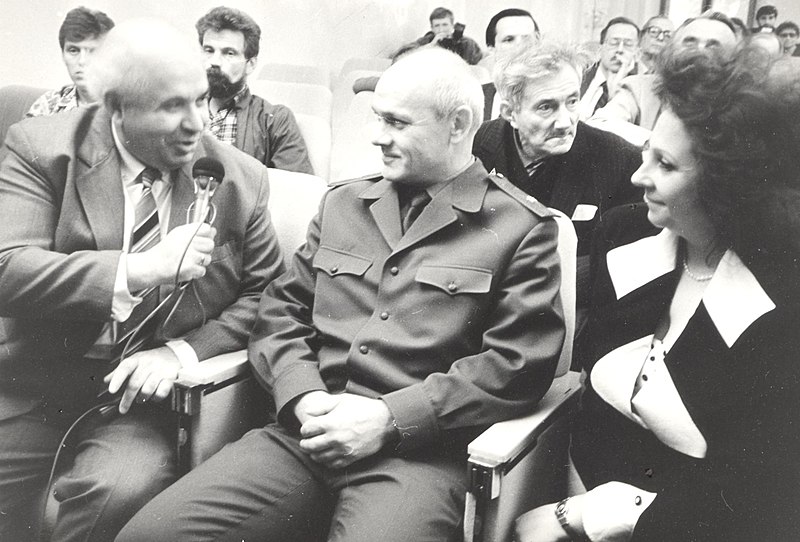
Шахматный обозреватель Яков Дамский берет интервью у действительного члена Леонардо-клуба Владимира Джанибекова.
Nick Parfjonov

Vladimir Aleksandrovich Dzhanibekov, a Soviet cosmonaut who made five flights.
Nick Parfjonov
Notes from the source article
Cited by Wikipedia
Notes from the source article
These works are cited by the source article, in its own numbering. They are recorded as its citations, not as sources VALÉORINE has verified.
- 1.Physics of Rotating Bodies: The Dzhanibekov Effect. cCamein. June 20, 2023.
- 2.Владимир Александрович Джанибеков. ASTROnote. 2 June 2013.
- 3.Vladimir Dzhanibekov – Сайт школы №50 г.Ташкента . school50.uz
- 4.Armstrong, William. Just Wind: Tales of Two Pilots Under Pressure. iUniverse. July 2003. 9780595287055.
- 5.Armstrong Jr, William G. Just Wind: Tales of Two Pilots Under Pressure. iUniverse. July 2003. 0595612539.
- 6.Airportjournals.com. Barron Hilton: The flying innkeeper.
- 7.Browne, Malcolm W. Round-the-World Balloon Flight Put Off, This Time Till November. The New York Times. 23 February 1992.
- 8.Observer Notre Dame St Marys. Balloon crashes, stalling attempt to circle the world. Observer.
- 9.Cedar Rapids Gazette. Balloon Crew. Newspapers.com.
- 10.Lutz Schmadel. Dictionary of Minor Planet Names. Springer. 262–. 5 August 2003. 978-3-540-00238-3.
- 11.The official website of the city administration Baikonur - Honorary citizens of Baikonur.
References
Citations
References
Each reference names the institution holding it, so a reader may go to the document itself.
reference work
Partially resolvedinstitutional register
Wikidata, structured authority record Q466513: Vladimir DzhanibekovWikimedia Foundation
Unverified
The Encyclopedia exists whether or not anything is for sale. Corrections are recorded rather than overwritten, and every version of this record is kept. Published 14 August 2026.
Elsewhere in Paintings
18,452 published records in this field, each with its sources named.
- Vladimir ChekalovArtist
- Vladimir Cybil CharlierArtist
- Vladimir DimitrovArtist
- Vladimir DubossarskyArtist
- Vladimír FranzArtist
- Vladimír JavorskýArtist
- Vladimir KachalskyArtist
- Vladimír KokoliaArtist
Best supported in this field
For owners
Own a work by Vladimir Dzhanibekov?
A specialist will read what you send and tell you what the house can establish, what it cannot, and whether the object is suited to sale. There is no charge and no obligation. The object stays with you throughout; nothing is shipped to us unless it is arranged in writing beforehand.