
visual poetry
Visual poetry is a style of poetry that incorporates graphic and visual design elements to convey its meaning. This style combines visual art and written expression to create new ways of presenting and interpreting poetry. poetry focuses on playing with form, which means it often takes on various art styles. These styles can range from altering the structure of the words on the page to adding other kinds of media to change the poem itself.
visual poetry

Marius de Zayas and Agnes Ernest Meyer · 291, No 2 1915 · Public domain
- Field
- poetry
VALÉORINE Encyclopedia
VALÉORINE documentary reading
Documentary summary
Visual poetry is a style of poetry that incorporates graphic and visual design elements to convey its meaning. This style combines visual art and written expression to create new ways of presenting and interpreting poetry. poetry focuses on playing with form, which means it often takes on various art styles. These styles can range from altering the structure of the words on the page to adding other kinds of media to change the poem itself.
Admitted source layer · organised and presented by VALÉORINE
Note VALÉORINE
No house-authored Note is published until its assertions and sources pass the VALÉORINE evidence contract. The documentary article remains available in full while that enrichment is being consolidated.
Documentary enrichment in progress · no unsupported statement published
Reference Check
Propose documentary evidence for visual poetry. A contribution is never written directly as fact: identity, source, rights and evidence gates still decide.
Sign in to contribute
World of VALÉORINE
Documentary connections
Only confirmed graph relationships appear here. Images are shown only when their identity and reuse rights both pass the documentary gate.

Documentary evidence
Evidence Panel
not yet certified
- Identity
- resolved
- Independent source families
- 0
- Admitted assertions
- 0
- Open conflicts
- 0
Authority files
gnd · 4838573-6 · wikidata · Q2578278 · wikipedia · Visual poetry
In this article
Differentiation from concrete poetry
Some forms of visual poetry may retain their narrative structure, but this is not a requirement of visual poetry. Some visual poets create more abstract works that steer away from linguistic meaning and instead focus heavily on the composition of words and letters to create a visually pleasing piece.
Literary theorists have identified visual poetry as a development of concrete poetry but with the characteristics of intermedia in which non-representational language and visual elements predominate. As the literary and artistic experiments of the 1950s that were at first loosely grouped together as concrete poetry extended further into the ambiguous sphere which Dick Higgins described in 1965 as 'Intermedia', it became apparent that such creations were further and further divorced from the representational language with which poetry had hitherto been associated and that they needed to be categorized as a separate phenomenon. In her survey, Concrete Poetry: A World View (1968), Mary Ellen Solt observed that certain trends included under the label concrete poetry were tending towards a "new visual poetry". Its chief characteristic is that it leaves behind the old poetic function of orality and is therefore distinct from the ancient tradition of shaped poetry from which concrete poetry claimed to have derived. Visual poetry, on the other hand, is to be distinguished by its deployment of typography. Solt included in her proposed new genre the work of Ian Hamilton Finlay, John Furnival and Hansjörg Mayer. Her definition was extended by Marvin A. Sackner in his introduction to the Ohio State University 2008 collection of visual poetry: "I define concrete poems as those in which only letters and/or words are utilized to form a visual image, whereas visual poems constitute those in which images are integrated into the text of the poem". He also separated out artist-generated picture poems and artists' books as an allied category, citing the work of Kenneth Patchen. Also to be found in the university collection is Tom Phillips' A Humument, as well as an assortment of handwritten but non-linguistic texts. In the light of these assertions, a new genealogy of forerunners to visual poetry emerges that includes Joan Miró's poem-painting Le corps de ma brune (1925), Piet Mondrian's incorporation of Michel Seuphor's text in Textuel (1928), and prints (druksels) by H.N. Werkman using elements of typography. The last also used the typewriter to create abstract patterns (which he called tiksels), using not just letters but also purely linear elements. Created during the 1920s, they anticipated the intermediary 'typestracts' of the concrete poet Dom Sylvester Houédard during the 1960s that would equally qualify as visual poetry. Klaus Peter Dencker also stresses the continuity of the new genre in his theoretical paper "From Concrete to Visual Poetry" (2000), pointing out its "intermedial and interdisciplinary" nature. The two are also interdependent and "without concrete poetry the current forms of visual poetry would be unthinkable". The academic Willard Bohn, however, prefers to categorize the whole gamut of literary and artistic experiment in this area since the late 19th century under the label of visual poetry and has done so in a number of books since 1986. From his reductionist point of view, "Visual poetry can be defined as poetry that is meant to be seen – poetry that presupposes a viewer as well as a reader".

"I Walked in Greatness", poem by Katharine Rhoades; "Woman", poem by Agnes Ernst Meyer; design by Marius de Zayas.
Katharine Rhoades, Agnes Ernest Meyer, Marius de Zayas · 91, No 3, 1915
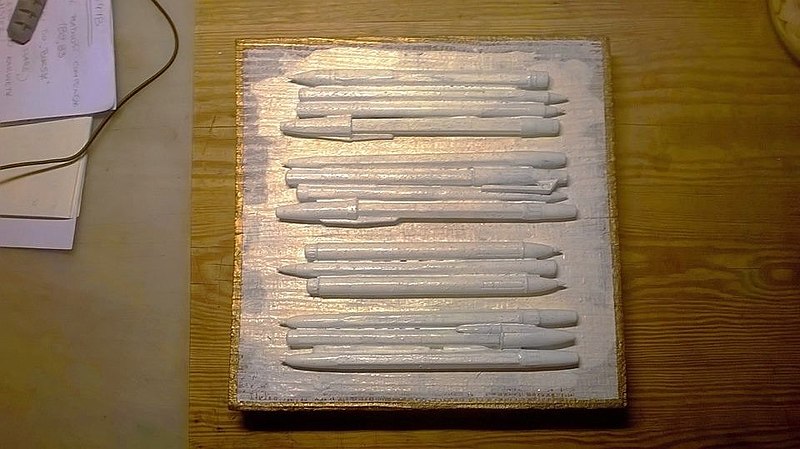
"Italian sonnet" by Witold Szwedkowski, example of haptic poetry
Witold Szwedkowski
Primary material
Documents and archives
authority file
- Gemeinsame Normdatei 4838573-6, Ruth and Marvin Sackner Archive of Concrete and Visual Poetry.
Unverified · Deutsche Nationalbibliothek
reference work
- “Visual poetry”, English Wikipedia, consulted as further reading
Reputable secondary · Wikipedia
authority record
- Wikidata, structured authority record Q2578278: visual poetry
Unverified · Wikidata
Citations
References
Each reference names the institution holding it, so a reader may go to the document itself.
authority file
Gemeinsame Normdatei 4838573-6, Ruth and Marvin Sackner Archive of Concrete and Visual Poetry.Deutsche Nationalbibliothek
Partially resolvedreference work
Partially resolvedauthority record
Unverified
The Encyclopedia exists whether or not anything is for sale. Corrections are recorded rather than overwritten, and every version of this record is kept. Published 14 August 2026.
Elsewhere in Terminology
620 published records in this field, each with its sources named.
- Viking artMovement
- Village ProseMovement
- Visigothic artMovement
- visual keiMovement
- Vorarlberg SchoolMovement
- vorticismMovement
- Washington Color SchoolMovement
- Weimar ClassicismMovement
Best supported in this field
For owners
Own an object connected with visual poetry?
A specialist will read what you send and tell you what the house can establish, what it cannot, and whether the object is suited to sale. There is no charge and no obligation. The object stays with you throughout; nothing is shipped to us unless it is arranged in writing beforehand.